
- Expertise:
- Platform Testing, Cryptocurrency, Retail Investing
- Credentials:
- Active investor since 2013 · 11+ years experience
- Tested:
- 50+ platforms · 200+ guides authored

- Expertise:
- Broker Comparison, ISA Strategy, Portfolio Management
- Credentials:
- Active investor since 2013 · 11+ years experience
- Tested:
- 40+ brokers with funded accounts
How We Test
Real accounts. Real money. Real trades. No demo accounts or press releases.
What we measure:
- Spreads vs advertised rates
- Execution speed and slippage
- Hidden fees (overnight, withdrawal, conversion)
- Actual withdrawal times
Scoring:
Fees (25%) · Platform (20%) · Assets (15%) · Mobile (15%) · Tools (10%) · Support (10%) · Regulation (5%)
Testing team:
Adam Woodhead (investing since 2013), Thomas Drury (Chartered ACII, 2018), Dom Farnell (investing since 2013) — 50+ platforms with funded accounts
Quarterly reviews · Corrections: [email protected]
Disclaimer
Not financial advice. Educational content only. We're not FCA authorised. Consult a qualified advisor before investing.
Capital at risk. Investments can fall. Past performance doesn't guarantee future results.
CFD warning. 67-84% of retail accounts lose money trading CFDs. High risk due to leverage.
Contact: [email protected]
To Buy Cryptocurrency in Canada, Here's What You Need to Do:
Buying cryptocurrency in Canada involves selecting a FINTRAC-registered exchange, completing identity verification, depositing Canadian dollars, purchasing your chosen cryptocurrencies, and securing your assets in a wallet. With over 30% of Canadians now holding digital assets, the process has become straightforward through regulated platforms like Kraken, Coinbase, and Bitbuy.
 Most Coins
Don’t invest unless you’re prepared to lose all the money you invest. This is a high-risk investment and you should not expect to be protected if something goes wrong. Take 2 mins to learn more.
How Do You Buy Cryptocurrency in Canada as a Beginner?
The Canadian cryptocurrency market has matured significantly, offering multiple pathways for new investors. Whether you're interested in Bitcoin, Ethereum, or emerging altcoins, the fundamental process remains consistent across all digital assets.
- Choose a Secure Exchange – Select a platform that supports Canadian users, CAD deposits, and offers the cryptocurrencies you want to buy.
- Register Your Account – Sign up using your email and create a strong, unique password.
- Verify Your Identity – Complete the KYC process by uploading government-issued ID and proof of address.
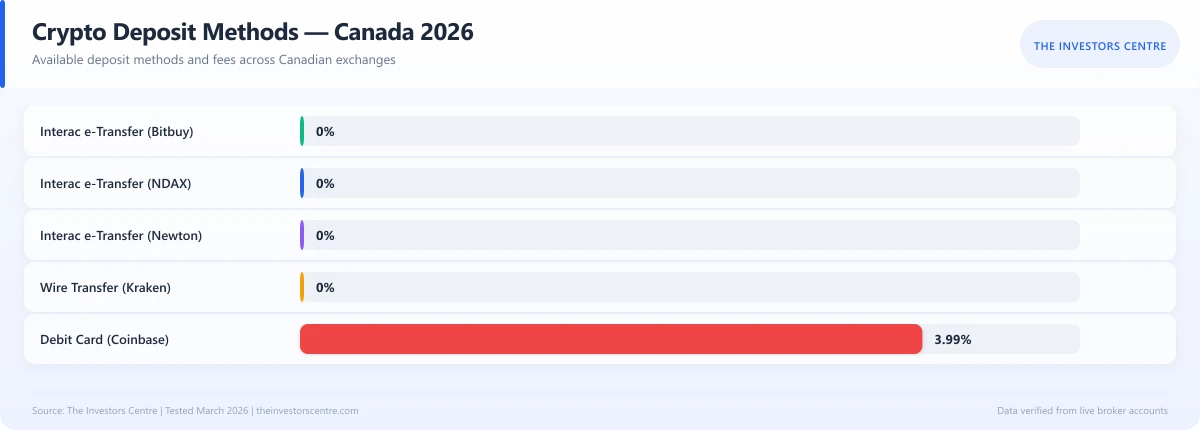
- Deposit Funds – Add CAD to your account using Interac e-Transfer, bank wire, or other supported methods.
- Place Your First Order – Choose a cryptocurrency, specify the amount in CAD, and confirm your purchase.
- Secure Your Assets – Transfer your crypto to a private wallet for enhanced long-term security.
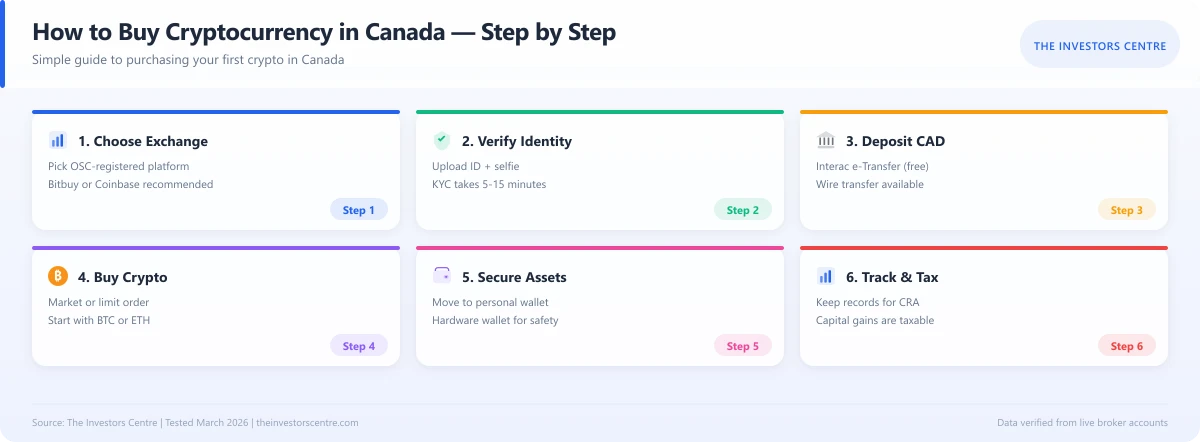
Step-by-Step Guide to Investing in Crypto in Canada
Step 1: Choose a Cryptocurrency Exchange
How Do You Choose the Right Exchange for Multiple Cryptocurrencies?
Selecting the right platform is essential for building a diversified cryptocurrency portfolio. When comparing the best crypto exchanges in Canada, look for platforms with broad token support, competitive fees, and robust security. Here are the key factors to evaluate:
- Cryptocurrency Selection – Ensure the exchange offers all the coins you're interested in. Kraken provides 390+ options, while Bitbuy focuses on 60+ major assets.
- Fee Structure – Compare trading, deposit, and withdrawal fees across platforms. Even small differences matter when building a multi-asset portfolio, so check our guide to low-fee crypto exchanges in Canada for detailed comparisons.
- Security Features – Look for two-factor authentication (2FA), cold storage policies, and insurance coverage.
- Regulatory Compliance – Verify FINTRAC registration and CSA compliance to ensure your funds are protected under Canadian law.
- User Experience – Beginners benefit from intuitive interfaces, while active traders need advanced charting and order types.
| Feature | Kraken | Coinbase | Bitbuy |
|---|---|---|---|
| Crypto Selection | 390+ cryptocurrencies | 250+ cryptocurrencies | 60+ cryptocurrencies |
| Trading Fees | 0.16% maker / 0.26% taker | 0.40% maker / 0.60% taker | 0.1% to 0.2% |
| CAD Deposit Methods | Wire transfer, Interac (via third party) | Bank transfer, debit/credit card, PayPal | Interac e-Transfer, bank wire, credit card |
| Best For | Advanced traders seeking variety and low fees | Beginners wanting simplicity | Canadians prioritising local support |
| Security | 2FA, 95% cold storage, SSL encryption | 2FA, biometric logins, AES-256 encryption | 2FA, BitGo custody, CIPF coverage |
| Regulation | FINTRAC registered, CSA compliant | FINTRAC registered MSB | FINTRAC registered, CIRO member |
Which Exchange Is Best for Building a Crypto Portfolio?
Your ideal exchange depends on your investment approach:
- Kraken – Best for investors wanting maximum cryptocurrency selection (390+) with the lowest fees (0.16%/0.26%). Ideal for building diversified portfolios across major coins and altcoins.
- Coinbase – Perfect for beginners seeking a simple interface and educational resources. Higher fees but exceptional ease of use and strong security track record.
- Bitbuy – Excellent for Canadians who prefer a locally-focused platform with straightforward Interac deposits and dedicated Canadian customer support.
Step 2: Register and Verify Your Identity
How Do You Complete Registration and KYC Verification?
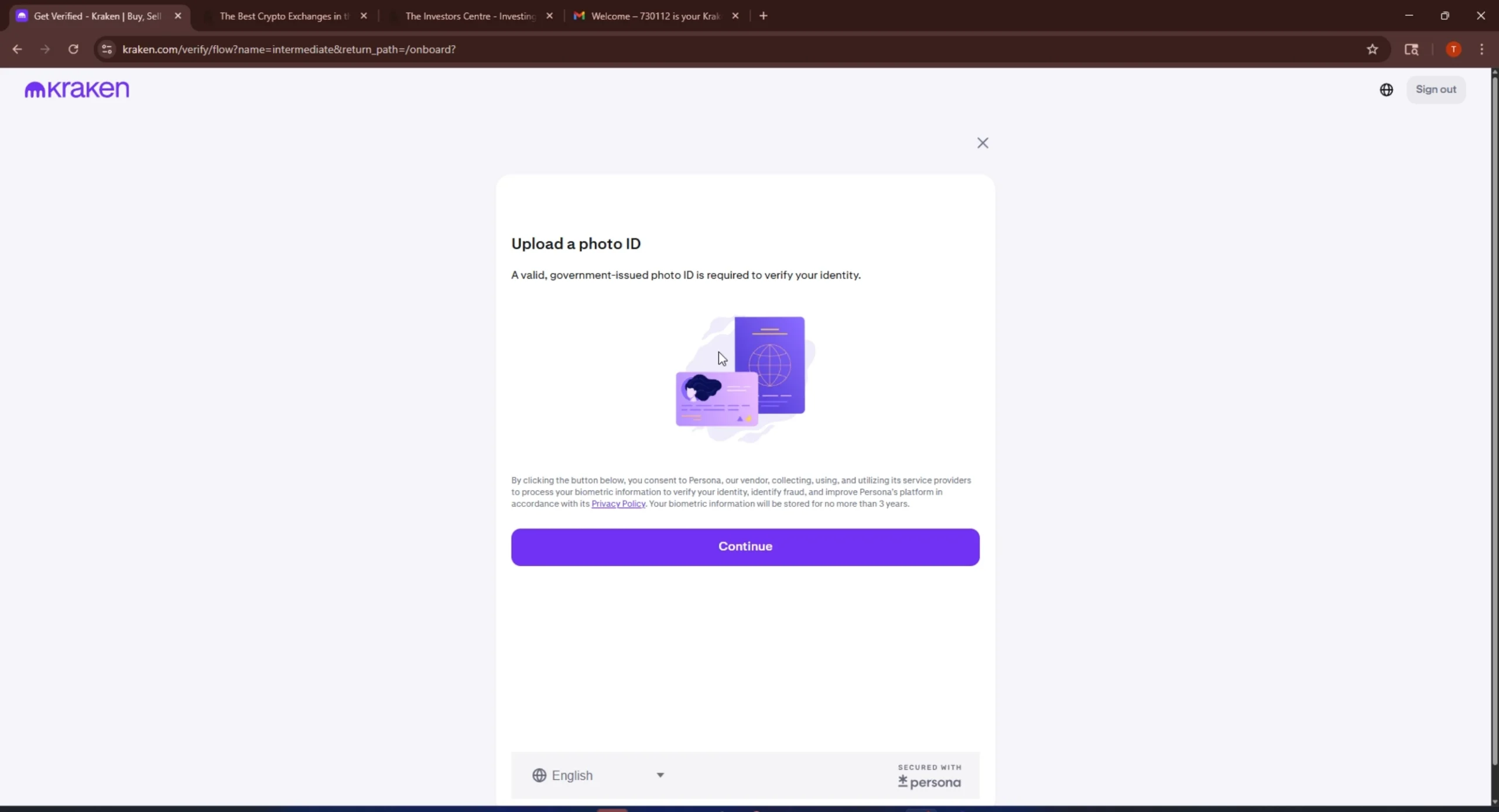
Once you've selected your exchange, the registration process is straightforward. Using Kraken as an example, here's what to expect:
Registration Process:
- Visit the exchange website and click "Sign Up" or "Create Account"
- Enter your email address and create a strong, unique password
- Agree to the platform's terms of service and privacy policy
- Verify your email address through the confirmation link sent to your inbox
KYC Verification (Know Your Customer):
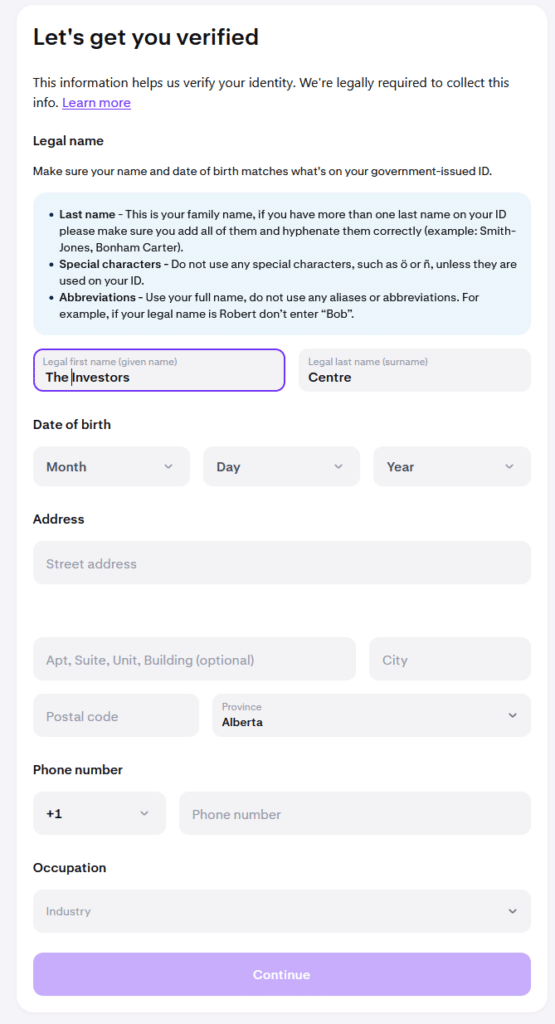
- Provide your full legal name, date of birth, and residential address
- Upload a government-issued ID (Canadian passport, driver's licence, or provincial ID card)
- Submit proof of address (utility bill, bank statement, or government correspondence dated within 90 days)
- Complete a selfie verification if required by the platform
Verification typically completes within a few hours, though high-demand periods may extend this to 1-2 business days. Once verified, you'll have full access to all trading features and higher deposit limits.
Why Is KYC Verification Required in Canada?
KYC verification is mandatory under Canadian law. FINTRAC (Financial Transactions and Reports Analysis Centre of Canada) requires all cryptocurrency exchanges to verify user identities as part of anti-money laundering (AML) regulations. This process protects both users and the broader financial system by preventing fraud, money laundering, and terrorist financing.
While the verification process may feel intrusive, it ultimately provides important protections. Verified accounts receive higher deposit and withdrawal limits, access to all platform features, and recourse through Canadian regulatory channels if issues arise.
Step 3: Deposit Canadian Dollars into Your Account
What Are the Best Ways to Fund Your Crypto Account?
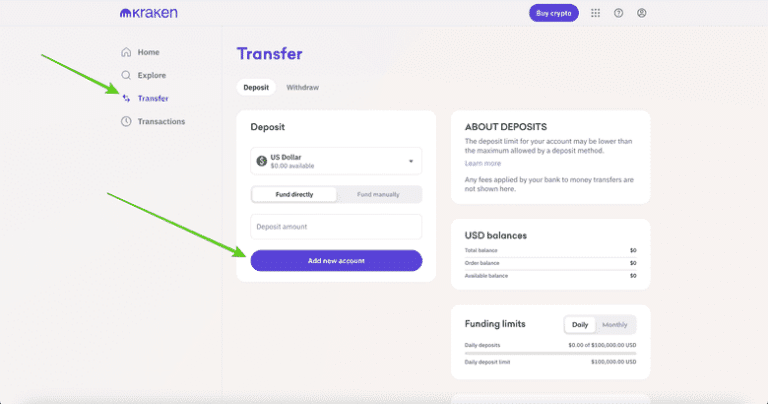
After completing verification, you'll need to deposit Canadian dollars before purchasing cryptocurrency. Canadian exchanges offer several funding options, each with different speeds, fees, and limits:
| Deposit Method | Processing Time | Typical Fees | Best For |
|---|---|---|---|
| Interac e-Transfer | Minutes to hours | Free to 1.5% | Most Canadians; fast, convenient deposits up to $10,000 |
| Bank Wire Transfer | 1-3 business days | $0-$15 flat fee | Large deposits over $10,000; lower percentage cost |
| Credit/Debit Card | Instant | 1.5%-3.5% | Immediate purchases; higher fees but instant availability |
| Pre-Authorized Debit (PAD) | 3-5 business days | Usually free | Recurring investments; set-and-forget approach |
Tip: Interac e-Transfer is the preferred method for most Canadian crypto investors due to its speed, low cost, and widespread availability. Before initiating any deposit, double-check the payment details provided by your exchange to avoid delays.
Step 4: Place Your First Cryptocurrency Order
How Do You Buy Cryptocurrency on a Canadian Exchange?
With funds deposited, you're ready to make your first purchase. The process is similar across most platforms:
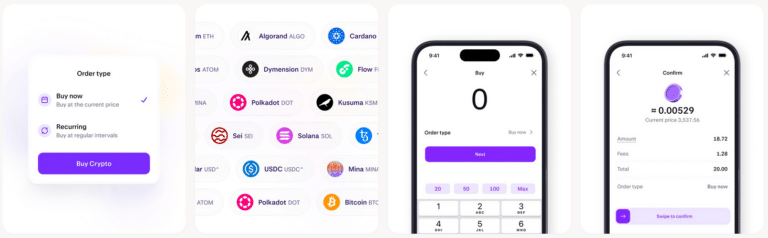
- Navigate to the Trading Section: Find the "Buy Crypto," "Trade," or "Markets" area of your exchange. Search for the cryptocurrency you want to purchase (e.g., BTC, ETH, SOL).
- Select Your Trading Pair: Choose the CAD pair for your desired cryptocurrency. For example, BTC/CAD to buy Bitcoin with Canadian dollars, or ETH/CAD for Ethereum.
- Enter Your Order Details: Specify how much you want to invest in CAD, or the quantity of cryptocurrency you wish to buy. Most exchanges show a preview of what you'll receive after fees.
- Choose Your Order Type:
- Market Order: Executes immediately at the current market price. Best for beginners who want quick, simple transactions.
- Limit Order: Sets a specific price at which you're willing to buy. The order only executes if the market reaches your price. Better for experienced traders seeking optimal entry points.
- Review and Confirm: Check all details including the amount, fees, and total cost before confirming your purchase.
Example: To buy $500 worth of Ethereum, navigate to ETH/CAD, enter $500 in the purchase amount field, select "Market Order" for immediate execution, review the estimated ETH you'll receive, and confirm the transaction.
Should You Use Market Orders or Limit Orders?
The choice between market and limit orders depends on your priorities:
- Market Orders are ideal for beginners and long-term investors who prioritise convenience over price optimisation. Your order executes instantly, but you may pay slightly more during volatile periods due to price slippage.
- Limit Orders suit active traders who want precise control over entry prices. You set your desired price and wait for the market to come to you. This approach can save money but requires patience and market awareness.
For most Canadians building long-term cryptocurrency portfolios, market orders provide the simplicity needed to stay consistent with their investment strategy.
Step 5: Secure Your Cryptocurrency Investment
Should You Keep Crypto on an Exchange or Move It to a Wallet?
After purchasing cryptocurrency, you need to decide where to store it. This decision balances convenience against security, and choosing the right crypto wallet depends on your investment size and trading frequency:
Exchange Storage (Custodial):
- Convenient for frequent trading and quick access
- No technical knowledge required
- Protected by exchange security measures and insurance
- Risk: Exchanges can be hacked, and you don't control your private keys
Private Wallet Storage (Non-Custodial):
- Full control over your cryptocurrency and private keys
- Protected from exchange hacks and insolvency
- Requires understanding of wallet setup and security
- Risk: Losing your recovery phrase means permanent loss of funds
| Wallet Type | Examples | Security Level | Best For |
|---|---|---|---|
| Hardware Wallets | Ledger Nano X, Trezor Model T | Highest — offline storage | Large holdings, long-term storage |
| Software Wallets | MetaMask, Trust Wallet, Exodus | Medium — device-based | Active trading, DeFi participation |
| Exchange Wallets | Kraken, Coinbase, Bitbuy | Variable — platform-dependent | Frequent traders, beginners |
How Do You Transfer Crypto to a Private Wallet?
- Set Up Your Wallet: Download and install your chosen wallet application, or set up your hardware wallet following the manufacturer's instructions. Securely record your recovery phrase and store it offline in multiple locations.
- Find Your Wallet Address: Open your wallet and locate the "Receive" function for the specific cryptocurrency you want to transfer. Copy the wallet address exactly.
- Initiate Withdrawal from Exchange: Log into your exchange account, navigate to "Withdraw," and select the cryptocurrency you want to transfer.
- Enter Wallet Address: Paste your wallet's receiving address into the withdrawal form. Triple-check this address — cryptocurrency transactions are irreversible.
- Confirm and Complete: Review the withdrawal amount and network fee, complete any security verification required, and confirm the transaction.
Your cryptocurrency will arrive in your wallet once the blockchain confirms the transaction, typically within 10-60 minutes depending on network congestion and the specific cryptocurrency.
Step 6: Monitor and Manage Your Portfolio
How Do You Track Multiple Cryptocurrency Investments?
Building a diversified crypto portfolio requires ongoing monitoring and management. Here are the tools and strategies that help Canadian investors stay informed:
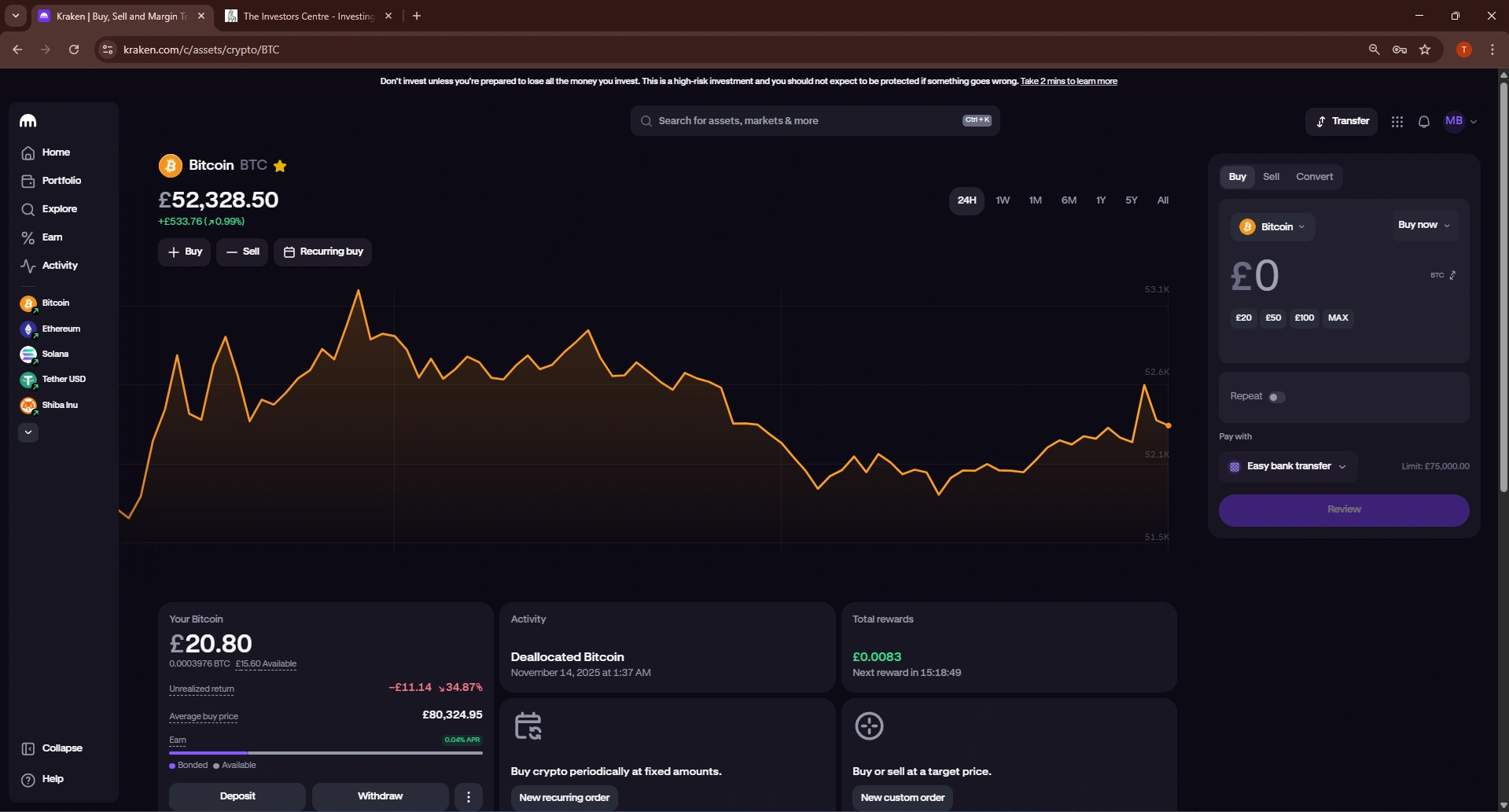
- Exchange Portfolio Dashboard: Most exchanges provide real-time portfolio tracking showing your holdings, asset allocation, and performance history. Kraken and Coinbase both offer comprehensive dashboards for monitoring multiple cryptocurrencies.
- Price Alerts: Set notifications for significant price movements on coins you own or are watching. This helps you react to opportunities without constantly checking prices.
- Portfolio Tracking Apps: Third-party applications like CoinGecko, CoinMarketCap, or Delta allow you to track holdings across multiple exchanges and wallets in one place.
- Tax Record Keeping: Canadian exchanges provide transaction history exports for CRA reporting. Download these regularly and consider using crypto tax software like Koinly or CoinTracker to simplify year-end reporting.
What Portfolio Management Strategies Work for Crypto?
Successful cryptocurrency investing typically involves these approaches:
- Dollar-Cost Averaging (DCA): Invest a fixed CAD amount at regular intervals regardless of price. This strategy reduces the impact of volatility and removes emotional decision-making.
- Rebalancing: Periodically adjust your portfolio to maintain target allocations. If one asset grows significantly, consider taking profits and redistributing to maintain diversification.
- Research-Based Investing: Stay informed about the cryptocurrencies you hold. Understand their technology, use cases, development progress, and competitive positioning.
Which Cryptocurrencies Should Canadians Consider Buying?
The cryptocurrency market offers thousands of options, but most Canadian investors focus on established projects with proven track records. Here's an overview of the most popular categories:
| Category | Examples | Characteristics | Risk Level |
|---|---|---|---|
| Store of Value | Bitcoin (BTC) | Limited supply (21M coins), digital gold, most established | Lower (for crypto) |
| Smart Contract Platforms | Ethereum (ETH), Solana (SOL), Cardano (ADA) | Enable decentralised applications, DeFi ecosystems | Medium |
| Payment Coins | XRP, Litecoin (LTC), Bitcoin Cash (BCH) | Fast transactions, lower fees, payment focus | Medium |
| Stablecoins | USDC, USDT, DAI | Pegged to CAD/USD, minimal volatility, trading pairs | Lowest |
| DeFi Tokens | Uniswap (UNI), Chainlink (LINK), Aave (AAVE) | Decentralised finance protocols, governance rights | Higher |
What Makes Bitcoin and Ethereum Essential for Canadian Portfolios?
Bitcoin and Ethereum together represent over 60% of total cryptocurrency market capitalisation and serve as the foundation for most investment portfolios:
- Bitcoin (BTC): Often called "digital gold," Bitcoin's fixed supply of 21 million coins and decade-long track record make it the most established cryptocurrency. Canadian investors use Bitcoin as a long-term store of value and portfolio diversification tool.
- Ethereum (ETH): Beyond being a cryptocurrency, Ethereum powers thousands of decentralised applications, NFT markets, and DeFi protocols. Its upcoming upgrades and strong developer community position it as the infrastructure for Web3.
Most Canadian crypto investors begin with Bitcoin and Ethereum before branching into smaller altcoins, ensuring portfolio stability through market-leading assets.
What Should You Know About Emerging Cryptocurrencies?
Altcoins (alternative cryptocurrencies) offer potential for higher returns but come with increased volatility and risk:
- Layer 1 Blockchains: Projects like Solana, Cardano, and Avalanche compete with Ethereum, offering faster transactions or different consensus mechanisms. Research their technology, adoption, and development activity before investing.
- Layer 2 Solutions: Networks like Polygon and Arbitrum build on Ethereum to improve speed and reduce costs. They benefit from Ethereum's security while solving scalability issues.
- Sector-Specific Tokens: Gaming, metaverse, AI, and oracle projects target specific use cases. These require deeper research to understand their competitive positioning.
Risk Management: Limit emerging altcoin exposure to 10-20% of your crypto portfolio. Many projects fail or become obsolete as technology evolves.
How Do Cryptocurrency Taxes Work in Canada?
What Are the CRA's Cryptocurrency Tax Rules?
The Canada Revenue Agency treats cryptocurrency as a commodity rather than currency, making all crypto transactions taxable events. Understanding these rules helps Canadian investors remain compliant and optimise their tax position:
Taxable Events Include:
- Selling cryptocurrency for Canadian dollars
- Trading one cryptocurrency for another (e.g., BTC to ETH)
- Spending cryptocurrency on goods or services
- Receiving cryptocurrency as payment or income
- Mining or staking rewards (treated as business income or capital gains)
Non-Taxable Events:
- Buying cryptocurrency with Canadian dollars (creates cost basis)
- Transferring crypto between your own wallets
- Holding cryptocurrency without selling (unrealised gains)
What Is the Capital Gains Tax Rate on Cryptocurrency?
Canada applies a 50% inclusion rate to cryptocurrency capital gains, meaning only half of your profit is added to taxable income:
Example Calculation:
- You buy $5,000 CAD of Bitcoin in January
- You sell it for $8,000 CAD in December
- Capital gain: $3,000
- Taxable amount (50% inclusion): $1,500
- Tax owed depends on your marginal tax bracket (e.g., 30% bracket = $450 tax)
Your actual tax rate depends on your total annual income and province. Higher earners in provinces like Quebec or Nova Scotia face combined federal-provincial rates approaching 54% on the included portion.
How Do You Track Crypto Transactions for Tax Purposes?
Accurate record-keeping is essential for CRA compliance:
- Transaction Details to Record: Date, transaction type (buy/sell/trade), amount in cryptocurrency, CAD value at transaction time, fees paid, wallet addresses involved
- Record-Keeping Tools: Most Canadian exchanges provide CSV exports of transaction history. Crypto tax software like Koinly, CoinTracker, or TokenTax automatically imports exchange data and calculates gains/losses using approved accounting methods.
- Accounting Methods: Canada requires specific identification or weighted average cost method for calculating capital gains. Tax software handles these calculations automatically.
The CRA can request up to 6 years of transaction history during audits. Maintain detailed records even after filing annual returns.
What Happens If You Don't Report Cryptocurrency Taxes?
Failure to report cryptocurrency transactions can result in significant penalties:
- Interest charges on unpaid taxes
- Late-filing penalties (5% of balance owing, plus 1% monthly)
- Gross negligence penalties (50% of understated tax)
- Potential criminal charges for tax evasion in severe cases
The CRA has increased cryptocurrency tax enforcement, working with exchanges to identify non-compliant taxpayers. Proactive compliance protects you from audits and penalties.
What Is Cryptocurrency and How Does It Work?
What Are the Key Features That Define Cryptocurrency?
Cryptocurrency is digital money secured by cryptography that operates on decentralised networks called blockchains. Unlike traditional currency issued by governments, cryptocurrencies function without central authority, allowing peer-to-peer transactions across borders.
Key characteristics that define cryptocurrency include:
- Decentralisation: No single entity controls the network. Transactions are validated by distributed participants (miners or validators) rather than banks.
- Transparency: All transactions are recorded on a public blockchain ledger that anyone can verify, creating accountability without requiring trust in intermediaries.
- Security: Cryptographic algorithms protect transactions and user funds. Once confirmed, transactions cannot be reversed or altered.
- Programmability: Beyond simple transfers, cryptocurrencies like Ethereum enable smart contracts—self-executing code that powers decentralised applications.
- Global Accessibility: Anyone with internet access can send and receive cryptocurrency 24/7, regardless of location or banking status.
How Does Blockchain Technology Enable Cryptocurrency?
Blockchain is the underlying technology that makes cryptocurrency possible. Think of it as a shared database distributed across thousands of computers worldwide, where each participant holds a complete copy of all transaction records.
When you send cryptocurrency, the transaction is broadcast to the network, verified by participants, grouped with other transactions into a "block," and permanently added to the chain. This process creates an immutable record that's extremely difficult to manipulate because changing any historical data would require controlling a majority of the network.
Different cryptocurrencies use different methods to achieve consensus on valid transactions. Bitcoin uses Proof of Work (mining), while Ethereum and many newer projects use Proof of Stake, which is more energy-efficient.
What Should You Consider Before Investing in Cryptocurrency?
What Are the Benefits of Cryptocurrency Investment?
- Growth Potential: Cryptocurrency has produced substantial returns for early investors, though past performance doesn't guarantee future results.
- Portfolio Diversification: Crypto often moves independently of traditional assets, potentially reducing overall portfolio correlation.
- 24/7 Markets: Unlike stocks traded through traditional trading platforms, cryptocurrency trades around the clock, providing flexibility for Canadian investors.
- Accessibility: Start investing with as little as $10 CAD on most platforms, with no minimum holding periods.
- Innovation Exposure: Investing in crypto provides exposure to blockchain technology development and decentralised finance innovation.
What Are the Risks of Cryptocurrency Investment?
- Volatility: Cryptocurrency prices can swing 10-20% or more in a single day. This volatility creates both opportunity and significant risk.
- Regulatory Uncertainty: While Canada has clear crypto regulations, global regulatory changes can impact prices and available services.
- Security Risks: Hacks, scams, and user error can result in permanent loss of funds. Proper security practices are essential.
- Complexity: Understanding different cryptocurrencies, wallets, and DeFi protocols requires ongoing education.
- Tax Obligations: All cryptocurrency transactions are taxable events in Canada, requiring careful record-keeping.
Risk Management Tips:
- Only invest what you can afford to lose entirely
- Diversify across multiple cryptocurrencies and asset classes
- Use dollar-cost averaging to reduce timing risk
- Secure your holdings with hardware wallets for significant amounts
- Stay informed about the projects you invest in
Final Thoughts on Buying Cryptocurrency in Canada
The Canadian cryptocurrency market offers a well-regulated environment for investors seeking exposure to digital assets. With FINTRAC-registered exchanges, multiple CAD deposit options, and clear tax guidelines, Canadians have straightforward pathways to build cryptocurrency portfolios.
Key takeaways for Canadian crypto investors:
- Start with Reputable Exchanges: Kraken offers the lowest fees and broadest selection, Coinbase provides the best beginner experience, and Bitbuy delivers excellent Canadian-focused service. Compare all options in our complete exchange guide.
- Prioritise Security: Complete KYC verification, enable two-factor authentication, and consider hardware wallets for significant holdings.
- Understand Your Tax Obligations: The CRA treats cryptocurrency as a commodity subject to capital gains tax. Keep detailed records of all transactions.
- Invest Responsibly: Only invest what you can afford to lose, diversify your holdings, and take a long-term perspective to weather market volatility.
- Stay Informed: The cryptocurrency landscape evolves rapidly. Continuous learning helps you make better investment decisions.
Whether you're buying your first cryptocurrency or expanding an existing portfolio, the fundamentals remain consistent: choose a secure platform, protect your assets, and approach the market with patience and proper risk management.
FAQs
References
- Financial Transactions and Reports Analysis Centre of Canada. "Money Services Business Registration Requirements." 2026. fintrac-canafe.gc.ca
- Canada Revenue Agency. "Guide for Cryptocurrency Users and Tax Professionals." 2026. canada.ca
- Canadian Securities Administrators. "Crypto Asset Trading Platform Requirements." 2026. securities-administrators.ca
- Ontario Securities Commission. "Registered Crypto Asset Trading Platforms." 2026. osc.ca
- Bank of Canada. "Cryptocurrencies and Digital Assets Research." 2026. bankofcanada.ca
- Kraken. "Fee Schedule and Supported Assets – Canada." 2026. kraken.com
- Coinbase. "Supported Cryptocurrencies and Pricing." 2026. coinbase.com
- Bitbuy. "Trading Fees and Deposit Methods." 2026. bitbuy.ca

Don’t invest unless you’re prepared to lose all the money you invest. This is a high-risk investment and you should not expect to be protected if something goes wrong. Take 2 mins to learn more.