
- Expertise:
- CFD Trading, Forex, Derivatives, Risk Management
- Credentials:
- Chartered ACII (2018) · Trading since 2012
- Tested:
- 40+ forex & CFD platforms with live accounts

- Expertise:
- Platform Testing, Cryptocurrency, Retail Investing
- Credentials:
- Active investor since 2013 · 11+ years experience
- Tested:
- 50+ platforms · 200+ guides authored
How We Test
Real accounts. Real money. Real trades. No demo accounts or press releases.
What we measure:
- Spreads vs advertised rates
- Execution speed and slippage
- Hidden fees (overnight, withdrawal, conversion)
- Actual withdrawal times
Scoring:
Fees (25%) · Platform (20%) · Assets (15%) · Mobile (15%) · Tools (10%) · Support (10%) · Regulation (5%)
Testing team:
Adam Woodhead (investing since 2013), Thomas Drury (Chartered ACII, 2018), Dom Farnell (investing since 2013) — 50+ platforms with funded accounts
Quarterly reviews · Corrections: [email protected]
Disclaimer
Not financial advice. Educational content only. We're not FCA authorised. Consult a qualified advisor before investing.
Capital at risk. Investments can fall. Past performance doesn't guarantee future results.
CFD warning. 67-84% of retail accounts lose money trading CFDs. High risk due to leverage.
Contact: [email protected]
What Is the Best Trading Platform in Australia?
Pepperstone is my top pick for 2026. ASIC-regulated, with the tightest spreads and fastest forex and CFD execution of the platforms I tested in Australia, plus full MT4, MT5, cTrader and TradingView support. Capital.com remains an excellent choice: 0% commission on all trades (AFSL 513393), spreads from 0.6 pips on EUR/USD, the best mobile app I've used for CFD trading in Australia, proper TradingView integration, and Melbourne-based support.
But "best" depends on how you trade. IG Australia's 18,000+ instruments and 50-year track record make it the most complete single platform available. Pepperstone's Razor account is the execution benchmark - nothing else I tested came close on raw spread cost.
| If You Want… | Choose… | Why |
|---|---|---|
| Best overall CFD platform | Capital.com | 0% commission, AI tools, best mobile app |
| Widest market access | IG Australia | 18,000+ instruments, CFDs + shares |
| Tightest forex spreads | Pepperstone | From 0.0 pips on Razor account |
| Global professional trading | Interactive Brokers | 150+ markets, 0.002% FX conversion |
| Trading + investing combined | CMC Markets | $0 ASX brokerage + 12,000 CFDs |
| Copy trading for beginners | eToro | CopyTrader, social feed, easy onboarding |
| Cheapest ASX share trading | moomoo | $3 flat brokerage, CHESS sponsored |

Trading CFDs and margin FX is risky and is not suitable for everyone.

74.48% of Retail CFD Accounts Lose Money

67% of retail CFD accounts lose money.

62.5% of retail CFD accounts lose money

70% of retail CFD accounts lose money.

51% of retail CFD accounts lose money.

Trading and investing involve risk. Capital at Risk
Trading Platforms vs Investing Platforms
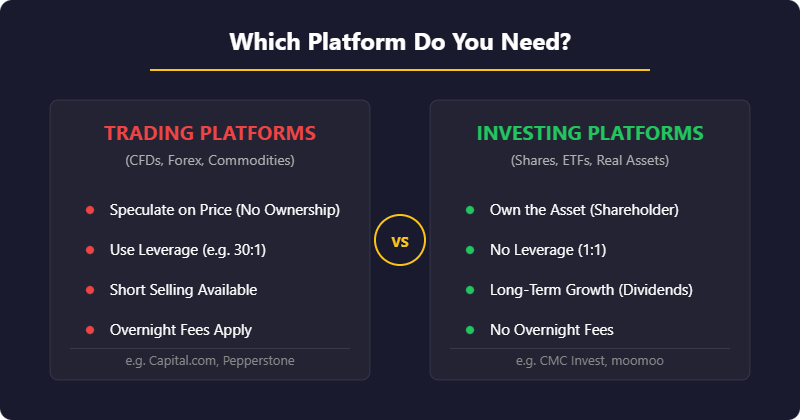
Here's the distinction that matters, because "trading platform" covers two different things in Australia:
CFD and forex brokers (Capital.com, Pepperstone, IG's CFD offering) let you speculate on price movements with leverage. You don't own anything. These suit active traders - forex, indices, commodities.
Share trading platforms (CMC Invest, Interactive Brokers, moomoo) let you buy and own ASX and international shares directly, typically with CHESS sponsorship. These suit investors building long-term portfolios. Some platforms - IG and CMC Markets - offer both. I've tested and compared all types.
Don't choose a platform based on headline spreads alone. Currency conversion fees, overnight funding charges, and withdrawal costs can turn a "cheap" broker expensive fast. I break down real costs for each platform below.
How Do Australia's Best Trading Platforms Compare?
CFD & Forex Comparison
Spreads are typical/average - actual spreads vary with market conditions. Data verified February 2026.
| # | Platform | EUR/USD Spread | AUS200 Spread | Gold Spread | Platforms Available | Commission | Get Started |
|---|---|---|---|---|---|---|---|
| 1 | Pepperstone | From 0.0 pips (Razor) | ~1.0 pt | From 0.13 | MT4, MT5, cTrader, TradingView | $7 USD/lot RT (Razor) | Visit |
| 2 | Capital.com | From 0.6 pips | ~1.0 pt | From 0.30 | Proprietary, TradingView, MT4 | $0 | Visit |
| 3 | IG Australia | From 0.6 pips | From 0.8 pt | From 0.1 | IG Platform, MT4, TradingView, L2 Dealer, ProRealTime | $0 (spread only) | Visit |
| 4 | Interactive Brokers | From ~0.1 pips | N/A (futures) | Via futures | TWS, IBKR GlobalTrader | Tiered | Visit |
| 5 | CMC Markets (CFD) | From 0.7 pips | From 1.0 pt | From 0.3 | Next Generation | $0 | Visit |
| 6 | eToro | From 1.0 pips | From 1.0 pt | From 0.45 | eToro Platform | $0 | Visit |
Share Trading & Investing Comparison
| # | Platform | ASX Brokerage | US Brokerage | CHESS Sponsored | Min Deposit | Get Started |
|---|---|---|---|---|---|---|
| 1 | IG Australia | $8 or 0.1% | $0 (0.7% FX) | ✓ Yes | $0 | Visit |
| 2 | CMC Invest | $0 (first $1k/day) | $0 (0.6% FX) | ✓ Yes | $0 | Visit |
| 3 | Interactive Brokers | 0.08% (min $6) | US$0.005/share | ✓ Yes | $0 | Visit |
| 4 | eToro | $2 per side | $2 per side | ✗ Custodian | $50 USD | Visit |
| 5 | moomoo | $3 or 0.03% | US$0.99 | ✓ Yes | $0 | Visit |
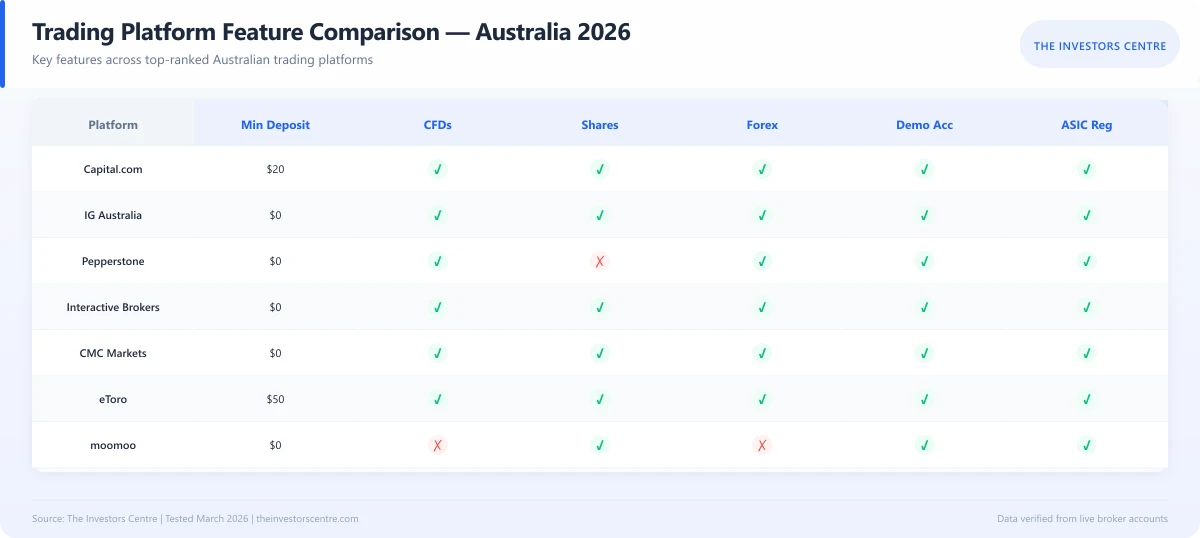
Capital.com and Pepperstone are CFD-only - they don't offer direct share ownership. If you want to own ASX shares outright, look at IG, CMC Invest, or Interactive Brokers.
How I Tested These Platforms
Between November 2025 and January 2026, I opened funded accounts on all seven platforms. I deposited between $500 and $1,000 AUD into each, placed live trades across forex, indices, and share CFDs, and tested withdrawal speeds back to Australian bank accounts.
I led the testing on CFD-focused platforms - Capital.com, IG (CFD side), and Pepperstone - focusing on spread accuracy during London/Sydney overlap sessions, execution quality on market orders, and charting tools under real conditions. Adam tested the share investing platforms - CMC Invest, Interactive Brokers, moomoo - with a focus on brokerage costs, CHESS sponsorship confirmation, and long-term investing features. I tested eToro's copy trading independently.
Scoring Methodology
I scored each platform across six weighted criteria:
| Criteria | Weight | What I Measured |
|---|---|---|
| Platform Technology & Tools | 25% | Charting depth, order types, TradingView/MT4/MT5 support, execution tech |
| Trading Costs (Spreads & Fees) | 25% | Live spreads recorded across sessions, commission structure, overnight funding, FX conversion |
| Asset Range & Market Access | 15% | Total instruments, forex pairs, indices, commodities, crypto, share CFDs |
| Mobile Trading Experience | 15% | App Store ratings, speed, usability, mobile-specific features |
| Education, Research & Support | 10% | Learning resources, market analysis, local support response times |
| Regulation & Safety | 10% | ASIC licence, global regulatory footprint, fund segregation |
No platform paid for their ranking or saw this content before publication.
The 7 Best Trading Platforms in Australia for 2026
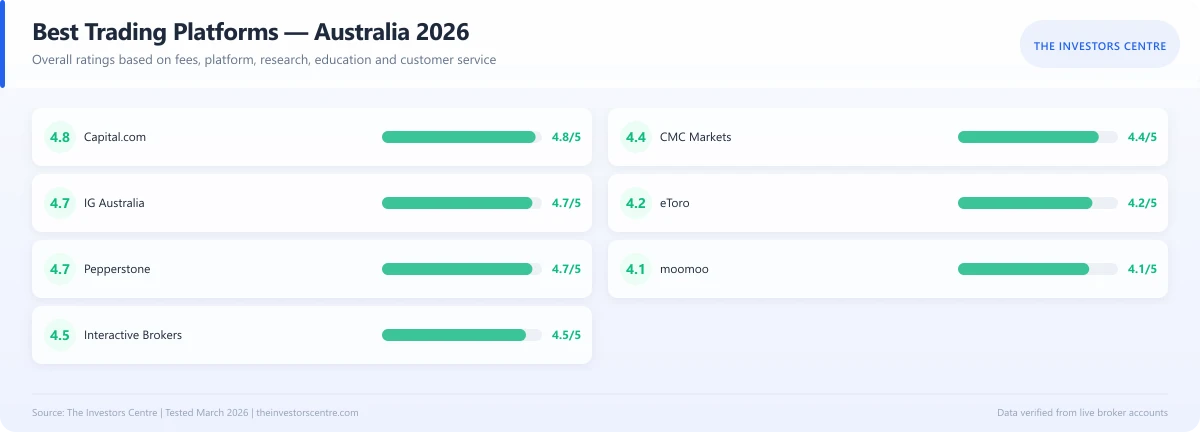
1. Pepperstone - Best Overall CFD Trading Platform (4.7/5)
2. Capital.com - Best for CFD Trading & Mobile App (4.8/5)
3. IG Australia - Best for Range of Markets (4.7/5)
4. Interactive Brokers - Best for Professional Traders (4.5/5)
5. CMC Markets - Best for Trading + Investing Combined (4.4/5)
6. eToro - Best for Copy Trading & Beginners (4.2/5)
7. moomoo - Best Low-Cost Share Trading App (4.1/5)
Pepperstone - Best Overall CFD Trading Platform
If you care about one thing above all else - getting the tightest spreads with the fastest execution - Pepperstone is where you land. The Razor account delivers: I recorded EUR/USD spreads from 0.0 pips during peak London/Sydney overlap, with an all-in cost (including the $7 round-turn commission) that beat every other platform I tested. During December, the average all-in cost on EUR/USD came in at roughly 0.77 pips. That's marginally better than Pepperstone's own advertised 0.80 pip average.
Pros
- Lowest all-in EUR/USD cost tested - Razor account averaged ~0.77 pips
- Best platform choice: MT4, MT5, cTrader, and TradingView with full functionality
- Melbourne-headquartered since 2010, ASIC-regulated (AFSL 414530)
- Equinix data centres ensure low-latency execution for Australian traders
Cons
- Narrow market range (~1,200 CFDs) compared to IG's 18,000+
- Mobile app functional but not exceptional - cTrader mobile crashed twice during US market open
- Education decent but not standout - Pepperstone is a specialist, not a generalist
What Platforms Does Pepperstone Offer?
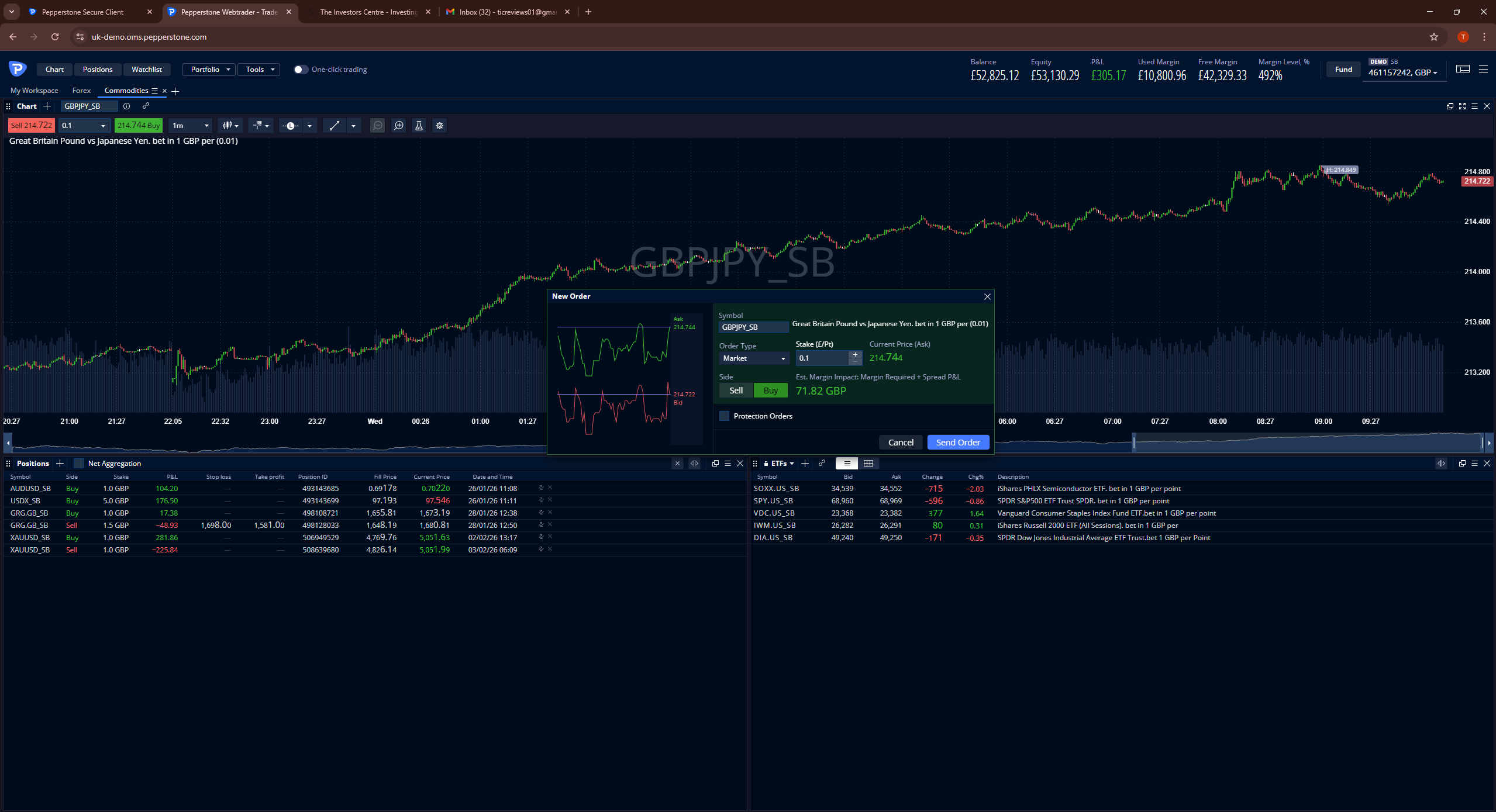
Platform choice is the strongest of any broker here: MT4, MT5, cTrader, and TradingView - each with full functionality. I primarily used cTrader because the depth-of-market display and one-click trading are cleaner than MT5's interface. Order fills felt faster. The spread history tool let me verify that Pepperstone's advertised numbers weren't marketing fiction. Whether you're running Expert Advisors on MT5, coding cBots on cTrader, or trading directly from TradingView, Pepperstone supports your workflow rather than forcing you into a proprietary platform.
What Are Pepperstone's Trading Fees?
The Razor account's all-in cost of ~0.77 pips on EUR/USD was the lowest total trading cost across all seven platforms I tested - and it was consistent, not a best-case figure. The Standard account at ~1.1 pips isn't competitive. If you're opening a Pepperstone account, get the Razor.
| Fee Type | Standard Account | Razor Account |
|---|---|---|
| EUR/USD Spread | From 1.0-1.1 pips | From 0.0 pips |
| Commission | $0 | $7 USD RT/lot (MT4/MT5), $6 RT/lot (cTrader) |
| All-In Cost (EUR/USD) | ~1.1 pips | ~0.80 pips |
| AUS200 Index | ~1.0 point | ~1.0 point |
| Gold | From 0.13 points | From 0.13 points |
| Share CFDs | $0.02/share (US), 0.07% (AU) | Same |
| Inactivity Fee | None | None |
What Is My Verdict on Pepperstone?
Pepperstone is the execution specialist. Best raw spreads, best platform selection, best choice for algorithmic traders. But it's CFD-only with a narrow market range and a forgettable mobile experience. If forex execution is your priority, nothing else I tested comes close. If you want the full package - platform polish, education, breadth - Capital.com or IG are stronger.
Capital.com - Best for CFD Trading & Mobile App
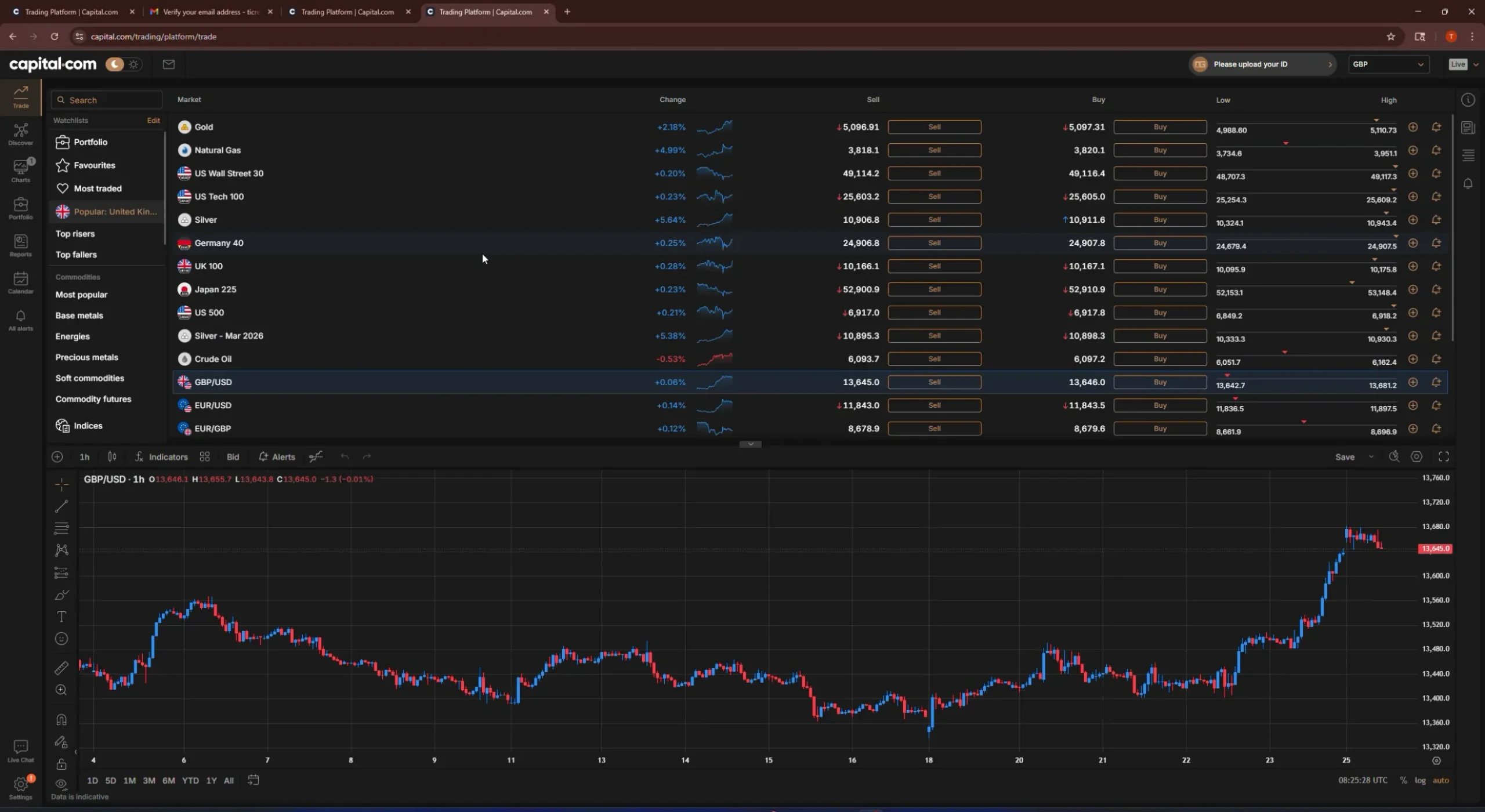
Capital.com does something most CFD brokers don't - it makes complex markets feel approachable without dumbing anything down. The AI-powered analysis flagged chart patterns and sentiment shifts I'd normally spot manually, which sounds like a gimmick until it catches something useful mid-session. During the AUD/USD sell-off in late November, the sentiment indicator shifted to 78% bearish before the pair had finished its 40-pip drop. I'd entered short at 0.6520. The AI confirmation gave me the confidence to hold through the retrace rather than closing early.
Pros
- 0% commission across 3,400+ markets with competitive spreads from 0.6 pips
- AI-powered sentiment analysis adds genuine value during live trading sessions
- Best mobile app tested - seamless TradingView integration
- ASIC-regulated (AFSL 513393) with Melbourne office and local support
Cons
- Proprietary web charting lags behind TradingView - defaulted to TradingView within first week
- No MT5 or cTrader - limits algorithmic traders
- 0.7% currency conversion fee on non-AUD trades adds up
Why Did Capital.com Take the Top Spot?
What earns Capital.com the #1 is the combination: 0% commission across 3,400+ markets, competitive spreads, an intuitive platform that works for first-timers and someone running 20 trades a day, and the standalone Investmate education app. Over six weeks of trading, EUR/USD spreads stayed at or below 0.8 pips during every London-Sydney overlap session. The mobile app never lagged - even during the December NFP release.
Founded in 2016, ASIC-regulated since 2021 (AFSL 513393). I'll be upfront: there's less local track record than IG or Pepperstone. But the platform has matured fast. TradingView integration is seamless - not the clunky bolt-on some brokers ship. The mobile app is the best I've used for placing CFD trades on the go. Melbourne office means local support during Australian hours.
Where Does Capital.com Fall Short?
The proprietary web platform's charting lags behind TradingView. I defaulted to TradingView within the first week and rarely opened the native charts after that. No MT5 or cTrader either, which limits algorithmic traders. And the 0.7% currency conversion fee on non-AUD trades adds up if you're not careful.
What Are Capital.com's Trading Fees?
Spreads verified against Capital.com's AU pricing page, February 2026. Live spreads during my testing averaged 0.7 pips on EUR/USD during London/Sydney overlap - slightly better than the 0.6 pip minimum advertised.
| Fee Type | Amount | Notes |
|---|---|---|
| EUR/USD Spread | From 0.6 pips | No commission - spread is the only cost |
| AUD/USD Spread | From 0.8 pips | Averaged 0.9 pips during my Sydney session testing |
| AUS200 Index | ~1.0 point | Variable with market conditions |
| Gold | From 0.30 points | Competitive for commodity traders |
| Overnight Funding | Benchmark rate + 4% annual | Only on leveraged positions |
| Currency Conversion | 0.7% | Applies to non-AUD base trades |
| Deposit / Withdrawal | $0 | Free for all methods |
| Inactivity Fee | None | - |
What Is My Verdict on Capital.com?
Capital.com is where I'd point most CFD traders in Australia right now - the platform technology, mobile experience, and cost transparency are ahead of the field. It's not the cheapest on raw spreads (Pepperstone wins there) and it's not for share investors (it's CFD-only). But for the majority of traders who want a modern, well-designed platform across forex, indices, and commodities, this is the one to beat.
IG Australia - Best for Range of Markets
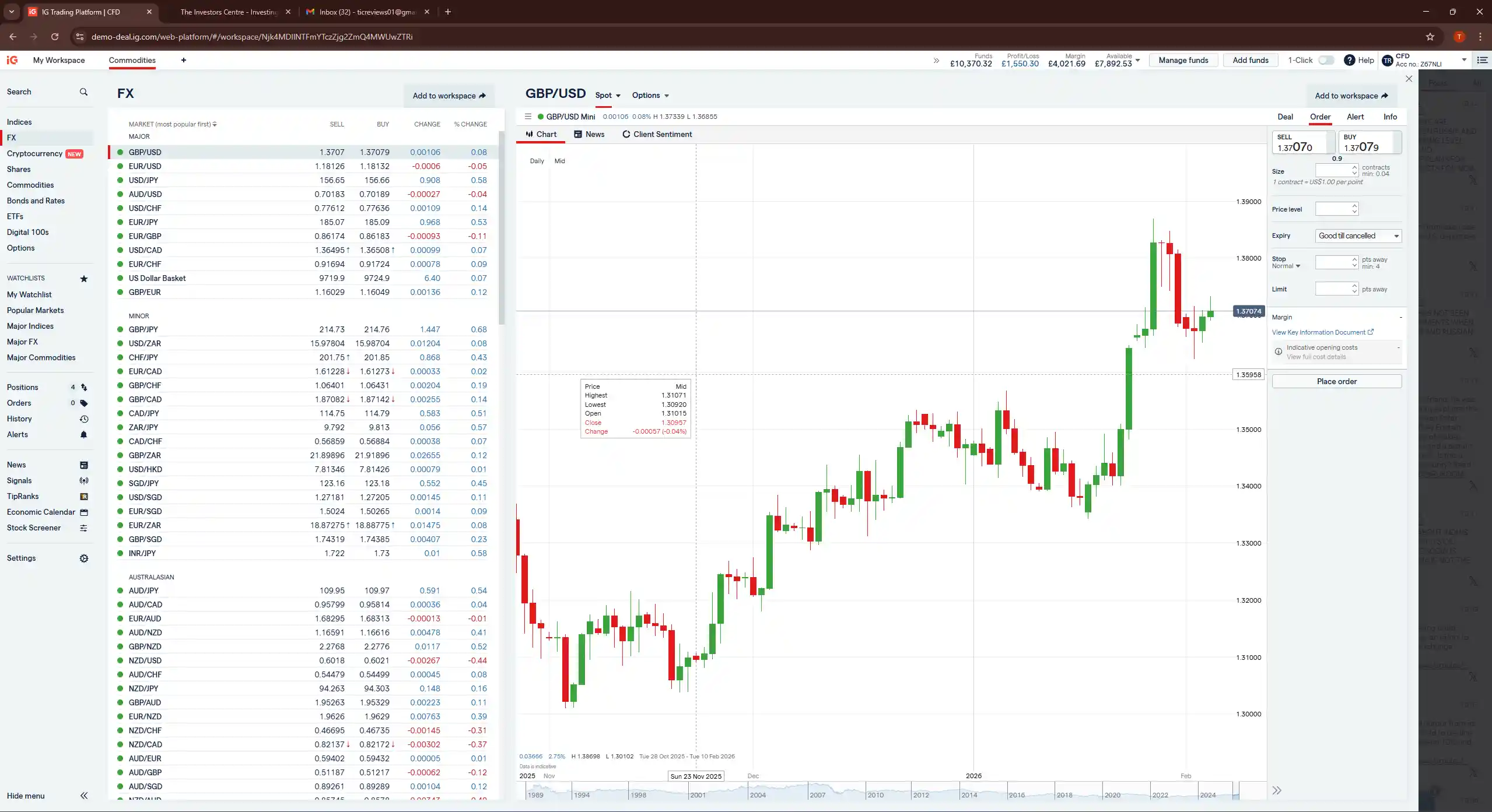
IG is the platform you graduate to when you realise you need access to everything. Fifty years in the business. 18,000+ instruments. Australia's first CFD provider. The only broker on this list where you can trade forex CFDs in the morning, buy ASX shares at lunch with CHESS sponsorship, and go short on US index futures after Wall Street opens. Nobody else matches that breadth.
Pros
- 18,000+ instruments - widest range of any Australian broker
- CFDs and direct share trading under one account with CHESS sponsorship
- Professional tools: L2 Dealer DMA, ProRealTime, IG Academy education
- 50-year track record, ASIC-regulated with local Australian offices
Cons
- Complexity tax - first two hours spent configuring workspace and charting packages
- $8 ASX brokerage, 0.7% FX conversion, $40/month ProRealTime
- Web platform logged out three times during a single afternoon session
What Makes IG's Professional Toolkit Stand Out?
Where IG earns its #2 spot - and very nearly #1 - is the professional toolkit. L2 Dealer provides genuine direct market access for equity CFDs. ProRealTime delivers institutional-grade charting (though at $40/month unless you're trading actively). IG Academy is one of the most comprehensive free education programmes available. This isn't a broker cutting corners.
Opening my IG account, the sheer scale hit immediately. The market screener returned more results than most brokers offer in total. I typed "lithium" out of curiosity and got 23 different instruments back - from individual mining stocks to commodity futures. No other platform I tested came close.
What Are IG Australia's Fees and Costs?
The trade-off is complexity. I spent the first two hours configuring my workspace and working out which of IG's four charting packages to default to. The account settings alone have more options than Capital.com's entire platform menu. The pricing also adds up: $8 ASX brokerage, 0.7% FX conversion on international shares, $40/month for ProRealTime. These nibble at returns if you're not trading frequently enough to trigger the discounted tiers. And the web platform logged me out three times during a single afternoon session in December - frustrating when you're monitoring open positions.
Fees verified from IG Australia's pricing page, February 2026. My live testing showed EUR/USD spreads averaging 0.85 pips during London session hours - slightly wider than Capital.com but with noticeably better execution on limit orders.
| Fee Type | Amount | Notes |
|---|---|---|
| EUR/USD Spread (CFD) | From 0.6 pips | Standard account, no commission |
| EUR/USD Spread (DMA) | From ~0.165 pips + $6 RT commission | L2 Dealer account |
| AUS200 Index | From 0.8 points | Tighter than most |
| Gold | From 0.1 points | Among the lowest available |
| ASX Share Trading | $8 or 0.1% | Drops to $5/0.05% after 3 trades/month |
| US/UK Shares | $0 commission | 0.7% currency conversion applies |
| ProRealTime | $40/month | Rebated with 4+ trades/month |
| Inactivity Fee | $18/month | Only after 24 months of no trading |
What Is My Verdict on IG Australia?
IG is the right choice if you want one platform that does everything - CFDs, forex, shares, sophisticated tools - without juggling multiple accounts. The depth is unmatched. But you pay for that breadth in complexity and cost. If you're looking for the cheapest ASX brokerage (CMC Invest wins), tightest forex spreads (Pepperstone wins), or the simplest beginner experience (Capital.com), look elsewhere.
Interactive Brokers - Best for Professional Traders
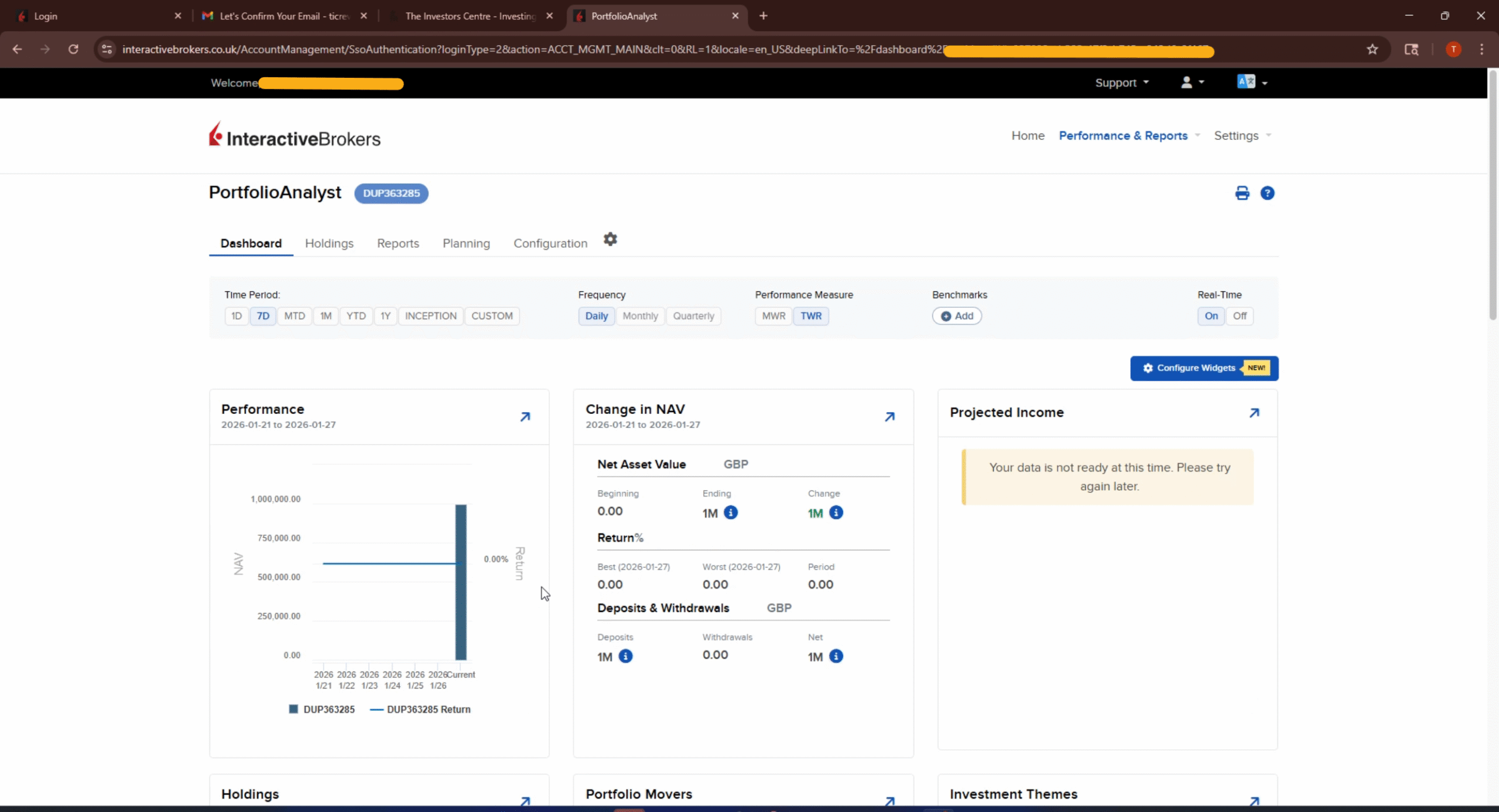
Interactive Brokers is the platform you either love or bounce off within the first hour. No middle ground. When I first opened Trader Workstation, the interface looked like it hadn't been redesigned since 2008 - because large parts of it haven't. Menus nest inside menus. The options chain requires its own tutorial. The portfolio view defaults to a layout that would confuse most retail traders.
Pros
- 0.002% currency conversion fee - $0.20 on $10,000 vs $75 at eToro
- 150+ markets across 33 countries - unmatched global access
- NASDAQ-listed (~$40B USD market cap), ASIC-regulated (AFSL 453554)
- Real-time Level II data, options probability calculator, multi-asset workspace
Cons
- Steep learning curve - TWS interface dated and complex
- Onboarding took six business days - slowest of all seven platforms
- Support responses averaged 4-6 hours for email queries
What Is Interactive Brokers' Cost Advantage?
Founded in 1978, NASDAQ-listed (~$40B USD market cap), ASIC-regulated (AFSL 453554). The most financially secure broker on this list, and it's not close. The 0.002% currency conversion fee is the stat that matters most: on a $10,000 USD conversion, you'd pay $0.20 with IBKR versus $75 with eToro. Over a year of regular international trading, that gap runs into hundreds of dollars.
But here's the thing: once you learn TWS, everything else feels limited. I set up a workspace with real-time Level II data on four ASX stocks, a forex heatmap, and an options probability calculator - all running simultaneously without a single lag spike. Try that on eToro.
What Are Interactive Brokers' Fees?
Fees verified from Interactive Brokers' AU pricing page, February 2026.
| Fee Type | Amount | Notes |
|---|---|---|
| ASX Brokerage | 0.08% (min $6, max $29) | Tiered pricing also available |
| US Stocks | US$0.005/share (min $1) | Volume discounts available |
| Currency Conversion | 0.002% (min $2) | By far the lowest available |
| Options | $0.65/contract (US) | Competitive for active options traders |
| Inactivity Fee | $10 USD/month | Waived if account > $100K or age ≤ 25 |
What Is My Verdict on Interactive Brokers?
IBKR suits traders and investors who think globally - US options, European ETFs, multi-currency portfolios where conversion costs compound. The 0.002% FX rate is an unfair advantage that no competitor matches. But the learning curve is steep, the interface is dated, and support is slow. If you manage more than $50,000 across international markets, the savings justify the friction. Below that, the complexity isn't worth it.
CMC Markets - Best for Trading + Investing Combined
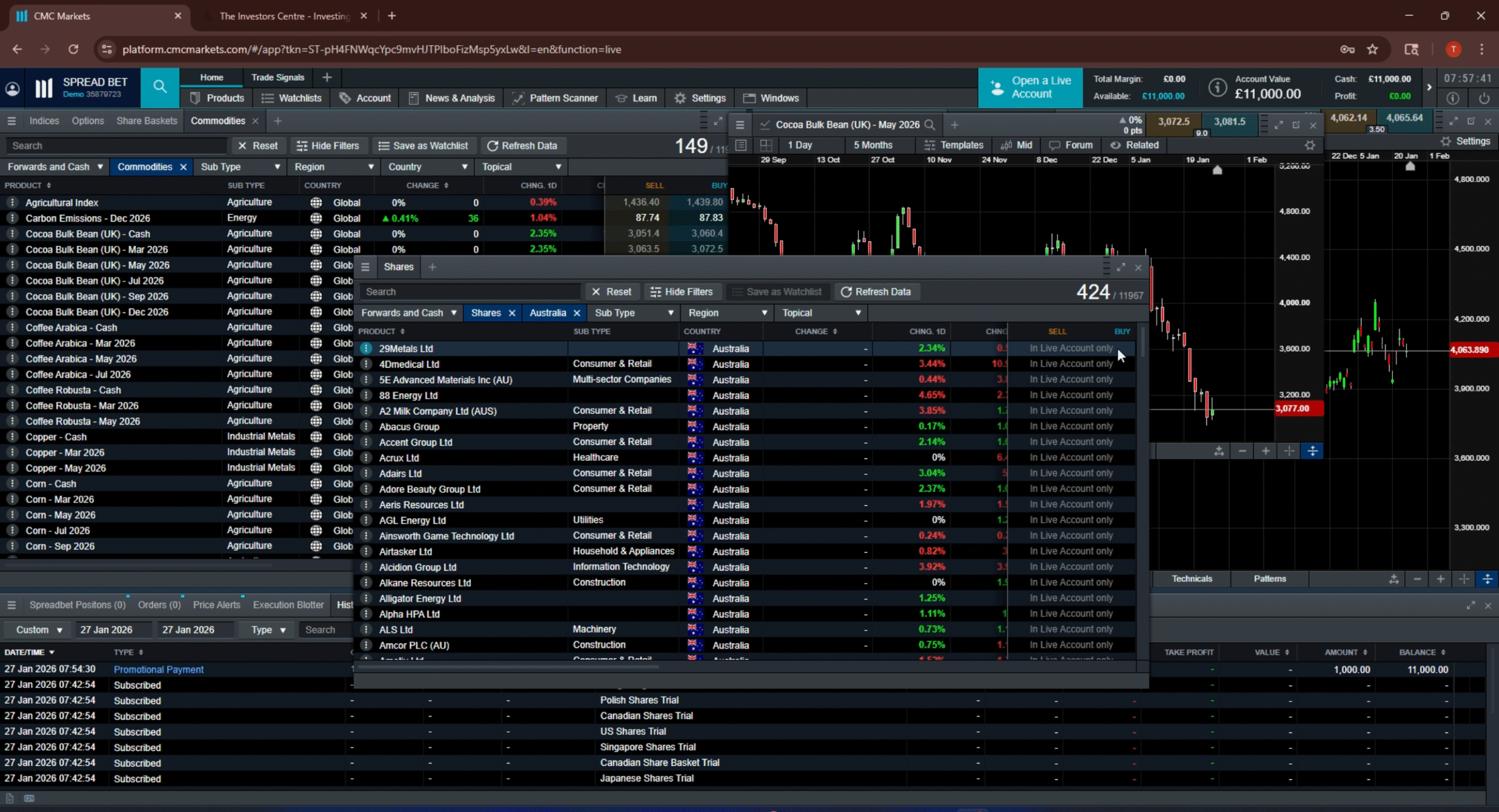
CMC Markets is two platforms wearing one brand. Once you understand that, the proposition clicks.
Pros
- Dual platform: 12,000+ CFDs via Next Generation + $0 ASX brokerage via CMC Invest
- CMC Invest CHESS sponsorship with access to 45,000+ stocks across 16 exchanges
- Founded 1989, ASIC-regulated (AFSL 238054) - longest-operating broker on this list
- 80+ technical indicators and client sentiment overlay on Next Generation
Cons
- Genuinely separate platforms - different apps, dashboards, account structures
- $11 brokerage on ASX trades over $1,000 is expensive vs moomoo's $3
- CMC Invest app crashed during a market open session in December
How Do CMC's Two Platforms Work Together?
CMC Next Generation is for CFD and forex traders - 12,000+ instruments, spreads from 0.7 pips on EUR/USD, and charting tools that rival IG's. I ran 11 index CFD trades through Next Generation over three weeks in November. Pattern recognition, 80+ technical indicators, and the client sentiment overlay genuinely added to my analysis. The platform felt mature and responsive.
CMC Invest is the share investing arm - $0 brokerage on your first buy per ASX stock per day (up to $1,000), CHESS sponsorship, and access to 45,000+ stocks and ETFs across 16 exchanges. Adam used CMC Invest as his primary ASX platform throughout testing and ranked it the strongest pure share investing option for cost-conscious Australians.
The catch: these are genuinely separate platforms. Different apps, different dashboards, different account structures. When I wanted to hedge an ASX share position with a CFD on the same stock, I had to switch between two interfaces. It works, but it's not the seamless experience IG's unified account provides. That said, CMC's heritage counts - founded in 1989, ASIC-regulated (AFSL 238054), the longest-operating broker on this list.
What Are CMC Markets' Fees?
CMC's split pricing means you evaluate each platform independently. The Invest side is among the cheapest for ASX shares. The CFD side sits mid-pack.
| Fee Type | CMC Invest (Shares) | CMC Next Gen (CFDs) |
|---|---|---|
| ASX Brokerage/Spread | $0 (first $1k/day), then $11 or 0.1% | From 0.7 pips (EUR/USD) |
| US Stock Trading | $0 commission | N/A (traded as CFDs) |
| Currency Conversion | 0.6% | N/A |
| AUS200 Index | N/A | From 1.0 point |
| Inactivity Fee | None on Invest | $15/month after 12 months |
What Is My Verdict on CMC Markets?
CMC is the clear winner if you want CFD trading and share investing without opening accounts at two different brokers. The $0 ASX brokerage on sub-$1,000 trades is hard to beat for regular small purchases. But the dual-platform setup is clunky, and once you exceed $1,000 per trade, the brokerage stops being competitive. If you only want CFDs, Capital.com is better. If you only want shares, moomoo is cheaper.
eToro - Best for Copy Trading & Beginners
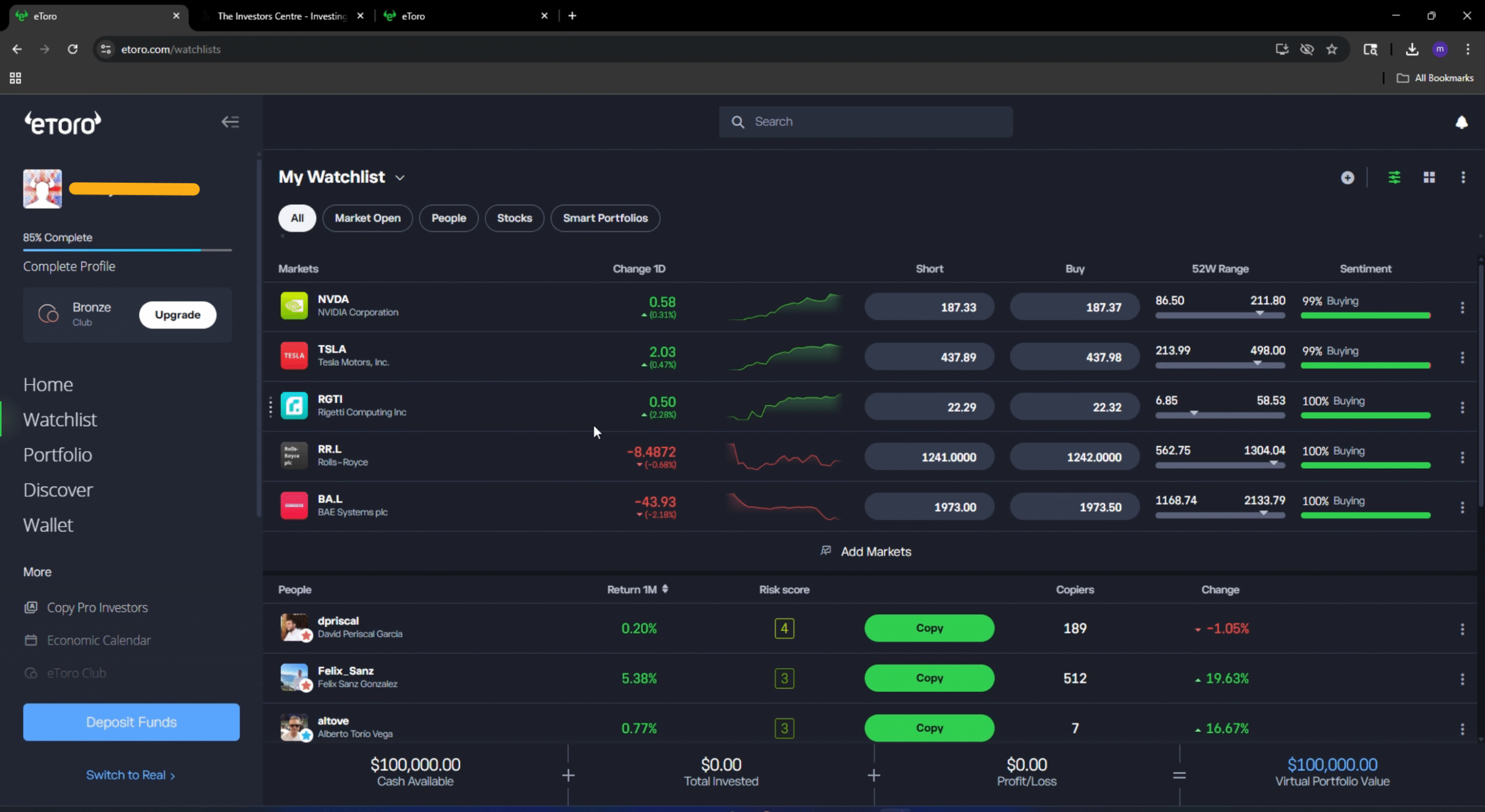
I'll be direct: eToro is the easiest platform on this list to pick up and start using. That's by design. For experienced traders, that simplicity becomes a limitation. For beginners, it's exactly what you need.
Pros
- CopyTrader works as advertised - mirrored copied traders' performance within 0.4% margin
- Easiest platform to pick up - purpose-built for beginners
- ASIC-regulated (AFSL 491139), 35+ million registered users globally
- Social feed makes investing less isolating for new traders
Cons
- Hidden costs: $2 per-side commission + 0.75% FX conversion = $9.50 per $1,000 US trade
- Custodian model - no CHESS sponsorship for Australian shares
- Limited charting tools - you'll outgrow it quickly
How Does eToro's CopyTrader Actually Perform?
CopyTrader is the standout. I tested it over four weeks in December, allocating $500 AUD to copy three "Popular Investors" - one forex-focused, one equities, one mixed. After 28 days, the combined return was +2.3%, mirroring the copied traders' performance within a 0.4% margin. The system works as advertised. Whether copy trading is a good long-term strategy is a different question - but as a learning tool for beginners who want market exposure while they figure things out, nothing else comes close.
What Are eToro's Real Costs?
What eToro isn't: cheap. The $2 per-side commission on stocks sounds reasonable until you factor in the 0.75% currency conversion fee. A $1,000 US stock purchase costs $9.50 all-in ($2 commission + $7.50 conversion). The same trade on CMC Invest costs $6. On IBKR, $1.02. Those gaps compound fast. Over my four-week test, the hidden FX fees alone cost me $38.
The headline "$0 commission" marketing is misleading - between the per-trade fee and the FX conversion, eToro is one of the more expensive platforms for international stock trading.
| Fee Type | Amount | Notes |
|---|---|---|
| ASX/US Stocks | $2 per side | Per trade |
| EUR/USD Spread | From 1.0 pips | No commission |
| Currency Conversion | 0.75% | Highest on this list |
| Withdrawal Fee | $5 USD | Per withdrawal |
| Inactivity Fee | $10 USD/month | After 12 months of no login |
| Copy Trading | Free to copy | Popular Investors earn 1.5% AUM from eToro |
What Is My Verdict on eToro?
eToro is purpose-built for beginners who want guided market exposure - through copy trading or through a social feed that makes investing less isolating. If you've never bought a stock and want the gentlest introduction available, eToro delivers that. But you'll outgrow it. The costs are too high, the charting too limited, and the custodian model a genuine downside. Start here if you must, then move to Capital.com (CFDs) or CMC Invest (shares) once you find your feet.
moomoo - Best Low-Cost Share Trading App
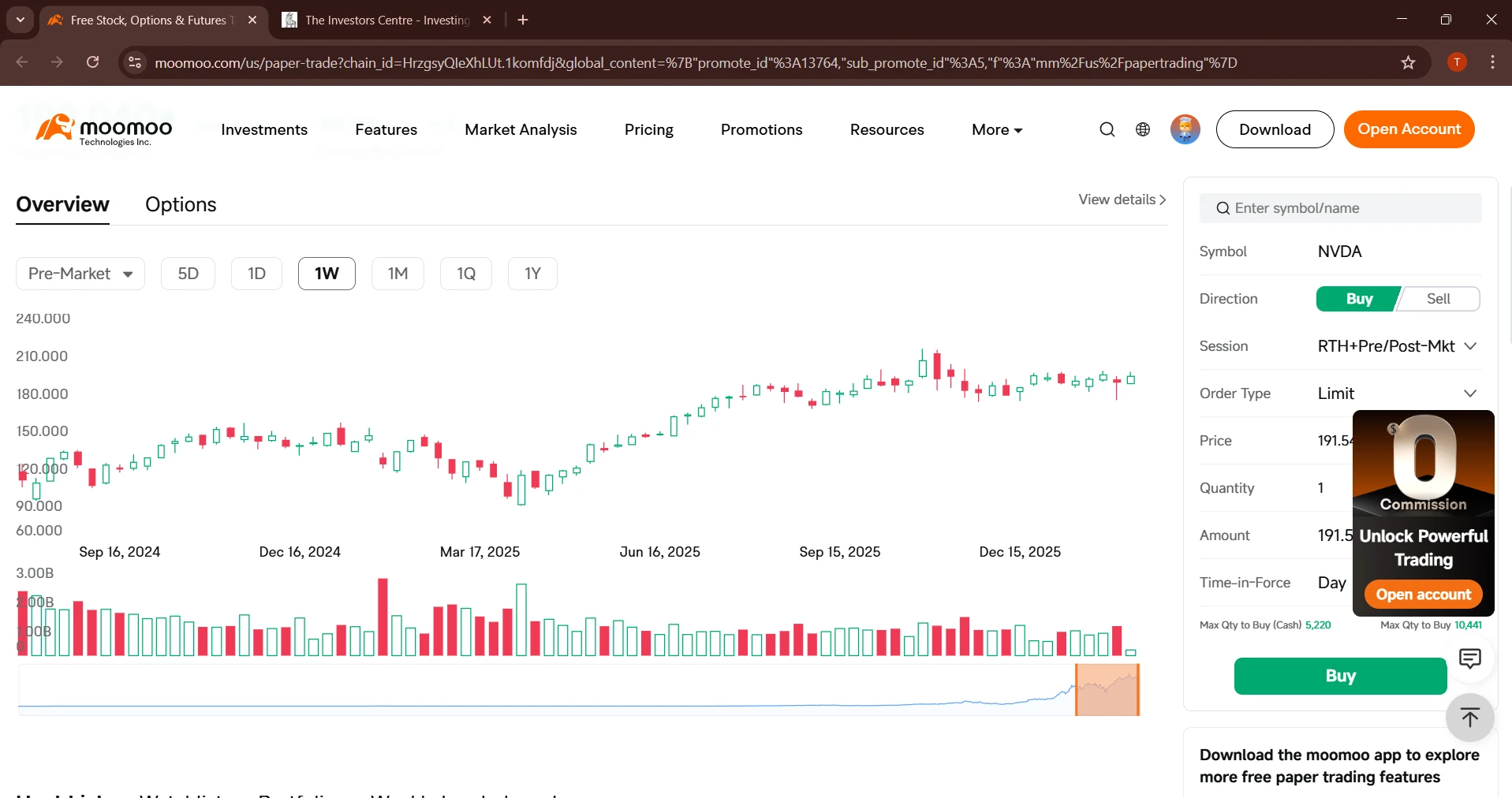
moomoo is the platform that surprised me most during testing. For a relatively new entrant to Australia, the depth of analytical tools packed into a $3-per-trade app is remarkable.
Pros
- $3 flat ASX brokerage with full CHESS sponsorship - undercuts IG ($8) and IBKR ($6)
- AI-powered stock analysis and institutional money flow indicators included free
- TradingView integration launched January 2026 - charting now competitive
- ASIC-regulated (AFSL 529455), US stocks at just US$0.99 per trade
Cons
- Limited markets: ASX, US, and Hong Kong only - no European, forex, CFDs, or commodities
- Customer support averaged 8 hours response time - slowest of all seven platforms
- No fractional shares - limits dollar-cost averaging on higher-priced US stocks
What Does moomoo Offer for the Price?
Adam ran moomoo as his secondary ASX platform from November through January and found the experience closer to Interactive Brokers than he expected. AI-powered stock analysis, institutional money flow indicators, real-time Level II data - features you'd normally associate with platforms costing 5-10x more in brokerage. The TradingView integration launched in January 2026 and brought charting up to a competitive standard.
At $3 flat for ASX trades (or 0.03%, whichever is greater) with full CHESS sponsorship, moomoo undercuts IG ($8) and IBKR ($6 minimum). US stocks cost just US$0.99 per trade. Genuinely budget-tier fees with mid-tier features. ASIC-regulated (AFSL 529455).
What Are moomoo's Fees?
For ASX investors making regular small-to-medium purchases, moomoo's $3 flat fee with CHESS sponsorship is hard to beat - only CMC Invest's $0 on sub-$1k trades is cheaper.
| Fee Type | Amount | Notes |
|---|---|---|
| ASX Brokerage | $3 or 0.03% | Whichever is greater, CHESS sponsored |
| US Stocks | US$0.99 per order | Plus SEC/FINRA regulatory fees |
| Hong Kong Stocks | HK$18 per trade | Plus platform fee |
| Currency Conversion | 0.25% | Competitive - better than eToro (0.75%) |
| Inactivity Fee | None | - |
| Deposit/Withdrawal | Free | PayID instant deposits |
What Is My Verdict on moomoo?
moomoo punches well above its weight for share investors. The $3 ASX brokerage with CHESS sponsorship, free analytical tools, and TradingView integration make it the best pure value play for Australian share investors. But the narrow market range (ASX, US, HK only), lack of CFDs and forex, and poor customer support keep it from climbing higher. If you only want to buy ASX and US shares at the lowest possible cost, moomoo is hard to beat.
Can You Use MT4, MT5, or TradingView with Australian Brokers?
Third-party platform support matters because many experienced traders have strategies, indicators, and muscle memory tied to a specific platform. Switching from MT4 to a proprietary platform means rebuilding - and that costs money during the transition.
| Platform | MT4 | MT5 | cTrader | TradingView | Proprietary |
|---|---|---|---|---|---|
| Pepperstone | ✓ | ✓ | ✓ | ✓ | ✗ |
| Capital.com | ✓ | ✗ | ✗ | ✓ | ✓ |
| IG Australia | ✓ | ✗ | ✗ | ✓ | ✓ (IG Platform) |
| Interactive Brokers | ✗ | ✗ | ✗ | ✓ (via API) | ✓ (TWS) |
| CMC Markets | ✗ | ✗ | ✗ | ✗ | ✓ (Next Generation) |
| eToro | ✗ | ✗ | ✗ | ✗ | ✓ |
| moomoo | ✗ | ✗ | ✗ | ✓ | ✓ |
If platform flexibility is your top priority, Pepperstone wins by a wide margin - MT4, MT5, cTrader, and TradingView, all with full functionality. Capital.com’s TradingView integration is the next best, with a seamless experience that doesn’t feel like a bolt-on.
How Should You Choose the Right Trading Platform?
For CFD and Forex Traders
Start with Capital.com if you want the best overall platform experience. Move to Pepperstone if you need the tightest spreads or specific platform support (MT5, cTrader). Choose IG if you need the widest instrument range or both CFDs and direct shares. Only consider Interactive Brokers if you’re trading globally across multiple asset classes and need the currency conversion savings.
For Share Investors
CMC Invest is the strongest option for cost-conscious ASX investors buying under $1,000 per trade. moomoo offers the best flat-fee structure ($3 per trade) with CHESS sponsorship and surprisingly deep analytical tools. Interactive Brokers wins for international portfolios. IG combines share investing with CFD access under one roof.
For Complete Beginners
eToro’s CopyTrader provides guided exposure while you learn. Capital.com’s Investmate app is the best standalone education tool. Both are easier to navigate than IG or Interactive Brokers. Start with one of these, then consider moving once you understand your trading style.
What Are the Tax Implications of Trading in Australia?
This is where most “best broker” guides stop short. Tax treatment varies significantly depending on whether the ATO classifies you as an investor, a trader, or a business. The distinction matters.
Investors (Buy and Hold)
Capital gains tax applies. If you hold shares for more than 12 months, you get a 50% CGT discount. This is the simplest treatment and applies to most people using CMC Invest, moomoo, or Interactive Brokers for long-term share holdings.
Traders (Active, Frequent Trading)
The ATO may classify you as carrying on a “trading business” if you trade frequently, with the intention of making short-term profits. In this case, profits and losses are assessable income - not capital gains. No 50% CGT discount. The upside: business expenses (platform subscriptions, data feeds, home office costs) may be deductible.
CFD Traders
CFD profits are generally treated as assessable income - not capital gains - regardless of holding period. No 50% CGT discount even if you hold a position for more than 12 months. CFD losses can typically offset other CFD gains within the same financial year. Record-keeping is critical: the ATO expects detailed trade records for every position.
Important: This is general information only - not tax advice. The ATO’s classification depends on your specific circumstances, trading frequency, and intent. Consult a registered tax agent or accountant who understands financial trading.
Final Thoughts
After three months of testing with real money across all seven platforms, my recommendation is straightforward: Capital.com is the best overall trading platform in Australia for 2026. The combination of 0% commission, competitive spreads, AI-powered tools, and the best mobile app I tested makes it the clear winner for most CFD and forex traders.
But the best platform is always the one that fits how you actually trade. If you prioritise raw spread cost, Pepperstone’s Razor account is unbeatable. If you need everything under one roof, IG is the most complete platform available. If you’re investing in ASX shares on a budget, moomoo’s $3 flat brokerage with CHESS sponsorship is hard to argue with.
Every platform on this list is ASIC-regulated. I’ve deposited real money into each one. The differences come down to cost, complexity, and what you’re trading. Pick the one that matches your priorities, not the one with the biggest advertising budget.
FAQs
Sources
- ASIC Professional Register - Australian Financial Services Licensees
- ASIC - Product Intervention Order: CFDs
- ATO - Capital Gains Tax Guide
- ATO - Trading as a Business: Income and Deductions
- ASX - CHESS Settlement System
- Capital.com Australia - Fees & Charges
- IG Australia - Fees & Charges
- Pepperstone - Trading Fees (Australia)
- Interactive Brokers - Commission Structure
- CMC Markets - Pricing (Australia)