
- Expertise:
- Platform Testing, Cryptocurrency, Retail Investing
- Credentials:
- Active investor since 2013 · 11+ years experience
- Tested:
- 50+ platforms · 200+ guides authored

- Expertise:
- Broker Comparison, ISA Strategy, Portfolio Management
- Credentials:
- Active investor since 2013 · 11+ years experience
- Tested:
- 40+ brokers with funded accounts
How We Test
Real accounts. Real money. Real trades. No demo accounts or press releases.
What we measure:
- Spreads vs advertised rates
- Execution speed and slippage
- Hidden fees (overnight, withdrawal, conversion)
- Actual withdrawal times
Scoring:
Fees (25%) · Platform (20%) · Assets (15%) · Mobile (15%) · Tools (10%) · Support (10%) · Regulation (5%)
Testing team:
Adam Woodhead (investing since 2013), Thomas Drury (Chartered ACII, 2018), Dom Farnell (investing since 2013) — 50+ platforms with funded accounts
Quarterly reviews · Corrections: [email protected]
Disclaimer
Not financial advice. Educational content only. We're not FCA authorised. Consult a qualified advisor before investing.
Capital at risk. Investments can fall. Past performance doesn't guarantee future results.
CFD warning. 67-84% of retail accounts lose money trading CFDs. High risk due to leverage.
Contact: [email protected]
What Is the Best Investment Broker in Ireland?
IG is our #1 pick for 2026, offering commission-free trading on over 11,000 stocks and ETFs, a low 0.15% FX fee, and more than 50 years of operating history as a FTSE 250-listed broker. For beginners, eToro is the best alternative with its intuitive social investing platform and the CopyTrader feature that lets newcomers mirror experienced investors.

72% of retail CFD accounts lose money.

51% of retail CFD accounts lose money.
Trading and investing involve risk. Capital at Risk

Trading and investing involve risk. Capital at Risk

Trading and investing involve risk. Capital at Risk
64% of retail CFD accounts lose money.
Trading and investing involve risk. Capital at Risk
How Do Ireland's Top Investment Brokers Compare in 2026?
Finding the right investment broker depends on your trading frequency, preferred assets, and how much you value direct Irish regulation versus EU-passported platforms. The table below provides a snapshot comparison of Ireland's leading brokers based on fees, asset range, and regulatory status.
| # | Provider | Stock Fee | Assets | Key Features | Regulation | Rating |
|---|---|---|---|---|---|---|
| 1 | IG | €0 | 11,000+ stocks | Zero commission, 0.15% FX fee, 24/5 US trading | BaFin Passported | 4.8/5 |
| 2 | eToro | €0-1 | 5,000+ stocks | CopyTrader, beginner-friendly, social features | CySEC Passported | 4.7/5 |
| 3 | DEGIRO | €2-3 | 50+ exchanges | Low fees, European focus, core selection | AFM Passported | 4.5/5 |
| 4 | Trading 212 | €0 | 10,000+ stocks | Zero commission, fractional shares, pies | CySEC Passported | 4.4/5 |
| 5 | Lightyear | €1 | 5,500+ stocks | Multi-currency accounts, SIPC protection | EFSA Passported | 4.3/5 |
| 6 | Saxo Markets | From €3 | 71,000+ | Professional tools, extensive research, options | FCA Passported | 4.2/5 |
| 7 | Davy Select | €25+ | Irish/UK focus | Local expertise, direct CBI regulation, advice | CBI Direct | 4.0/5 |

Here Are the 7 Best Investment Brokers in Ireland
After analysing fees, regulation, asset selection, and platform usability, these are the top investment brokers available to Irish investors in 2026:
1. IG — Best Overall Investment Broker
2. eToro — Best for Beginners and Social Trading
3. DEGIRO — Best for Low-Cost European Investing
4. Trading 212 — Best for Commission-Free Stock Trading
5. Lightyear — Best for Multi-Currency Investing
6. Saxo Markets — Best for Experienced Investors
7. Davy Select — Best for Irish Market Expertise
IG — Best Overall Investment Broker
Best Overall
Pros
- Commission-free trading on 11,000+ stocks and ETFs
- Low 0.15% FX fee and 24/5 trading on popular US stocks
- 50+ years of operating history with FTSE 250 listing
Cons
- Investment offering is newer to Ireland than established rivals
- Broad product range can feel complex for beginners
What Are IG's Fees?
IG charges zero commission on all stock and ETF trades for Irish investors, with no platform, custody, or account maintenance fees. Currency conversion costs 0.15%, matching the lowest rate among major brokers serving Ireland. Combined with interest paid on uninvested cash, this makes IG the joint most competitively priced broker in the Irish market.
What Can You Trade with IG?
IG provides access to more than 11,000 stocks and ETFs across US, UK, and European exchanges, with 24/5 trading available on the most popular US stocks. Experienced traders can also access leveraged products such as CFDs, options, and turbo warrants through the same account, though these carry higher risk and suit active traders rather than long-term investors.
How Is IG Regulated?
Irish clients are served by IG Europe GmbH, regulated by Germany's BaFin and passported into Ireland under MiFID II. Client funds and assets are held in segregated accounts, and Irish investors receive €20,000 protection under Germany's investor compensation scheme. IG Group, founded in 1974 and listed on the FTSE 250, is regulated by multiple top-tier authorities globally.
What Is the Platform Like?
IG offers a polished web platform and a highly rated mobile app with watchlists, alerts, and advanced charting. The IG Academy provides one of the most comprehensive free education libraries of any broker, and a demo account lets you practise before committing real money. The breadth of features takes some learning, but everyday investing is straightforward.
eToro — Best for Beginners and Social Trading
Best for Beginners
Pros
- Extremely user-friendly for beginners
- CopyTrader lets you mirror successful investors
- Commission-free stock and ETF trading
Cons
- FX conversion spreads up to 0.5%
- $5 withdrawal fee and $10 monthly inactivity charge
What Are eToro's Fees?
eToro charges zero commission on stock and ETF trades, making money through spreads on CFD positions and currency conversion (up to 0.5% on EUR/USD conversions). Withdrawals cost $5, and accounts inactive for 12 months face a $10 monthly fee. There is no minimum deposit for Irish users.
How Does CopyTrader Work?
CopyTrader allows you to automatically replicate the trades of successful investors on the platform. You allocate a portion of your funds to copy one or more traders, and your account mirrors their positions proportionally. This feature is ideal for beginners learning investment strategies while building a portfolio.
How Is eToro Regulated?
eToro (Europe) Ltd is regulated by CySEC in Cyprus and operates in Ireland under EU passporting. Irish investors receive €20,000 protection under the ICF scheme, plus up to €1,000,000 additional coverage through Lloyd's of London insurance. Client funds are segregated from company assets.
What Is the Platform Like?
eToro's platform is designed for simplicity, featuring a social feed where investors share ideas and trades. The interface is clean and mobile-friendly, with educational content integrated throughout. While basic compared to professional platforms, the streamlined approach removes barriers for new investors.
DEGIRO — Best for Low-Cost European Investing
Best Value
Pros
- Very competitive fees (EUR 2-3 for European stocks)
- Access to 50+ global exchanges
- Core selection of low-cost ETFs with EUR 1 trades
Cons
- EUR 2.50 annual connectivity fee per exchange
- Limited research and analysis tools
What Are DEGIRO's Fees?
DEGIRO charges €2-3 per trade for European stocks, €0.50 plus $0.004 per share for US stocks, and €1 for core selection ETFs. There's a €2.50 annual fee per exchange you trade on, plus €1 per year for Irish investors. Currency conversion costs 0.25% (manual) or 0.1% (auto). No withdrawal or inactivity fees apply.
What Is the Core Selection?
DEGIRO's core selection features over 200 carefully chosen ETFs that you can trade for just €1 per order. This includes popular Vanguard, iShares, and SPDR ETFs covering global equities, bonds, and commodities. It's designed for long-term investors building diversified portfolios at minimal cost.
How Is DEGIRO Regulated?
DEGIRO is regulated by the Dutch Authority for Financial Markets (AFM) and operates in Ireland through EU passporting. Irish investors receive €20,000 compensation protection through the Dutch investor protection scheme. Client assets are held in a separate legal entity (SPV) for additional security.
What Is the Platform Like?
DEGIRO's platform prioritises functionality over flashy features. The web platform and mobile app provide straightforward order placement, portfolio tracking, and basic research tools. While not as sophisticated as professional-grade platforms like Saxo, the streamlined approach suits investors focused on execution rather than analysis.
Trading 212 — Best for Commission-Free Stock Trading
Zero Commission
Pros
- Zero commission on all stock and ETF trades
- Fractional shares enable diversification from EUR 1
- Pies feature for automated portfolio rebalancing
Cons
- No ISA wrapper for UK investors (Irish not affected)
- Limited order types compared to professional platforms
What Are Trading 212's Fees?
Trading 212 charges zero commission on stock and ETF trades, earning revenue from interest on uninvested cash and payment for order flow. Currency conversion costs 0.15% (the lowest among major brokers). There are no withdrawal fees, inactivity charges, or account maintenance costs. The free model makes it ideal for cost-conscious investors.
How Do Pies Work?
Pies let you create custom portfolios by allocating percentages to different stocks or ETFs. When you add money, Trading 212 automatically divides it according to your allocations, rebalancing to maintain your target weightings. You can create multiple Pies for different strategies and share them with other users.
How Is Trading 212 Regulated?
Trading 212 UK Ltd is authorised by CySEC in Cyprus and operates across Europe under passporting. Irish investors receive €20,000 protection through the Investor Compensation Fund. Client assets are segregated and held with tier-1 banks, separate from the company's operational funds.
What Is the Platform Like?
Trading 212's platform is clean and modern, designed for mobile-first investing. The interface focuses on simplicity without sacrificing functionality, featuring real-time quotes, news integration, and social sharing. While it lacks advanced charting tools, the streamlined experience suits investors focused on long-term portfolio building.
Lightyear — Best for Multi-Currency Investing
Best Multi-Currency
Pros
- Hold accounts in EUR, USD, and GBP simultaneously
- Direct US market access with SIPC protection ($500k)
- Flat EUR 1 per trade regardless of size
Cons
- Smaller stock universe (5,500) than competitors
- Limited to stocks and ETFs (no options or bonds)
What Are Lightyear's Fees?
Lightyear charges a flat €1 per trade regardless of order size, making it predictable for both small and large investments. Currency conversion uses mid-market rates with a 0.35% markup, competitive for multi-currency trading. There are no withdrawal fees, inactivity charges, or custody fees. Bank transfers are free.
How Does Multi-Currency Work?
Lightyear lets you hold balances in EUR, USD, and GBP simultaneously, converting only when needed. This minimises FX costs for investors with diversified currency exposures. For example, Irish investors can hold EUR for European stocks and convert a lump sum to USD for US investments, avoiding repeated conversion fees.
How Is Lightyear Regulated?
Lightyear is regulated by the Estonian Financial Supervision Authority (EFSA) and operates in Ireland under EU passporting. Irish investors receive €20,000 protection under Estonia's investor compensation scheme. US assets benefit from $500,000 SIPC protection through Lightyear's US custodian, DriveWealth.
What Is the Platform Like?
Lightyear's platform emphasises simplicity with a clean, modern interface available on web and mobile. Portfolio tracking is clear, with multi-currency balances displayed prominently. While research tools are basic, the platform integrates news and company fundamentals. The streamlined design suits investors focused on long-term holdings.
Saxo Markets — Best for Experienced Investors
Professional Grade
Pros
- Access to 71,000+ instruments across asset classes
- Professional research and analysis tools
- GBP 85,000 UK FSCS protection (higher than EU EUR 20k)
Cons
- Higher fees than discount brokers (from EUR 3 per trade)
- Platform complexity requires learning curve
What Are Saxo Markets' Fees?
Saxo Markets charges from €3 per trade for European stocks and $1 for US stocks under its Classic pricing tier. The Platinum tier (for accounts over €200k) reduces fees further. Options, bonds, and futures have separate fee schedules. FX conversion costs 0.5%. While higher than discount brokers, fees reflect the comprehensive service offering.
What Research Is Available?
Saxo provides institutional-quality research including daily market commentary, technical analysis, economic calendars, and company fundamentals. SaxoStrats (their research team) publishes macro analysis and trading ideas. Premium clients receive personalised portfolio reviews and access to dedicated relationship managers.
How Is Saxo Markets Regulated?
Saxo Markets operates in Ireland through Saxo Capital Markets UK, authorised by the UK Financial Conduct Authority. Irish investors receive £85,000 FSCS protection—significantly higher than the €20,000 provided by EU schemes. This makes Saxo attractive for larger portfolios where investor protection matters.
What Is the Platform Like?
SaxoTraderGO provides professional-grade functionality with advanced charting, customisable layouts, and sophisticated order types. The platform scales from desktop to mobile without losing capabilities. While powerful, the extensive features create a steeper learning curve than beginner-focused platforms.
Davy Select — Best for Irish Market Expertise
Local Expertise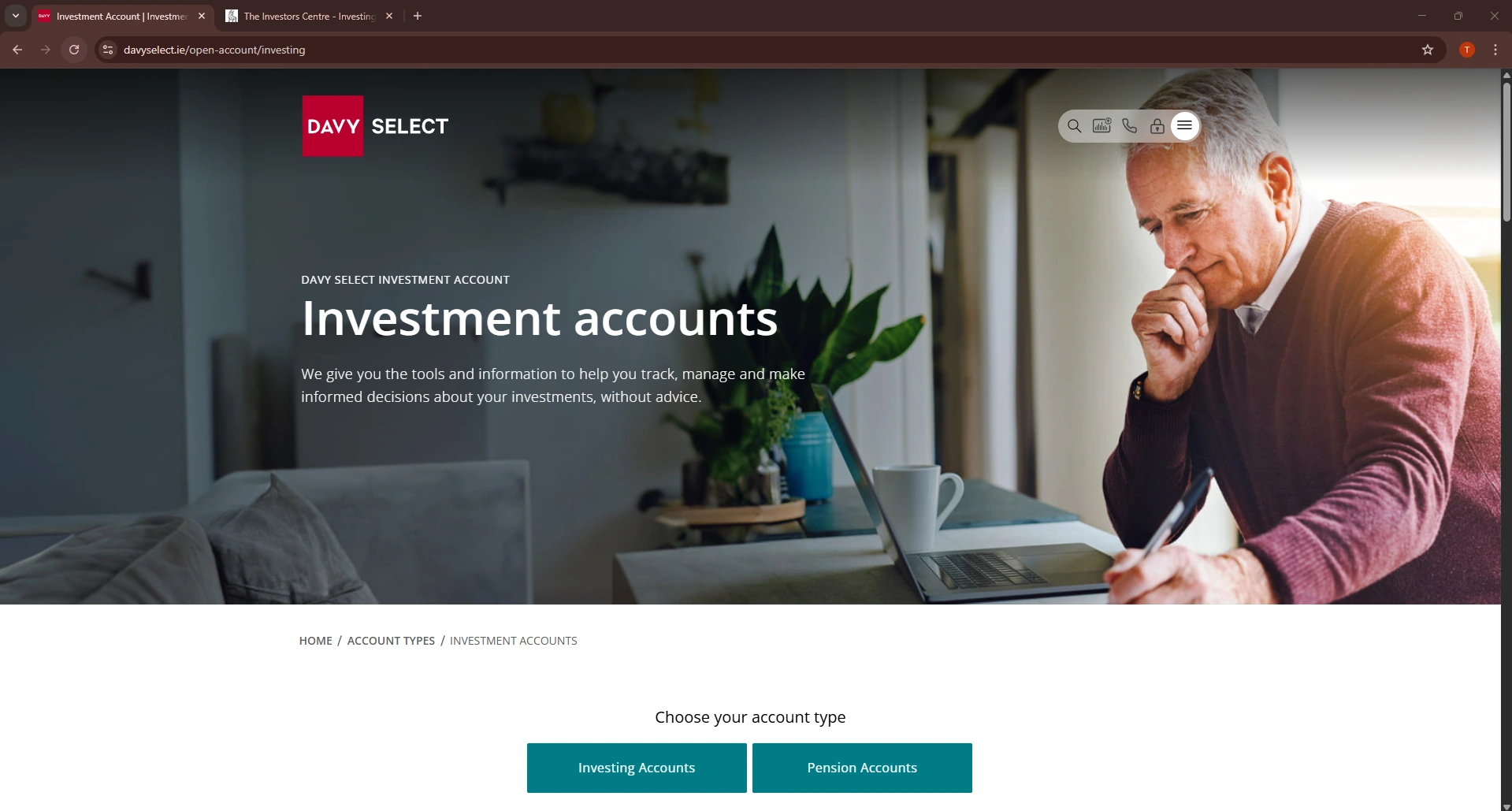
Pros
- Direct Central Bank of Ireland regulation
- Deep Irish market expertise and research
- Comprehensive Irish tax reporting
Cons
- Higher fees (EUR 25+ per trade) than European competitors
- Limited international market access
What Are Davy Select's Fees?
Davy Select charges €25 per trade for Irish stocks, with varying fees for UK and international markets. A 0.3% annual custody fee applies (€100 minimum). While expensive compared to online brokers, the fees reflect personalised service, research access, and comprehensive Irish tax reporting that simplifies compliance.
Why Choose an Irish-Focused Broker?
Davy provides deep expertise in Irish stocks, bonds, and investment funds often unavailable on international platforms. Their research team covers Irish companies comprehensively. For investors prioritising Irish market exposure or wanting local advice familiar with Irish tax regulations, the premium fees may be justified.
How Is Davy Select Regulated?
J&E Davy is directly authorised by the Central Bank of Ireland, making it the only broker on this list with direct Irish regulation. Irish investors receive €20,000 protection under the Investor Compensation Scheme. Being locally regulated means accountability to Irish authorities.
What Is the Platform Like?
Davy Select offers both online trading and phone-based execution with dealing support. The platform is functional rather than cutting-edge, focused on execution and portfolio reporting. For investors valuing human interaction and advice over self-service technology, the traditional approach may appeal despite less modern features.

How Does Regulation Affect Irish Investors?
Irish investors face a choice between brokers directly regulated by the Central Bank of Ireland and those operating under EU passporting from regulators like CySEC (Cyprus), AFM (Netherlands), or EFSA (Estonia). Both frameworks provide MiFID II protections, but understanding the differences helps you evaluate investor protection and recourse mechanisms.
What Is the Difference Between Direct Irish Regulation and EU Passporting?
Direct Central Bank of Ireland regulation means the broker holds an Irish licence and falls entirely under Irish regulatory oversight. Only Davy Select offers this on our list. These firms must comply with CBI requirements, face Irish regulatory inspections, and provide recourse through Irish authorities if issues arise.
EU passporting allows brokers regulated in one European country to offer services across the EU under their home country's supervision. For example, eToro and Trading 212 are regulated by CySEC in Cyprus, IG operates under German BaFin supervision, and DEGIRO under Dutch AFM supervision. These firms must meet MiFID II standards but answer to their home regulator, not the CBI.
Does Investor Protection Differ?
All brokers on this list provide investor compensation if the firm fails, but limits vary by jurisdiction. The table below compares protection levels across different regulatory schemes serving Irish investors.
Do You Pay Tax on Investments in Ireland?
Yes. Irish residents pay Capital Gains Tax (CGT) at 33% on profits from selling shares, ETFs, and other investments. A €1,270 annual exemption applies, meaning gains below this threshold are tax-free. Losses can be carried forward to offset future gains.
Dividend income faces different treatment depending on the source. Irish dividends are taxed at your marginal income tax rate plus USC and PRSI. Foreign dividends may benefit from tax treaty provisions but still require declaration on your annual return.
Revenue.ie provides comprehensive guidance on investment taxation, and most investors with portfolios above €20,000 should consider professional tax advice given the complexity of Irish tax rules.
What Are the Hidden Costs of Investing in Ireland?
Beyond headline trading fees, several costs can significantly impact your returns. Currency conversion charges and Ireland's unique ETF taxation rules deserve particular attention when choosing a broker and structuring your portfolio.
How Does Currency Conversion Affect Your Returns?
Most Irish investors want exposure to US markets, but every trade in USD incurs a currency conversion fee. These range from 0.15% (IG and Trading 212) to 0.5% (eToro), applied each time you buy or sell. For frequent traders, these costs compound significantly over time.
Brokers like Lightyear allow you to hold multiple currencies, converting once and then trading without repeated fees. This approach suits investors making regular US stock purchases, as a single annual conversion proves far cheaper than converting on every trade.
For a €10,000 investment in US stocks with monthly additions of €500, the difference between a 0.15% and 0.5% FX fee exceeds €100 over three years. Factor this into your broker comparison alongside headline commission rates.
What Is the Deemed Disposal Rule for ETFs?
Ireland's deemed disposal rule creates a significant tax complication for ETF investors. Every 8 years from purchase, you must pay exit tax on any gains in your EU-domiciled ETFs, even if you haven't sold them. This "paper gain" is taxed at 38% (reduced from 41% in Budget 2026).
The rule applies to UCITS ETFs domiciled in Ireland or other EU countries – essentially every ETF available through European brokers. US-domiciled ETFs avoid deemed disposal but face 41% tax on dividends and inheritance tax complications.
This makes long-term ETF investing in Ireland more complex than in other countries. Some investors prefer individual stocks (which only face 33% CGT on actual sale) or accept the deemed disposal cost as the price of diversified, low-cost ETF exposure. If you're building an ETF-focused portfolio, consider exploring investment apps in Ireland that provide clear tax reporting tools.
Final Thoughts
IG stands out as the best overall investment broker for Irish investors in 2026, combining commission-free trading on over 11,000 stocks and ETFs with a low 0.15% FX fee and more than 50 years of operating history. For beginners, eToro's intuitive social trading platform and CopyTrader feature make it the most approachable choice, while DEGIRO offers the best balance of competitive fees and simplicity for long-term investors, and Trading 212's zero-commission model is hard to beat for cost-conscious portfolios.
Your choice ultimately depends on what you're investing in and how often you trade. Lightyear serves multi-currency investors well with its transparent FX rates, while Saxo Markets provides professional-grade tools for experienced traders managing significant portfolios. Those seeking Irish market expertise may value Davy Select despite its premium pricing and its direct Central Bank of Ireland regulation.
Whichever broker you choose, ensure you understand Ireland's tax obligations and the investor protection limits that apply. The €20,000 compensation cap means diversifying across brokers becomes prudent for larger portfolios, and the deemed disposal rule requires careful planning for ETF-heavy strategies.
FAQs
Sources
- Central Bank of Ireland. "Register of Regulated Firms." January 2026.
- Investor Compensation Company DAC. "How the Scheme Works." January 2026.
- Revenue Ireland. "Capital Gains Tax (CGT)." January 2026.
- Citizens Information. "Capital Gains Tax." January 2026.
- Competition and Consumer Protection Commission. "Investor Compensation Scheme." January 2026.
- European Securities and Markets Authority. "MiFID II." January 2026.
- IG Europe GmbH. "Share Dealing Account: Buy Stocks from Zero Commission." 2026.
- eToro. "Fees and Charges." January 2026.