
- Expertise:
- CFD Trading, Forex, Derivatives, Risk Management
- Credentials:
- Chartered ACII (2018) · Trading since 2012
- Tested:
- 40+ forex & CFD platforms with live accounts

- Expertise:
- Platform Testing, Cryptocurrency, Retail Investing
- Credentials:
- Active investor since 2013 · 11+ years experience
- Tested:
- 50+ platforms · 200+ guides authored
How We Test
Real accounts. Real money. Real trades. No demo accounts or press releases.
What we measure:
- Spreads vs advertised rates
- Execution speed and slippage
- Hidden fees (overnight, withdrawal, conversion)
- Actual withdrawal times
Scoring:
Fees (25%) · Platform (20%) · Assets (15%) · Mobile (15%) · Tools (10%) · Support (10%) · Regulation (5%)
Testing team:
Adam Woodhead (investing since 2013), Thomas Drury (Chartered ACII, 2018), Dom Farnell (investing since 2013) — 50+ platforms with funded accounts
Quarterly reviews · Corrections: [email protected]
Disclaimer
Not financial advice. Educational content only. We're not FCA authorised. Consult a qualified advisor before investing.
Capital at risk. Investments can fall. Past performance doesn't guarantee future results.
CFD warning. 67-84% of retail accounts lose money trading CFDs. High risk due to leverage.
Contact: [email protected]
Quick Answer – What Is the Best Trading Platform in Ireland?
eToro is the best trading platform in Ireland for most beginners, offering commission-free stock trading and social trading features. For low-cost investing, DEGIRO and Lightyear offer competitive fees starting from €1 per trade, while Interactive Brokers suits advanced traders with direct Central Bank of Ireland authorisation.
51% of retail CFD accounts lose money.
Trading and investing involve risk. Capital at Risk

Trading and investing involve risk. Capital at Risk

62.5% of retail CFD accounts lose money
Trading and investing involve risk. Capital at Risk
67% of retail CFD accounts lose money.
How Do the Best Trading Platforms in Ireland Compare?
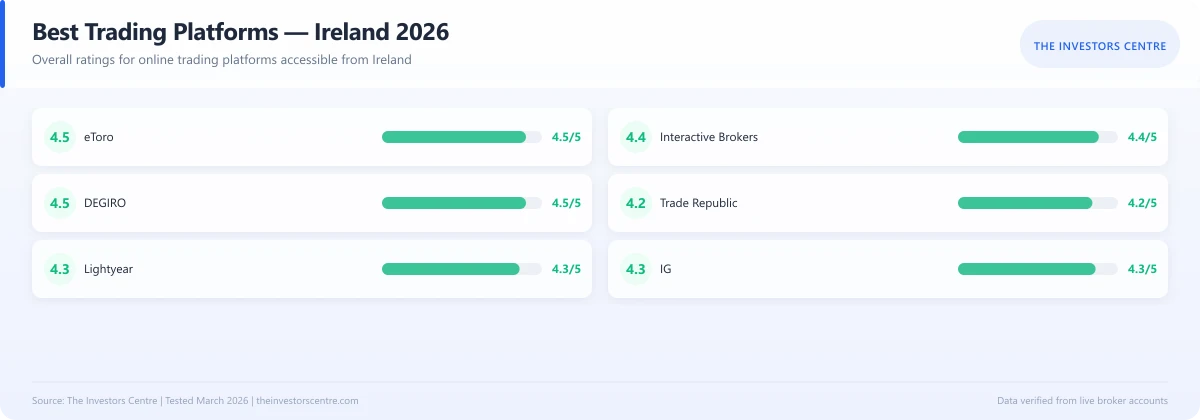
The table below provides a quick comparison of the six best trading platforms available to Irish investors in 2026. Each platform has been assessed on trading fees, minimum deposit requirements, regulatory status, and overall value.
| # | Platform | Trading Fee | Min. Deposit | Regulation | Rating |
|---|---|---|---|---|---|
| 1 | eToro | 0% stocks | €100 | CySEC (EU) | 4.5/5 |
| 2 | DEGIRO | From €1 | €0.01 | BaFin (EU) | 4.5/5 |
| 3 | Lightyear | From €1 | None | Estonian FSA | 4.3/5 |
| 4 | Interactive Brokers | From $1 | None | CBI Direct | 4.4/5 |
| 5 | Trade Republic | €1 flat | None | BaFin (EU) | 4.2/5 |
| 6 | IG | Spread-based | €250 | BaFin (EU) | 4.3/5 |
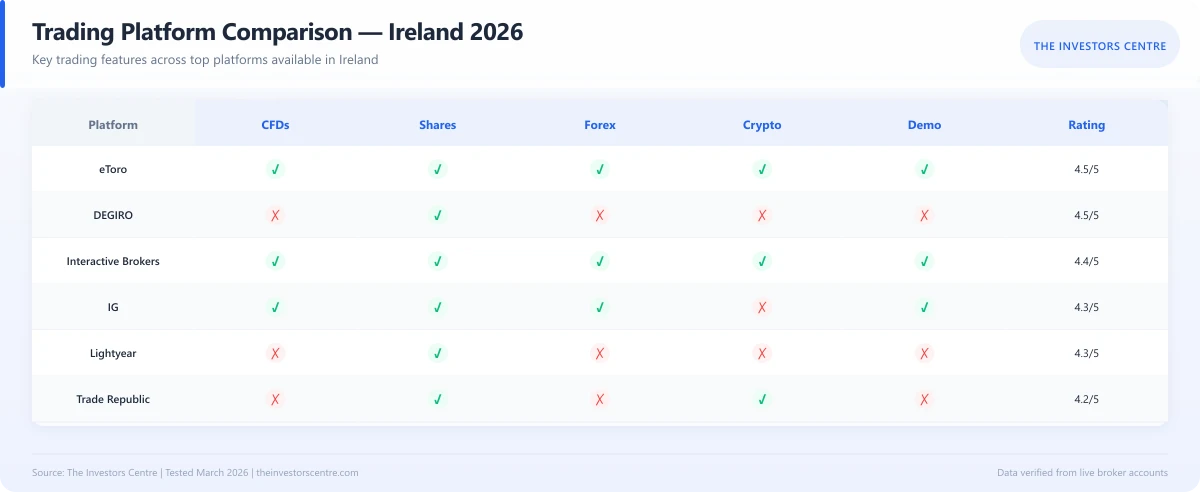
Here Are The Top 6 Trading Platforms in Ireland:
1. eToro — Best for Beginners and Social Trading
2. DEGIRO — Best for Low-Cost Investing
3. Lightyear — Best for Interest on Uninvested Cash
4. Interactive Brokers — Best for Advanced Traders
5. Trade Republic — Best for Commission-Free Trading
6. IG — Best for Spread Betting and CFDs
eToro — Best for Beginners and Social Trading
Top Pick for Beginners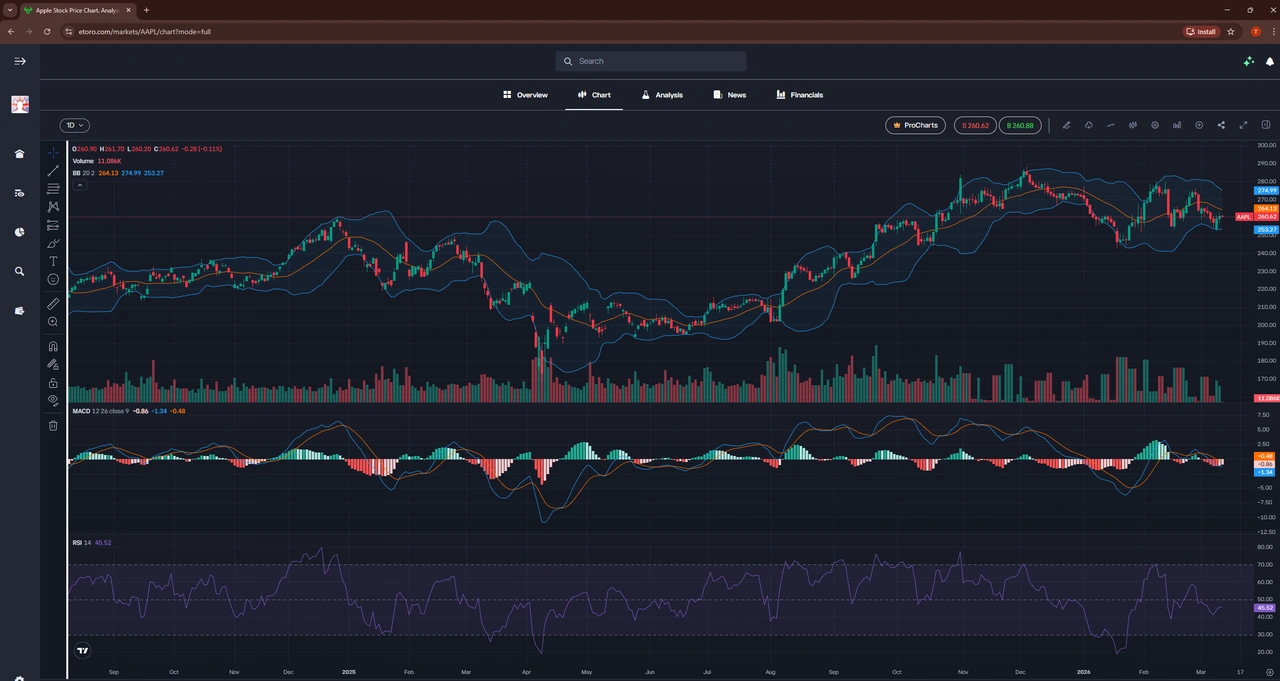
Pros
- Commission-free stock and ETF trading
- CopyTrader feature to replicate successful investors
- Over 3,000 stocks and 270 ETFs available
Cons
- High currency conversion fees of 0.75%
- EUR 5 withdrawal fee and $10 monthly inactivity fee
- No tax-efficient wrappers available for Irish investors
What Are eToro's Trading Fees?
eToro charges 0% commission on stock and ETF trades when opening buy positions. This makes it highly competitive for Irish investors building long-term portfolios. However, the platform generates revenue through spreads, which vary by asset class but are generally wider than traditional brokers.
Currency conversion is charged at 0.75%, significantly higher than competitors like Interactive Brokers (0.002%) or DEGIRO (0.25%). For those trading primarily in USD, this can represent a substantial hidden cost. A €5 withdrawal fee applies to all amounts, and accounts inactive for 12 months incur a $10 monthly charge.
What Assets Can You Trade on eToro?
eToro provides access to over 3,000 stocks across major global exchanges including the US, UK, and European markets. The platform offers 270 ETFs, covering various sectors and investment strategies. Irish investors can trade US, European, and select Asian stocks, though the selection is smaller than dedicated stock brokers like Interactive Brokers.
Beyond stocks, eToro offers cryptocurrencies, commodities, forex, and indices through CFDs. This multi-asset capability suits investors wanting diverse exposure from a single platform. However, those seeking bonds or more complex derivatives should look elsewhere.
Is eToro Regulated in Ireland?
eToro (Europe) Ltd is authorised and regulated by the Cyprus Securities and Exchange Commission (CySEC) under licence number 109/10. Irish clients access services under MiFID II passporting, which permits CySEC-regulated firms to operate throughout the European Union.
Client funds are held in segregated accounts with tier-1 banks. Cypriot investor compensation covers up to €20,000 per client if the firm fails. While not directly regulated by the Central Bank of Ireland, CySEC is a recognised EU regulator with equivalent standards to Irish oversight.
How Does eToro's Social Trading Work?
eToro's CopyTrader allows you to automatically replicate the positions of experienced traders on the platform. You allocate a portion of your funds to copy another user, and your account mirrors their trades proportionally. This democratises access to investment strategies that might otherwise require significant expertise.
The social feed functions like a financial social network, where users share insights, trading ideas, and portfolio updates. While this can accelerate learning, remember that past performance doesn't guarantee future results. Irish investors should still conduct their own research before copying any trader.
DEGIRO — Best for Low-Cost Investing
Lowest Fees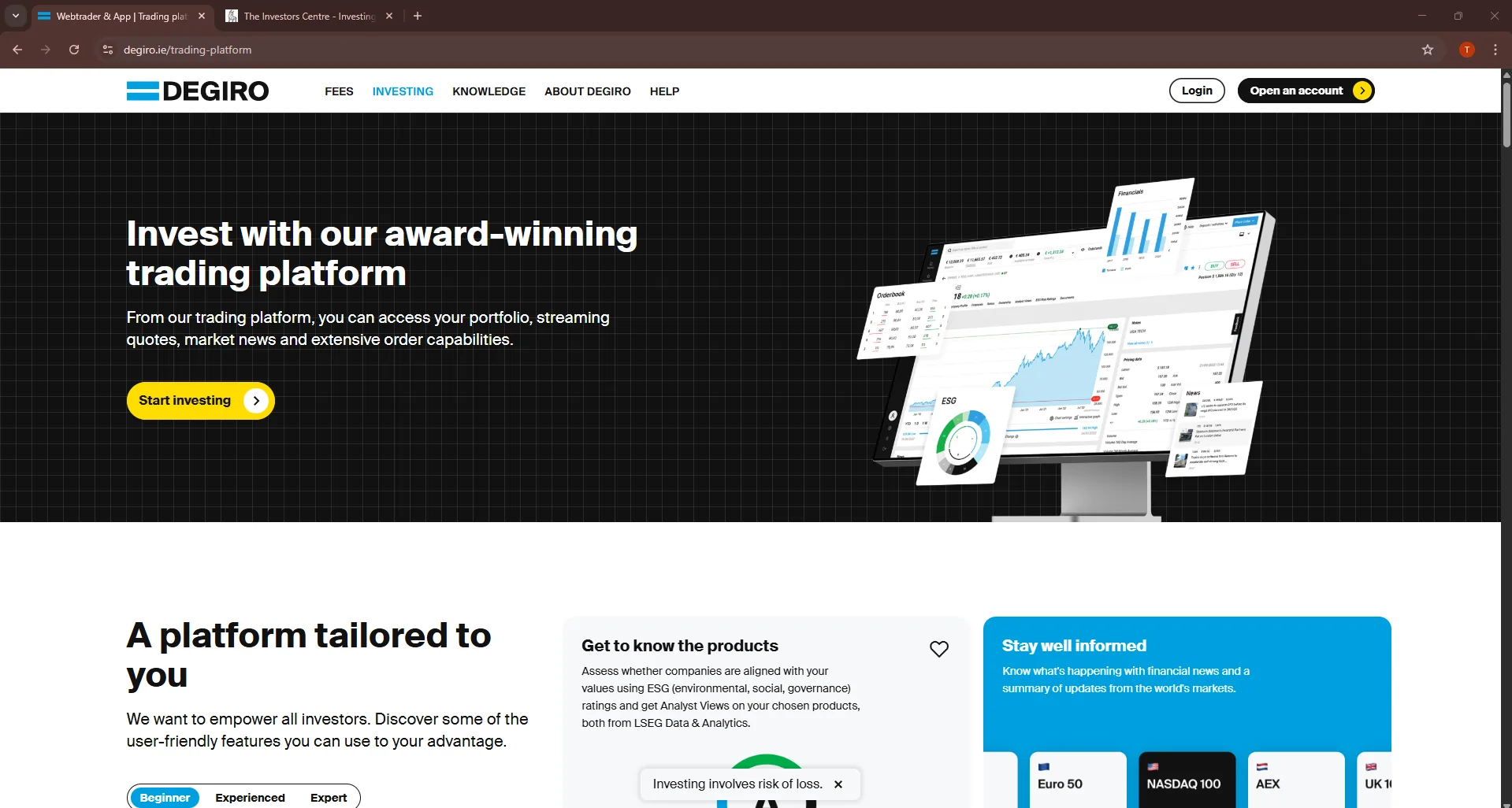
Pros
- Low trading fees starting from EUR 1 per transaction
- Access to 50+ global stock exchanges
- Over 1 million products available for trading
Cons
- EUR 2.50 annual connectivity fee per exchange
- Basic platform with limited charting tools
- Limited research and analysis resources
What Are DEGIRO's Trading Fees?
DEGIRO's fees are among the lowest in Europe. Euronext Dublin trades cost €2 plus 0.05% of transaction value. US stock trades are charged €0.50 plus $0.004 per share. German Xetra trades cost €2 plus 0.018%. These transparent, competitive rates suit frequent traders and those building positions gradually.
Currency conversion is charged at 0.25%, substantially lower than eToro (0.75%) though higher than Interactive Brokers (0.002%). Some exchanges charge a €2.50 annual connectivity fee, clearly disclosed upfront. No inactivity fees, withdrawal charges, or account maintenance costs apply, making DEGIRO excellent for buy-and-hold investors.
What Markets Can You Access Through DEGIRO?
DEGIRO provides access to over 50 exchanges worldwide, covering stocks, ETFs, bonds, options, and futures. Irish investors can trade on Euronext Dublin, the London Stock Exchange, NYSE, NASDAQ, and all major European bourses. This breadth exceeds most competitors at this price point.
The platform offers over 1 million instruments including stocks, ETFs, bonds, investment funds, and derivatives. This extensive selection suits both beginners building simple ETF portfolios and advanced traders seeking specific international exposure. Bonds and options availability sets DEGIRO apart from app-based competitors.
Is DEGIRO Regulated in Ireland?
DEGIRO Ireland Limited is a branch of flatexDEGIRO Bank Dutch Branch, which is part of flatexDEGIRO Bank AG. The bank is authorised and supervised by the German Federal Financial Supervisory Authority (BaFin). Irish operations fall under this German banking licence through MiFID II passporting.
As a German bank, DEGIRO benefits from the German deposit guarantee scheme covering up to €100,000 per client. Client assets are segregated in Special Purpose Vehicles (SPVs), providing bankruptcy-remote protection. This structure offers strong investor protections equivalent to Irish-regulated firms.
What Account Types Does DEGIRO Offer?
DEGIRO offers several account profiles: Basic, Active, Trader, and Day Trader. The Basic account suits most Irish investors, offering core trading functionality with debit money disabled. Active and Trader profiles enable margin trading and short selling, requiring more experience and carrying higher risk.
Custody accounts are also available, where securities are not lent out and margin trading is prohibited. This conservative option suits risk-averse investors wanting absolute security of holdings. Joint accounts and corporate accounts can be opened, providing flexibility for different investor structures.
Lightyear — Best for Interest on Uninvested Cash
Best Interest Rates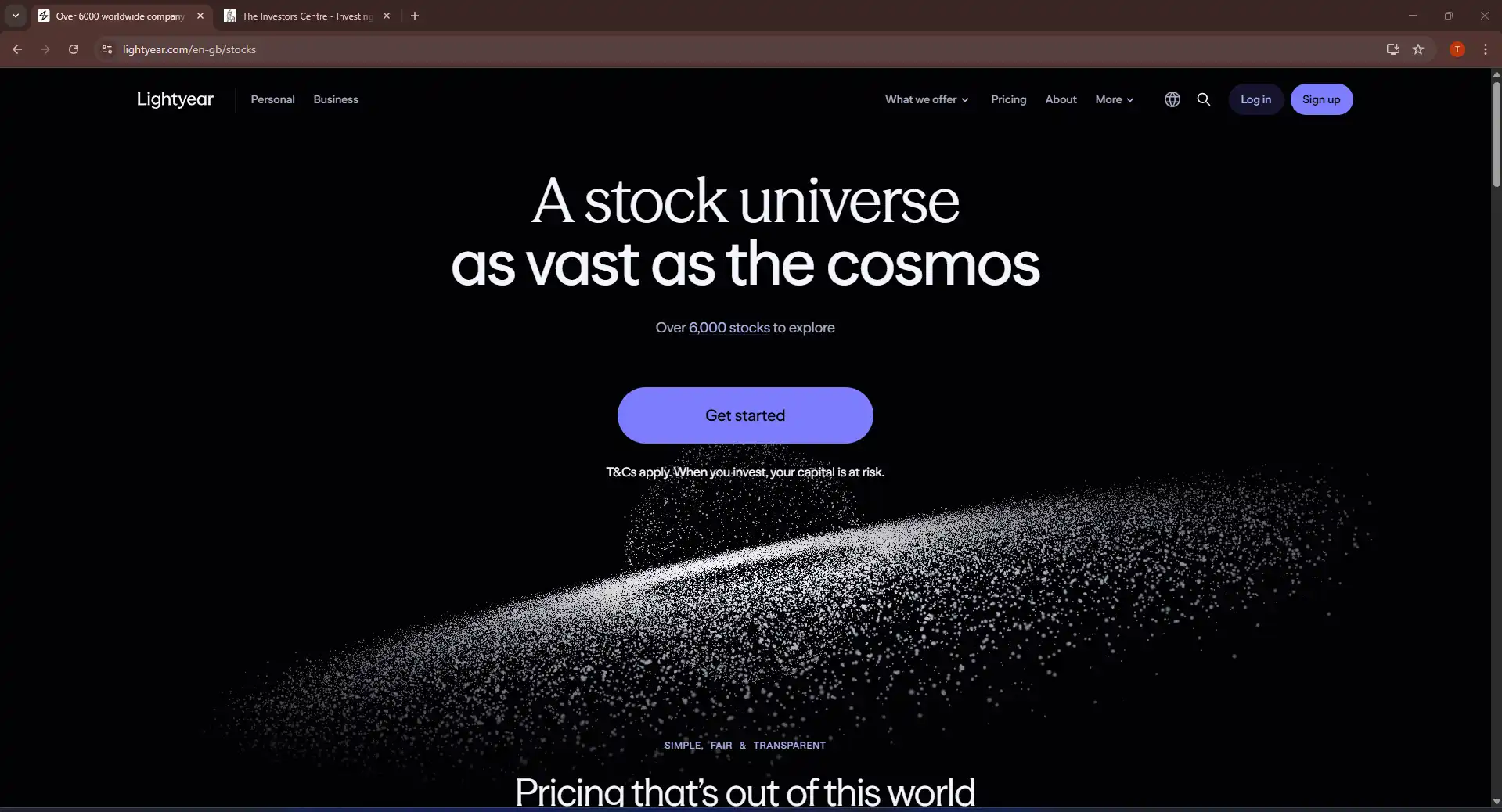
Pros
- Interest earned on uninvested cash at approximately 3.5%
- No minimum deposit required to open an account
- Clean and modern mobile app interface
Cons
- Limited to US stocks and ETFs primarily
- No access to European or Asian markets
- Basic research and analysis tools
What Are Lightyear's Trading Fees?
Lightyear charges €1 flat commission on both buy and sell orders for US stocks and ETFs. This simple, transparent structure makes cost calculation straightforward. There are no additional platform fees, account maintenance charges, or withdrawal fees, keeping total costs low.
Currency conversion between EUR and USD is charged at 0.35%, competitive against DEGIRO (0.25%) and significantly better than eToro (0.75%). The combination of low trading fees and interest on uninvested cash makes Lightyear particularly attractive for those holding reserves between trades.
How Does Lightyear's Interest Feature Work?
Lightyear pays interest on uninvested EUR balances, currently around 3.5% annually (subject to change with market rates). Interest accrues daily and is paid monthly, providing meaningful returns on cash held for trading opportunities or between investments. This rate substantially exceeds typical bank savings accounts.
The feature transforms Lightyear from a pure trading platform into a cash management tool. For Irish investors who maintain reserves for opportunistic buying or between investment cycles, this interest income partially offsets inflation and enhances overall returns. Interest is automatically credited without requiring any action.
What Markets Does Lightyear Cover?
Lightyear currently focuses exclusively on US markets, providing access to all NYSE and NASDAQ-listed stocks and ETFs. This covers approximately 6,000 securities including all major US companies and the most popular ETFs like SPY, QQQ, and VOO. The US-only approach keeps the platform simple and focused.
This limitation means no access to European stocks, UK shares, or Asian markets. Irish investors wanting diversification across geographies or preferring European equities should use DEGIRO or Interactive Brokers alongside Lightyear. The US market focus suits those primarily interested in American tech giants and index funds.
Is Lightyear Regulated in Ireland?
Lightyear Europe AS is authorised and supervised by the Estonian Financial Supervision and Resolution Authority (Finantsinspektsioon). Irish clients access services under MiFID II passporting, which permits Estonian-regulated investment firms to operate throughout the European Union.
Client funds are held in segregated accounts separate from company assets. Estonian investor compensation covers up to €20,000 per client. While newer than established brokers, Lightyear operates under equivalent EU regulatory standards to Irish-authorised firms, providing comparable investor protections.
Interactive Brokers — Best for Advanced Traders
Professional Grade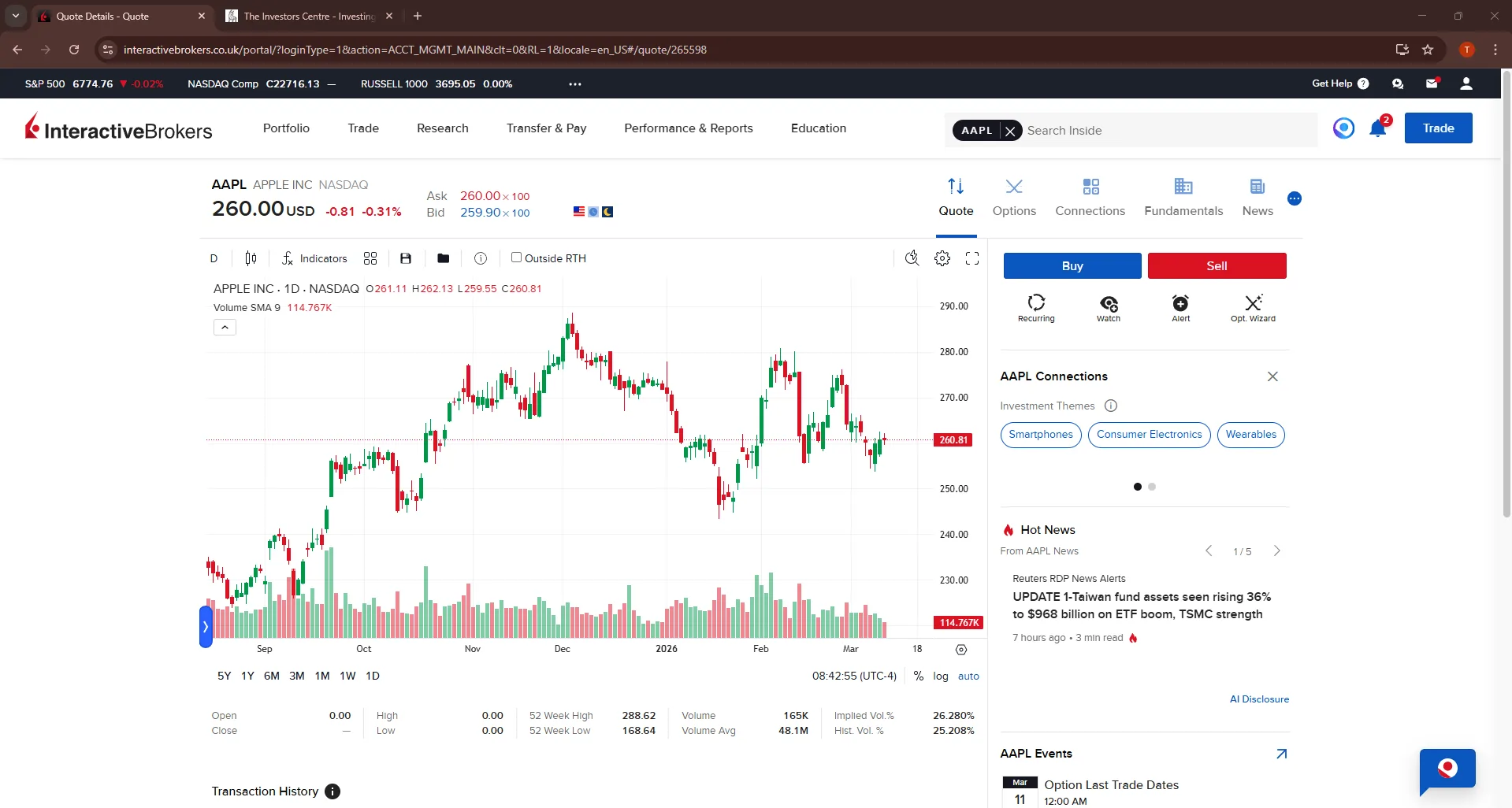
Pros
- Authorised by the Central Bank of Ireland
- Access to 150+ markets across 33 countries
- Currency conversion fees as low as 0.002%
Cons
- Complex interface not suited for beginners
- $10 monthly activity fee for smaller accounts
- Steep learning curve for the platform
What Are Interactive Brokers' Trading Fees?
Interactive Brokers offers tiered pricing: Fixed starts from $1 per US stock trade, while Tiered pricing charges $0.0035 per share with a $0.35 minimum. For most Irish investors trading in reasonable size, Tiered pricing proves cheaper. European stocks typically cost €1-4 depending on venue and value traded.
Currency conversion is charged at just 0.002%, by far the lowest among platforms reviewed. This makes IBKR ideal for trading across multiple currencies. A $10 monthly minimum activity fee applies to accounts under $100,000, though you only pay if commissions don't meet this threshold. Accounts over $100,000 pay no monthly fee.
What Markets Does Interactive Brokers Cover?
Interactive Brokers provides access to over 150 markets in 33 countries, covering stocks, ETFs, options, futures, forex, bonds, and funds. This includes all major exchanges plus many smaller regional bourses. Irish investors can trade on Euronext Dublin, LSE, NYSE, NASDAQ, Hong Kong, Tokyo, and countless others from a single account.
The sheer breadth is unmatched. Beyond equities, IBKR offers currency trading, commodities futures, listed options on numerous underlyings, and fixed income securities. This makes it suitable for diversified portfolios spanning multiple asset classes and geographies, though such breadth requires knowledge to use effectively.
What Trading Platforms Does Interactive Brokers Offer?
Trader Workstation (TWS) is IBKR's flagship platform, offering professional-grade charting, advanced order types, algorithmic trading, and portfolio analysis. The learning curve is steep but rewards serious traders with unparalleled functionality. TWS runs on Windows, Mac, Linux, and through a web browser.
IBKR Mobile provides comprehensive mobile trading with advanced order types and portfolio tracking. For beginners, IBKR GlobalTrader offers a simplified experience with basic trading functionality. The variety of platforms caters to different experience levels, though even the simplified version assumes some investment knowledge.
Is Interactive Brokers Regulated in Ireland?
Interactive Brokers Ireland Limited is authorised and regulated by the Central Bank of Ireland (CBI). This direct Irish regulation differentiates IBKR from competitors operating under EU passporting. Irish clients benefit from local regulatory supervision and recourse through Irish authorities.
The Irish Investor Compensation Scheme covers up to €20,000 per client. IBKR segregates client assets and maintains substantial capital reserves as required by regulators. As a publicly-traded company (NASDAQ: IBKR) with $10+ billion in equity capital, Interactive Brokers represents one of the most financially secure brokers available to Irish investors.
Trade Republic — Best for Commission-Free Trading
Simple & Mobile
Pros
- EUR 1 flat commission per trade
- No minimum deposit required
- Fractional shares available from EUR 1
Cons
- Limited to German and US markets primarily
- No Irish or UK stocks available
- Mobile-first platform with limited desktop features
What Are Trade Republic's Trading Fees?
Trade Republic charges a simple €1 flat fee per trade, regardless of order size. This applies to stocks, ETFs, and derivatives. There are no additional platform fees, custody charges, or account maintenance costs. Currency conversion is charged at 0.30%, competitive within the industry.
The €1 fee structure makes Trade Republic particularly attractive for investors making frequent small trades or building positions gradually. Unlike percentage-based commissions, your cost remains constant whether trading €100 or €10,000 worth of securities. No minimum deposit is required, lowering the barrier to entry for new investors.
What Products Can You Trade on Trade Republic?
Trade Republic offers access to approximately 10,000 stocks and ETFs across German and US markets. This includes all DAX, MDAX, and major US listings. While the selection is smaller than DEGIRO or Interactive Brokers, it covers the most popular investment opportunities for European retail investors.
Derivatives including knock-out certificates and factor certificates are available for more sophisticated strategies. Trade Republic also offers fractional shares, allowing investment from €1 in expensive stocks like Amazon or Tesla. This democratises access to high-priced securities for smaller investors. Cryptocurrencies including Bitcoin, Ethereum, and major altcoins can be traded 24/7 from the same app.
What Features Does Trade Republic Offer?
Savings plans allow automated recurring investments in stocks, ETFs, or crypto from €10 monthly. Over 2,500 ETFs can be added to savings plans, making regular portfolio building simple. The mobile app includes real-time push notifications for price movements, news, and corporate actions.
Trade Republic offers 2% interest on uninvested EUR balances (subject to terms and market rates). The card feature allows spending directly from your portfolio balance. These banking-adjacent features position Trade Republic as more than a pure trading platform, suitable for those wanting integrated financial management.
Is Trade Republic Regulated in Ireland?
Trade Republic Bank GmbH is authorised as a credit institution and regulated by the German Federal Financial Supervisory Authority (BaFin) and the Deutsche Bundesbank. Irish clients access services under MiFID II passporting, which permits German banks to operate throughout the European Union.
As a German bank, client deposits are covered by the German Deposit Protection Scheme up to €100,000 per customer. Securities held by Trade Republic are segregated in custody accounts, providing bankruptcy-remote protection. While a relatively new entrant (founded 2015), Trade Republic operates under robust German banking regulation equivalent to Irish oversight.
IG — Best for Spread Betting and CFDs
CFD Specialist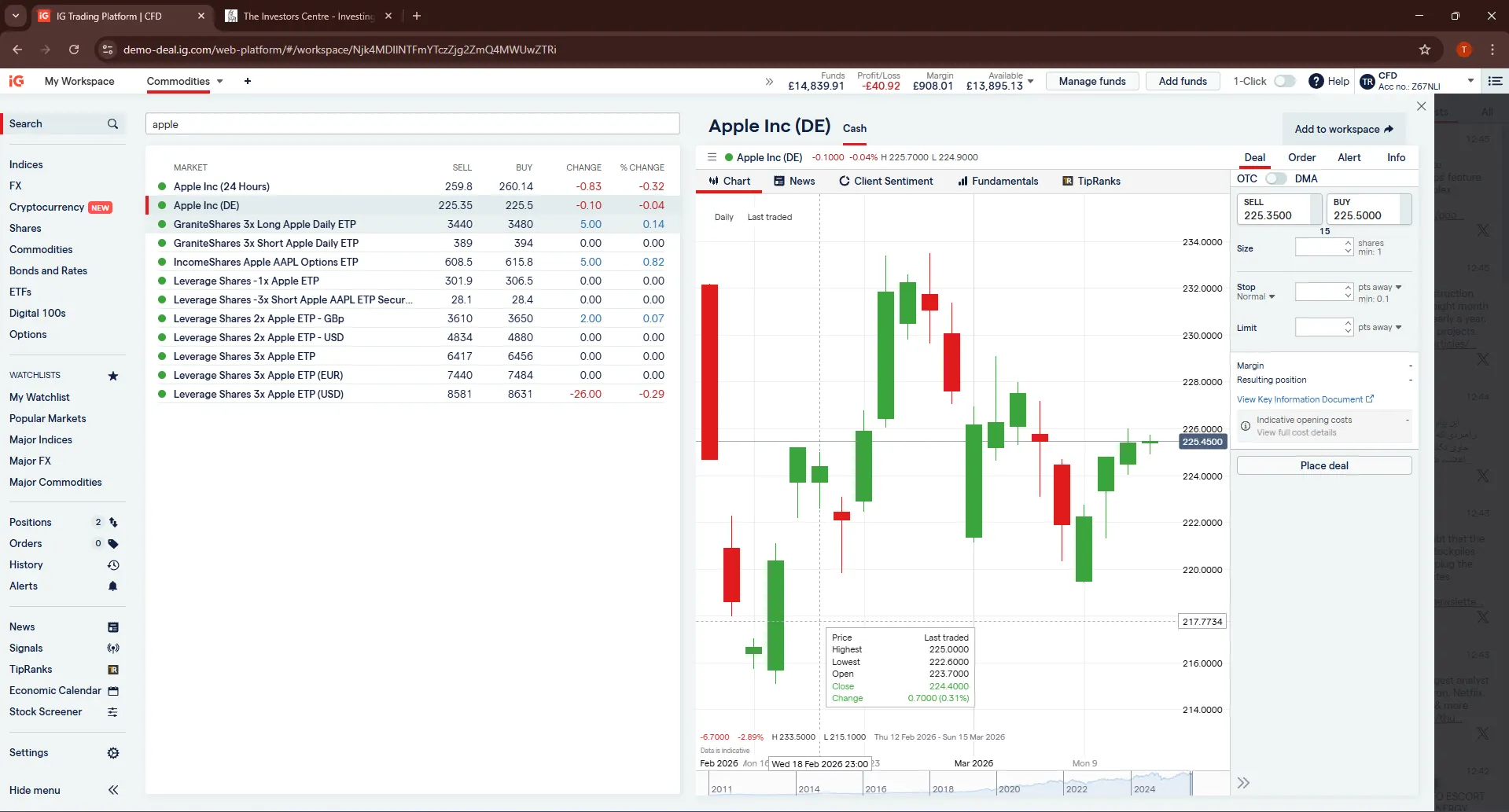
Pros
- Over 17,000 markets available for trading
- Established and trusted broker operating since 1974
- Comprehensive educational resources and analysis tools
Cons
- High CFD risk with 70% of retail accounts losing money
- EUR 250 minimum deposit required
- EUR 18 per month inactivity fee after 2 years
How Does CFD Trading Work on IG?
CFD (Contract for Difference) trading allows you to speculate on price movements without owning the underlying asset. You can profit from both rising and falling markets through long and short positions. Leverage amplifies both gains and losses, making CFDs suitable only for experienced traders who understand the risks.
IG offers CFDs on indices, shares, forex, commodities, cryptocurrencies, and more. Irish retail clients face ESMA leverage caps (30:1 max for major currency pairs, down to 2:1 for crypto). While this limits risk exposure, CFDs remain high-risk instruments. The majority of retail CFD accounts lose money, a fact IG prominently discloses.
What Markets Does IG Cover?
IG provides access to over 17,000 markets including stocks, indices, forex, commodities, cryptocurrencies, bonds, and interest rates. Coverage spans major global exchanges plus many regional markets. Irish investors can trade on Euronext Dublin, LSE, NYSE, NASDAQ, and numerous European and Asian bourses.
Beyond CFDs, IG offers share dealing accounts for owning physical stocks and ETFs. Barrier options and turbos provide alternative ways to speculate on price movements with defined risk. The breadth of instruments suits traders wanting diverse exposure from a single account, though the complexity requires knowledge to navigate effectively.
What Does Trading on IG Cost?
IG's pricing varies by instrument. CFDs are charged through spreads, which differ by asset class and market conditions. Equity CFDs on major indices typically have tight spreads but carry overnight financing charges for positions held past market close. Commission-based pricing is available for share CFDs, starting from 0.10% per trade.
Physical share dealing costs €10 per trade for Irish shares and €8 for UK shares. US shares cost $10. These fees are higher than discount brokers like DEGIRO but include comprehensive platform access. A €250 minimum deposit applies, and accounts inactive for two years incur an €18 monthly fee. Currency conversion varies by currency pair.
Is IG Regulated in Ireland?
IG Group Holdings plc is publicly listed on the London Stock Exchange. Irish clients trade through IG Europe GmbH, a German entity authorised and regulated by the German Federal Financial Supervisory Authority (BaFin). Services are provided in Ireland under MiFID II passporting.
Client funds are segregated from company capital. German investor compensation covers up to €20,000 per client. IG has operated since 1974 with a strong track record and substantial capital reserves. While not directly regulated by the Central Bank of Ireland, BaFin is a recognised EU regulator with equivalent standards to Irish oversight.
What Should Irish Investors Consider When Choosing a Trading Platform?
Beyond fees and available assets, Irish investors should understand the regulatory framework protecting their investments and what happens if a platform fails. The European regulatory environment provides meaningful protections, but coverage varies between providers.
How Are Trading Platforms Regulated in Ireland?
Trading platforms serving Irish investors operate under two main arrangements. Some, like Interactive Brokers Ireland, hold direct authorisation from the Central Bank of Ireland. Most others operate under MiFID II passporting, where authorisation from another EU regulator permits them to serve Irish clients.
Both arrangements provide legitimate regulatory oversight and client protections. However, directly CBI-authorised firms fall under Irish regulatory supervision, while passported firms are primarily supervised by their home regulator. You can verify any platform's regulatory status through the Central Bank of Ireland's register at registers.centralbank.ie.
MiFID II requires all regulated investment firms to segregate client assets from company funds, provide clear fee disclosure, and meet minimum capital requirements. These protections apply regardless of which EU member state provides the authorisation.
What Is the Investor Compensation Scheme?
The Investor Compensation Scheme provides a safety net if an authorised investment firm fails and cannot return client assets. In Ireland, the scheme is administered by the Investor Compensation Company DAC and covers up to 90% of an investor's loss, with a maximum payout of €20,000 per person.
This protection applies to firms directly authorised by the Central Bank of Ireland. For platforms operating under EU passporting, equivalent home-country schemes apply, typically also providing €20,000 maximum coverage. The scheme does not cover losses from poor investment decisions or market movements, only situations where the firm itself fails.
Investors with larger portfolios should consider spreading funds across multiple platforms to maximise protection coverage, or prioritise platforms with strong capital positions and established track records.
How Is Trading Taxed in Ireland?
Understanding tax implications is essential for Irish investors, as the tax treatment varies significantly depending on what you trade. The main taxes affecting traders are Capital Gains Tax on shares and Exit Tax on certain funds, each with different rates and rules.
What Is Capital Gains Tax on Shares?
When you sell shares for a profit in Ireland, Capital Gains Tax applies at 33% on the gain. You receive an annual exemption of €1,270, meaning the first €1,270 of gains each tax year is tax-free. Losses can be offset against gains, reducing your overall liability.
CGT payment deadlines depend on when you sell. For disposals between January and November, tax is due by 15 December of the same year. December disposals are payable by 31 January the following year. You must file a return by 31 October of the year after disposal, even if no tax is due.
Stamp duty also applies when buying shares: 1% on Irish shares and 0.5% on UK shares. US shares do not attract stamp duty, making them marginally more cost-effective to trade from a tax perspective.
How Are ETFs Taxed Differently?
Irish and EU-domiciled ETFs fall under a different tax regime called Exit Tax, currently charged at 38% (reduced from 41% in January 2026). Unlike CGT, you cannot offset losses against gains, and there is no annual exemption.
The deemed disposal rule requires you to pay tax on unrealised gains every eight years, even if you have not sold. This means long-term ETF investors face periodic tax bills on paper profits, which can impact compounding returns over time. The complexity of this regime leads some Irish investors to favour direct share ownership or investment trusts taxed under the standard CGT rules.
Given these complexities, consulting a tax advisor before making significant investment decisions is advisable. For those interested in cryptocurrency trading in Ireland, separate tax rules apply with crypto treated as a chargeable asset subject to 33% CGT.
Final Thoughts
The best trading platform for you depends on your experience level, investment goals, and how much you plan to trade. eToro offers the most accessible entry point for beginners with its commission-free stocks and social features, while DEGIRO and Lightyear provide excellent value for cost-conscious investors building long-term portfolios.
For those seeking professional-grade tools and the assurance of direct Central Bank of Ireland oversight, Interactive Brokers stands out despite its steeper learning curve. Active traders interested in spread betting should consider IG, while Trade Republic serves mobile-first investors wanting simple access to US and German markets.
Whichever platform you choose, verify its regulatory status, understand the fee structure fully, and consider how Irish tax rules will affect your specific investment approach. Starting with a smaller amount to test a platform before committing significant capital is always sensible.
FAQs
Sources
- Central Bank of Ireland. "Register of Authorised Firms." 2026.
- Revenue Commissioners. "Capital Gains Tax." 2026.
- Investor Compensation Company DAC. "Scope of Compensation Coverage." 2026.
- Competition and Consumer Protection Commission. "ICS Protection." 2026.
- Citizens Information. "Capital Gains Tax." 2026.
- Revenue Commissioners. "Taxation of ETFs in Ireland." 2026.
- Interactive Brokers Ireland. "Client Protection." 2026.
- European Securities and Markets Authority. "MiFID II." 2026.