
- Expertise:
- CFD Trading, Forex, Derivatives, Risk Management
- Credentials:
- Chartered ACII (2018) · Trading since 2012
- Tested:
- 40+ forex & CFD platforms with live accounts

- Expertise:
- Platform Testing, Cryptocurrency, Retail Investing
- Credentials:
- Active investor since 2013 · 11+ years experience
- Tested:
- 50+ platforms · 200+ guides authored
How We Test
Real accounts. Real money. Real trades. No demo accounts or press releases.
What we measure:
- Spreads vs advertised rates
- Execution speed and slippage
- Hidden fees (overnight, withdrawal, conversion)
- Actual withdrawal times
Scoring:
Fees (25%) · Platform (20%) · Assets (15%) · Mobile (15%) · Tools (10%) · Support (10%) · Regulation (5%)
Testing team:
Adam Woodhead (investing since 2013), Thomas Drury (Chartered ACII, 2018), Dom Farnell (investing since 2013) — 50+ platforms with funded accounts
Quarterly reviews · Corrections: [email protected]
Disclaimer
Not financial advice. Educational content only. We're not FCA authorised. Consult a qualified advisor before investing.
Capital at risk. Investments can fall. Past performance doesn't guarantee future results.
CFD warning. 67-84% of retail accounts lose money trading CFDs. High risk due to leverage.
Contact: [email protected]
Which forex pairs do Australian traders actually trade?
AUD/USD first, by a distance, because it is the one major pair that moves twice on an Australian clock: once in the Asian session on RBA and China news, and again overnight on US data. Around it sit AUD/JPY, the region's risk barometer, AUD/NZD, the slow-moving trans-Tasman cross, and EUR/AUD, the trending cross with the wider spread, before you get to the global majors, which from Australia are evening and night markets. This guide covers when each pair actually moves in AEST and what trading them costs at Pepperstone, verified AUD-first: Standard account spreads from 1.0 pip with no commission, or Razor raw spreads from 0.0 pips plus AUD $3.50 per side on MT4 and MT5 with an AUD-denominated account. It is a pairs-and-sessions guide; the broker's forex offering itself is reviewed separately.
 Top Rated
Trading CFDs and FX carries significant risk and is not suitable for everyone. You have no interest in the underlying asset.
Why is AUD/USD the home pair?
Because it is the only major pair whose two engines both run while an Australian is awake for at least one of them. Most currency pairs have one home session; AUD/USD has a working day and a working night.
The daytime engine: the Asian session
The Australian dollar prices Australian news in Australian hours. RBA rate decisions land at 2:30pm AEST, the quarterly inflation prints and monthly labour data arrive at 11:30am AEST, and because the currency trades partly as a proxy for Chinese demand for Australian exports, Chinese data releases late morning AEST move it too. This is the session where an Australian trader has a genuine home advantage: the news breaks in your afternoon, not at 3am.
The overnight engine: US data
The other half of the pair is the US dollar, and its news lands in the AEST night: the monthly US jobs report at 10:30pm or 11:30pm AEST depending on daylight saving, and Federal Reserve decisions at around 4am or 5am AEST. The practical consequence is that AUD/USD positions held through the night are exposed to the pair's biggest scheduled moves, which is an argument for either watching the calendar closely or being deliberately flat through the releases that matter.
What do the other AUD crosses offer?
Three crosses, three quite different personalities, and knowing which is which matters more than any indicator.
AUD/JPY: the risk barometer
AUD/JPY pairs a commodity currency against the classic funding currency, which makes it the cross that amplifies risk sentiment: it tends to climb steadily when equity markets are calm and drop hard when they are not. It moves well in the Asian session, since both economies report in it, and it is the least forgiving of the AUD crosses in a risk-off week.
AUD/NZD: the trans-Tasman range
Two economies this similar rarely diverge for long, so AUD/NZD spends most of its life inside a range, with its sharpest moves clustered around the days the RBA and RBNZ diverge on rates. It is the cross for traders who prefer mean-reversion to momentum, with the caveat that when the range does break, it is usually because one central bank genuinely changed course.
EUR/AUD: the trending cross
EUR/AUD links two currencies whose economies barely overlap, which is why it produces long, persistent trends that the tighter crosses rarely manage. The price of admission is a wider spread than AUD/USD and a market that does most of its moving in the European hours, from around 5pm AEST onwards.
How do the majors look from an Australian clock?
EUR/USD, GBP/USD and USD/JPY are the world's most liquid pairs, and from Australia they are evening markets. London opens at around 5pm to 6pm AEST depending on the time of year, the London and New York overlap, the deepest liquidity of the 24-hour day, runs roughly 10:30pm to 2am AEST, and by an Australian breakfast the main session is done. That is not a reason to avoid them, spreads on EUR/USD are at their tightest of any pair, but it does mean the majors demand either an evening trading routine or a style that sets orders and walks away. USD/JPY is the partial exception: Tokyo gives it a genuine Asian-session life, which is why it pairs naturally with AUD/USD in an Australian-hours watchlist.
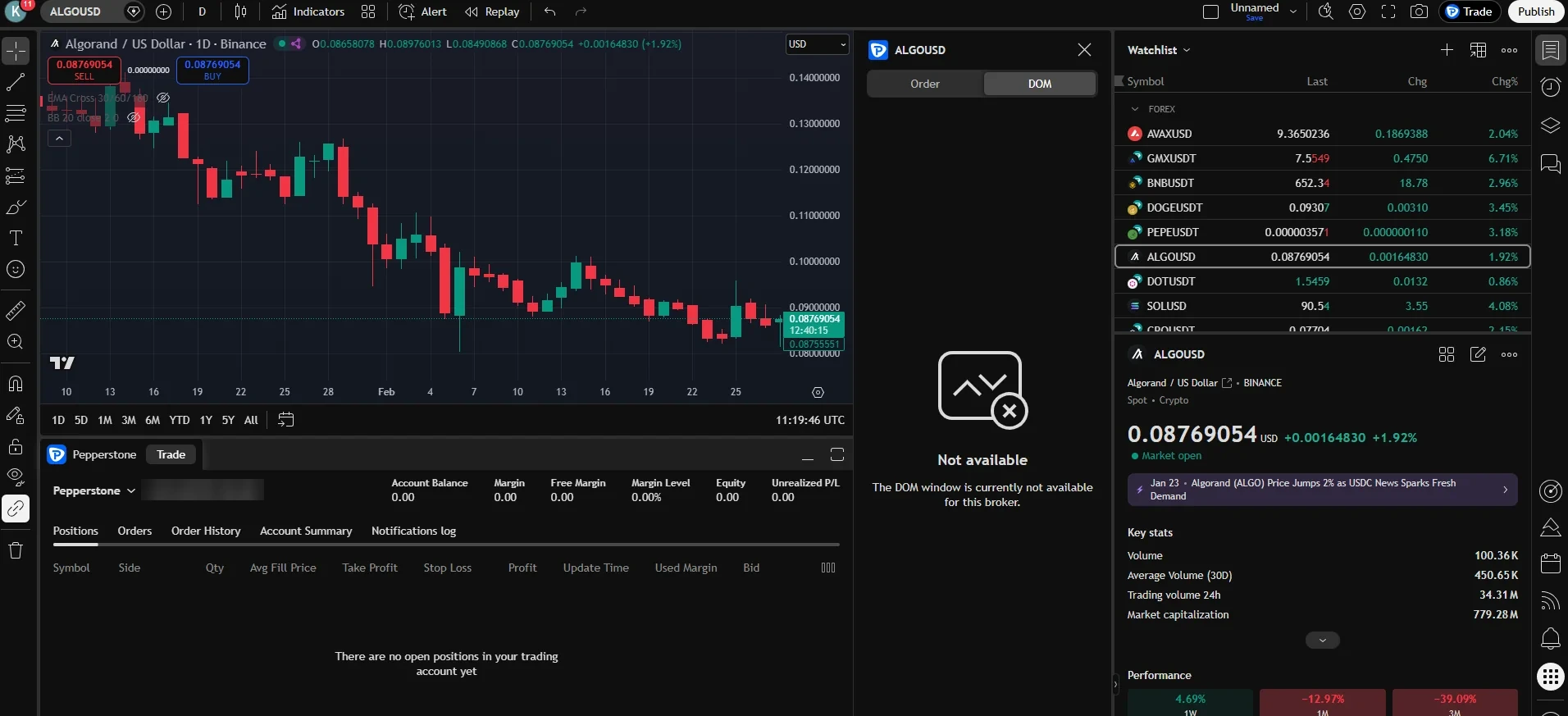
What does trading these pairs cost at Pepperstone?
Two account types, and the arithmetic is simple once the commissions are stated AUD-first, which Pepperstone's Australian pricing helpfully is.
Spreads and commission, in AUD
The Standard account builds the cost into the spread, from 1.0 pip on the majors, with no commission. The Razor account quotes raw spreads from 0.0 pips and charges commission instead: on MT4 and MT5 with an AUD-denominated account that is AUD $3.50 per side, AUD $7.00 per round turn per lot; on cTrader it is USD $6.00 per round turn, on TradingView USD $7.00 per round turn, and on Pepperstone's own web and mobile platform USD $3.50 per side, all converted to your account currency at the spot rate where they are not already in it. Verified against Pepperstone's Australian pricing page on 18 August 2026. For the raw spread itself, Pepperstone publishes minimums rather than averages: AUD/USD on Razor is quoted from 0.0 pips, and the number to trust is the live spread the order ticket shows before you deal. As with any pair, the spread is generally at its best when liquidity is deepest, which for AUD/USD means the London and New York overlap covered above.
Execution, platforms and the CFD leverage cap
Pepperstone's own published figures quote execution speeds from 50 milliseconds and a 99.59% fill rate, checked 18 August 2026, which is the class of plumbing that matters if your style is short-term. The pairs on this page trade on MT4, MT5, cTrader, TradingView and Pepperstone's own web and mobile platform, so the session analysis above applies whichever screen you prefer. Under ASIC's rules, the CFD leverage cap for retail clients is 30:1 on major FX pairs, including AUD/USD, and 20:1 on minor FX pairs, which includes crosses like AUD/NZD; the full asset-class table and what each cap means in margin terms is in my guide to CFD leverage in Australia.
How is this guide different from our Pepperstone forex review?
Deliberately different jobs: this page is a pairs-and-sessions guide, which pairs move when on an Australian clock and what each costs to trade, while my Pepperstone forex review covers the broker's offering itself, the full pair count, account types, platforms and how the pricing compares with rivals. Read this one to decide what to trade and when; read that one to decide whether Pepperstone is the right venue. If the answer is yes, the account process, including the appropriateness assessment ASIC requires at onboarding, is walked through in my guide to opening a Pepperstone account, and if your style is intraday, the session logic above feeds straight into my day trading guide.
How this guide was researched
I am UK-based, so the pricing here is document work, done rigorously and dated: Pepperstone's Australian pricing and forex pages and the ASIC CFD leverage cap schedule, verified 11 August 2026 and re-checked against Pepperstone's current pages on 18 August 2026. The session behaviour is the part that transfers directly from first-hand experience: I trade these pairs on Pepperstone's UK platforms, and a pair's liquidity clock is a property of the global market, not of the entity you trade it through, so the AEST session mapping above is the same market I watch from the other end of the day. Spread figures are Pepperstone's published minimums rather than my own samples; a dated live reading through the overlap can be added when one is taken.
Frequently Asked Questions
References
- Pepperstone: Australian pricing (spreads and Razor commission)
- Pepperstone: forex markets (pairs and execution statistics)
- Pepperstone: ASIC retail CFD leverage limits
- Reserve Bank of Australia: announcement schedule (AEST release times)
Trading CFDs and FX carries significant risk and is not suitable for everyone. You have no interest in the underlying asset.