
- Expertise:
- CFD Trading, Forex, Derivatives, Risk Management
- Credentials:
- Chartered ACII (2018) · Trading since 2012
- Tested:
- 40+ forex & CFD platforms with live accounts

- Expertise:
- Platform Testing, Cryptocurrency, Retail Investing
- Credentials:
- Active investor since 2013 · 11+ years experience
- Tested:
- 50+ platforms · 200+ guides authored
How We Test
Real accounts. Real money. Real trades. No demo accounts or press releases.
What we measure:
- Spreads vs advertised rates
- Execution speed and slippage
- Hidden fees (overnight, withdrawal, conversion)
- Actual withdrawal times
Scoring:
Fees (25%) · Platform (20%) · Assets (15%) · Mobile (15%) · Tools (10%) · Support (10%) · Regulation (5%)
Testing team:
Adam Woodhead (investing since 2013), Thomas Drury (Chartered ACII, 2018), Dom Farnell (investing since 2013) — 50+ platforms with funded accounts
Quarterly reviews · Corrections: [email protected]
Disclaimer
Not financial advice. Educational content only. We're not FCA authorised. Consult a qualified advisor before investing.
Capital at risk. Investments can fall. Past performance doesn't guarantee future results.
CFD warning. 67-84% of retail accounts lose money trading CFDs. High risk due to leverage.
Contact: [email protected]
What are tokenised stocks on Pepperstone Crypto, in one paragraph?
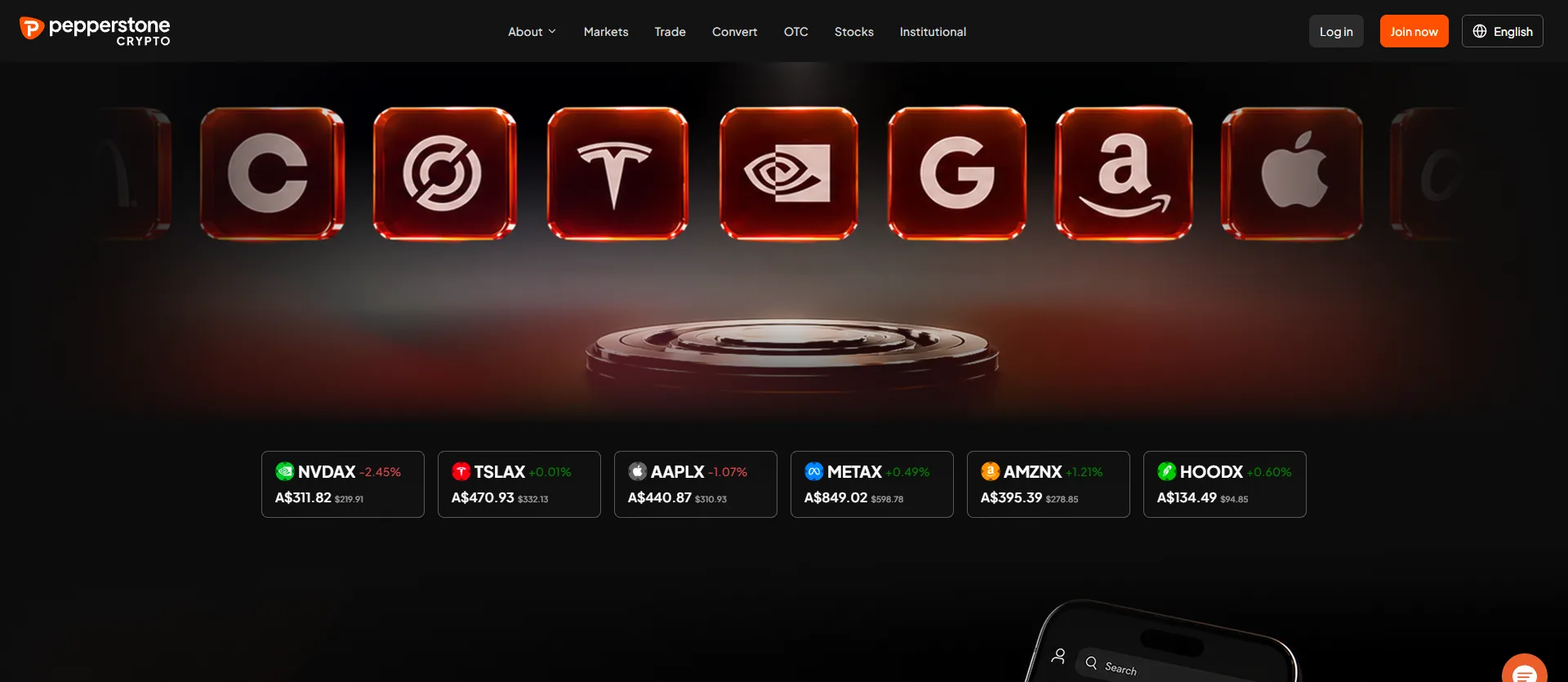
Tokenised stocks are crypto tokens on pcrypto.com that track the price of big listed US names, Nvidia, Tesla and Apple among them, priced in AUD and tradeable around the clock from the same app as the coin range. You are buying the price movement, not the share: no place on the share register, no voting rights, and no dividend entitlement stated as at my August 2026 check. The cost model is clean, no commission on the buy or sell with the whole cost in a spread shown before you confirm, and the product runs under Pepperstone Digital's AUSTRAC registration rather than an ASIC financial services licence, which is the most important paragraph on this page. This guide covers what the tokens are, what they cost, when they trade and how they differ from the group's share CFDs.
 Spot Crypto Exchange
Digital Assets are highly volatile. You may lose some or all of your investment. Please ensure you understand and accept the risks.
What exactly is a tokenised stock?
A tokenised stock is a crypto token engineered to track the market price of a listed share. Pepperstone's own framing is exact, "exposure to the price, not the share itself", and every practical consequence flows from that sentence.
What you are actually holding
When you buy the Nvidia token on pcrypto, you hold a token in your exchange account whose value moves with Nvidia's share price, converted into AUD. The token sits on the exchange like any coin balance. You do not need a US brokerage account, you do not convert AUD into US dollars first, and you can deal in the small fractional amounts crypto platforms are built for.
What you are not holding
You are not a shareholder. The product page is candid that a token holder has the price movement rather than a place on the share register, so there are no voting rights, and no dividend entitlement is stated anywhere on the product page as at my 11 August 2026 check. Unless Pepperstone states otherwise in the token's own documentation, the working assumption should be that dividends and corporate actions belong to whoever holds the underlying shares, not to you. If a dividend matters to your reason for owning a name, this is the wrong wrapper and a real shareholding is the right one.
Which names can you actually trade?
The line-up reads like a list of the stocks Australians actually ask about: Nvidia, Tesla, Apple, Meta, Amazon, Microsoft and Coinbase were all live when I checked the product page on 11 August 2026, alongside a token tracking the big S&P 500 ETF for anyone who wants the index rather than a single name. The tokens carry their own tickers, NVDAX for the Nvidia token and TSLAX for Tesla, so they are easy to tell apart from the underlying shares. I am deliberately not printing a count: pcrypto has added listings quickly all year and any number written here would be stale within weeks, so check the live page for what is tradeable today.

What do tokenised stocks cost to trade?
Differently from the rest of the platform, and in the buyer's favour on the visible line items.
No commission, spread only, through Convert
Tokenised stock trades run through pcrypto's Convert flow, and the product page states there are no trading fees to buy or sell: the entire cost sits in the spread, which is baked into the price shown before you confirm, with nothing added afterwards. That makes the quoted price the all-in price, which is genuinely rare in retail markets, and it also means the spread is the number to watch, because it is the only cost there is. It will not be identical at every hour of the day, and the sensible habit is to glance at the Convert preview before committing rather than assuming the spread you saw last week.
How that compares with the coin side
Standard coin trading on pcrypto carries a flat 0.1% commission plus spread, so the stock tokens are on a different, simpler schedule, checked 11 August 2026 and worth re-verifying because fee models on young products move. My full review of the platform's fees, funding rails and custody is the Pepperstone Crypto review.
When can you trade them?
The headline pitch is around-the-clock access, and it deserves both the headline and a caveat. The product page advertises the tokens as tradeable 24/7 from the app, which matters on an Australian clock: the New York session runs through the middle of the AEST night, so a conventional US share trade from Australia either happens at midnight or waits for a market that moved without you. The caveat is that the underlying share only trades during US market hours, so outside them the token's price comes from the token market rather than a live exchange tape: expect the spread to be at its best while the US market is open, and treat weekend prices with a little more care. That is a general property of tokenised assets rather than a criticism of this product, but it belongs in any honest guide.
Who holds the tokens, and under what rulebook?
This is the paragraph to read twice. Tokenised stocks live on pcrypto.com, operated by Pepperstone Digital Pty Limited (ACN 683 263 836), registered with AUSTRAC as a digital currency exchange, registration 100889269. It is not an Australian Financial Services Licence holder, and the tokens are not a product of Pepperstone's ASIC-licensed CFD business, so the protections attached to that business do not carry over: same corporate group, different rulebook. AUSTRAC registration is an anti-money-laundering regime, not an investor-protection licence, it is the same basis every Australian spot crypto exchange operates on, and nothing on the platform is covered by the Financial Claims Scheme. Your tokens sit in your account on the exchange, a claim on the operator's custody arrangements as with any centralised exchange. Whether stock tokens can be withdrawn on-chain is not stated on the product page as at 11 August 2026, so I make no claim either way; ask support before assuming the coin-side withdrawal feature extends to them.
How do tokenised stocks differ from Pepperstone's share CFDs and the SPCX perp?
The Pepperstone group now offers three quite different ways to hold a view on a company, and confusing them is easy because the names on the screen look the same.
The three wrappers, side by side
A share CFD, on Pepperstone's ASIC-regulated brokerage side, is a derivative contract with the broker that trades during market hours and lives under the CFD rulebook, with its own costs and protections. A tokenised stock is a spot asset on the AUSTRAC-registered exchange side: you buy the token outright with your AUD balance, hold it like a coin, and can trade it around the clock. And the SPCX perp, covered in my guide to trading SpaceX exposure on pcrypto, points the same token machinery at a company with no listed share at all. The mechanics of the CFD-versus-spot decision, which costs bite when, and why holding period is the real decider, are worked through in my crypto CFDs vs spot comparison, and the logic transfers directly to stock tokens.
Which wrapper fits which job
For owning the share itself, with the register entry and any dividends, none of the three fits: that is a stockbroking account's job. For price exposure in AUD with small ticket sizes and no market-hours constraint, the token is the purpose-built tool; the CFD suits the shorter tactical trade on the regulated brokerage side, and the differences in protection between the two sides should weigh at least as much as the differences in cost.
How are tokenised stocks taxed in Australia?
As crypto assets, not as shares and not as CFDs. The ATO treats the disposal of a crypto token as a capital gains tax event, so selling a stock token, or swapping it for another token, crystallises a gain or loss under the CGT rules, with the usual discount considerations for longer holds. One line of care with our other tax guide: my page on CFD trading tax in Australia covers the CFD side, which is generally treated on revenue account, whereas tokens are spot crypto and generally fall under CGT, so do not carry conclusions from one wrapper to the other. Records matter, every trade with its AUD value at the time, and specific situations belong with a registered tax agent.
How this guide was researched
I am UK-based and pcrypto is geo-limited to Australia, so this is document work, done rigorously and dated: the live tokenised-stocks product page, the pcrypto fee and about pages, and the ATO's published guidance on crypto assets, all checked on 11 August 2026. This is a new product, so I have been deliberate about what the copy does not claim: no token count, no dividend statement beyond what the product page says, and no assumption about on-chain withdrawal where the page is silent.
Frequently Asked Questions
References
- Pepperstone Crypto: tokenised stocks (product, names, fees, hours, disclosures)
- Pepperstone Crypto: fees (coin-side 0.1% standard commission)
- Pepperstone Crypto: about (operator, AUSTRAC registration, custody statements)
- Australian Taxation Office: crypto asset investments (CGT treatment)
Digital Assets are highly volatile. You may lose some or all of your investment. Please ensure you understand and accept the risks.