What is an SA302, in one paragraph?
An SA302 is HMRC's tax calculation for one tax year: the income you declared through Self Assessment and the tax due on it. Mortgage lenders use it to verify self-employed income, and you can download up to four years of them free from your HMRC online account, usually alongside a tax year overview.
Why you are reading this
Nobody googles this form for fun. You are here because a lender or broker has asked for one, so here is what they are actually asking for, how to get it in ten minutes, and the cases where this document quietly undersells what you earn.
What is an SA302?
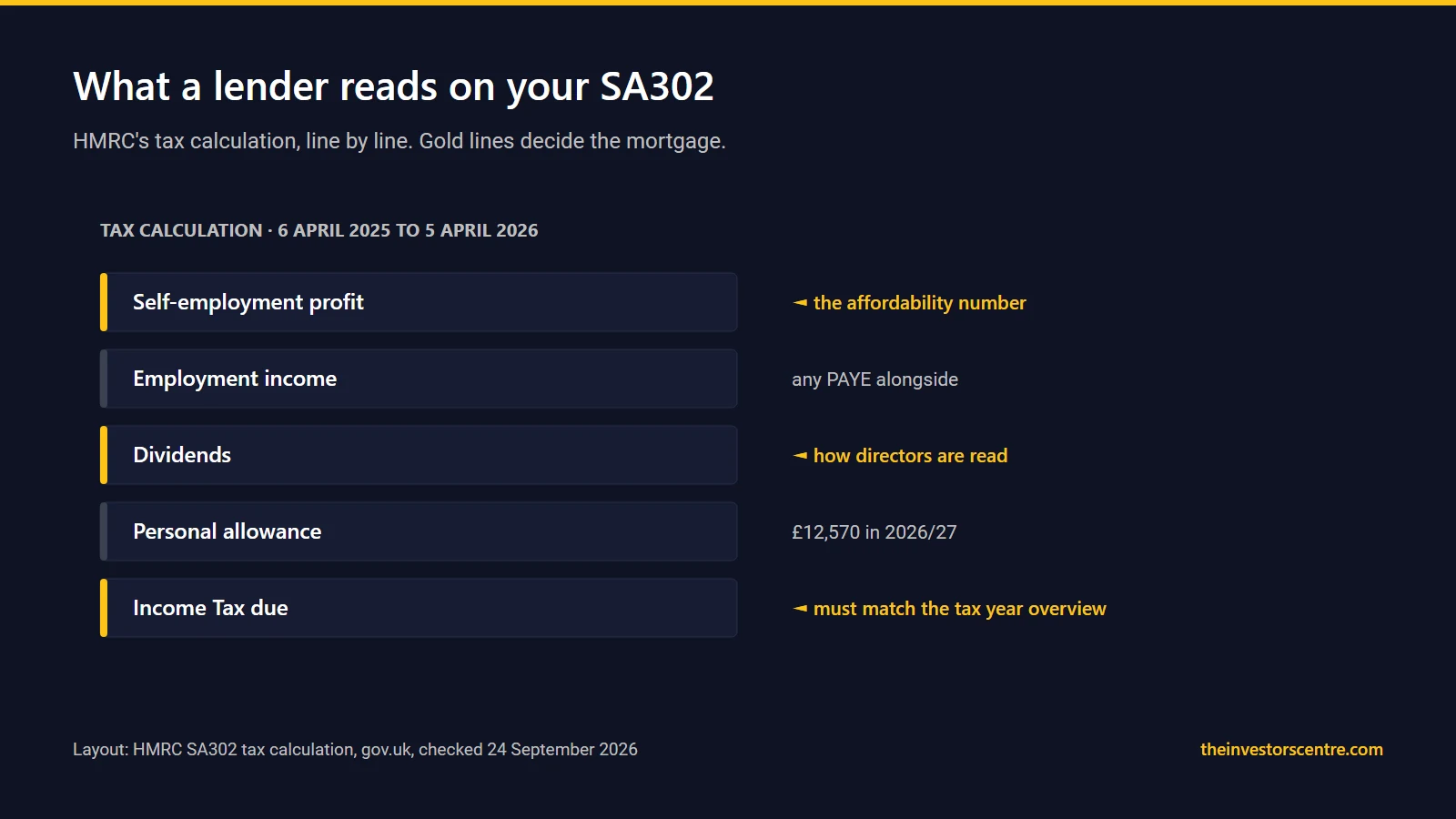
It is the official summary of one year's Self Assessment: your income by type (self-employment, employment, dividends, property, interest), the allowances applied, and the tax calculated. HMRC calls the on-screen version a "tax calculation"; SA302 is the old paper form's name, and lenders still use it.
The important property is that it is HMRC's record, not yours. Anyone can type numbers into a spreadsheet. An SA302 shows what you declared and are being taxed on, so lenders treat it as the ground truth of self-employed income. I file Self Assessment every year as a company director, and this one page is what makes my income real to anyone official.
Is an SA302 the same as a tax year overview?
No, and lenders usually want both because each proves a different thing.
| Document | What it proves | Where it comes from |
|---|---|---|
| SA302 / tax calculation | What income you declared and what tax was due | Your Self Assessment return |
| Tax year overview | What tax HMRC actually recorded and you paid | HMRC's own account records |
The pair has to agree. A lender cross-checks the tax due on the SA302 against the tax shown on the overview, and a mismatch stalls an application faster than a small income does.
How do you get your SA302 from HMRC?
Online, free, about ten minutes:
- Sign in to your HMRC online account at gov.uk.
- Go to Self Assessment, then the tax year you need.
- Select "Get your SA302 tax calculation" and print or save the PDF.
- Download the matching tax year overview from the same account.
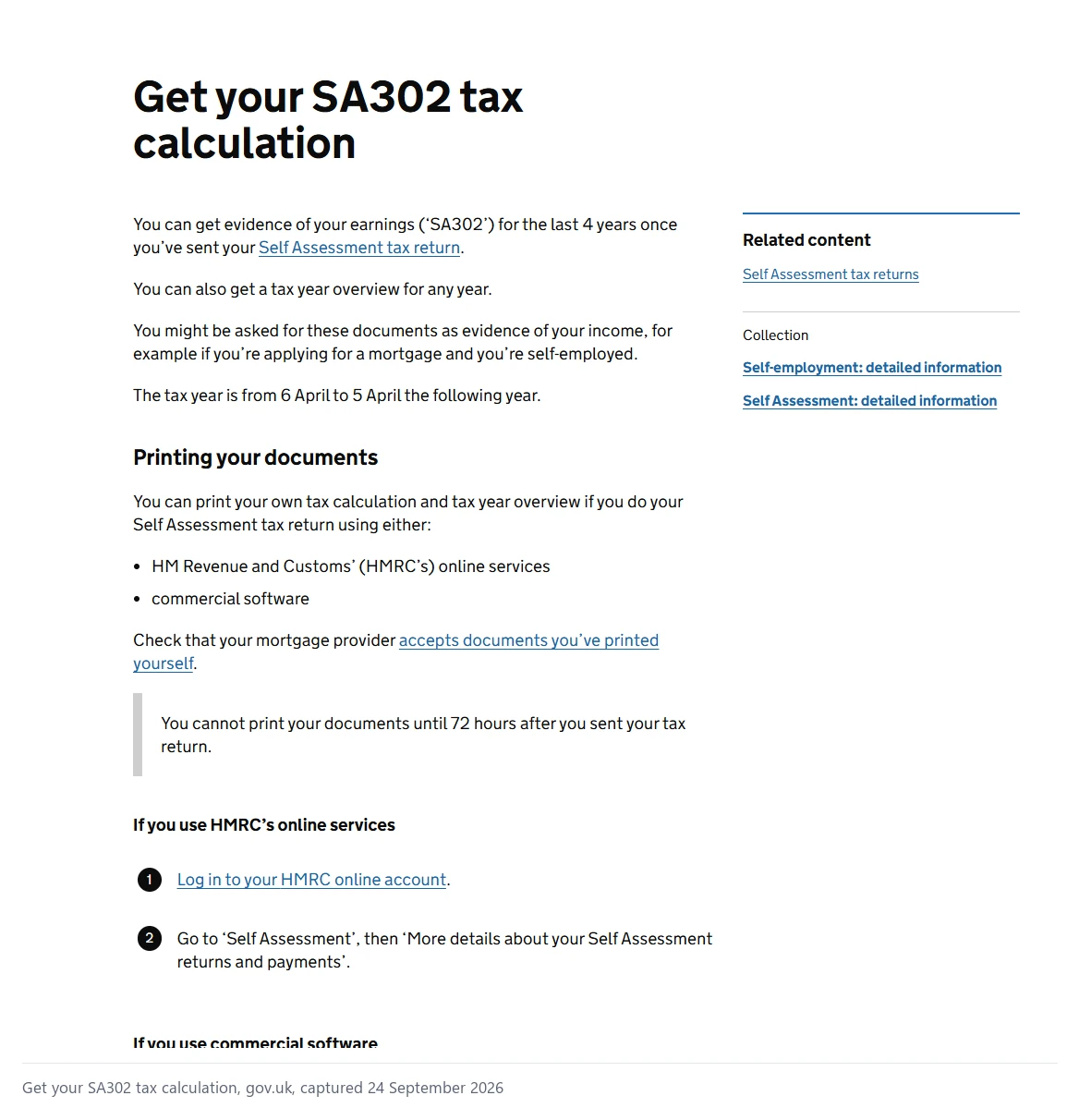
Up to four years are available, enough for any lender's ask. One wrinkle: if your accountant files through commercial software, the equivalent document is that software's "tax calculation" printout, and most lenders accept it alongside the HMRC tax year overview. Ask which format the lender wants before compiling the pack.
What do mortgage lenders actually check on an SA302?
Four things, in roughly this order. The total declared income, because that is the number affordability runs on. The mix, since salary, dividends and self-employment profit can be weighted differently. The trend across years, where most lenders average two years or take the latest if lower. And consistency with the tax year overview and your bank statements.
Notice what is missing: revenue. A lender does not care what your business turned over. It cares what reached your tax return.
Why can an SA302 undersell what you really earn?
Because it reports taxable income, and good tax planning pushes taxable income down. Three groups hit this hardest:
- Anyone with heavy legitimate expenses. The profit line is what survives after costs.
- Company directors who retain profit. Money kept in the business never reaches the SA302. The trade-off: salary or dividends.
- CIS construction subcontractors. Trade deductions can shrink an SA302 to a fraction of real earnings. Lenders with construction-scheme criteria read gross payment statements instead, the basis specialist brokers use to place CIS mortgages.
When the SA302 tells your story well, use it. When it does not, the fix is a lender whose criteria read the evidence your income does produce.
How many years of SA302s do lenders want?
Two is the standard, and one year is enough for a small group of lenders that underwrite first-year figures individually. Full-time investors and traders sit in the same system, and we walk through their version on the .co.uk in mortgages for traders.
What do the big lenders actually require? We checked their criteria pages
We read six lenders' own intermediary criteria pages in late September 2026 and recorded what each one says. Nobody compiles this, and the differences are the whole game:
| Lender | Years of figures | Directors assessed on | Worth knowing |
|---|---|---|---|
| Halifax | Latest 2 years' Tax Calculations + Tax Year Overviews, newest under 18 months old | Salary + dividends drawn; salary + net profit only by underwriter exception (2+ years' accounts, accountant's projection, majority shareholder) | The exception route exists, but it is an exception |
| NatWest | Minimum two full years' trading | Salary + dividends, last 2 years (20%+ shareholding = self-employed) | Average if income held or rose; latest year if it fell |
| Nationwide | Last two years, latest year end under 18 months old | Salary + dividends; uses the LOWER of latest year vs two-year average | No drafts or projections, ever |
| Santander | Average of last 2 years, or latest if lower | Salary + dividends via accountant's certificate (20%+ shareholding = self-employed) | Every self-employed application capped at 90% LTV |
| HSBC | Average over last 2 years, SA302 + overview within 18 months | The applicant's share of company net profit after corporation tax, averaged | One of the few mainstream lenders reading profit, not drawings |
| Saffron BS | 2+ years standard; 1 year possible on its specialist range | Net Profit After Tax plus salary may be considered for 50%+ shareholders; latest year's figures for rising or falling income | Also reads CIS gross from 3 months' slips |
Read the spread and the SA302's role gets clearer. Four of the six read a director's drawings, one reads company profit, one will read either. Same applicant, same documents, materially different borrowing power depending on the door you knock on.
FAQ: SA302 questions answered
How long does it take to get an SA302?
Minutes, online, for any of the last four tax years. Only the print-and-post route through HMRC's phone line takes weeks, and almost nobody needs it now.
What does an SA302 look like?
One to two pages headed "Tax calculation": income by category, allowances, then the tax due. No logos, no colour. Plain is normal.
Is an SA302 the same as a tax return?
No. The return is what you file; the SA302 is HMRC's calculation of what that filing means. Lenders want the calculation, not the return itself.
Does an SA302 show dividends?
Yes, dividends you declared appear as their own line, and that is how a lender sees a director's salary-plus-dividends pattern.
Can I get one if I have never filed Self Assessment?
No. That is the trap for the newly self-employed: no return, no SA302, no evidenced income. File your first return as early as possible after the tax year ends if a mortgage is on the horizon.
Is it free?
Yes. Anyone charging you for an SA302 is charging for ten minutes on gov.uk.
Sources
- GOV.UK: Get your SA302 tax calculation
- GOV.UK: Understand your Self Assessment tax bill
- MoneyHelper: self-employed mortgage guidance
The gov.uk journey and figures on this page were walked and checked on 24 September 2026, and we re-check them each tax year.
Capital at risk. This article is information, not financial or mortgage advice. The Investors Centre is not authorised to give mortgage advice; speak to an FCA-regulated adviser about your own case.