
- Expertise:
- CFD Trading, Forex, Derivatives, Risk Management
- Credentials:
- Chartered ACII (2018) · Trading since 2012
- Tested:
- 40+ forex & CFD platforms with live accounts

- Expertise:
- Broker Comparison, ISA Strategy, Portfolio Management
- Credentials:
- Active investor since 2013 · 11+ years experience
- Tested:
- 40+ brokers with funded accounts
How We Test
Real accounts. Real money. Real trades. No demo accounts or press releases.
What we measure:
- Spreads vs advertised rates
- Execution speed and slippage
- Hidden fees (overnight, withdrawal, conversion)
- Actual withdrawal times
Scoring:
Fees (25%) · Platform (20%) · Assets (15%) · Mobile (15%) · Tools (10%) · Support (10%) · Regulation (5%)
Testing team:
Adam Woodhead (investing since 2013), Thomas Drury (Chartered ACII, 2018), Dom Farnell (investing since 2013) — 50+ platforms with funded accounts
Quarterly reviews · Corrections: [email protected]
Disclaimer
Not financial advice. Educational content only. We're not FCA authorised. Consult a qualified advisor before investing.
Capital at risk. Investments can fall. Past performance doesn't guarantee future results.
CFD warning. 67-84% of retail accounts lose money trading CFDs. High risk due to leverage.
Contact: [email protected]
Pepperstone or CMC Markets for Australian CFD traders?
A cost-against-range contest between two well-matched ASIC firms, priced here from both firms' published Australian pages as at 1 September 2026, and neither sweeps the board. Pepperstone (AFSL 414530) offers CFDs on 1,350+ instruments, leveraged derivatives capped for retail clients at 30:1 on forex majors, with raw Razor pricing and six platforms including cTrader and TradingView. CMC Markets (CFDs under CMC Markets Asia Pacific Pty Ltd, AFSL 238054) counters with 12,000+ instruments, spreads from 0.5 pips on EUR/USD, an FX Active account whose percentage commission undercuts Razor's AUD 3.50 a side on AUD/USD-sized trades, and a separately licensed share-investing arm, CMC Invest. Pick Pepperstone for execution machinery and clean fee small print. Pick CMC for sheer market coverage, or for real share investing under the same roof.
 Top Rated
Trading CFDs and FX carries significant risk and is not suitable for everyone. You have no interest in the underlying asset.
How do the two stack up on paper?
The structural picture needs laying out before any pricing rounds, because one row in this table matters more than it looks: CMC operates in Australia as two different companies under two different licences, and the rest of this page treats them separately because the law does.
| Item | Pepperstone | CMC Markets |
|---|---|---|
| Entity and licence | Pepperstone Group Limited, AFSL 414530 | CFDs: CMC Markets Asia Pacific Pty Ltd, AFSL 238054; share investing runs separately as CMC Invest (AFSL 246381) |
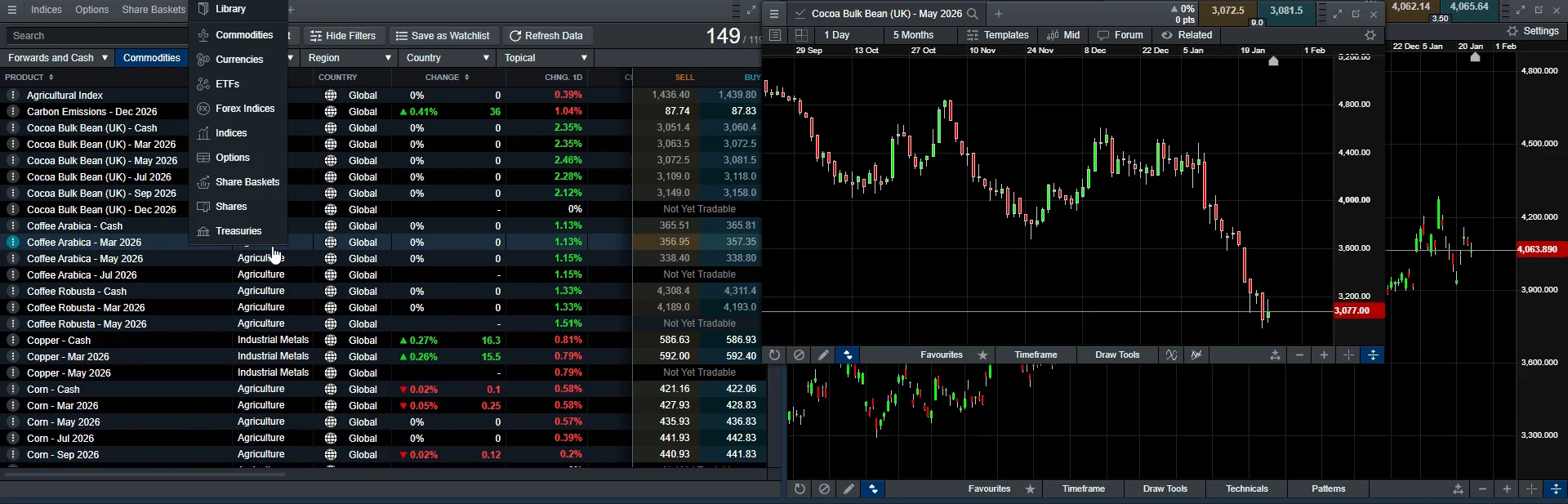
| CFD instruments | 1,350+ | 12,000+ across forex, indices, commodities, shares, crypto, options and treasuries |
| Platforms | TradingView, MT4, MT5, cTrader, plus Pepperstone's own web platform and mobile app | Proprietary platform (Next Generation lineage) alongside MT4, MT5 and TradingView |
| Minimum deposit | About A$10 equivalent by card; none by bank transfer | None |
| Inactivity cost | No inactivity fee | A$15/month once an account has sat dormant for 12 months |
| Real share ownership | Not offered | Yes, via CMC Invest: 40,000+ stocks and ETFs across the ASX and 15 international markets |
Range is CMC's row, clearly. Nine times the instrument count is not a rounding difference, and if your strategy touches treasuries, options or the long tail of global shares, Pepperstone may simply not list what you trade.
Round one: what does a forex CFD cost?
The answer runs closer than Pepperstone's reputation suggests. Both firms publish two tiers of pricing, so this round is really two fights.
Standard accounts: CMC starts ahead
CMC's standard CFD account quotes EUR/USD from 0.5 pips with no commission. Pepperstone's Standard account builds roughly a 1-pip markup into the spread instead of charging commission. On the published minimums, CMC's headline spread is the tighter of the two, a row Pepperstone does not win. The usual caveats apply in both directions: minimum spreads are not average spreads, and CMC labels its pricing tables indicative.
Raw accounts: pricing the commission
Razor charges raw spreads plus AUD 7 per standard lot round turn on an AUD MT4 or MT5 account (taken at open on MT4, AUD 3.50 per side on MT5), while cTrader, TradingView and the Pepperstone platform are priced in US dollars and converted at spot. CMC's FX Active account offers 0.0-pip minimum spreads on six majors, EUR/USD and AUD/USD among them, plus a commission of 0.0025% per transaction. On a A$100,000 leg, the size of an AUD/USD standard lot, that comes to about A$2.50, under Razor's AUD 3.50. Because it is a percentage, it rises on pairs where a standard lot is worth more than A$100,000, EUR/USD included.
On paper, then, FX Active is the cheaper raw account. The narrowing footnotes: it covers six pairs where Razor's pricing covers the full range, and Pepperstone lets you run raw pricing through cTrader or TradingView while FX Active lives on CMC's own stack. My funded experience with Razor's live spreads sits in the Pepperstone forex guide; treat both firms' minimums as marketing until you have watched real quotes at the hours you trade.
Round two: share CFDs and the fee small print
This is the round where the cheap-broker narrative flips depending on which line you read.
CMC publishes Australian share CFDs at 0.09% commission with a A$7.00 minimum, and US share CFDs at 2 cents a unit with a US$10.00 minimum, concrete AUD-first figures that make cost planning easy. Its holding costs are equally explicit: the tom-next rate plus a 1% CMC charge on forex, and a benchmark rate plus or minus 2.5% on index and share CFD positions held overnight.
The small print is where Pepperstone claws back ground. No inactivity fee against CMC's A$15 a month after a year idle. Free deposits and withdrawals. No A$20 monthly ASX data subscription. None of these matter to a full-time trader; all of them matter to someone who trades in bursts and leaves the account parked between them, and the smaller the account, the harder those fixed charges bite.
Which platform line-up serves you better?
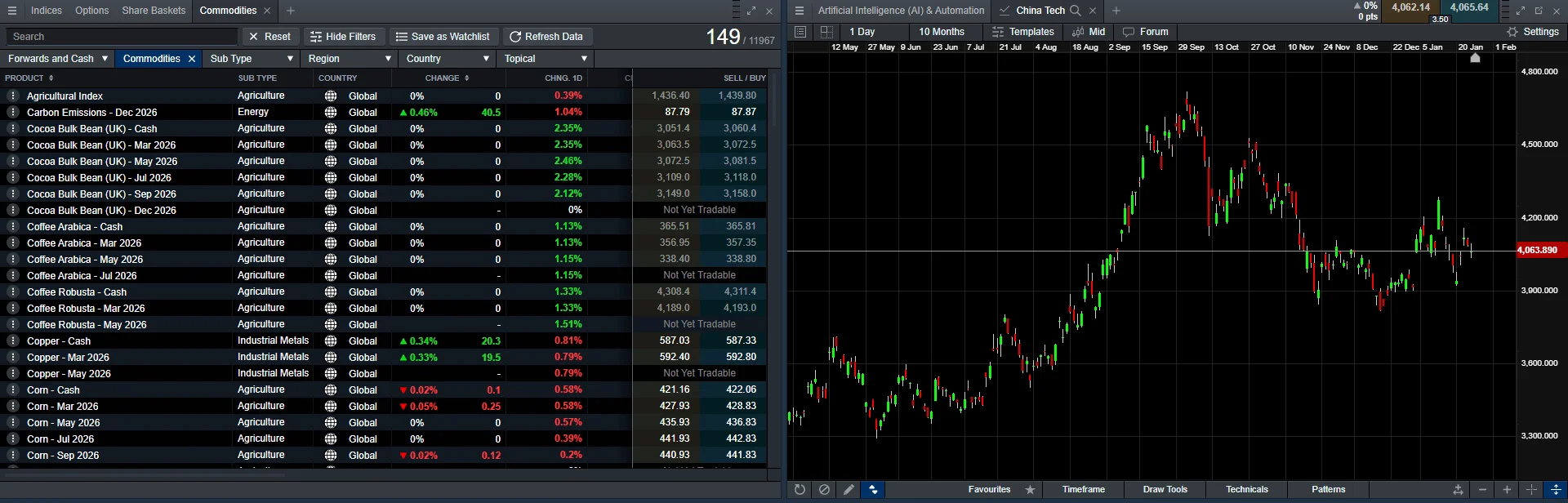
The old shorthand, CMC's beautiful proprietary platform against Pepperstone's third-party stable, is out of date. CMC Australia now lists MT4, MT5 and TradingView alongside its own Next Generation platform, so four of the six names overlap. Two real differences survive. Pepperstone still has cTrader exclusively in this pairing, which matters if depth-of-market execution is your thing, and it fields its own web platform and mobile app for traders who want simplicity, though on Razor the commission still moves with the platform you pick. CMC's counterpunch is that Next Generation remains one of the most complete proprietary platforms in the industry, with charting and product access built for its 12,000-instrument range rather than bolted on. Platform choice used to decide this comparison; now it mostly follows from whichever broker you picked for other reasons. For how Pepperstone's execution stacks up against a closer structural rival, see Pepperstone vs IC Markets.
What is CMC Invest, and why does the licence line matter?
Because it is a different company. CFD trading at CMC happens with CMC Markets Asia Pacific Pty Ltd under AFSL 238054; share investing happens with CMC Markets Stockbroking Limited, trading as CMC Invest, under AFSL 246381 as a participant of the ASX, SSX and Cboe. Different licences, different products, different account. Through CMC Invest you can own 40,000+ stocks and ETFs, with $0 brokerage on US, UK, Canadian and Japanese listings (FX spreads apply), the first ASX buy under $1,000 per security per day free, and A$11.00 or 0.10% otherwise. Pepperstone has no equivalent: it is a CFD specialist, full stop. If owning shares alongside your trading is part of the plan, this is CMC's strongest single argument, and it is why the licence line opened this section.
So which one should you open?
Score the rounds honestly and the pattern is clean. The dedicated forex or index trader who wants raw pricing on cTrader or TradingView, no idle-account fees and a lean specialist broker belongs at Pepperstone; the account guide covers ASIC's appropriateness assessment and the A$10-equivalent card minimum. The breadth trader, anyone whose watchlist runs past forex and indices into options, treasuries or obscure global shares, needs CMC's 12,000-instrument range, and the six-major FX Active account is genuinely sharp pricing for a raw-spread pairs trader who lives on CMC's platforms anyway. And the trader-investor hybrid who wants CFDs and real share ownership under one brand has only one candidate here, because only CMC brings a stockbroking licence to the table.
Frequently Asked Questions
References
- CMC Markets: Australian homepage, entities and product range (checked 1 September 2026)
- CMC Markets: forex spreads and FX Active terms (checked 1 September 2026)
- CMC Markets: CFD pricing, holding and dormancy costs (checked 1 September 2026)
- CMC Invest: share investing brokerage rates (checked 1 September 2026)
- Pepperstone: Razor and Standard pricing (checked 1 September 2026)
- Pepperstone: platform line-up (checked 1 September 2026)
Trading CFDs and FX carries significant risk and is not suitable for everyone. You have no interest in the underlying asset.