
- Expertise:
- CFD Trading, Forex, Derivatives, Risk Management
- Credentials:
- Chartered ACII (2018) · Trading since 2012
- Tested:
- 40+ forex & CFD platforms with live accounts

- Expertise:
- Broker Comparison, ISA Strategy, Portfolio Management
- Credentials:
- Active investor since 2013 · 11+ years experience
- Tested:
- 40+ brokers with funded accounts
How We Test
Real accounts. Real money. Real trades. No demo accounts or press releases.
What we measure:
- Spreads vs advertised rates
- Execution speed and slippage
- Hidden fees (overnight, withdrawal, conversion)
- Actual withdrawal times
Scoring:
Fees (25%) · Platform (20%) · Assets (15%) · Mobile (15%) · Tools (10%) · Support (10%) · Regulation (5%)
Testing team:
Adam Woodhead (investing since 2013), Thomas Drury (Chartered ACII, 2018), Dom Farnell (investing since 2013) — 50+ platforms with funded accounts
Quarterly reviews · Corrections: [email protected]
Disclaimer
Not financial advice. Educational content only. We're not FCA authorised. Consult a qualified advisor before investing.
Capital at risk. Investments can fall. Past performance doesn't guarantee future results.
CFD warning. 67-84% of retail accounts lose money trading CFDs. High risk due to leverage.
Contact: [email protected]
Quick Answer: What's the Cheapest Crypto Exchange in Australia?
Pepperstone Crypto is the cheapest crypto exchange in Australia for most traders. It charges a flat 0.1% fee per trade with no hidden spread mark-ups, and AUD deposits via PayID are free and instant. Backed by one of Australia’s most trusted ASIC-regulated brokers, it delivered the lowest total cost per trade in my hands-on testing.

Don’t invest unless you’re prepared to lose all the money you invest.

Investing in crypto carries a high level of risk.

51% of retail CFD accounts lose money.

Investing in crypto carries a high level of risk.

Investing in crypto carries a high level of risk.
How Do the Best Low-Fee Crypto Exchanges Compare?
I ranked these five exchanges based on total cost to the trader — not just the headline fee you see on their marketing pages. The table below covers maker-taker fees, spreads, AUD deposit support, and withdrawal costs so you can compare them side by side.
| # | Exchange | Our Score | Maker Fee | Taker Fee | Typical BTC/AUD Spread | AUD Deposit Methods | Withdrawal Fee | Cryptos | AUSTRAC Registered | Get Started |
|---|---|---|---|---|---|---|---|---|---|---|
| 1 | Pepperstone Crypto | 4.7/5 | 0.1% (flat) | 0.1% (flat) | None (no mark-up) | PayID, bank transfer, card | Free (AUD bank) | 39 (7 Spot + 32 Convert) | Yes | Visit |
| 2 | Kraken Pro | 4.65/5 | 0.16% | 0.26% | Tight (~0.1%) | PayID, OSKO, bank transfer | Free (AUD bank) | 400+ | Yes | Visit |
| 3 | eToro | 3.8/5 | ~1% (flat) | ~1% (flat) | Built into price | PayID, bank transfer, card | $5 USD | 80+ | Yes (ASIC-regulated) | Visit |
| 4 | Coinbase | 4.5/5 | 0.40% | 0.60% | Moderate (~0.3%) | Card, bank transfer | Varies by method | 250+ | Yes | Visit |
| 5 | Crypto.com | 3.5/5 | 0.40% | 0.60% | Moderate (~0.4%) | Card, bank transfer, PayID | Crypto network fee | 250+ | Yes | Visit |
Trustpilot ratings as of March 2026: Pepperstone 4.5/5 (2,885 reviews), Kraken 3.4/5 (5,379 reviews), eToro 4.2/5 (30,529 reviews), Coinbase 4.0/5 (21,570 reviews), Crypto.com 1.3/5 (20,215 reviews). Fee data last verified: 2 May 2026. Trustpilot ratings checked on 13 March 2026. AUSTRAC registration status confirmed via the AUSTRAC public register. Always confirm current rates on each platform’s fee page before trading.
Top 5 Low-Fee Crypto Exchanges in Australia
Here are the five cheapest crypto exchanges in Australia based on my hands-on testing:
1. Pepperstone Crypto — the lowest total cost per trade, backed by an ASIC-regulated broker with zero spread mark-ups
2. Kraken Pro — lowest maker-taker fees, ideal for active and high-volume traders
3. eToro — higher crypto fees but unbeatable if you also want stocks, ETFs, and copy trading in one place
4. Coinbase — competitive maker-taker fees on a globally trusted, publicly listed platform
5. Crypto.com — broad coin selection with fee discounts for CRO stakers, plus a popular Visa card
Pepperstone Crypto – Lowest Total Cost for Australian Traders
Pepperstone Crypto is the newest entrant on this list, but it’s backed by one of the most established names in Australian online trading. Pepperstone Group has been operating since 2010 and holds an Australian Financial Services Licence (AFSL 414530) issued by ASIC. The crypto arm launched as a separate AUSTRAC-registered entity (registration 100889269) and now offers 39 cryptocurrencies — 7 available for full spot trading (BTC, ETH, SOL, USDC, USDT, LTC, XRP) plus 32 more via Convert, including major altcoins like ADA, DOGE, BNB, AVAX, LINK, AAVE, UNI and SUI.
What sets Pepperstone Crypto apart from every other exchange on this list is fee simplicity. There’s a single flat 0.1% commission on every trade — no maker-taker distinction, no tiered volume schedule, and crucially, no spread mark-up. The price you see is the price you get. On a $1,000 trade that’s $1.00 in fees, full stop. No other Australian platform I’ve tested comes close to that total cost. Trustpilot rates Pepperstone 4.5 out of 5 based on 2,885 reviews as of March 2026 — one of the highest scores of any broker operating in Australia.
Pros
- Flat 0.1% fee with zero spread mark-up delivers the lowest total cost per trade
- Backed by an ASIC-regulated, AFSL-holding broker with 14+ years of operation
- Free AUD deposits via PayID and free AUD withdrawals to bank
- Seven order types including limit, stop-limit, and trailing stop
Cons
- Only 7 cryptocurrencies available for full spot trading (32 more via Convert) — a curated lineup rather than the 400+ catalogues offered by Kraken or Coinbase
- No staking, earn products, or DeFi integrations
- Brand-new crypto platform with limited track record in the exchange space
- Not suitable for traders wanting access to the full long tail of altcoins and niche tokens
My Personal Experience with Pepperstone Crypto
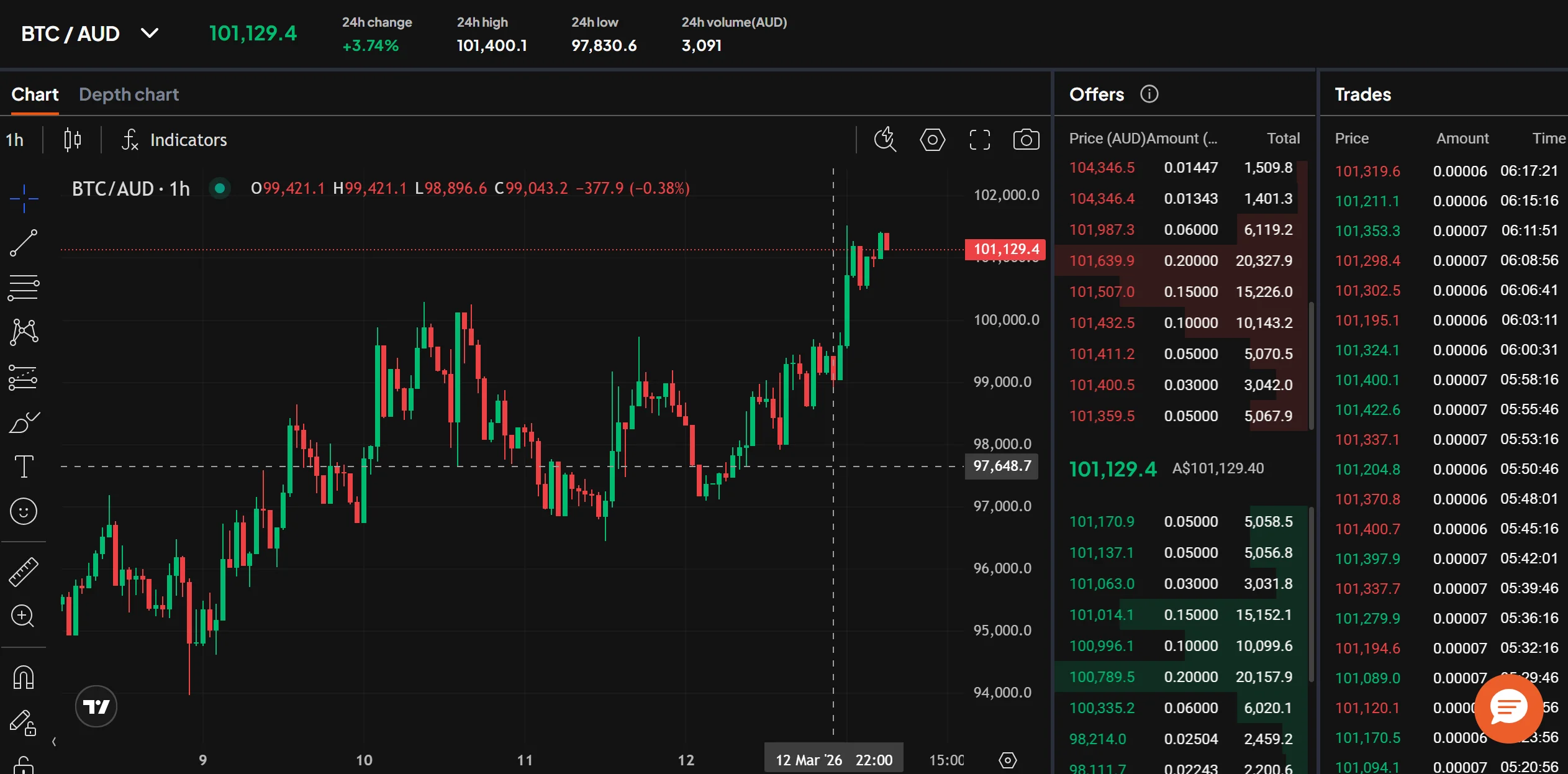
I opened my Pepperstone Crypto account in early 2026 specifically to test the fee claims — and they held up. The onboarding was fast, largely because I already had a verified Pepperstone trading account. AUD deposits via PayID landed within seconds, and the first trade I placed — a $1,000 limit buy on BTC/AUD — cost me exactly $1.00 in commission with no visible spread mark-up. That’s genuinely the cheapest trade I’ve executed on any Australian platform.
The platform itself is clean and focused. There are seven order types available — market, limit, stop, stop-limit, trailing stop, take-profit, and take-profit-limit — which gives you the same level of execution control as Kraken Pro. The interface pulls in TradingView charts and the order book has decent depth on BTC/AUD during Australian hours.
The obvious trade-off is the Spot/Convert split. The 7 spot-tradeable coins cover the majors (BTC, ETH, SOL, LTC, XRP) and both stablecoins (USDT, USDC), with full orderbook trading. The other 32 — including BNB, ADA, DOGE, AVAX, LINK, AAVE, UNI, SUI and a gold-backed token in XAUT — are accessible via Convert rather than the full spot interface. It covers more than just Bitcoin and Ethereum, but if you’re after the latest meme coin or niche Layer 2 token, you’ll still need Kraken or Coinbase. For investors primarily buying and holding mainstream assets — which covers the majority of Australian crypto investors — Pepperstone Crypto delivers the lowest cost I’ve found. The ASIC-regulated parent company, Proof of Reserves transparency, and established infrastructure make it feel like a proper institutional-grade offering rather than a startup exchange.
How Much Does It Actually Cost to Buy $1,000 of Bitcoin on Pepperstone Crypto?
Here’s what I actually paid when buying $1,000 AUD of Bitcoin on Pepperstone Crypto:
- AUD deposit via PayID: $0
- Trading fee (flat, any order type): $1.00 (0.1%)
- Spread mark-up: $0 (no mark-up applied)
- Approximate exchange spread: ~$0.50
- Total cost: ~$1.50
That’s roughly half what you’d pay on Kraken Pro with a limit order, and a fraction of the cost on Coinbase, eToro, or Crypto.com. For anyone dollar-cost averaging into Bitcoin or Ethereum on a regular basis, the savings are significant over a year.
Key Details About Pepperstone Crypto
Full disclosure: I currently hold crypto positions on Pepperstone Crypto, Kraken, Coinbase, and eToro, and maintain active funded accounts on all five platforms listed in this guide. Our editorial methodology is independent of our commercial relationships — see how we test for full details.
| Detail | Pepperstone Crypto |
|---|---|
| Registered Entity | Pepperstone Group Limited |
| AUSTRAC Number | 100889269 |
| ASIC Licence | AFSL 414530 |
| Cryptocurrencies | 39 (7 Spot + 32 Convert) |
| Order Types | 7 (market, limit, stop, stop-limit, trailing stop, TP, TP-limit) |
| Proof of Reserves | Yes |
| Trustpilot Rating | 4.5/5 (2,885 reviews) |
Kraken Pro – Lowest Maker-Taker Fees for Active Traders
Kraken was the first crypto exchange I ever used. I signed up back in 2019 when I first got involved in crypto, and it’s been a constant in my portfolio ever since. Back then I was an instant-buy guy — hitting that market order button every time Bitcoin dipped, driven mostly by FOMO. I’ve since learned that habit was quietly costing me a lot more than it needed to. These days I exclusively use Kraken Pro, and the difference in fees is night and day.
Kraken has been operating since 2011 and has never suffered a major security breach — a track record almost no other exchange can match. For Australians, it’s AUSTRAC-registered through Bit Trade Pty Ltd (DCE100575789-001), the local exchange Kraken acquired in 2020, and it currently lists over 400 cryptocurrencies. The BTC/AUD order book has solid depth, which keeps spreads tight and means you’re not losing money to thin liquidity the way you might on smaller local platforms. Trustpilot rates Kraken 3.4 out of 5 based on 5,379 reviews as of February 2026 — the lower score largely reflects frustrations with the standard platform and verification delays rather than the Pro trading experience.
Pros
- Maker fees start at just 0.16%, among the lowest available to Australians
- Fees reduce further as your 30-day trading volume increases
- Deep liquidity on BTC/AUD and ETH/AUD pairs keeps spreads tight
- Strong security record with no major hacks since launch in 2011
Cons
- The Pro interface is complex and not beginner-friendly
- AUD deposits require PayID or OSKO — no instant card deposits available
- Customer support response times can be slow during peak periods
- The standard Kraken platform charges significantly higher fees, which can confuse new users
My Personal Experience with Kraken Pro
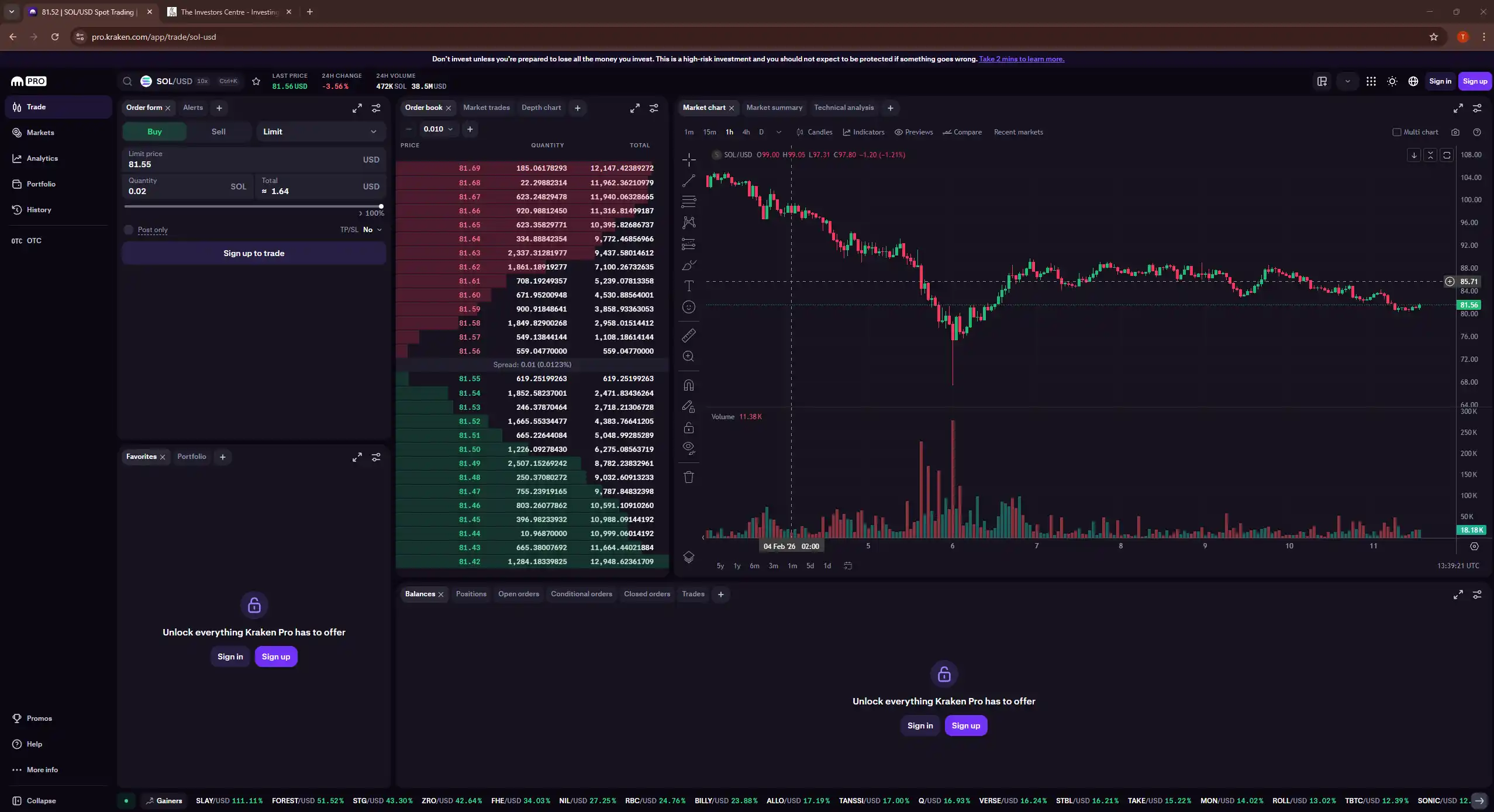
Kraken holds a special place for me because it’s where my crypto journey started in 2019. For the first year or so, I used the standard Kraken interface and hit instant buy on everything — usually at the worst possible moment, driven by whatever was pumping on Twitter that week. I was paying fees I didn’t even understand at the time, and the spread on instant buys was eating into my returns without me realising it.
Switching to Kraken Pro was a turning point. The interface took a bit of getting used to, but once I understood limit orders and the maker-taker fee structure, I couldn’t go back. A $2,000 market order costs me $5.20 in taker fees (0.26%), but placing a limit order on the same pair drops that to $3.20 (0.16%). Over seven years of using this platform, those savings have genuinely added up.
I still swap between Kraken and Coinbase depending on which coins are available — some altcoins list on one before the other — but Kraken Pro is my go-to for any serious position and sits comfortably among the top-rated crypto apps I’ve tested. AUD deposits via PayID land in minutes, withdrawals back to my bank are free and settle next business day, and the liquidity on major pairs during Australian trading hours is consistently solid.
How Much Does It Actually Cost to Buy $1,000 of Bitcoin on Kraken Pro?
Here’s what I actually paid when buying $1,000 AUD of Bitcoin on Kraken Pro:
- AUD deposit via PayID: $0
- Trading fee (taker, market order): $2.60 (0.26%)
- Trading fee (maker, limit order): $1.60 (0.16%)
- Approximate spread cost: ~$1.00 (0.1%)
- Total cost (market order): ~$3.60
- Total cost (limit order): ~$2.60
Compare that to paying $6.00–$10.00+ on platforms like Coinbase or eToro for the same $1,000 trade. If you’re regularly investing in Bitcoin and dollar-cost averaging $500 a fortnight, switching to Kraken Pro limit orders could save you roughly $100–$150 annually in fees alone.
Pros and Cons of Using Kraken Pro
Full disclosure: I currently hold crypto positions on Pepperstone Crypto, Kraken, Coinbase, and eToro, and maintain active funded accounts on all five platforms listed in this guide. Our editorial methodology is independent of our commercial relationships — see how we test for full details.
| Detail | Kraken Pro |
|---|---|
| Registered Entity | Bit Trade Pty Ltd |
| AUSTRAC DCE Number | DCE100575789-001 |
| Cryptocurrencies | 400+ |
| Trustpilot Rating | 3.4/5 (5,379 reviews) |
eToro – Best for Low-Fee Multi-Asset Investing
I signed up with eToro shortly after opening my Kraken and Coinbase accounts in 2019, and the reason was simple — I wanted to trade stocks and ETFs alongside crypto without managing multiple platforms. eToro is the only exchange on this list that lets you do that. Its crypto fees are higher than the dedicated exchanges above, but if you’re building a diversified portfolio that includes Australian and US shares, the convenience of having everything in one place has genuine value.
eToro is ASIC-regulated in Australia through eToro AUS Capital Limited (ACN 612 791 803, AFSL 491139). It’s one of the most recognisable investing platforms globally, with over 30 million users. Trustpilot rates eToro 4.2 out of 5 based on 30,529 reviews as of February 2026. The platform supports AUD deposits via PayID and bank transfer, and offers copy trading features that let you mirror the portfolios of other investors on the platform.
Pros
- Trade crypto, stocks, and ETFs in a single app — genuinely unique on this list
- ASIC-regulated with an Australian Financial Services Licence
- Simple AUD deposits via PayID and bank transfer
- Copy trading lets you follow experienced investors’ portfolios automatically
Cons
- Crypto trading fee of approximately 1% is the highest on this list
- Limited to around 80 cryptocurrencies — far fewer than Kraken or Coinbase
- $5 USD withdrawal fee applies regardless of amount
- No advanced order types or pro trading interface for crypto
My Personal Experience with eToro
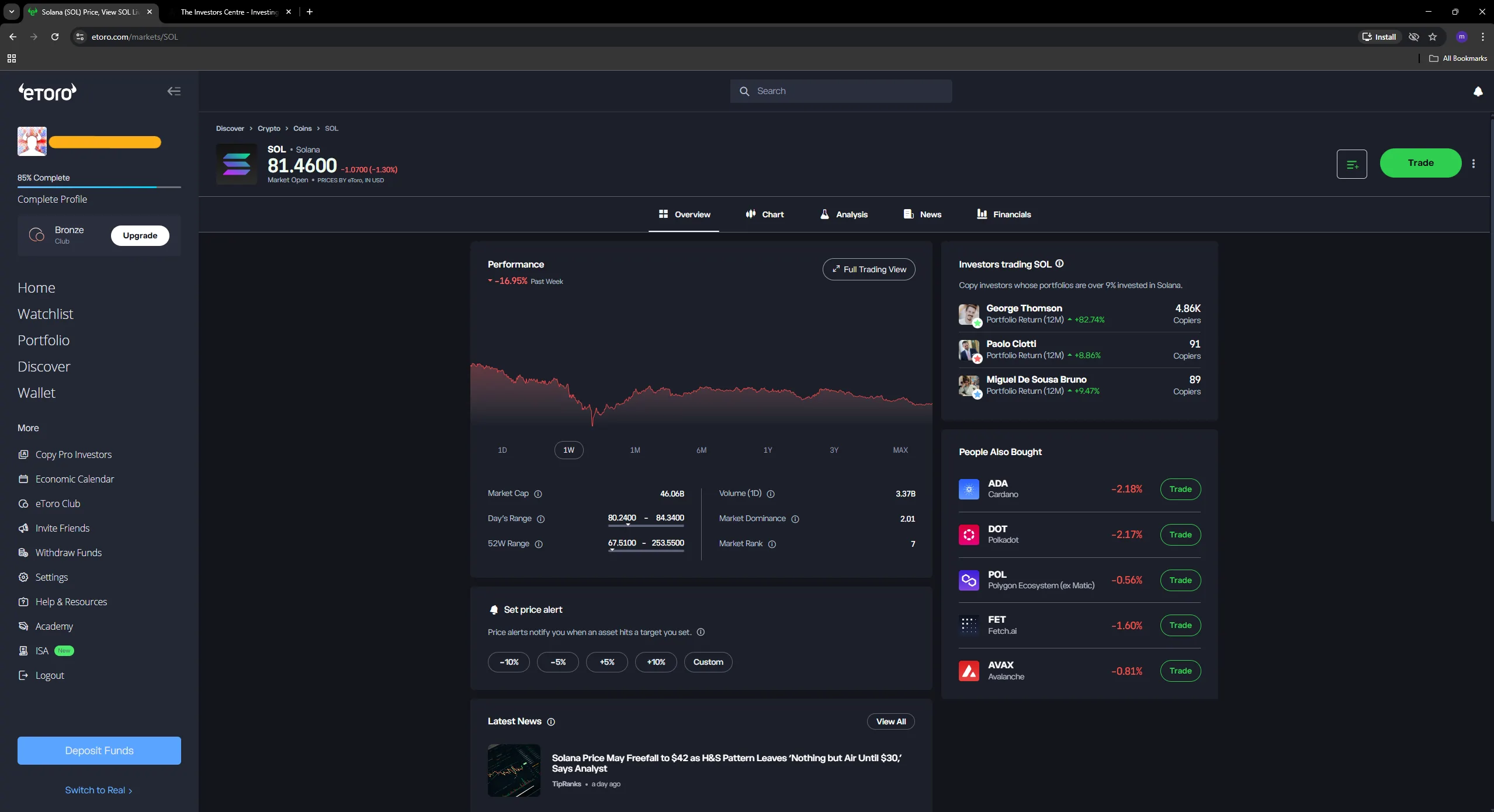
eToro is the platform I reach for when I want to make a quick crypto buy alongside a share trade. I’ve used it on and off since 2019 and the experience has always been straightforward — deposit AUD, buy what I want, everything lives in one dashboard. The interface is deliberately simple, which suits the way I use it.
The 1% crypto fee is noticeable, especially when you’re used to Pepperstone Crypto’s 0.1% or Kraken Pro’s 0.16%. On a $1,000 Bitcoin purchase, that’s $10 versus $1.00–$1.60 — a real difference if crypto is your main focus. But I’ve kept eToro in my rotation because the multi-asset angle saves me from juggling a separate share trading account. Zero brokerage on stocks and ETFs means the overall cost of managing a diversified portfolio is actually quite competitive.
Where eToro falls short for crypto-focused traders is depth. Around 80 cryptocurrencies is a fraction of what Kraken or Coinbase offer, and there are no advanced order types. You won’t find limit orders with stop-losses or maker-taker pricing here. If crypto is your primary focus, eToro isn’t the cheapest or the most featured. If you want one app to manage crypto, shares, and ETFs — especially paired with a bank that works well with crypto — it earns its place on this list.
How Does eToro’s 1% Crypto Fee Compare When You Factor In Stocks and ETFs?
On crypto alone, eToro is the most expensive option here:
- $1,000 crypto trade: ~$10.00 (1% fee)
- Same trade on Pepperstone Crypto: ~$1.00 (0.1% flat)
- Same trade on Kraken Pro: ~$2.60 (0.26% taker)
That’s roughly four to ten times the cost. But eToro’s crypto fee needs to be viewed in the context of the full platform:
- Stock and ETF trades: $0 brokerage
- Copy trading: No additional fee
- Single dashboard for crypto, shares, and ETFs: saves managing multiple accounts
If you’re investing $1,000 into crypto and $1,000 into stocks each month, your total cost on eToro is approximately $10.00 (crypto fee only, stocks are free). Running the same split across Kraken Pro (crypto) plus a separate share trading platform (typically $5–$10 per stock trade) could cost you $12–$15 total across two platforms. For a broader look beyond just fees, see my full exchange comparison covering all the major Australian platforms.
Pros and Cons of Using eToro
| Detail | eToro |
|---|---|
| Registered Entity | eToro AUS Capital Limited (ACN 612 791 803) |
| ASIC Licence | AFSL 491139 |
| Cryptocurrencies | 80+ |
| Trustpilot Rating | 4.2/5 (30,529 reviews) |
Coinbase – Best Low Fees on a Globally Trusted Platform
Coinbase was the second exchange I signed up with, not long after Kraken in 2019. At the time I was using standard Coinbase, which has always been slick and easy to navigate but charges fees that make you wince once you know what’s available elsewhere. Coinbase now offers Advanced Trade with proper maker-taker pricing built into the same account — no separate sign-up needed. That was a game-changer for anyone who’d been overpaying on the simple interface.
As a publicly listed company on the NASDAQ, Coinbase carries a level of institutional trust that most crypto exchanges simply don’t have. It’s AUSTRAC-registered in Australia through Coinbase Australia Pty Ltd (DCE100784914-001), lists over 250 cryptocurrencies, and offers insurance on custodial assets. Trustpilot rates Coinbase 4.0 out of 5 based on 21,570 reviews as of February 2026 — one of the higher scores among major exchanges, with most praise directed at the platform’s reliability and security.
Pros
- Publicly listed company with institutional-grade security and asset insurance
- Maker-taker fees (0.40%/0.60%) are significantly lower than simple Coinbase buys
- TradingView integration and advanced order types built in
- Over 250 cryptocurrencies available with regular new listings
Cons
- No direct AUD bank deposits — you’ll need to use card or workarounds
- Base fees are still roughly double what Kraken Pro charges
- The Advanced interface sits within the main Coinbase app, which can feel cluttered
- Withdrawal fees vary by method and can be harder to predict upfront
Is Coinbase Advanced Trade Really Cheaper Than Standard Coinbase?
Significantly. On a $1,000 AUD trade, here’s the difference:
- Standard Coinbase (simple buy): approximately $14.90 in fees (~1.49% flat fee on card purchase)
- Coinbase Advanced (limit order, maker): approximately $4.00 (0.40%)
- Coinbase Advanced (market order, taker): approximately $6.00 (0.60%)
That’s a saving of roughly $9–$11 per trade just by switching to the Advanced view within the same app. If you’re still using standard Coinbase for your crypto purchases, switching to Advanced takes about ten seconds and costs nothing.
My Personal Experience with Coinbase
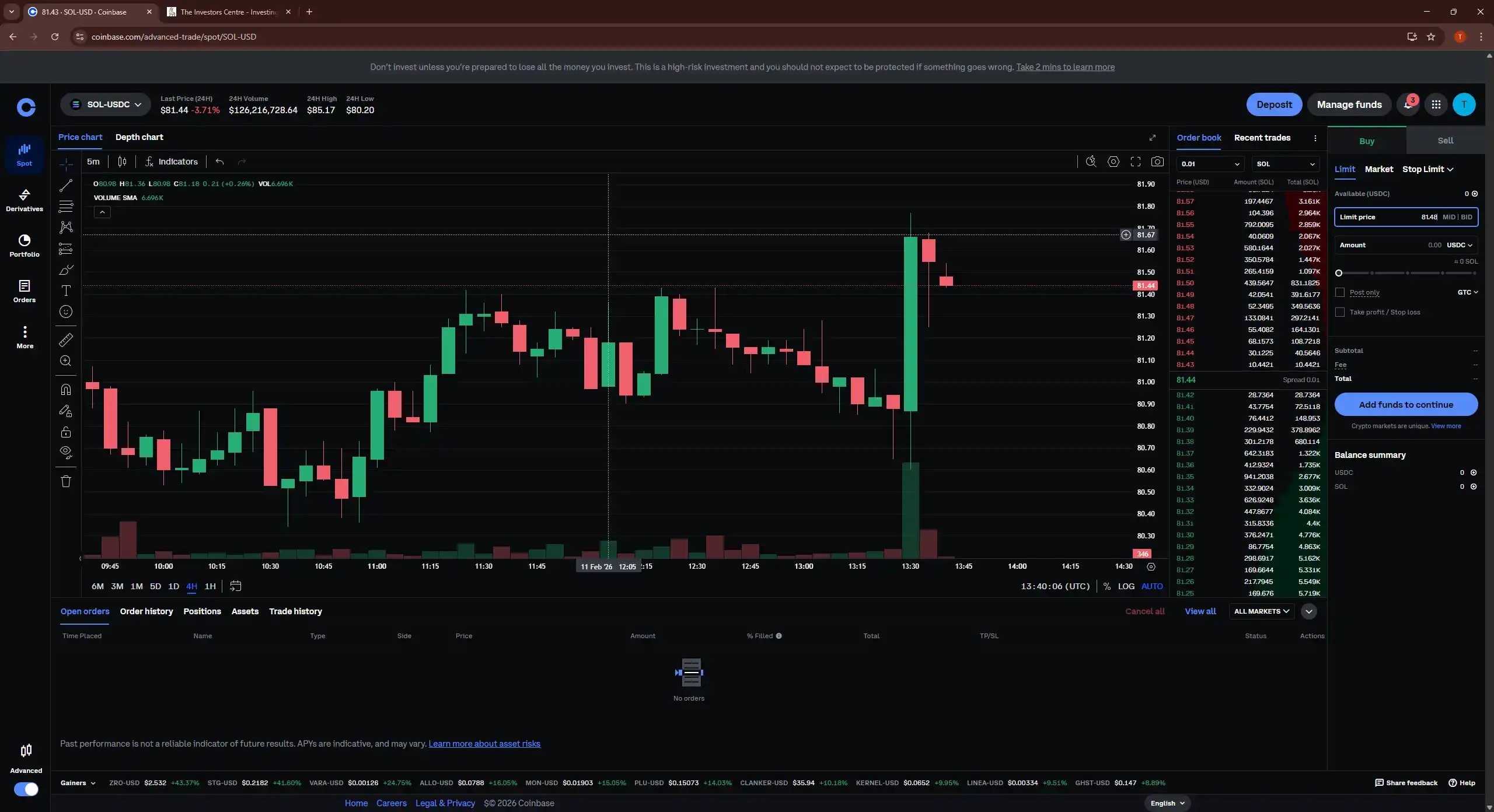
I’ve used Coinbase alongside Kraken since 2019, and the main reason I keep both active is coin availability. There have been plenty of times where a token I wanted listed on Coinbase days or even weeks before it appeared on Kraken, and vice versa. Having both accounts ready to go means I’m never stuck waiting for a listing.
The switch from standard Coinbase to Advanced was seamless — it’s the same account, you just toggle into the Advanced trading view. The fees immediately dropped from the flat percentages I’d been paying on simple buys to a 0.40% maker and 0.60% taker structure. It’s not as cheap as Kraken Pro or Pepperstone Crypto, but for the level of trust and insurance Coinbase provides, I consider the premium fair.
One thing that does frustrate me as an Australian is the lack of direct AUD bank deposits. You can fund via card, but that adds fees on top. I’ve worked around this by depositing AUD elsewhere and transferring crypto in, but it’s an extra step that Pepperstone and Kraken don’t require. For straightforward AUD-to-crypto trades, Pepperstone Crypto or Kraken Pro wins. For anyone getting started with crypto in Australia, switching from standard to Advanced is the single easiest fee upgrade you can make.
Pros and Cons of Using Coinbase
| Detail | Coinbase |
|---|---|
| Registered Entity | Coinbase Australia Pty Ltd |
| AUSTRAC DCE Number | DCE100784914-001 |
| Cryptocurrencies | 250+ |
| Trustpilot Rating | 4.0/5 (21,570 reviews) |
Crypto.com – Broad Selection With CRO Fee Discounts
Crypto.com is one of the most recognisable crypto brands globally, largely thanks to aggressive marketing deals including naming rights to the former Staples Center in Los Angeles. The platform offers over 250 cryptocurrencies with maker-taker fees starting at 0.40%/0.60% on the exchange. Fee discounts are available for users who stake CRO tokens, which can bring costs down significantly for committed users.
For Australians, Crypto.com is AUSTRAC-registered under Foris DAX AU Pty Ltd (DCE100825942-001) and supports AUD deposits via bank transfer and card. The platform’s headline feature beyond trading is the Crypto.com Visa Card, which offers cashback rewards in CRO on everyday spending — a genuine perk if you’re already holding CRO. However, the Trustpilot rating tells a cautionary story: 1.3 out of 5 based on 20,215 reviews as of March 2026, with widespread complaints about customer support, withdrawal delays, and account restrictions.
Pros
- Over 250 cryptocurrencies with staking available on 30+ assets
- CRO staking unlocks meaningful fee discounts and Visa card cashback tiers
- Crypto.com Visa Card offers up to 5% cashback on spending
- AUSTRAC-registered with Proof of Reserves published regularly
Cons
- Trustpilot rating of 1.3/5 reflects serious customer support and withdrawal issues
- Fee discounts are tied to staking CRO — a volatile utility token
- Base fees of 0.40%/0.60% are higher than Pepperstone Crypto and Kraken Pro
- Complex fee structure with multiple tiers and token-based discounts
My Personal Experience with Crypto.com
I tested Crypto.com’s Australian platform to evaluate whether the CRO discount model makes it competitive on fees. Without staking any CRO, a $1,000 market order cost me $6.00 in taker fees (0.60%), plus an estimated $4.00 in spread — roughly $10.00 total. That’s comparable to eToro and significantly more expensive than Pepperstone Crypto or Kraken Pro.
The Visa Card is the standout feature. If you’re going to hold CRO anyway, the cashback on everyday spending (1–5% depending on your staking tier) can offset some of those trading costs over time. But tying your fee savings to a volatile utility token is a strategy that works until it doesn’t — CRO lost over 90% of its value during the 2022 bear market, and anyone staking for card benefits watched their locked tokens collapse.
The low Trustpilot score (1.3/5) is hard to ignore. While some of the reviews relate to the global platform rather than the Australian arm specifically, the volume of complaints about withdrawal delays and frozen accounts gives me pause. For Australian traders focused purely on low fees, Pepperstone Crypto and Kraken Pro are safer choices. Crypto.com earns its place for users who want the broader ecosystem — staking, the Visa card, and a wide coin selection — and are willing to accept the trade-offs.
How Much Does It Cost to Trade $1,000 of Bitcoin on Crypto.com?
Here’s what I paid on a $1,000 AUD BTC purchase on Crypto.com without any CRO staking discounts:
- AUD deposit via bank transfer: $0
- Trading fee (taker, market order): $6.00 (0.60%)
- Trading fee (maker, limit order): $4.00 (0.40%)
- Approximate spread cost: ~$4.00
- Total cost (market order): ~$10.00
- Total cost (limit order): ~$8.00
With CRO staking at the higher tiers, maker fees can drop to 0.04% and taker to 0.10%, bringing the total cost of a $1,000 trade below $2.00. But you need to stake a significant amount of CRO to reach those levels, which adds risk. For most Australian investors not already committed to the CRO ecosystem, the base fees are uncompetitive.
Key Details About Crypto.com
| Detail | Crypto.com |
|---|---|
| Registered Entity | Foris DAX AU Pty Ltd |
| AUSTRAC DCE Number | DCE100825942-001 |
| Cryptocurrencies | 250+ |
| Trustpilot Rating | 1.3/5 (20,215 reviews) |
What Fees Will You Pay When Using a Crypto Exchange in Australia?
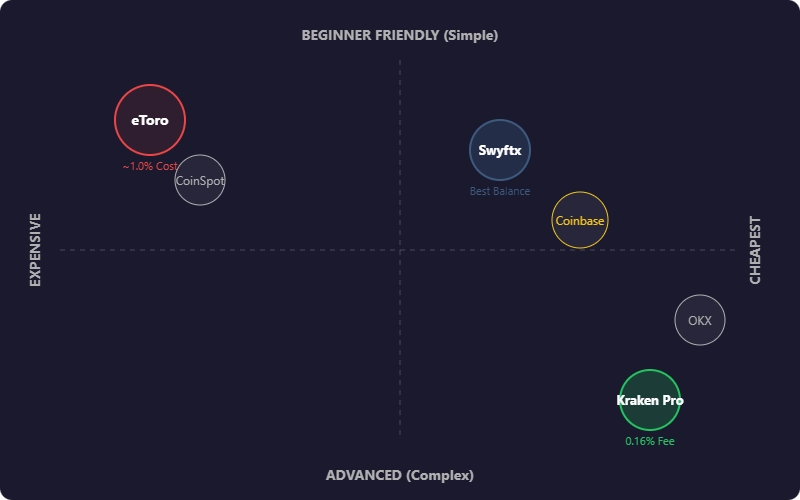
Crypto exchange fees in Australia aren’t always obvious. The number you see on the homepage is rarely the full picture. Most platforms charge a combination of trading fees, spread costs, and deposit or withdrawal fees — and the balance between those three varies significantly from one exchange to the next. Understanding what you’re actually paying is the first step to reducing your costs.
What Are Trading Fees and How Do They Differ Between Exchanges?
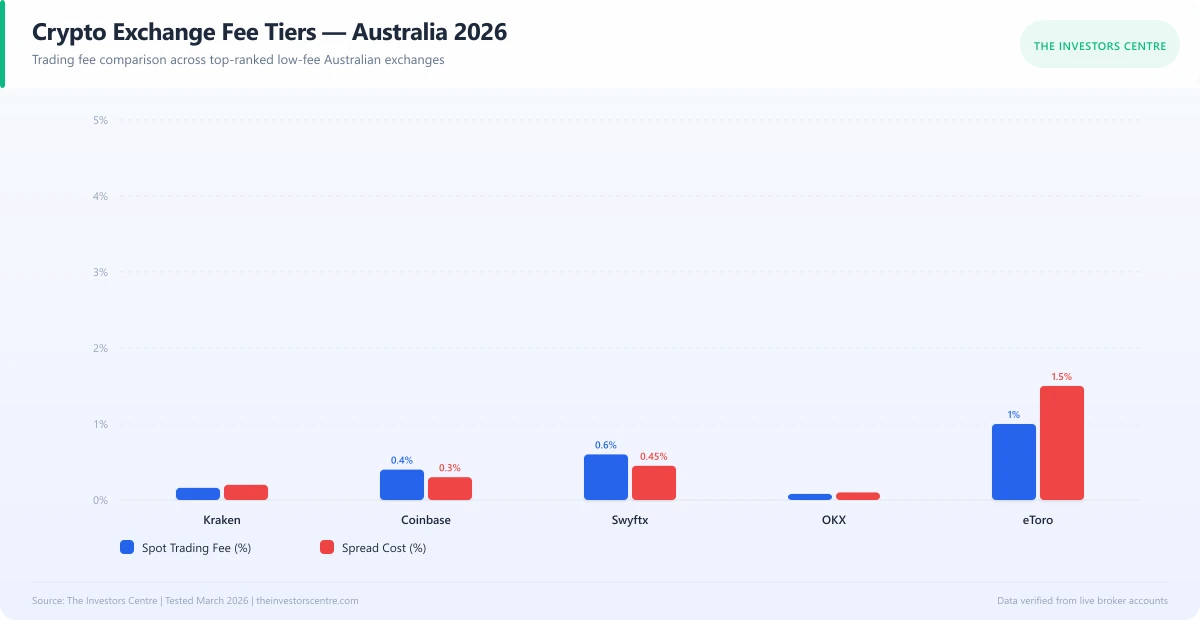
Trading fees are the percentage the exchange takes each time you buy or sell crypto. Most exchanges use a maker-taker model. If you place a limit order that adds liquidity to the order book (a maker order), you pay a lower fee. If you place a market order that takes liquidity immediately (a taker order), you pay a higher fee. On Kraken Pro, that’s 0.16% maker and 0.26% taker. On Coinbase, it’s 0.40% and 0.60%. Some platforms like Pepperstone Crypto use a flat fee instead — 0.1% regardless of order type — which is simpler and, in this case, also the cheapest.
The difference compounds quickly. On $10,000 worth of trades in a month, Pepperstone Crypto's flat 0.1% costs $10. Kraken Pro's 0.16% maker costs $16. Coinbase's 0.40% maker costs $40. Over a year, those gaps become hundreds of dollars that stay in your portfolio or don't, depending entirely on which exchange you use.
What Deposit and Withdrawal Fees Should You Expect?
Most Australian exchanges offer free AUD deposits via bank transfer, PayID, or OSKO. This is one area where the local market is genuinely competitive — platforms like Pepperstone Crypto, Kraken, and eToro don’t charge to deposit AUD through these methods.
Card deposits are a different story. Credit or debit card top-ups typically cost between 1.5% and 3.5%, depending on the exchange and your card provider. On a $1,000 deposit, that’s $15–$35 before you’ve even made a trade. I’d recommend avoiding card deposits wherever possible and sticking with bank transfers.
Withdrawal fees also vary. AUD bank withdrawals are free on Pepperstone Crypto and Kraken. eToro charges a flat $5 USD. If you’re withdrawing crypto to a private wallet, you’ll pay a network fee that depends on the blockchain — Bitcoin withdrawals are typically more expensive than sending stablecoins on cheaper networks.
What Are Spread Costs and Why Do They Matter More Than Trading Fees?
The spread is the difference between the buy price and the sell price of a cryptocurrency at any given moment. It’s essentially a hidden fee built into the price you see. Some exchanges are transparent about their spread, while others bundle it into the displayed price so you never see the cost separately.
Spreads are influenced by liquidity. On popular pairs like BTC/AUD with deep order books (Kraken Pro, for example), spreads can be as tight as 0.05%–0.1%. On smaller exchanges or less liquid pairs, spreads can blow out to 0.5%–1% or more. That means two exchanges could both advertise a 0.1% trading fee, but if one has a 0.5% spread and the other has a 0.05% spread, the actual cost of your trade is wildly different.
This is exactly why I don’t rank exchanges on headline trading fees alone. A platform with a 0.6% fee and a 0.2% spread (0.8% total) can actually be cheaper in practice than one with a 0.1% fee and a 0.8% spread (0.9% total). Pepperstone Crypto stands out here because it charges zero spread mark-up on top of its 0.1% commission — the tightest total cost I’ve measured.
How Much Does It Really Cost to Buy $1,000 of Bitcoin in Australia?
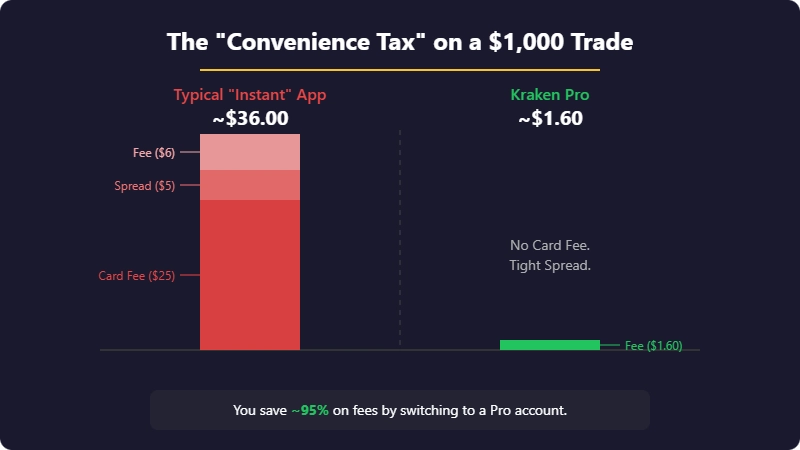
I bought $1,000 AUD of Bitcoin on each of the five exchanges to compare what I actually paid in total — trading fee plus estimated spread cost plus any deposit charges using a free bank transfer.
| Exchange | Trading Fee | Spread Cost (est.) | Deposit Fee (PayID/Bank) | Total Cost | % of Trade |
|---|---|---|---|---|---|
| Pepperstone Crypto | $1.00 | ~$0.50 | $0 | ~$1.50 | 0.15% |
| Kraken Pro (limit) | $1.60 | ~$1.00 | $0 | ~$2.60 | 0.26% |
| Kraken Pro (market) | $2.60 | ~$1.00 | $0 | ~$3.60 | 0.36% |
| eToro | $10.00 | Built in | $0 | ~$10.00 | 1.00% |
| Coinbase (limit) | $4.00 | ~$3.00 | $0 | ~$7.00 | 0.70% |
| Coinbase (market) | $6.00 | ~$3.00 | $0 | ~$9.00 | 0.90% |
| Crypto.com (limit) | $4.00 | ~$4.00 | $0 | ~$8.00 | 0.80% |
| Crypto.com (market) | $6.00 | ~$4.00 | $0 | ~$10.00 | 1.00% |
The differences are stark. Over a year of investing $1,000 per month, the gap between Pepperstone Crypto (~$18 annually) and eToro (~$120 annually) is over $100. That's not life-changing money, but it's a free trade's worth of Bitcoin you're either keeping or giving away every year.
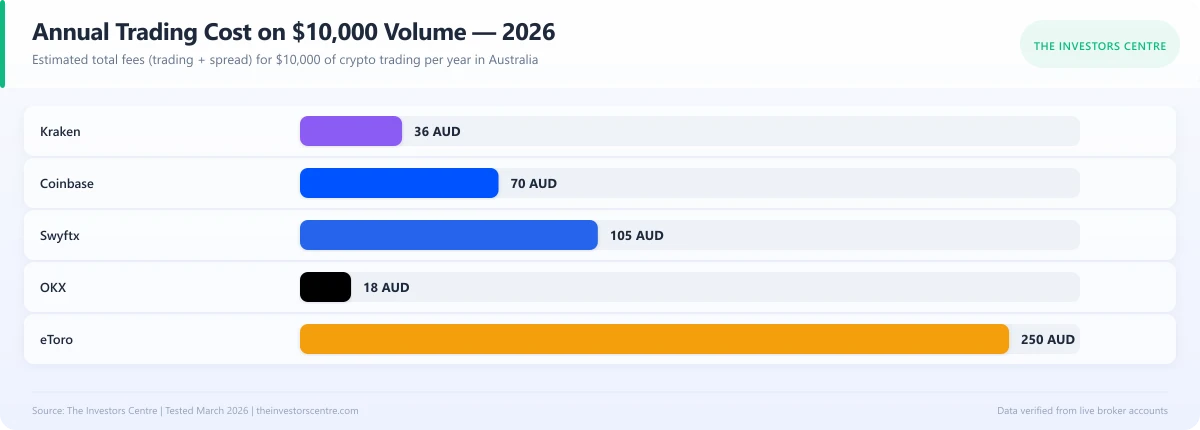
Costs based on live trades executed between November 2025 and March 2026.
How Can You Reduce Your Crypto Trading Fees in Australia?
Even on the cheapest exchange, there are ways to bring your costs down further. Most Australian traders are paying more than they need to simply because they haven’t adjusted their trading habits.
Are There Fee Discounts for High-Volume Trading?
Yes. Most exchanges operate on a tiered fee schedule where fees decrease as your 30-day trading volume increases. On Kraken Pro, maker fees can drop from 0.16% to as low as 0.00% at the highest volume tiers. Crypto.com offers similar volume discounts, especially when combined with CRO staking. Pepperstone Crypto charges a flat 0.1% regardless of volume, which is already lower than most tiered starting rates.
These tiers are usually based on rolling 30-day volume, so you don’t need to commit to a specific plan — your fee rate adjusts automatically as your volume changes. If you’re consolidating trades that you’d normally split across multiple platforms, that concentrated volume can push you into a lower tier on your primary exchange.
Can You Lower Fees by Using Native Exchange Tokens?
Some exchanges offer fee discounts for holding or paying fees in their native token. Crypto.com, for example, reduces trading fees for users who stake CRO. The catch is that you’re adding another asset to your portfolio — one that’s tied directly to the exchange’s performance. If the exchange faces trouble, the token typically drops with it. I’d only recommend this approach if you’re already a committed user of that platform and comfortable with the risk of holding a utility token alongside your core positions.
Is It Cheaper to Use Bank Transfers Instead of Cards?
Almost always. AUD bank transfers via PayID or OSKO are free on most Australian exchanges. Card deposits typically carry a surcharge of 1.5%–3.5%. On a $2,000 deposit, that’s $30–$70 in fees before you’ve placed a single trade.
The only advantage cards offer is speed — they’re instant, whereas some bank transfers can take minutes to a few hours. But with PayID, most deposits arrive within seconds anyway, making the card surcharge even harder to justify. Unless you’re in a genuine rush and can’t wait a few minutes, bank transfers are the better choice every time.
How Does Capital Gains Tax Affect Your Crypto Costs in Australia?
Fees aren’t the only cost of trading crypto in Australia. The ATO treats cryptocurrency as property, which means selling, swapping, or even spending crypto can trigger a capital gains tax event. This is an often-overlooked cost that can dwarf what you pay in exchange fees.
If you sell crypto at a profit within 12 months of purchase, the gain is added to your taxable income and taxed at your marginal rate. Hold for longer than 12 months and you receive a 50% CGT discount — meaning only half the gain is taxable. For someone in the 37% tax bracket, that discount can reduce the effective tax rate on a crypto gain from 37% to 18.5%.
This has direct implications for how you trade. Frequent trading on low-fee exchanges still generates tax events on every transaction. A buy-and-hold strategy on a slightly more expensive platform might actually leave you with more after tax if it means fewer CGT events. Platforms that generate ATO-compatible tax reports can also save you accounting costs at the end of the financial year, which is another real saving that doesn’t show up in fee comparisons.
What Other Factors Should You Consider Beyond Fees?
The cheapest crypto exchange in Australia isn’t automatically the best one for you. Fees matter, but they’re one piece of a larger picture that includes regulation, security, and the quality of support when something goes wrong.
Why Is AUSTRAC Registration Non-Negotiable?
Every exchange on this list is AUSTRAC-registered, and that should be a hard requirement for any Australian investor. AUSTRAC registration means the exchange complies with Australia’s anti-money laundering and counter-terrorism financing laws, maintains know-your-customer processes, and reports suspicious activity to regulators.
Using an unregistered exchange might save you a fraction on fees, but you lose all regulatory oversight and protections. If something goes wrong — a hack, a withdrawal freeze, a dispute — you have no Australian regulatory body to escalate to. Platforms like Binance, which lost its AUSTRAC registration and banking partnerships in 2023, are a cautionary example of why this matters.
How Important Is Exchange Security for Australian Users?
Exchange security should rank alongside fees as a top priority. The cheapest trade in the world means nothing if the platform gets hacked and your funds disappear. Key security features to look for include cold storage for the majority of user funds, two-factor authentication, proof-of-reserves audits, and insurance or compensation policies.
Kraken stands out here with its clean security record since 2011. Coinbase offers insurance on custodial assets as a publicly listed company. Pepperstone Crypto benefits from the infrastructure and compliance framework of its ASIC-regulated parent company. Crypto.com publishes proof-of-reserves data. eToro benefits from ASIC regulation and segregated client funds. None of these are guarantees, but they’re meaningful layers of protection that unregulated platforms typically don’t provide.
How Good Is Customer Support on These Platforms?
Customer support becomes critical the moment something goes wrong — a stuck withdrawal, a failed verification, a deposit that doesn’t appear. In my experience, Pepperstone has the best support for Australian users, with fast response times and local staff via phone and live chat. Coinbase has improved significantly but can still be slow during high-traffic periods. Kraken’s support is adequate but not exceptional. Crypto.com’s low Trustpilot score (1.3/5) reflects consistent complaints about support responsiveness. eToro sits in the middle — functional but not outstanding.
If you’re newer to crypto, I’d weigh support quality heavily. A 0.1% fee saving is meaningless if you’re stuck for days trying to resolve an issue with an unresponsive support team.
Which Exchanges Didn’t Make the Top 5?
Australia has a solid range of AUSTRAC-registered crypto exchanges beyond the five I’ve ranked above. None of these made my top five specifically for low fees, but several are strong platforms that might suit different priorities.
Swyftx – was previously ranked third on this list and remains a strong platform for everyday Australian crypto buyers. It offers 420+ cryptocurrencies, instant PayID deposits, free AUD withdrawals, and one of the highest Trustpilot ratings of any exchange (4.5/5). The 0.6% base trading fee plus spread makes it more expensive than Pepperstone Crypto and Kraken Pro for most trades, which is why it dropped out of the top five in this fee-focused ranking. If ease of use and local support matter more to you than squeezing out the absolute lowest cost, Swyftx is still an excellent choice.
OKX – has the lowest published trading fees of any exchange available in Australia (0.08% maker / 0.10% taker), but the lack of PayID support and limited AUD on-ramp options mean the total cost for most Australian users is higher than it appears. Card deposit fees of 1.5%–3.5% can wipe out the trading fee savings entirely. The Australian platform also has a significantly reduced coin selection compared to the global version, and a Trustpilot rating of 2.2/5 reflects ongoing customer support concerns. For experienced traders who fund via crypto transfer, OKX’s spot fees are genuinely excellent. For most Australians depositing AUD, the friction outweighs the savings.
CoinSpot – is one of Australia’s largest and most popular exchanges, with over 530 cryptocurrencies and a simple interface. Trading fees start at 0.1% on the OTC market, but the instant buy fee of 1% is where most casual users end up. It’s excellent for beginners and has strong brand trust in Australia, but on a fee-focused ranking, the instant buy cost holds it back. If you exclusively use the OTC market with limit orders, CoinSpot’s fees are competitive — but most users don’t.
Independent Reserve – has operated since 2013 and caters well to SMSF investors and institutional clients. Fees start at 0.5% and drop to 0.02% at the highest volume tiers. The coin selection is more limited (around 35 cryptocurrencies), but the platform is reliable, well-regulated, and offers an OTC desk. It didn’t make the list because the starting fee is higher than Pepperstone Crypto, Kraken Pro, and Coinbase, and the asset range is narrow.
BTC Markets – is another Melbourne-based veteran from 2013. Fees start at 0.85%, which is among the highest of any Australian exchange. It compensates with excellent reliability, OTC trading, and SMSF support. For long-term holders making infrequent large trades, the higher fee might be acceptable. For regular traders watching their costs, 0.85% is hard to justify when alternatives exist at a fraction of the price.
Cointree – charges fees from 0.75% and offers around 200 cryptocurrencies. Its partnership with Blueshyft for cash deposits is unique, but the higher fee structure and smaller coin selection meant it didn’t compete on cost with the top five.
CoinJar – is one of Australia’s oldest exchanges (founded 2013) with fees starting at 1% on the standard platform. The CoinJar Exchange product has lower fees for active traders, but the default experience is expensive and the coin selection (around 60 assets) is limited.
Digital Surge – offers over 400 cryptocurrencies with fees from 0.50%. The platform faced difficulties in 2022 due to FTX exposure but has since recovered. Fees are mid-range and the platform is solid, but it didn’t offer enough of a cost advantage to displace the top five.
Coinstash – has the largest coin selection in Australia (over 1,000 tokens) with fees from 0.85%. It’s ideal for anyone hunting obscure altcoins, but the higher fee tier kept it off a fee-focused ranking.
How I Tested and Ranked These Exchanges
I scored each exchange based on the total cost of trading as an Australian user — not just the headline fee. My methodology weights trading fees at 40%, spread costs at 25%, AUD deposit and withdrawal costs at 20%, and fee transparency at 15%. Each platform was tested with a live funded account using real AUD.
The ranking also factors in practical considerations for Australian users: PayID support, AUD pair liquidity, AUSTRAC registration, and customer support quality. An exchange with the lowest fees in the world doesn’t earn a top spot if most Australians can’t deposit AUD without paying a card surcharge.
Testing Log
- Testing period: November 2025 – March 2026
- Deposit method: PayID or bank transfer where available, card where not
- Test trade: $1,000 AUD purchase of Bitcoin (BTC) on each platform
- Order types tested: Market order (taker) and limit order (maker) where available
- Measured: Trading fee charged, estimated spread at time of execution, deposit fee, withdrawal fee (AUD to bank), time to deposit, time to withdraw
- Verification: Fee data cross-referenced against each platform’s published fee schedule. Trustpilot ratings checked on trustpilot.com. AUSTRAC registration status confirmed via AUSTRAC’s public register.
- Platforms tested with funded accounts: Pepperstone Crypto, Kraken Pro, eToro, Coinbase, Crypto.com
- Last data update: March 2026
Content Update Log
- March 2026: Rankings restructured by Adam Woodhead. Pepperstone Crypto added as new #1 following hands-on testing. Crypto.com added at #5. Swyftx and OKX moved to “didn’t make top 5” section. Coinbase Advanced renamed to Coinbase throughout. eToro moved from #5 to #3. All fee data re-verified. Trustpilot ratings updated. Cost comparison table updated with Pepperstone Crypto data. Two new FAQs added.
- May 2026: Pepperstone Crypto coin count updated from 12 to 39 following platform expansion (7 Spot + 32 Convert). Cryptocurrency listings refreshed across comparison table, Pepperstone review, Key Details, and FAQ.
- February 2026: Full content rewrite by Adam Woodhead. All fee data re-verified across five platforms. Trustpilot ratings updated. AUSTRAC registration numbers confirmed. OKX Australian platform reassessed following 2024 launch. Real cost comparison table added based on live $1,000 BTC trades. “Exchanges that didn’t make the top 5” section added.
- January 2026: Testing period completed. $1,000 AUD deposited and traded on each of the five platforms. Spread, fee, and withdrawal data recorded.
- December 2025: Original page published (previous version by Thomas Drury).
Which Low-Fee Exchange Should You Choose?
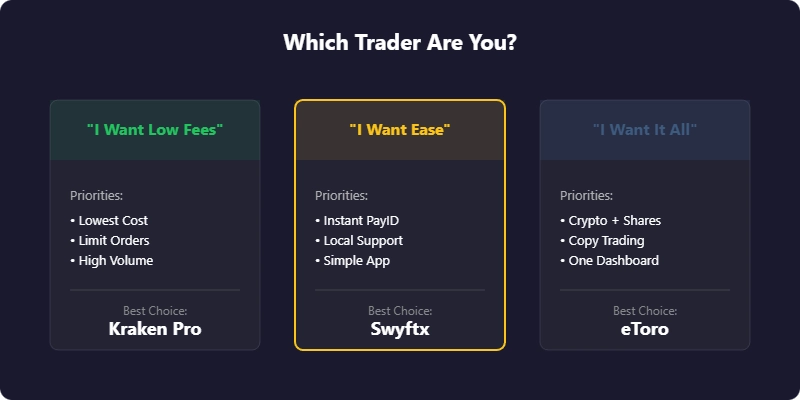
The right exchange depends on how you actually trade. Here’s the short version:
You want the absolute lowest total cost and you’re buying major coins — go with Pepperstone Crypto. Its flat 0.1% fee with zero spread mark-up delivered the cheapest trade in my testing, and the ASIC-regulated parent company adds a layer of trust that newer crypto-only platforms can’t match.
You want the lowest maker-taker fees with access to 400+ coins — Kraken Pro. No other AUSTRAC-registered exchange matches its maker fee of 0.16%, and the free PayID deposits mean you’re not losing money before the trade even executes. The best choice for active traders who need variety.
You want crypto, stocks, and ETFs in one app and fee savings across your full portfolio — eToro is the only platform here that offers multi-asset investing. The 1% crypto fee is the highest on this list, but zero brokerage on stocks means the total cost of a diversified portfolio can actually compete.
You want a globally trusted, insured platform and don’t mind paying a small premium — Coinbase gives you maker-taker pricing on a NASDAQ-listed exchange with asset insurance. The fees are higher than Pepperstone Crypto and Kraken Pro, but the institutional backing is hard to match.
You want a broad coin selection with staking and a Visa card ecosystem — Crypto.com offers 250+ coins, staking rewards, and cashback through its Visa card. The base fees are mid-range, but CRO stakers can unlock some of the lowest rates available. Be aware of the low Trustpilot score and the risks of tying your fee savings to a volatile token.
Final Thoughts
The cheapest crypto exchange in Australia depends on how you trade. If you’re buying the major coins and want the absolute lowest total cost, Pepperstone Crypto’s flat 0.1% fee with no spread mark-up is hard to beat — and the ASIC-regulated backing gives it credibility that most crypto-native exchanges can’t match. If you need access to hundreds of altcoins and you’re comfortable with a pro interface, Kraken Pro delivers the lowest maker-taker fees by a clear margin.
eToro earns its place for the specific use case of combining crypto with stocks and ETFs in one app — something no other exchange on this list offers. Coinbase sits in the middle — not the cheapest, but backed by the kind of institutional trust and insurance that some investors prioritise over saving a few dollars per trade. Crypto.com rounds out the list with its broader ecosystem of staking, a Visa card, and CRO-based fee discounts, though the low Trustpilot score warrants caution.
My advice: pick the exchange that matches how you actually invest, not just the one with the smallest number on the fee page. Set up a Pepperstone Crypto account if you haven’t already — even if you use another platform for variety, having it ready for your larger trades will save you money over time.
FAQs
References
- Australian Transaction Reports and Analysis Centre (AUSTRAC) — Regulatory guidelines for cryptocurrency exchanges in Australia
- Australian Taxation Office (ATO) — Cryptocurrency and tax obligations for Australian investors
- Pepperstone — Crypto trading fees and platform details
- Kraken — Fee schedule and trading fee tiers
- eToro — Trading fees and charges
- Coinbase — Fee structure
- Crypto.com — Exchange fee schedule
- Trustpilot — Ratings verified March 2026: Pepperstone, Kraken, eToro, Coinbase, Crypto.com
- Reserve Bank of Australia (RBA) — Digital assets and the Australian financial system