
- Expertise:
- CFD Trading, Forex, Derivatives, Risk Management
- Credentials:
- Chartered ACII (2018) · Trading since 2012
- Tested:
- 40+ forex & CFD platforms with live accounts

- Expertise:
- Broker Comparison, ISA Strategy, Portfolio Management
- Credentials:
- Active investor since 2013 · 11+ years experience
- Tested:
- 40+ brokers with funded accounts
How We Test
Real accounts. Real money. Real trades. No demo accounts or press releases.
What we measure:
- Spreads vs advertised rates
- Execution speed and slippage
- Hidden fees (overnight, withdrawal, conversion)
- Actual withdrawal times
Scoring:
Fees (25%) · Platform (20%) · Assets (15%) · Mobile (15%) · Tools (10%) · Support (10%) · Regulation (5%)
Testing team:
Adam Woodhead (investing since 2013), Thomas Drury (Chartered ACII, 2018), Dom Farnell (investing since 2013) — 50+ platforms with funded accounts
Quarterly reviews · Corrections: [email protected]
Disclaimer
Not financial advice. Educational content only. We're not FCA authorised. Consult a qualified advisor before investing.
Capital at risk. Investments can fall. Past performance doesn't guarantee future results.
CFD warning. 67-84% of retail accounts lose money trading CFDs. High risk due to leverage.
Contact: [email protected]
Quick Answer: How Do You Short Tesla Stock in Canada?
To short Tesla (TSLA) in Canada, open a margin account with a broker that supports short selling or CFD trading, deposit the required collateral, and place your short position. Canadian investors can short Tesla through traditional short selling, put options, inverse ETFs, or CFDs—each with different risk profiles and capital requirements.
- Choose a Canadian broker that supports short selling (eToro, Questrade, or Interactive Brokers)
- Open and fund a margin account with the required collateral
- Select your shorting method (traditional, options, inverse ETFs, or CFDs)
- Place your short position and set stop-loss orders to manage risk
Platforms like eToro, Questrade, and Interactive Brokers allow Canadian residents to short US stocks including Tesla. The process takes 10-15 minutes once your account is verified.
Short selling carries significant risk, including the potential for unlimited losses if Tesla's stock price rises. Only trade with capital you can afford to lose. CFDs are complex instruments—67% of retail investor accounts lose money when trading CFDs with eToro.
 Top Rated
CFDs are complex instruments with a high risk of losing money rapidly due to leverage. 51% of retail CFD accounts lose money when trading CFD’s with this provider. You should consider whether you understand how CFDs work and whether you can afford to take the high risk of losing your money.
What Is Short Selling?
Short selling is a trading strategy where you profit from a stock's price decline rather than its rise. Instead of buying low and selling high, you borrow shares from your broker, sell them at the current market price, and aim to buy them back later at a lower price. The difference between your sell price and buy-back price becomes your profit.
When you short Tesla, you're essentially betting the stock will fall. If TSLA drops from $435 to $400, you'd profit $35 per share (minus fees). However, if Tesla rises instead, you face losses—and unlike regular investing, these losses are theoretically unlimited since a stock's price can keep climbing indefinitely.

Why Would You Short Tesla Stock?
Traders short Tesla for several reasons. Some believe the stock is overvalued relative to its fundamentals—Tesla trades at significantly higher price-to-earnings ratios than traditional automakers. Others use short positions to hedge existing long positions in their portfolio, protecting against potential downturns.
Tesla's stock is notoriously volatile, influenced by factors ranging from quarterly deliveries and earnings reports to CEO Elon Musk's social media activity. This volatility creates opportunities for short sellers, though it equally increases risk. As of January 2026, approximately 78.3 million Tesla shares are sold short, representing about 2.69% of the float—relatively low compared to historical levels.
What Are the Steps to Short Tesla in Canada?
Shorting Tesla as a Canadian investor requires choosing the right broker, understanding margin requirements, and selecting an appropriate shorting method for your experience level and risk tolerance.
Step 1 – Choose a Broker That Supports Short Selling
Not all Canadian brokers offer short selling capabilities, particularly for US stocks like Tesla. You'll need a platform registered with CIRO (Canadian Investment Regulatory Organization, formerly IIROC) that provides access to US markets and margin accounts. Look for competitive borrow rates, reliable order execution, and transparent fee structures.
Canadian investors commonly use Questrade, Interactive Brokers, or TD Direct Investing for traditional short selling. For CFD-based shorting, eToro is popular due to its user-friendly interface. If you're new to trading, you may want to compare Canadian trading platforms before committing.
What Should You Look for in a Shorting Broker?
Focus on CIRO membership for investor protection under CIPF (up to $1 million coverage), competitive margin rates, share availability for borrowing, and responsive customer support. Advanced traders should prioritize platforms with real-time short availability data and low borrow fees—Tesla is typically easy to borrow with rates under 5% annually.
Step 2 – Open and Fund a Margin Account
Short selling requires a margin account, not a standard cash account. When you apply, your broker will assess your trading experience, financial situation, and risk tolerance. Once approved, you'll need to deposit sufficient collateral to meet margin requirements before placing short trades.
For most Canadian brokers, you'll need a minimum of $2,000 CAD to open a margin account. Funding is typically done via Interac e-Transfer (instant to 30 minutes) or bank wire transfer (1-3 business days). Credit card deposits are generally not available for margin accounts.
What Are Canada's Margin Requirements for Short Selling?
Under CIRO rules, the margin requirement for shorting stocks priced at $5 or higher is 150% of the market value. This means to short $10,000 worth of Tesla, you'd need $15,000 in your account (the $10,000 proceeds from selling plus $5,000 additional collateral). Securities on CIRO's List of Securities Eligible for Reduced Margin (LSERM) may qualify for lower requirements.
| Stock Price | Margin Requirement | Example ($10,000 Position) |
|---|---|---|
| $5.00 or higher | 150% of market value | $15,000 required |
| $2.00 - $4.99 | 150% of market value | $15,000 required |
| $1.50 - $1.99 | $3.00 per share | Varies by share count |
| Below $1.50 | 200% of market value | Short selling often restricted |
Step 3 – Select Your Shorting Method
Canadian investors have four main ways to profit from Tesla's potential decline. Each method has distinct advantages, risks, and capital requirements. Your choice depends on your experience level, account type, and risk tolerance.
What Are the Different Ways to Short Tesla?
| Method | Risk Level | Capital Required | Best For |
|---|---|---|---|
| Traditional Short Selling | High (unlimited loss potential) | $15,000+ (150% margin) | Experienced traders |
| Put Options | Medium (limited to premium paid) | $500 - $5,000+ | Intermediate traders |
| Inverse ETFs | Medium (can lose entire investment) | $50+ | Beginners and hedgers |
| CFD Trading | High (leveraged losses) | $50+ (with leverage) | Active traders |
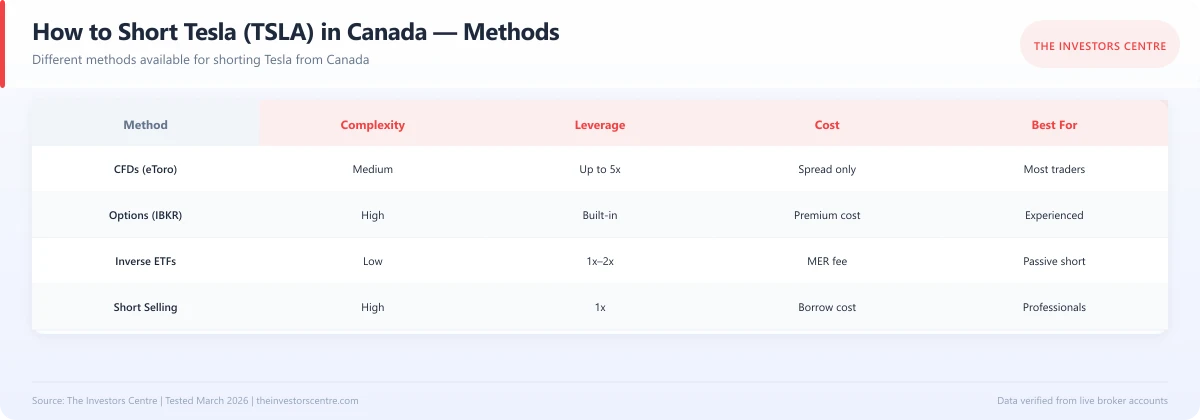
Traditional Short Selling: Borrow Tesla shares through your broker, sell them, then buy them back later at (hopefully) a lower price. Requires margin account and carries unlimited loss potential.
Put Options: Purchase put contracts giving you the right to sell Tesla at a set price before expiration. Your maximum loss is limited to the premium paid, making this a popular alternative to direct shorting.
Inverse ETFs: Buy shares of funds like TSLS or TSLQ that rise when Tesla falls. No margin account needed, making this the most accessible method for beginners.
CFD Trading: Trade contracts that mirror Tesla's price movement without owning shares. CFDs offer leverage but amplify both gains and losses. Available through platforms like eToro.
Step 4 – Place Your Short Position and Manage Risk
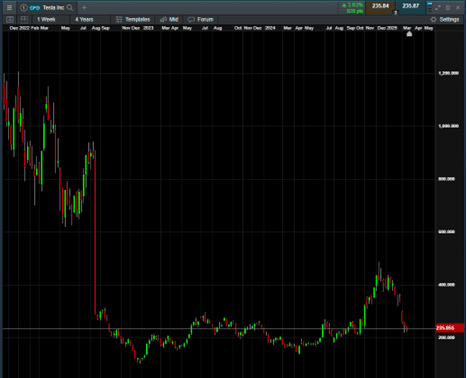
Once you've selected your method, navigate to Tesla (TSLA) on your platform, choose "Sell" or "Short," and enter your position size. Review the order details including any borrowing fees, then confirm. For inverse ETFs, simply place a standard "Buy" order for the ETF shares.
After opening your position, monitor it closely. Set a stop-loss order to automatically close your position if Tesla rises beyond your risk tolerance—this limits potential losses. Consider taking partial profits if the trade moves in your favour rather than waiting for a larger move.
How Do You Manage Risk When Shorting?
Always use stop-loss orders—experienced traders typically set stops 5-10% above their entry price. Size positions appropriately; never risk more than 1-2% of your total portfolio on a single short trade. Monitor Tesla news and earnings dates, as these can trigger sharp price movements. Maintain adequate margin to avoid forced liquidations during volatile periods.
Which Platforms Can You Use to Short Tesla in Canada?
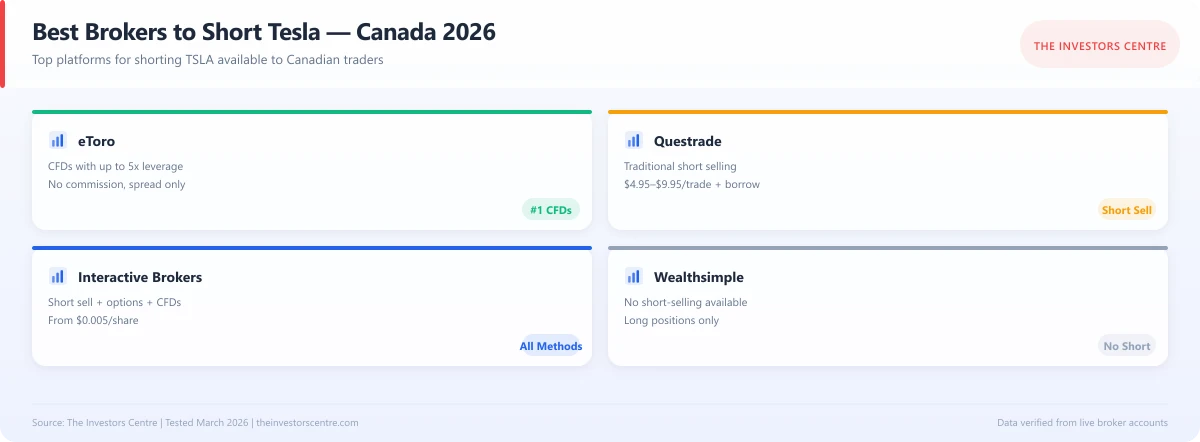
Several brokers allow Canadians to short US stocks like Tesla. When selecting a platform, consider whether you want to short directly (traditional/options) or use alternatives (inverse ETFs/CFDs). Here's how the leading platforms compare:
| Platform | Methods Available | Commission | Minimum Deposit | Best For |
|---|---|---|---|---|
| eToro | CFDs, Inverse ETFs | 0% (spread-based) | $50 USD | CFD short selling |
| Questrade | Traditional, Options, ETFs | $4.95 - $9.95 | $1,000 CAD | Traditional shorting |
| Interactive Brokers | All methods | $0.01/share | $0 | Advanced traders |
Here Are the Top 3 Best Platforms for Shorting Tesla in Canada
1. eToro — Best for CFD Short Selling
2. Questrade — Best for Traditional Short Selling & Options
3. Interactive Brokers — Best for Advanced Traders
1. eToro – Best for CFD Short Selling
eToro offers Canadian investors an accessible way to short Tesla through CFDs. The platform's intuitive interface makes it straightforward to open short positions, and you can start with as little as $50. CFD trading means you don't need to borrow actual shares—you're simply trading on Tesla's price movement.
Pros
- User-friendly platform ideal for beginners
- Low minimum deposit requirement ($50 USD)
- Copy trading feature to follow experienced short sellers
- No commission (costs built into spread)
Cons
- CFDs only—no traditional short selling
- Overnight fees accumulate on longer holds
What Are eToro's Fees for Shorting Tesla?
eToro charges no commission on CFD trades—costs are built into the spread between buy and sell prices. For Tesla CFDs, spreads are typically competitive though wider than direct trading.
Overnight fees apply for positions held beyond market hours. These financing charges accumulate daily and can significantly impact longer-term positions. Check current overnight rates on eToro's platform before opening positions you plan to hold for days or weeks.
What Can You Short on eToro?
eToro provides CFD access to thousands of stocks including Tesla, along with indices, commodities, forex, and cryptocurrencies. All are available for short positions through simple "Sell" orders.
The platform also offers inverse ETFs that can be purchased in your eToro account, providing another way to gain short exposure without CFD overnight fees. This includes access to inverse Tesla ETFs like TSLS and TSLQ.
How Safe Is eToro for Canadian Traders?
eToro is regulated in multiple jurisdictions though not directly by CIRO in Canada. Canadian users trade through eToro's international entities. Client funds are held in segregated accounts separate from company funds.
The platform has operated since 2007 and serves millions of users globally. However, CFD trading carries inherent risks—67% of retail investor accounts lose money when trading CFDs with eToro. Always start with a practice account to understand the platform before using real capital.
Who Should Use eToro for Shorting?
eToro excels for beginners wanting to short Tesla without the complexity of traditional margin accounts. The low minimum deposit ($50 USD) and intuitive interface make it accessible to newer traders.
The copy trading feature allows you to automatically mirror the trades of experienced short sellers, providing a learning opportunity. However, active traders and those wanting traditional short selling capabilities should consider Questrade or Interactive Brokers instead.
CFDs are complex instruments with a high risk of losing money rapidly due to leverage. 51% of retail CFD accounts lose money when trading CFD’s with this provider. You should consider whether you understand how CFDs work and whether you can afford to take the high risk of losing your money.
2. Questrade – Best for Traditional Short Selling & Options
Questrade is a popular Canadian discount broker offering full short-selling capabilities for US stocks including Tesla. With CIRO membership and CIPF protection, it's a solid choice for Canadians wanting traditional margin shorting or put options. ETF purchases are commission-free, making inverse Tesla ETFs cost-effective here.
Pros
- Traditional short selling and options available
- Free ETF purchases (including inverse ETFs)
- CIPF protection up to $1 million
- CIRO regulated for Canadian investor protection
Cons
- $1,000 minimum to open account
- Higher commissions than some competitors ($4.95-$9.95)
What Does Questrade Charge for Shorting?
Stock trades cost $4.95-$9.95 per trade depending on order size. This applies to both opening and closing short positions. Options trades are $9.95 plus $1 per contract—so buying Tesla put options costs the base fee plus $1 per contract purchased.
ETF purchases are free at Questrade, making inverse Tesla ETFs particularly cost-effective. You'll only pay commissions when selling the ETF. Margin rates for short selling are competitive, typically 6-9% annually depending on account balance.
What Shorting Methods Does Questrade Support?
Questrade provides access to traditional short selling on US and Canadian stocks, including Tesla. Options trading is fully supported with Tesla puts available at various strike prices and expiration dates.
You can also purchase inverse ETFs including TSLS, TSLQ, and TSLZ commission-free. This gives Canadian investors three distinct ways to profit from Tesla's potential decline, all from one account.
Is Questrade Safe and Regulated?
Questrade is a CIRO member, providing the highest level of regulatory oversight for Canadian brokers. Client accounts are protected by CIPF (Canadian Investor Protection Fund) up to $1 million in the unlikely event Questrade fails.
The company has operated since 1999 and is one of Canada's largest discount brokers with over $35 billion in assets under administration. Funds are held in segregated accounts at major Canadian financial institutions.
Who Should Choose Questrade?
Questrade is ideal for Canadian investors wanting traditional short selling with full regulatory protection. The $1,000 minimum is reasonable for serious traders, and commission-free ETF purchases make inverse ETF strategies particularly attractive.
Options traders benefit from comprehensive put option availability on Tesla and other US stocks. The platform suits intermediate to advanced traders comfortable with margin requirements and willing to pay per-trade commissions for full shorting capabilities.
Trading and investing involve risk. The value of your investments can go up or down, and you may lose all or part of your capital. These products may not be suitable for all investors. Please ensure you fully understand the risks involved.
3. Interactive Brokers – Best for Advanced Traders
Interactive Brokers offers the most comprehensive shorting capabilities with access to global markets, real-time short availability data, and competitive borrow rates. The platform provides professional-grade tools including detailed margin analytics and options strategies. Ideal for experienced traders who need sophisticated order types and low costs at scale.
Pros
- Lowest borrow rates and margin costs (starting at 6.83%)
- Real-time short availability data
- Advanced trading platform with professional tools
- No minimum deposit requirement
Cons
- Steep learning curve for beginners
- Platform can be overwhelming initially
What Are Interactive Brokers' Shorting Costs?
Stock commissions start at just $0.01 per share with a $1 minimum per order, making Interactive Brokers the cheapest for active short sellers. Tesla borrows typically cost 0.25-2% annually, significantly lower than most brokers.
Margin rates start at 6.83% for balances over $100,000, scaling down to even lower rates for larger accounts. This makes Interactive Brokers extremely cost-effective for traders regularly holding short positions or those shorting larger position sizes.
What Markets and Instruments Does IB Support?
Interactive Brokers provides access to short selling on stocks listed across 150 markets in 33 countries. Tesla can be shorted directly, through put options, or via inverse ETFs—all from the same platform.
The platform displays real-time short availability with current borrow rates before you place trades. This transparency helps you understand exact costs upfront. Advanced traders can also access short futures positions and options strategies including spreads and combinations.
How Safe Is Interactive Brokers?
Interactive Brokers Canada Inc. is a CIRO member and member of CIPF, providing up to $1 million protection per account. The parent company (IBKR) is publicly traded on NASDAQ with over $12 billion in equity capital.
Client funds are held in segregated accounts at major Canadian banks. Interactive Brokers has operated since 1978 and is one of the largest electronic brokers globally, serving professional and active traders worldwide with consistently strong regulatory ratings.
Who Should Use Interactive Brokers?
Interactive Brokers is best suited for experienced traders and active short sellers who value low costs, professional tools, and comprehensive market access. The platform's complexity is overkill for casual traders or those making occasional short trades.
If you frequently short stocks, trade options, or need access to global markets, Interactive Brokers delivers the best combination of low fees and powerful features. The no-minimum account requirement makes it accessible despite the advanced platform.
CFDs are complex instruments with a high risk of losing money rapidly due to leverage. 62.5% of retail CFD accounts lose money when trading CFD’s with this provider. You should consider whether you understand how CFDs work and whether you can afford to take the high risk of losing your money.
What Are the Best Inverse Tesla ETFs for Canadians?
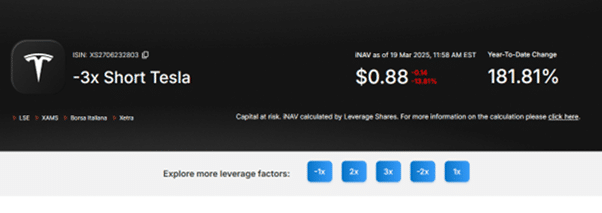
Inverse ETFs offer the simplest way to profit from Tesla's decline without margin accounts or complex strategies. These funds use derivatives to deliver returns opposite to Tesla's daily performance. Canadian investors can access US-listed inverse Tesla ETFs through most brokers that offer US market access, including those on our list of best investment platforms in Canada.
| ETF | Ticker | Leverage | Expense Ratio | Best For |
|---|---|---|---|---|
| Direxion Daily TSLA Bear 1X | TSLS | -1x | 1.07% | Conservative short exposure |
| Tradr 2X Short TSLA Daily | TSLQ | -2x | 1.15% | Aggressive short-term trades |
| T-Rex 2X Inverse Tesla Daily | TSLZ | -2x | 1.05% | Leveraged bearish bets |
Important: Inverse and leveraged ETFs are designed for daily trading, not long-term holding. Due to daily rebalancing and compounding effects, returns over longer periods can differ significantly from expected performance. These products are best suited for short-term tactical trades.
What Fees Will You Pay When Shorting Tesla?
Shorting costs vary significantly by method and platform. Understanding all fees helps you calculate potential profits accurately and choose the most cost-effective approach for your strategy.
| Fee Type | Traditional Short | Options | Inverse ETFs | CFDs |
|---|---|---|---|---|
| Commission | $1-$10/trade | $9.95 + $1/contract | $0-$10 | $0 (spread) |
| Borrow Fee | 0.25%-5% annually | N/A | N/A | N/A |
| Margin Interest | 6%-10% annually | N/A | N/A | N/A |
| Overnight Fees | N/A | N/A | N/A | Variable |
| Expense Ratio | N/A | N/A | 1.05%-1.15% | N/A |
Example: Shorting $10,000 of Tesla traditionally for 30 days with a 3% annual borrow fee and 7% margin interest costs approximately $83 in borrowing/interest fees, plus commissions. Buying $10,000 of TSLS for the same period costs roughly $29 in embedded expense ratio fees.
What Are the Risks of Shorting Tesla Stock?
Shorting Tesla is among the riskiest trades you can make. The stock's extreme volatility, passionate investor base, and unpredictable news flow have burned many short sellers over the years. Understanding these risks is essential before opening any short position.
What Is a Short Squeeze?
A short squeeze occurs when a heavily shorted stock rises sharply, forcing short sellers to buy back shares to limit losses. This buying pressure pushes the price even higher, creating a self-reinforcing cycle. Tesla experienced a historic short squeeze in 2020 that caused catastrophic losses for shorts. Similar dynamics can affect other positions—if you're interested in shorting currencies, our guide on how to short the US dollar covers those strategies.
While Tesla's current short interest (2.69% of float) is relatively low, sudden positive news—like strong delivery numbers or breakthrough announcements—can trigger rapid price spikes that squeeze remaining shorts.
Can You Lose More Than You Invest?
Yes, with traditional short selling and CFDs. When you short a stock, your potential loss is theoretically unlimited because there's no cap on how high a stock price can rise. If you short Tesla at $435 and it doubles to $870, you've lost 100% of your position value—and you'd still owe the broker the shares.
This is why risk management is critical. Stop-loss orders, position sizing, and maintaining adequate margin cushion help protect against catastrophic losses.
Do You Pay Tax on Short Selling Profits in Canada?
Short selling profits are taxed as capital gains in Canada. The Canada Revenue Agency (CRA) treats profits from closing short positions the same as gains from selling regular investments—only 50% of your capital gain is added to your taxable income for the year.
For example, if you profit $5,000 from shorting Tesla, $2,500 would be added to your taxable income and taxed at your marginal rate. Losses can be used to offset capital gains from other investments, and unused losses can be carried back three years or forward indefinitely.
Keep detailed records of all trades including entry/exit prices, dates, and fees. Consider using tax software or consulting a CPA familiar with investment taxation, particularly for complex strategies involving options or frequent trading.
Can You Short Tesla in a TFSA or RRSP?
No, traditional short selling is not permitted in registered accounts like TFSAs or RRSPs. These accounts are designed for long-term investing, and regulators prohibit margin trading and short selling within them.
However, you can hold inverse ETFs (like TSLS or TSLQ) in registered accounts, providing a way to gain short exposure to Tesla within your TFSA or RRSP. Just be aware that frequent trading of volatile products in registered accounts may attract CRA scrutiny, and losses in registered accounts cannot be claimed against other income.
For active short selling strategies, you'll need a non-registered margin account. The flexibility of online trading platforms in Canada allows you to maintain separate accounts for different strategies.
Final Thoughts
Shorting Tesla in Canada is accessible through multiple methods—from traditional short selling and options to inverse ETFs and CFDs. Each approach has distinct advantages: inverse ETFs offer simplicity with capped losses, while traditional shorting and CFDs provide more direct exposure with higher risk.
Before shorting Tesla, honestly assess your risk tolerance and experience level. Start with paper trading or small positions to understand how short positions behave. Use stop-losses religiously, and never risk more than you can afford to lose—Tesla has humbled many confident short sellers over the years.
Whether you choose eToro for CFDs, Questrade for traditional shorting, or Interactive Brokers for advanced strategies, ensure your broker is CIRO-regulated and understand all associated fees. For broader market comparison, explore our guide to Canadian trading platforms.
FAQs
References
- Canadian Investment Regulatory Organization (CIRO). "List of Securities Eligible for Reduced Margin (LSERM)." November 2025. ciro.ca
- Canada Revenue Agency (CRA). "Capital Gains." 2025. canada.ca
- NASDAQ. "Tesla, Inc. (TSLA) Short Interest." January 2026. nasdaq.com
- Interactive Brokers Canada. "Margin Requirements - Canada - Stocks." 2025. interactivebrokers.ca
- Direxion. "Tesla Single-Stock Leveraged ETFs | TSLL TSLS." January 2026. direxion.com
- Ontario Securities Commission (OSC). "Joint CSA and IIROC Staff Notice 23-329 - Short Selling in Canada." 2023. osc.ca
51% of retail investor accounts lose money when trading CFDs with this provider.