
- Expertise:
- CFD Trading, Forex, Derivatives, Risk Management
- Credentials:
- Chartered ACII (2018) · Trading since 2012
- Tested:
- 40+ forex & CFD platforms with live accounts

- Expertise:
- Broker Comparison, ISA Strategy, Portfolio Management
- Credentials:
- Active investor since 2013 · 11+ years experience
- Tested:
- 40+ brokers with funded accounts
How We Test
Real accounts. Real money. Real trades. No demo accounts or press releases.
What we measure:
- Spreads vs advertised rates
- Execution speed and slippage
- Hidden fees (overnight, withdrawal, conversion)
- Actual withdrawal times
Scoring:
Fees (25%) · Platform (20%) · Assets (15%) · Mobile (15%) · Tools (10%) · Support (10%) · Regulation (5%)
Testing team:
Adam Woodhead (investing since 2013), Thomas Drury (Chartered ACII, 2018), Dom Farnell (investing since 2013) — 50+ platforms with funded accounts
Quarterly reviews · Corrections: [email protected]
Disclaimer
Not financial advice. Educational content only. We're not FCA authorised. Consult a qualified advisor before investing.
Capital at risk. Investments can fall. Past performance doesn't guarantee future results.
CFD warning. 67-84% of retail accounts lose money trading CFDs. High risk due to leverage.
Contact: [email protected]
What Are the Best Trading Platforms in Canada?
CMC Markets is the best trading platform in Canada for 2026, offering CIRO regulation with CIPF protection up to CAD $1,000,000, spreads from 0.8 pips on EUR/USD, and access to over 12,000 CFD instruments. For beginners, OANDA provides a regulated entry point with no minimum deposit, while traders seeking lower costs can access raw spreads from 0.0 pips through offshore brokers like Axi.

70% of retail CFD accounts lose money.

76.6% of retail CFD accounts lose money.
71.63% of retail CFD accounts lose money.
Trading and investing involve risk. Capital at Risk

Trading and investing involve risk. Capital at Risk

Trading and investing involve risk. Capital at Risk

76% of retail CFD accounts lose money.
How Do Canada's Top Trading Platforms Compare?
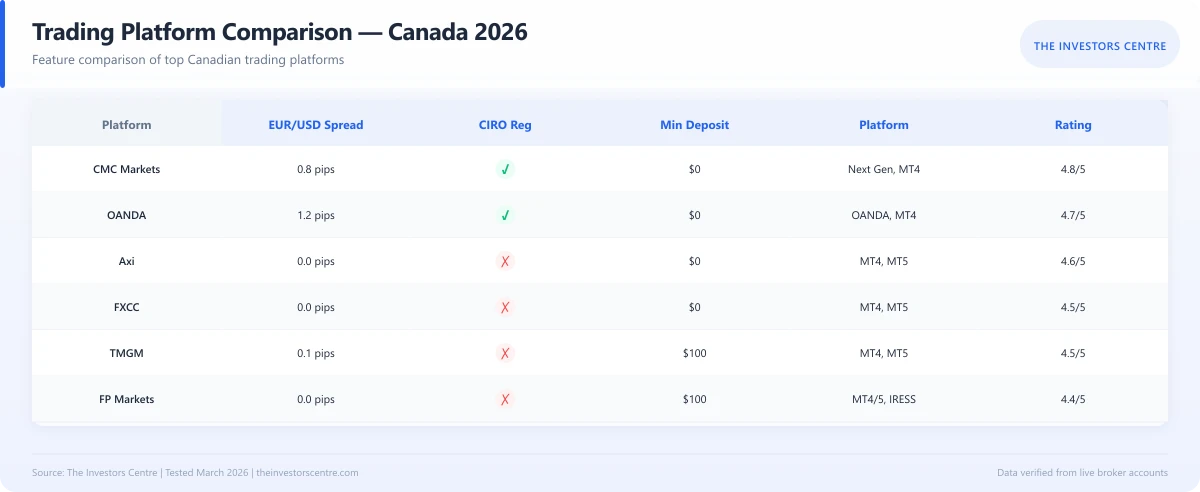
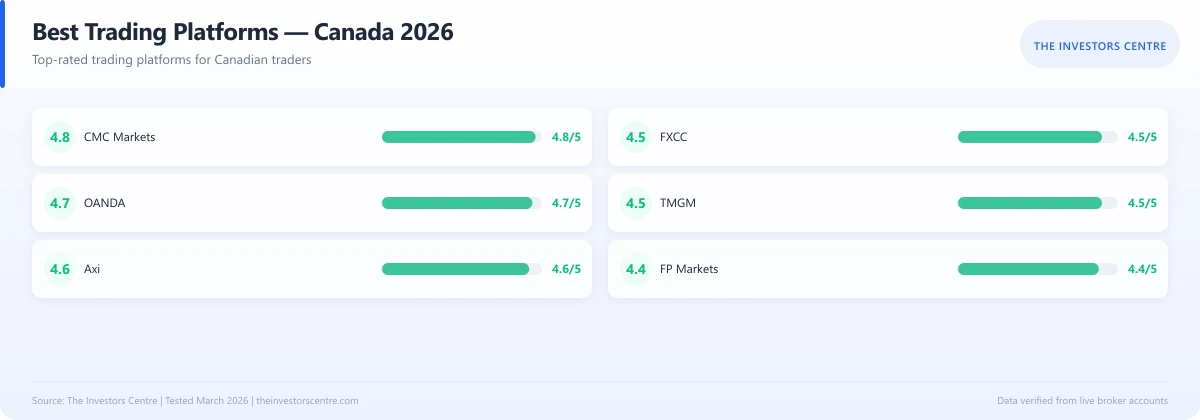
We've tested seven platforms across spreads, regulation, minimum deposits, and platform quality. The table below compares the key features that matter most to Canadian traders in 2026.
| # | Provider | EUR/USD Spread | CIRO Regulated | Min Deposit | TIC Score | Best For |
|---|---|---|---|---|---|---|
| 1 | CMC Markets | 0.8 pips | Yes | $0 | 4.8/5 | CIPF protection |
| 2 | OANDA | 1.2 pips | Yes | $0 | 4.7/5 | Beginners |
| 3 | Axi | 0.0 pips | No | $0 | 4.6/5 | Low costs |
| 4 | FXCC | 0.0 pips | No | $0 | 4.5/5 | ECN execution |
| 5 | TMGM | 0.1 pips | No | $100 | 4.5/5 | Fast execution |
| 6 | FP Markets | 0.0 pips | No | $100 AUD | 4.4/5 | Platform variety |
| 7 | AvaTrade | 0.6 pips | Yes | $100 | 4.4/5 | Copy trading |
Here Are The Top 7 Trading Platforms in Canada:
1. CMC Markets — Best Overall
2. OANDA — Best for Beginners
3. Axi — Best for Low-Cost Trading
4. FXCC — Best for ECN Execution
5. TMGM — Best for Fast Execution
6. FP Markets — Best for Platform Variety
7. AvaTrade — Best for Copy Trading
CMC Markets – Best Overall
🏆 Editor's Choice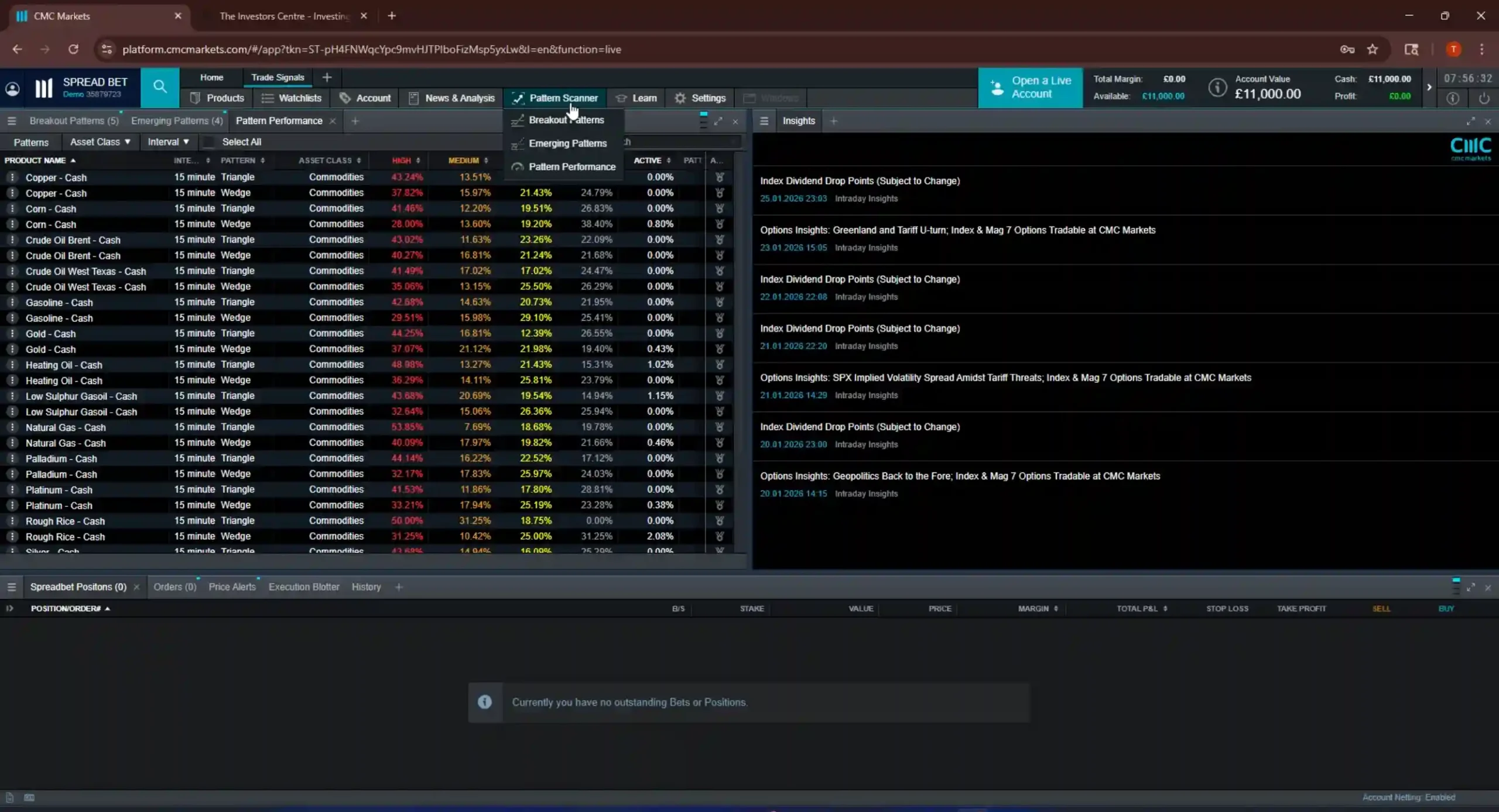
Pros
- CIRO-regulated with full CIPF protection up to CAD $1,000,000
- Over 12,000 tradeable instruments including forex, indices, and commodities
- Award-winning Next Generation platform with advanced charting
Cons
- Spreads slightly higher than offshore ECN brokers
- Maximum leverage limited to 1:50 under CIRO rules
What Are the Fees and Spreads?
CMC Markets offers spreads from 0.8 pips on EUR/USD with no commission on standard accounts, making it competitively priced among CIRO-regulated brokers. The spread-only pricing model simplifies cost calculations for traders who prefer transparent, all-inclusive pricing without separate commission charges.
Additional costs include overnight financing for positions held past market close and a CAD $15 monthly inactivity fee after 12 months of dormancy. Currency conversion fees apply when trading instruments denominated in currencies other than your account base currency.
What Trading Platforms Are Available?
CMC Markets' proprietary Next Generation platform delivers institutional-grade charting with over 115 technical indicators, 12 chart types, and customisable layouts. The platform supports advanced order types including guaranteed stop-losses, which cap maximum risk for a small premium regardless of market gaps.
Mobile trading is available through dedicated iOS and Android apps that maintain full functionality including charting, alerts, and order management. MetaTrader 4 is also available for traders who prefer the familiar MT4 interface and require Expert Advisor compatibility.
Is This Broker Regulated in Canada?
CMC Markets operates under full CIRO regulation for Canadian clients, providing investor protection through the Canadian Investor Protection Fund up to CAD $1,000,000. This protection covers client assets if CMC Markets becomes insolvent, though it does not protect against trading losses.
The broker segregates client funds from operational capital in separate bank accounts, ensuring client money remains protected even if the firm faces financial difficulties. CMC Markets also maintains memberships with provincial securities commissions and adheres to strict reporting and capital adequacy requirements.
Who Should Use CMC Markets?
CMC Markets suits Canadian traders prioritising regulatory protection and institutional-grade platforms over minimal costs. The combination of CIPF coverage, competitive spreads among regulated options, and advanced charting makes it ideal for serious retail traders who value oversight.
Traders requiring the absolute tightest spreads or leverage above 1:50 should consider offshore alternatives, as CMC Markets' regulatory compliance means slightly wider spreads and leverage restrictions compared to unregulated platforms.
OANDA – Best for Beginners
🎓 Beginner Friendly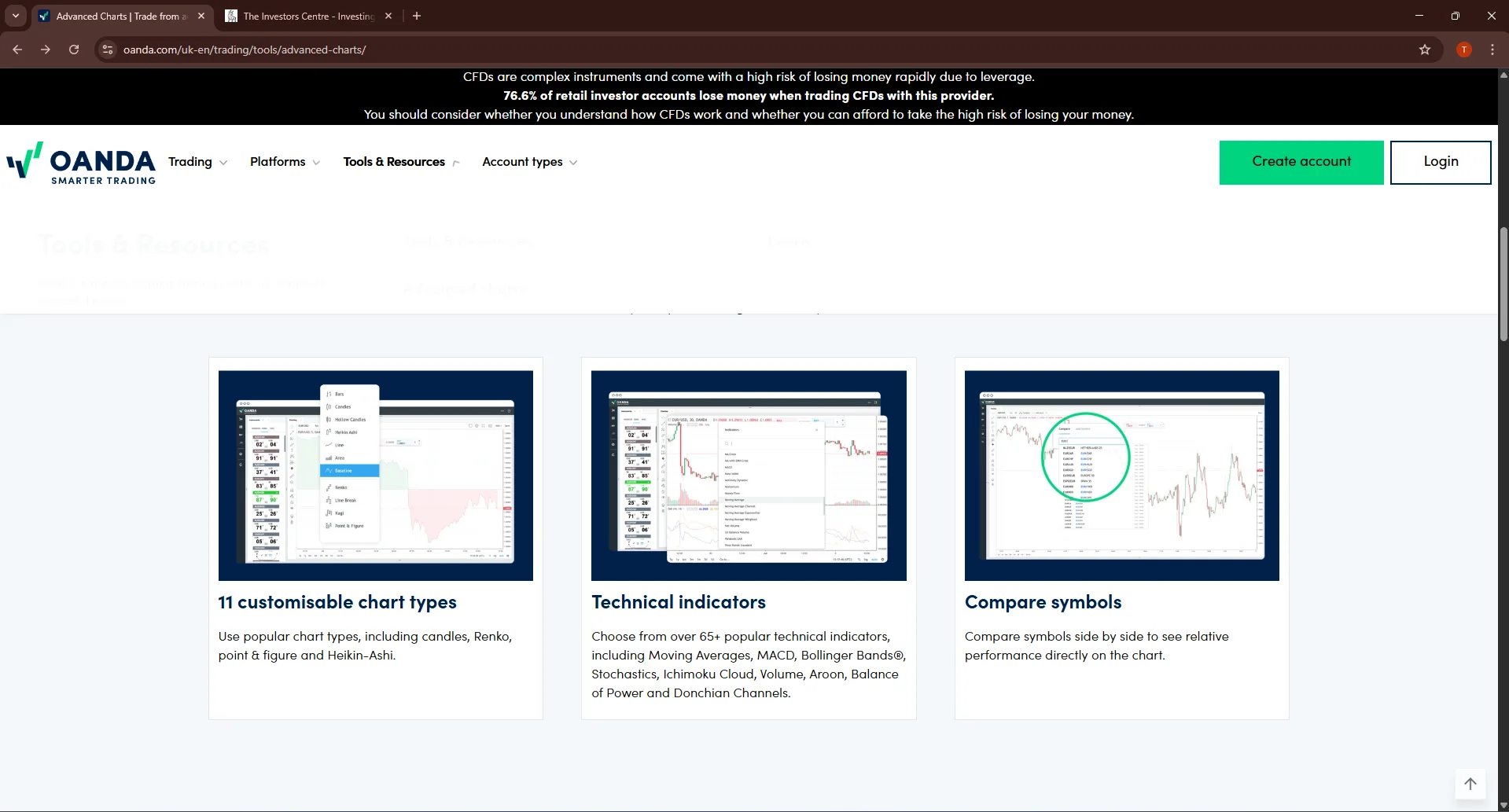
Pros
- No minimum deposit requirement
- User-friendly proprietary platform ideal for beginners
- CIRO-regulated with CIPF protection
Cons
- Spreads wider than some competitors at 1.2 pips on EUR/USD
- Limited instrument range compared to CMC Markets
What Are the Fees and Spreads?
OANDA charges spreads from 1.2 pips on EUR/USD with no separate commission charges, positioning it in the mid-range among CIRO-regulated brokers. While slightly wider than CMC Markets' 0.8 pips, the transparent pricing and no minimum deposit make it accessible for traders starting with small capital.
No inactivity fees apply during the first 12 months of account dormancy, and overnight financing charges are competitive with industry standards. Currency conversion fees apply when trading instruments denominated in foreign currencies.
What Trading Platforms Are Available?
OANDA's proprietary web-based platform emphasises simplicity and intuitive navigation, making it particularly suitable for traders new to forex and CFD markets. The platform includes essential charting tools, technical indicators, and one-click trading functionality without overwhelming novice users.
Mobile apps for iOS and Android mirror the web platform's straightforward design. MetaTrader 4 and MetaTrader 5 are available for traders who require advanced automation and expert advisor functionality as they progress beyond beginner status.
What Educational Resources Are Provided?
OANDA provides comprehensive educational content including video tutorials, webinars, and written guides covering forex fundamentals through to advanced trading strategies. The learning centre structures content by experience level, allowing beginners to progress systematically through core concepts.
The broker's market analysis section delivers daily commentary on major currency pairs and market-moving events, helping traders understand how news impacts price movements. A demo account with virtual funds allows risk-free practice before committing real capital.
Who Should Use OANDA?
OANDA is ideal for Canadian beginners seeking a gentle introduction to forex and CFD trading under regulatory protection. The no minimum deposit requirement removes barriers to entry, while the intuitive platform design reduces the learning curve associated with more complex trading software.
Experienced traders seeking the tightest possible spreads or extensive instrument ranges may find better value elsewhere, particularly with offshore brokers offering raw spreads from 0.0 pips.
Axi – Best for Low-Cost Trading
💰 Lowest Spreads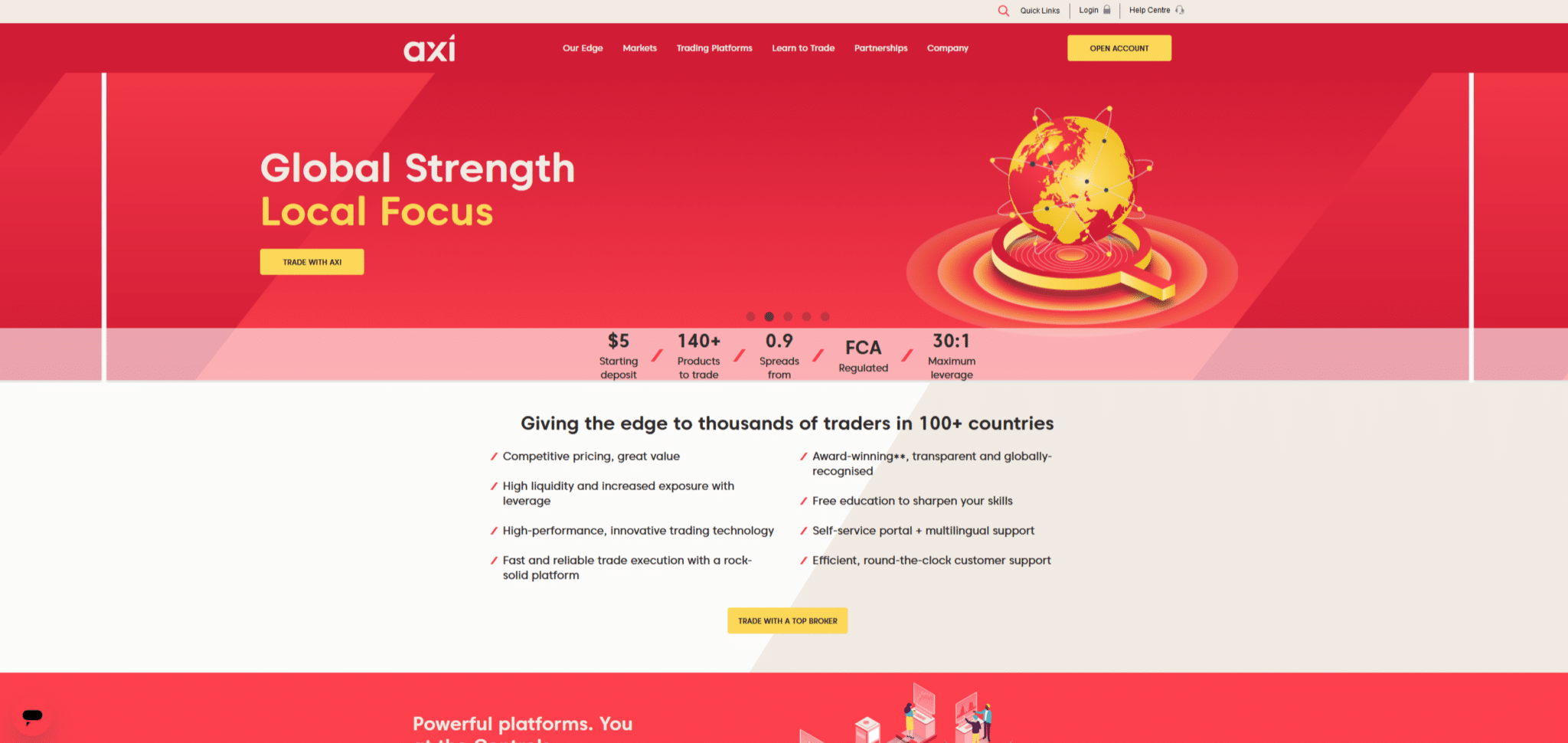
Pros
- Raw spreads from 0.0 pips on Pro accounts
- ASIC regulation provides credible oversight
- No minimum deposit requirement
Cons
- No CIPF protection as offshore broker
- Commission charges apply on Pro accounts (USD $3.50 per lot)
What Are the Fees and Spreads?
Axi's Pro account delivers raw spreads from 0.0 pips on major forex pairs, charging a USD $3.50 commission per standard lot (per side). This commission-based model results in total costs from approximately 0.7 pips on EUR/USD, significantly lower than spread-only pricing from CIRO-regulated brokers.
The Standard account offers commission-free trading with spreads from 1.2 pips, similar to OANDA's pricing. Overnight financing charges and currency conversion fees apply across both account types. No inactivity fees are charged regardless of account dormancy period.
What Trading Platforms Are Available?
Axi provides MetaTrader 4 as its primary platform, delivering the industry-standard interface familiar to millions of traders worldwide. MT4 supports automated trading through Expert Advisors, custom indicators, and comprehensive backtesting functionality for algorithmic strategies.
The platform's mobile apps maintain full functionality including charting, order management, and EA monitoring. Axi Copy Trading is available for traders who prefer following experienced traders' strategies rather than executing their own analysis.
How Is Axi Regulated?
Axi operates under ASIC regulation (AFSL 318232), one of the world's strictest regulatory frameworks. While Canadian traders forego CIPF protection when choosing Axi, ASIC oversight includes segregated client accounts, negative balance protection, and regular financial reporting requirements.
Disputes escalate to Australian regulatory authorities rather than Canadian equivalents. Traders comfortable with foreign jurisdiction oversight benefit from Axi's lower costs and higher leverage (up to 1:500 for professional clients) compared to CIRO-regulated alternatives.
Who Should Use Axi?
Axi suits cost-conscious Canadian traders willing to trade without CIPF protection in exchange for significantly tighter spreads. Active traders executing frequent trades benefit most from the reduced transaction costs, as the savings accumulate substantially compared to wider spread-only pricing.
Traders requiring Canadian regulatory protection, access to OBSI dispute resolution, or CIPF coverage should choose CIRO-regulated brokers like CMC Markets or OANDA despite higher trading costs.
FXCC – Best for ECN Execution
⚡ True ECN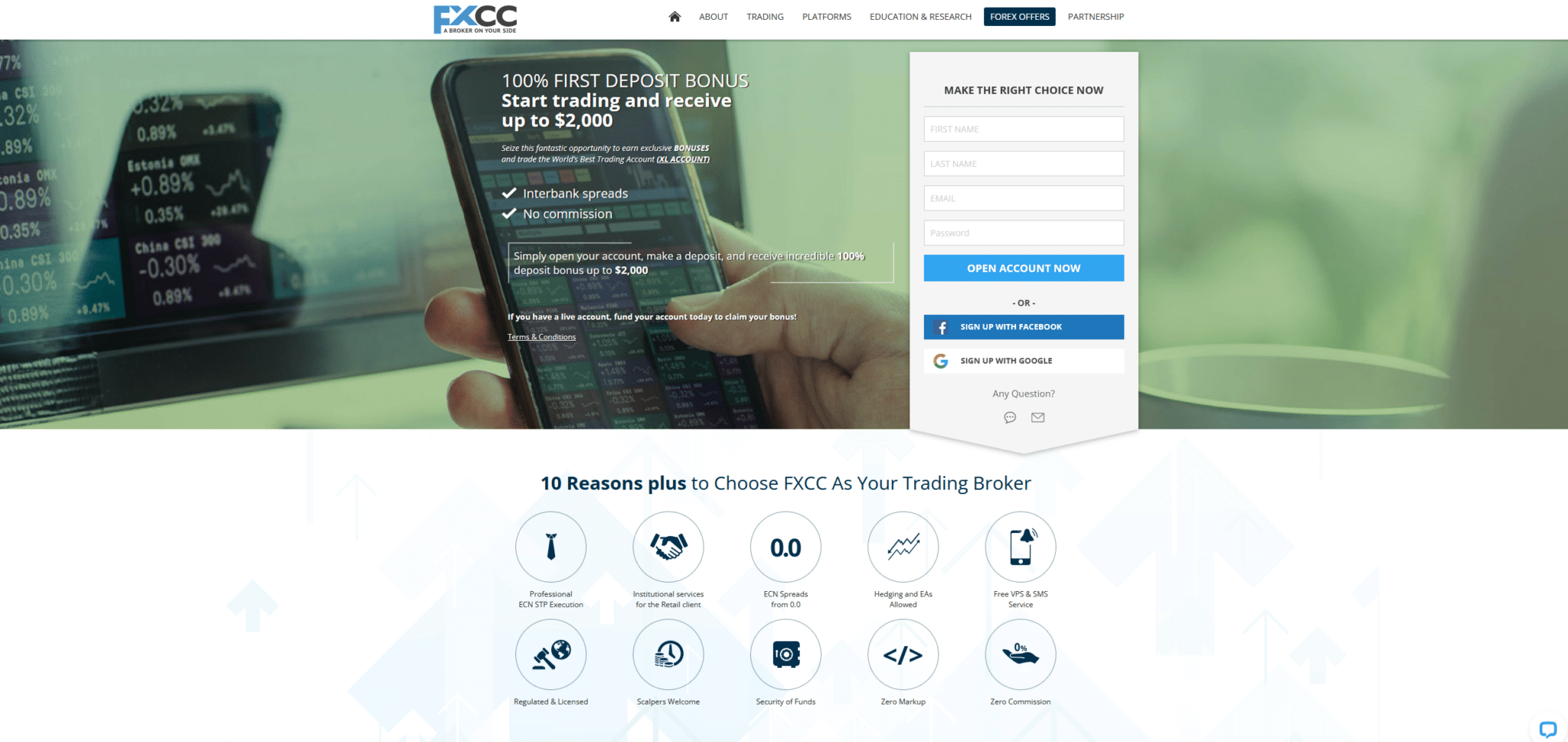
Pros
- True ECN execution with direct market access
- Raw spreads from 0.0 pips
- No minimum deposit requirement
Cons
- CySEC regulation less stringent than CIRO or ASIC
- No Canadian regulatory protection
What Are the Fees and Spreads?
FXCC's ECN account charges raw spreads from 0.0 pips plus a commission of USD $4 per standard lot round-turn. Total trading costs typically range from 0.8-1.0 pips on major pairs, competitive with other ECN brokers but slightly higher than Axi's USD $3.50 per side commission.
The broker offers commission-free Standard accounts with spreads from 1.5 pips, though the ECN account provides better value for active traders. No inactivity fees, withdrawal fees, or account maintenance charges apply.
How Does ECN Execution Work?
FXCC operates a true ECN (Electronic Communication Network) where buy and sell orders from multiple liquidity providers compete transparently. Traders access Level II pricing showing depth of market, allowing visibility of available liquidity at various price levels.
Orders execute at best available prices without dealer intervention, eliminating potential conflicts of interest inherent in market maker models. This results in faster execution speeds and reduced slippage during volatile market conditions, though spreads widen during low liquidity periods.
Is FXCC Safe and Regulated?
FXCC holds CySEC regulation (license 121/10), operating under European Union regulatory frameworks. While CySEC maintains investor compensation schemes (up to EUR 20,000), Canadian traders cannot access Canadian investor protection mechanisms or dispute resolution through local authorities.
The broker segregates client funds in separate bank accounts and maintains professional indemnity insurance. However, traders should understand that foreign regulation provides different protections than CIRO oversight, particularly regarding leverage limits and negative balance protection implementation.
Who Should Use FXCC?
FXCC suits experienced Canadian traders who understand ECN execution and prioritise direct market access over regulatory protection. Scalpers and high-frequency traders benefit most from the transparent pricing and fast execution inherent to ECN models.
Beginners or traders requiring Canadian regulatory safeguards should choose CIRO-regulated brokers. FXCC's ECN model requires understanding of variable spreads and market depth concepts that novice traders may find confusing.
TMGM – Best for Fast Execution
🚀 94ms Average
Pros
- 94ms average execution speed
- Spreads from 0.1 pips on major pairs
- ASIC-regulated with strong oversight
Cons
- $100 minimum deposit requirement
- No CIPF protection for Canadian traders
What Are the Fees and Spreads?
TMGM offers spreads from 0.1 pips on its Edge account with USD $3 commission per lot per side, delivering total costs from approximately 0.7 pips on EUR/USD. This pricing competes directly with Axi while offering superior execution speeds beneficial for scalping strategies.
The Classic account provides commission-free trading with spreads from 1.2 pips. Overnight financing charges and currency conversion fees apply across both account types. A $100 minimum deposit applies, higher than Axi's no minimum requirement but still accessible for most traders.
How Fast Is TMGM's Execution?
TMGM achieves 94ms average execution speeds through strategic data centre placement and direct connectivity to liquidity providers. Orders route through Equinix NY4 and LD5 facilities, minimising latency between order submission and fill confirmation.
The broker processes 99.89% of orders at requested prices with minimal slippage during normal market conditions. High-frequency traders and scalpers benefit most from these speeds, as every millisecond impacts profitability when holding positions for seconds or minutes.
How Is TMGM Regulated?
TMGM operates under ASIC regulation (AFSL 436416), providing similar regulatory protections to Axi. Client funds segregate in separate accounts with tier-one Australian banks, and negative balance protection prevents traders owing more than deposited capital.
Canadian traders access foreign regulatory protections rather than CIPF coverage. Disputes escalate through Australian channels including the Australian Financial Complaints Authority rather than Canadian equivalents like OBSI.
Who Should Use TMGM?
TMGM suits active Canadian traders executing frequent short-term trades where execution speed materially impacts profitability. Scalpers holding positions for seconds to minutes benefit most from the 94ms average execution, as slower platforms introduce slippage that erodes profits.
Long-term position traders derive less benefit from ultra-fast execution, as holding trades for days or weeks makes millisecond differences immaterial. These traders may prioritise other factors like regulatory protection or lower overall costs.
FP Markets – Best for Platform Variety
🖥️ Multiple Platforms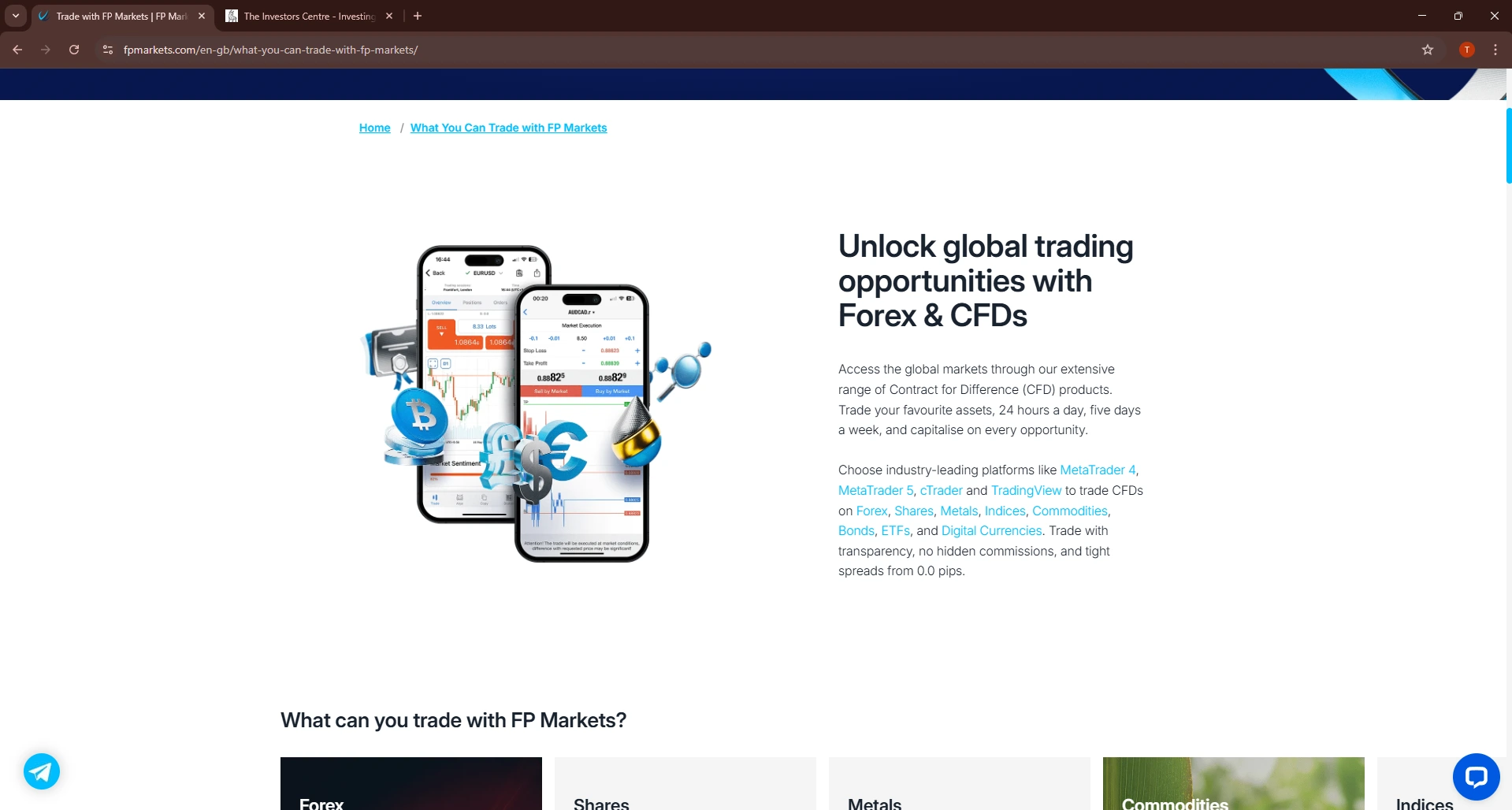
Pros
- Widest platform selection: MT4, MT5, cTrader, TradingView
- Raw spreads from 0.0 pips
- ASIC regulation provides credible oversight
Cons
- $100 AUD minimum deposit
- No Canadian regulatory protection
What Are the Fees and Spreads?
FP Markets' Raw account delivers spreads from 0.0 pips with USD $3 commission per lot per side, matching Axi's pricing structure. Total costs on EUR/USD typically range from 0.6-0.8 pips, competitive among offshore brokers offering raw spread pricing.
The Standard account provides commission-free trading with spreads from 1.4 pips. All accounts require a $100 AUD minimum deposit (approximately $90 CAD), higher than no-minimum alternatives like Axi or FXCC but still accessible. No inactivity fees or withdrawal charges apply.
What Platforms Are Available?
FP Markets provides MetaTrader 4, MetaTrader 5, cTrader, and TradingView integration—the most comprehensive platform selection among brokers in our comparison. Each platform maintains the same raw spreads and execution quality, allowing traders to choose based on interface preferences and features.
cTrader offers advanced order types and superior charting compared to MT4, appealing to traders prioritising platform sophistication. TradingView integration allows trading directly from charts within the popular analysis platform. All platforms include mobile apps maintaining full functionality.
How Is FP Markets Regulated?
FP Markets operates under ASIC regulation (AFSL 286354), providing Australian regulatory protections including segregated client accounts, negative balance protection, and regular financial reporting. Client funds hold in separate accounts with National Australia Bank, one of Australia's major banking institutions.
Canadian traders forego CIPF protection when choosing FP Markets, though ASIC regulation provides comparable oversight to CIRO in terms of capital adequacy and business conduct requirements. Disputes escalate through Australian regulatory channels rather than Canadian equivalents.
Who Should Use FP Markets?
FP Markets suits Canadian traders who value platform choice and want flexibility to switch between different trading interfaces. Traders experienced with cTrader or preferring TradingView integration find FP Markets uniquely positioned among offshore options.
Beginners should consider whether they'll utilise the platform variety, as simpler brokers like OANDA may provide better value if using only one platform. The $100 AUD minimum deposit also creates a higher entry barrier than no-minimum alternatives.
AvaTrade – Best for Copy Trading
👥 Social Trading
Pros
- CIRO-regulated with CIPF protection
- Multiple copy trading platforms (DupliTrade, ZuluTrade)
- Comprehensive educational resources
Cons
- Wider spreads (0.6 pips) than offshore competitors
- $100 minimum deposit requirement
What Are the Fees and Spreads?
AvaTrade charges spreads from 0.6 pips on EUR/USD with no separate commission, positioning it competitively among CIRO-regulated brokers though wider than offshore alternatives. The all-inclusive spread pricing simplifies cost calculations without requiring commission tracking.
A $100 minimum deposit applies, standard for regulated brokers. Inactivity fees of $50 per quarter apply after 12 months of account dormancy. Overnight financing charges and currency conversion fees follow industry norms. Copy trading through DupliTrade or ZuluTrade may incur additional platform fees depending on strategy selection.
How Does Copy Trading Work?
AvaTrade provides DupliTrade and ZuluTrade integration, allowing traders to automatically replicate strategies from experienced traders. Users browse strategy performance statistics, select traders to follow, and allocate capital for proportional copy trading execution in their own accounts.
DupliTrade focuses on algorithmic strategy providers, while ZuluTrade emphasises individual trader copying. Both platforms display comprehensive performance metrics including historical returns, drawdowns, and win rates. Traders maintain full control to stop copying or adjust allocation percentages anytime.
Is AvaTrade Regulated in Canada?
AvaTrade operates under CIRO regulation for Canadian clients, providing CIPF protection up to CAD $1,000,000 per account category. The broker maintains separate entities regulated by Central Bank of Ireland, ASIC, and other jurisdictions, though Canadian clients trade through the CIRO-regulated entity.
Client funds segregate in separate accounts with major Canadian financial institutions, and the broker maintains professional indemnity insurance. Leverage limits of 1:50 for major forex pairs apply under CIRO rules, lower than AvaTrade's offshore offerings but consistent with Canadian regulatory requirements.
Who Should Use AvaTrade?
AvaTrade suits Canadian traders prioritising copy trading functionality under regulatory protection. Beginners or those lacking time for independent analysis benefit from accessing experienced traders' strategies while maintaining CIPF coverage unavailable with offshore alternatives.
Active traders requiring the tightest possible spreads find better value with offshore brokers offering raw spreads from 0.0 pips. AvaTrade's 0.6 pip spreads, while competitive among CIRO-regulated options, cost approximately 0.6 pips per round-turn more than offshore ECN alternatives.
What Is the Difference Between CIRO and Offshore Brokers?
Canadian traders choosing between CIRO-regulated and offshore brokers face a fundamental tradeoff between regulatory protection and trading costs. CIRO-regulated brokers provide CIPF coverage up to CAD $1,000,000 but charge wider spreads and limit leverage to 1:50. Offshore brokers offer tighter spreads and higher leverage without Canadian investor protection mechanisms.
CIPF protection covers client assets if a CIRO member firm becomes insolvent, protecting up to CAD $1,000,000 in general accounts plus additional coverage for registered accounts like RRSPs and TFSAs. This protection does not cover trading losses—only firm insolvency. Offshore brokers regulated by ASIC or CySEC maintain their own investor compensation schemes, though Canadian traders cannot access Canadian protection mechanisms.
Can You Trust Offshore Brokers?
Reputable offshore brokers regulated by ASIC or CySEC maintain credible oversight comparable to CIRO in many respects. ASIC-regulated brokers like Axi, TMGM, and FP Markets segregate client funds, provide negative balance protection, and submit to regular audits. However, disputes escalate through foreign regulatory channels without access to Canada's Ombudsman for Banking Services and Investments (OBSI).
The tradeoff centres on priorities: traders prioritising maximum regulatory protection and Canadian dispute resolution choose CIRO-regulated brokers despite higher costs. Those comfortable with foreign regulatory oversight and willing to forego CIPF protection access significantly lower spreads and higher leverage with reputable offshore alternatives.
What Are the Leverage Limits for Canadian Traders?
CIRO-regulated brokers must adhere to strict leverage limits designed to protect retail traders from excessive risk. These limits vary by instrument type, with major forex pairs receiving the highest leverage allowance and single stocks the most restricted.
Offshore brokers operating outside CIRO jurisdiction can offer significantly higher leverage, with some platforms providing up to 1:500 on major forex pairs. While this amplifies potential profits, it equally magnifies losses, and traders forfeit CIPF protection when choosing unregulated platforms.
What Is the Difference Between CIRO and Offshore Leverage?
CIRO leverage limits of 1:50 for major forex pairs mean traders need CAD $2,000 in margin to control a $100,000 position. Offshore brokers offering 1:500 leverage require only CAD $200 for the same position size, dramatically reducing capital requirements but increasing risk proportionally.
Canadian traders can access higher leverage by opening accounts with offshore brokers like Axi, FXCC, or TMGM, though this requires accepting the absence of CIPF protection and local regulatory oversight. The best forex brokers in Canada offer both regulated and offshore options to suit different risk tolerances.
How Is Trading Income Taxed in Canada?
Canadian traders must report all trading profits to the Canada Revenue Agency, with tax treatment depending on whether activity qualifies as capital gains or business income. The distinction significantly impacts the effective tax rate applied to profits.
What Is the Difference Between Capital Gains and Business Income?
Capital gains treatment applies to occasional traders who hold positions for investment purposes. Only 50% of capital gains are taxable, meaning a $10,000 profit results in $5,000 being added to taxable income at your marginal rate.
Business income treatment applies to frequent traders, those using significant leverage, or individuals whose trading resembles a commercial operation. Business income is 100% taxable but allows deduction of trading-related expenses including platform fees, data subscriptions, and home office costs.
The CRA examines factors including trading frequency, holding periods, leverage usage, and whether trading represents a primary income source when determining classification. Consulting a tax professional familiar with securities trading is advisable for active traders.
Final Thoughts
The best trading platform in Canada for 2026 depends on your priorities regarding regulation, costs, and features. CMC Markets leads our rankings as the top CIRO-regulated option, combining competitive spreads with full CIPF protection and access to over 12,000 instruments. OANDA suits beginners seeking a user-friendly entry point with no minimum deposit, while AvaTrade excels for copy trading enthusiasts who want local regulation.
Traders willing to forego CIPF protection for lower costs and higher leverage have strong offshore options. Axi delivers raw spreads from 0.0 pips, TMGM offers the fastest execution at 94ms, and FP Markets provides the widest platform selection including cTrader and TradingView integration.
Regardless of which platform you choose, understanding the regulatory implications is essential. CIRO-regulated brokers provide CAD $1,000,000 in CIPF protection per account category and access to Canadian dispute resolution through OBSI. Offshore brokers offer cost and leverage advantages but require accepting foreign jurisdiction oversight without local investor protection. For those exploring broader options, our guides to cryptocurrency exchanges in Canada and investment platforms in Canada provide additional comparisons.
FAQs
Sources
- Canadian Investment Regulatory Organization. "About CIRO." Accessed January 2026.
- Canadian Investor Protection Fund. "About CIPF Coverage." Accessed January 2026.
- Ontario Securities Commission. "Canadian Investor Protection Fund (CIPF)." Accessed January 2026.
- Canada Revenue Agency. "Foreign Currencies - Capital Gains." Accessed January 2026.
- Financial Transactions and Reports Analysis Centre of Canada. "FINTRAC Guidance." Accessed January 2026.
- GetSmarterAboutMoney.ca. "How Your Investments Are Protected." Ontario Securities Commission. Accessed January 2026.