
- Expertise:
- Platform Testing, Cryptocurrency, Retail Investing
- Credentials:
- Active investor since 2013 · 11+ years experience
- Tested:
- 50+ platforms · 200+ guides authored

- Expertise:
- CFD Trading, Forex, Derivatives, Risk Management
- Credentials:
- Chartered ACII (2018) · Trading since 2012
- Tested:
- 40+ forex & CFD platforms with live accounts
How We Test
Real accounts. Real money. Real trades. No demo accounts or press releases.
What we measure:
- Spreads vs advertised rates
- Execution speed and slippage
- Hidden fees (overnight, withdrawal, conversion)
- Actual withdrawal times
Scoring:
Fees (25%) · Platform (20%) · Assets (15%) · Mobile (15%) · Tools (10%) · Support (10%) · Regulation (5%)
Testing team:
Adam Woodhead (investing since 2013), Thomas Drury (Chartered ACII, 2018), Dom Farnell (investing since 2013) — 50+ platforms with funded accounts
Quarterly reviews · Corrections: [email protected]
Disclaimer
Not financial advice. Educational content only. We're not FCA authorised. Consult a qualified advisor before investing.
Capital at risk. Investments can fall. Past performance doesn't guarantee future results.
CFD warning. 67-84% of retail accounts lose money trading CFDs. High risk due to leverage.
Contact: [email protected]
What Are the Best Forex Brokers in Canada for 2026?
CMC Markets is the best forex broker in Canada for 2026, offering ultra-competitive spreads from 0.7 pips on EUR/USD and access to over 330 currency pairs. All forex brokers operating in Canada must be regulated by the Canadian Investment Regulatory Organization (CIRO), with client funds protected up to $1 million through the Canadian Investor Protection Fund (CIPF). Canadian traders can access leverage up to 50:1 on major currency pairs like USD/CAD and EUR/USD.

70% of retail CFD accounts lose money.

62.5% of retail CFD accounts lose money

76.6% of retail CFD accounts lose money.

70% of retail CFD accounts lose money.

Trading and investing involve risk. Capital at Risk

Trading and investing involve risk. Capital at Risk

64% of retail CFD accounts lose money.
How Do the Best Forex Brokers in Canada Compare?
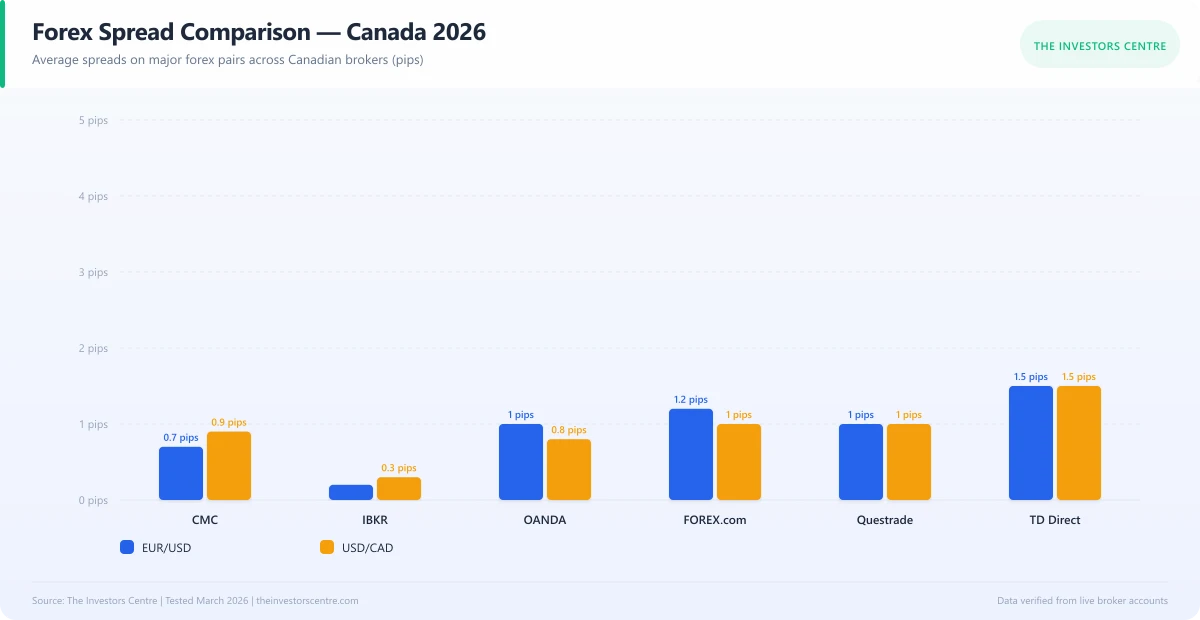
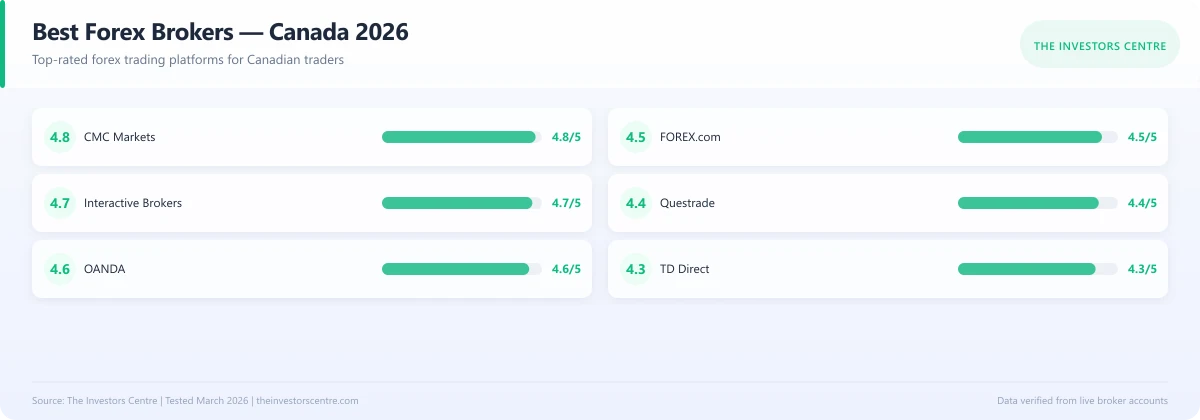
The table below provides a quick comparison of spreads, currency pair availability, platforms, and our overall rating for each CIRO-regulated forex broker available to Canadian traders in 2026.
| # | Broker | EUR/USD Spread | Pairs | Platform | Rating |
|---|---|---|---|---|---|
| 1 | CMC Markets | 0.7 pips | 330+ | Next Gen, MT4 | 4.8 |
| 2 | Interactive Brokers | 0.1-0.2 pips* | 100+ | TWS, IBKR | 4.7 |
| 3 | OANDA | 0.9-1.0 pips | 68+ | OANDA, MT4 | 4.6 |
| 4 | FOREX.com | 1.0-1.3 pips | 80+ | FOREX.com, MT4/5 | 4.5 |
| 5 | Questrade | ~1.0 pip | 100+ | Questrade Global | 4.4 |
| 6 | TD Direct Investing | ~1.5 pips | 50+ | WebBroker | 4.3 |
| 7 | Saxo Bank | 0.6-0.9 pips | 185+ | SaxoTraderGO | 4.3 |
*Interactive Brokers charges a commission of 0.08-0.20 basis points in addition to spreads.
Here Are the 7 Best Forex Brokers in Canada
1. CMC Markets — Best Overall
2. Interactive Brokers — Best for Low-Cost Trading
3. OANDA — Best for Beginners
4. FOREX.com — Best for Research and Education
5. Questrade — Best Canadian Multi-Asset Broker
6. TD Direct Investing — Best for Bank Integration
7. Saxo Bank — Best for Professional Traders
CMC Markets — Best Overall
🏆 Editor's Choice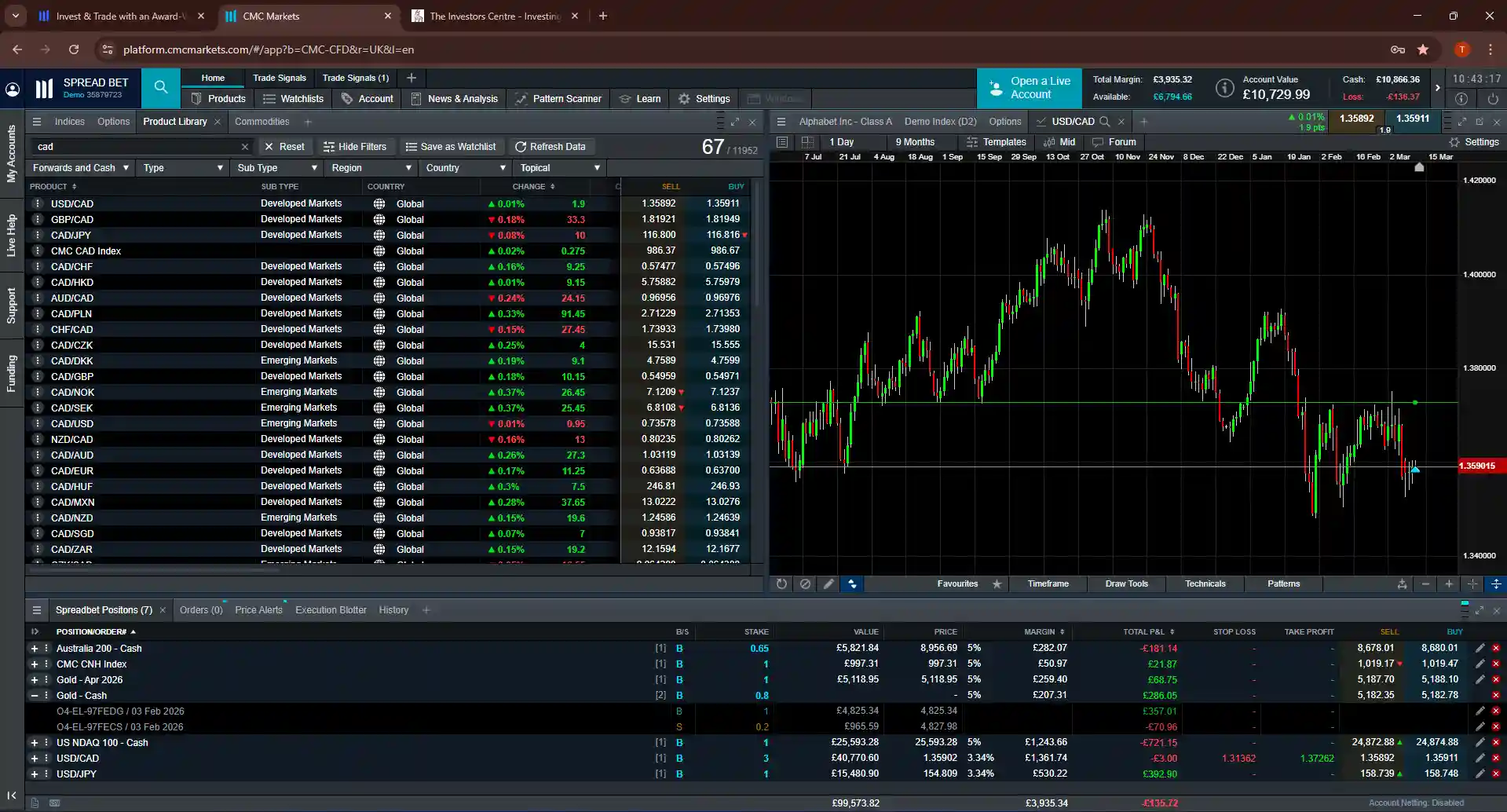
Pros
- Ultra-competitive spreads from 0.7 pips on EUR/USD
- Largest forex pair selection (330+) among Canadian brokers
- Award-winning Next Generation platform with advanced tools
- No minimum deposit requirement
Cons
- No MT5 platform availability
- Inactivity fee of $15 CAD/month after 12 months
What Are the Spreads and Fees?
CMC Markets offers some of the tightest spreads in the Canadian market, with EUR/USD averaging 0.7 pips and USD/CAD from 1.3 pips during active trading hours. There are no commissions on standard accounts, and the broker provides up to 20% spread discounts through its price improvement technology.
What Currency Pairs Can You Trade?
CMC Markets provides access to over 330 currency pairs—the largest selection available to Canadian traders. This includes all major pairs (EUR/USD, GBP/USD, USD/CAD), minors, and an extensive range of exotics. You can trade positions as small as 0.01 lots (micro-lots), making it accessible for smaller accounts.
How Good Is the Trading Platform?
The Next Generation platform is CMC's proprietary web and mobile platform, featuring customizable layouts, 115+ technical indicators, pattern recognition, and integrated Reuters news. The platform executes trades in an average of 0.0030 seconds. MetaTrader 4 is also available for those who prefer it, though MT5 is not currently offered.
Is CMC Markets Safe and Regulated?
CMC Markets Canada Inc. holds CIRO membership and is registered with provincial securities commissions across Canada. Client funds are held in segregated accounts at Canadian chartered banks, and the broker maintains CIPF membership providing up to $1 million coverage per account category. The company has operated in Canada for over a decade and is part of CMC Markets plc, listed on the London Stock Exchange.
Interactive Brokers — Best for Low-Cost Trading
💰 Lowest Costs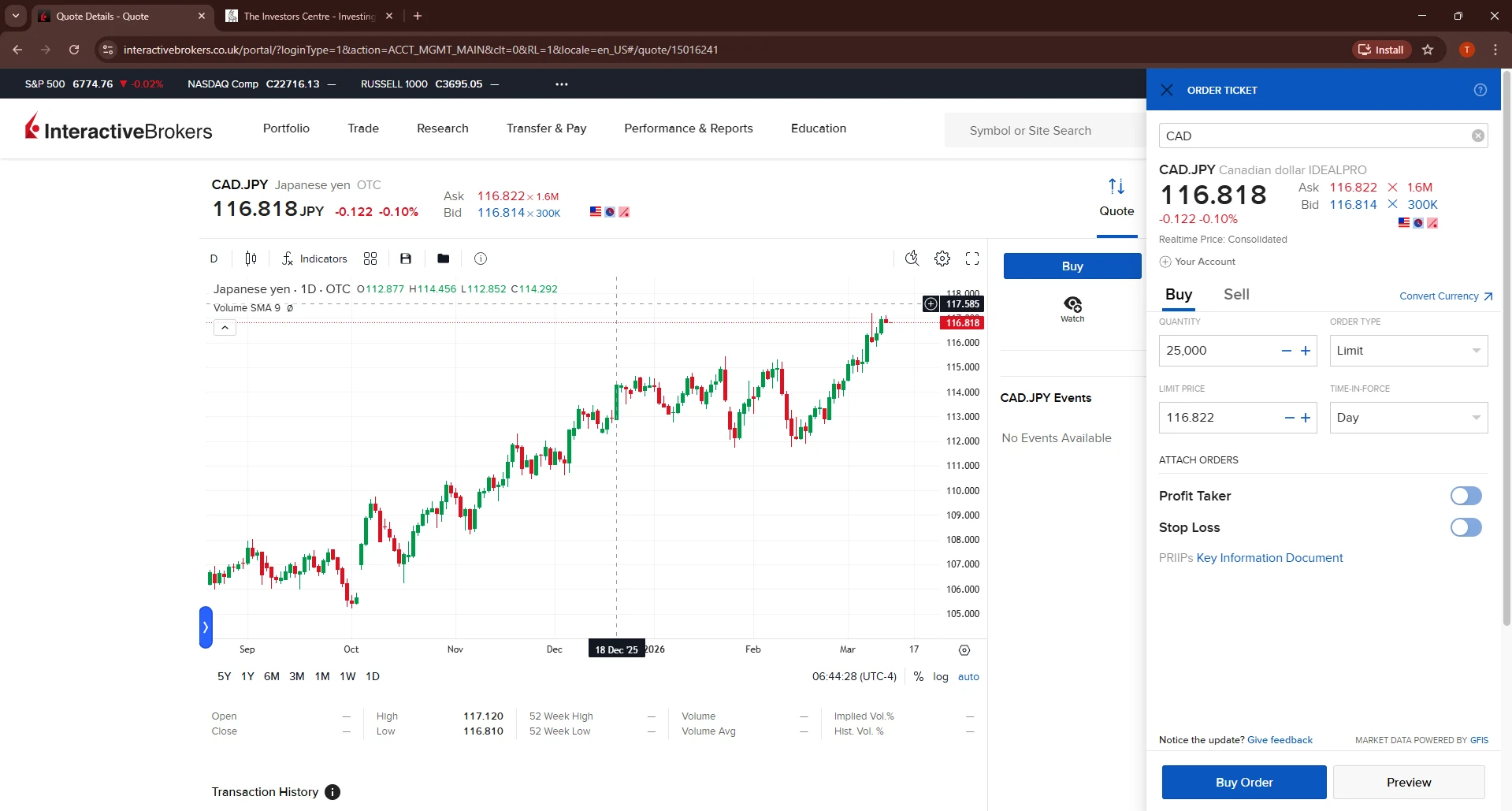
Pros
- Industry-leading low spreads from 0.1 pips on majors
- Professional-grade Trader Workstation platform
- Access to 100+ currency pairs with deep liquidity
- Strong institutional reputation and regulatory standing
Cons
- Steep learning curve for beginners
- Commission-based pricing adds to costs
- $10/month inactivity fee if trading volume is low
What Are the Spreads and Fees?
Interactive Brokers charges spreads from 0.1-0.2 pips on major currency pairs, among the lowest in the industry. However, you'll also pay a commission of 0.08-0.20 basis points per trade (approximately $2 per 100,000 traded). Active traders benefit from tiered pricing that reduces commissions based on monthly volume.
What Currency Pairs Can You Trade?
IBKR provides access to over 100 currency pairs with institutional-grade liquidity from multiple bank sources. You can trade spot forex with same-day settlement or forex CFDs with overnight positions. Minimum trade size is 25,000 units (0.25 lots), higher than some competitors but reasonable for serious traders.
How Good Is the Trading Platform?
Trader Workstation (TWS) is one of the most powerful retail trading platforms available, offering advanced order types, algorithmic trading, real-time risk analytics, and direct market access. The learning curve is steep, but seasoned traders appreciate the control and customization. The newer IBKR Mobile and WebTrader platforms provide simpler interfaces for casual trading.
Is Interactive Brokers Safe and Regulated?
Interactive Brokers Canada Inc. holds CIRO membership and is a member of CIPF, providing up to $1 million coverage per account category. The parent company (NASDAQ: IBKR) has operated since 1978 and manages over $400 billion in client assets globally. Client funds are held in segregated accounts at Canadian chartered banks.
OANDA — Best for Beginners
🌟 Beginner Friendly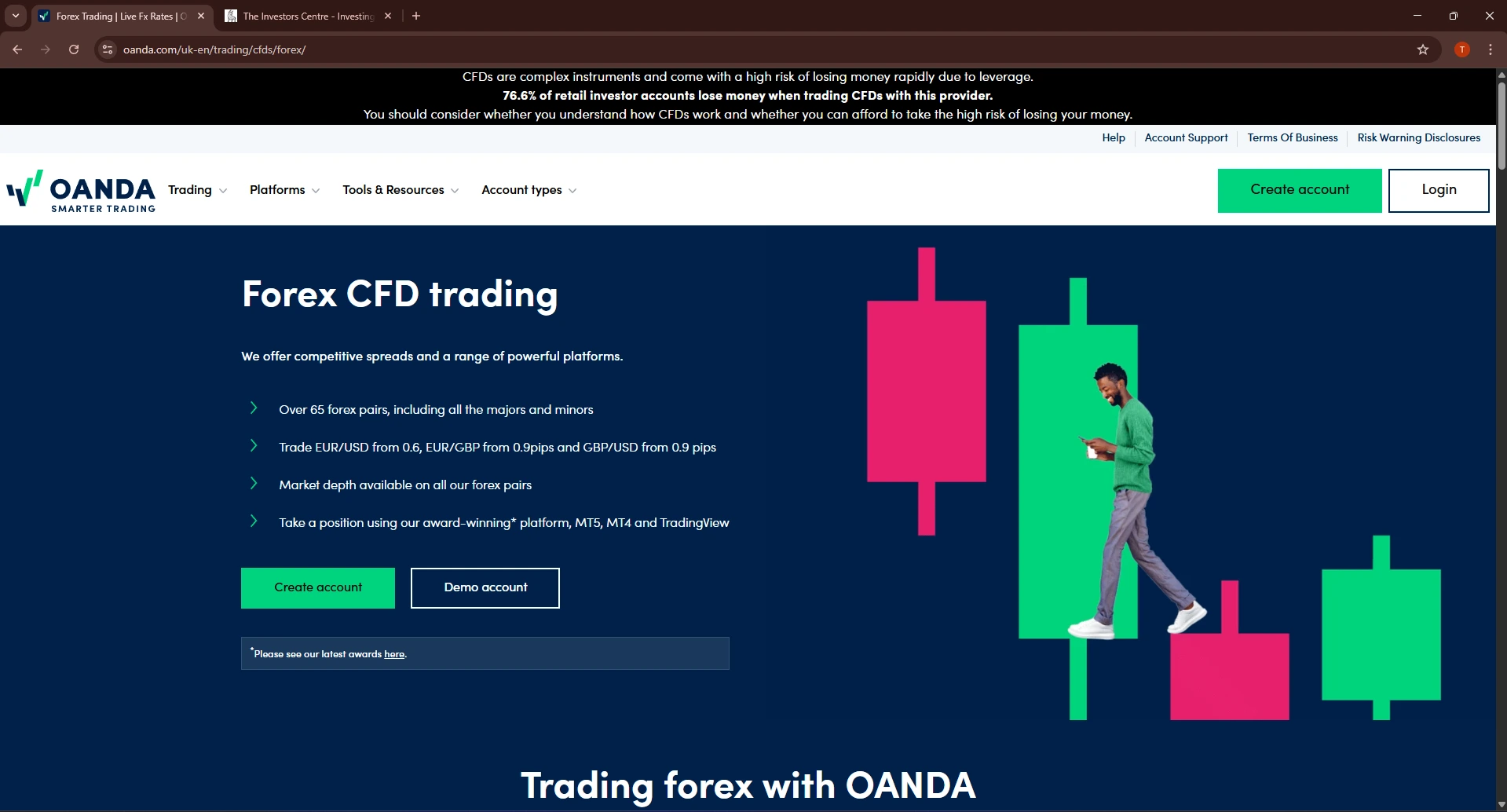
Pros
- No minimum deposit -- start with any amount
- Trade micro-lots (as small as 1 unit) for precise position sizing
- User-friendly platform perfect for beginners
- Excellent educational resources and demo account
Cons
- Spreads slightly higher than top competitors
- Smaller currency pair selection (68+)
What Are the Spreads and Fees?
OANDA charges spreads of 0.9-1.0 pips on EUR/USD and similar major pairs. While not the absolute tightest, spreads are transparent with no commissions on standard accounts. The broker's straightforward pricing makes it easy for beginners to understand their total trading costs without hidden fees.
What Currency Pairs Can You Trade?
OANDA offers access to 68+ currency pairs including all major and popular minor pairs. While the selection is smaller than CMC Markets, it covers the currencies most traders need. The unique ability to trade micro-lots (down to 1 unit) makes OANDA ideal for beginners practicing with small amounts.
How Good Is the Trading Platform?
OANDA's proprietary web and mobile platforms prioritize simplicity without sacrificing essential features. The clean interface shows real-time quotes, basic charting, and easy order entry. MetaTrader 4 is also available for those wanting more advanced technical analysis tools. The unlimited demo account lets beginners practice indefinitely.
Is OANDA Safe and Regulated?
OANDA Corporation ULC holds CIRO membership and is registered in all Canadian provinces and territories. Client funds are segregated at major Canadian banks, and CIPF membership provides up to $1 million coverage per account category. The company has operated since 1996 and is known for transparent pricing and reliable order execution.
FOREX.com — Best for Research and Education
📚 Best Education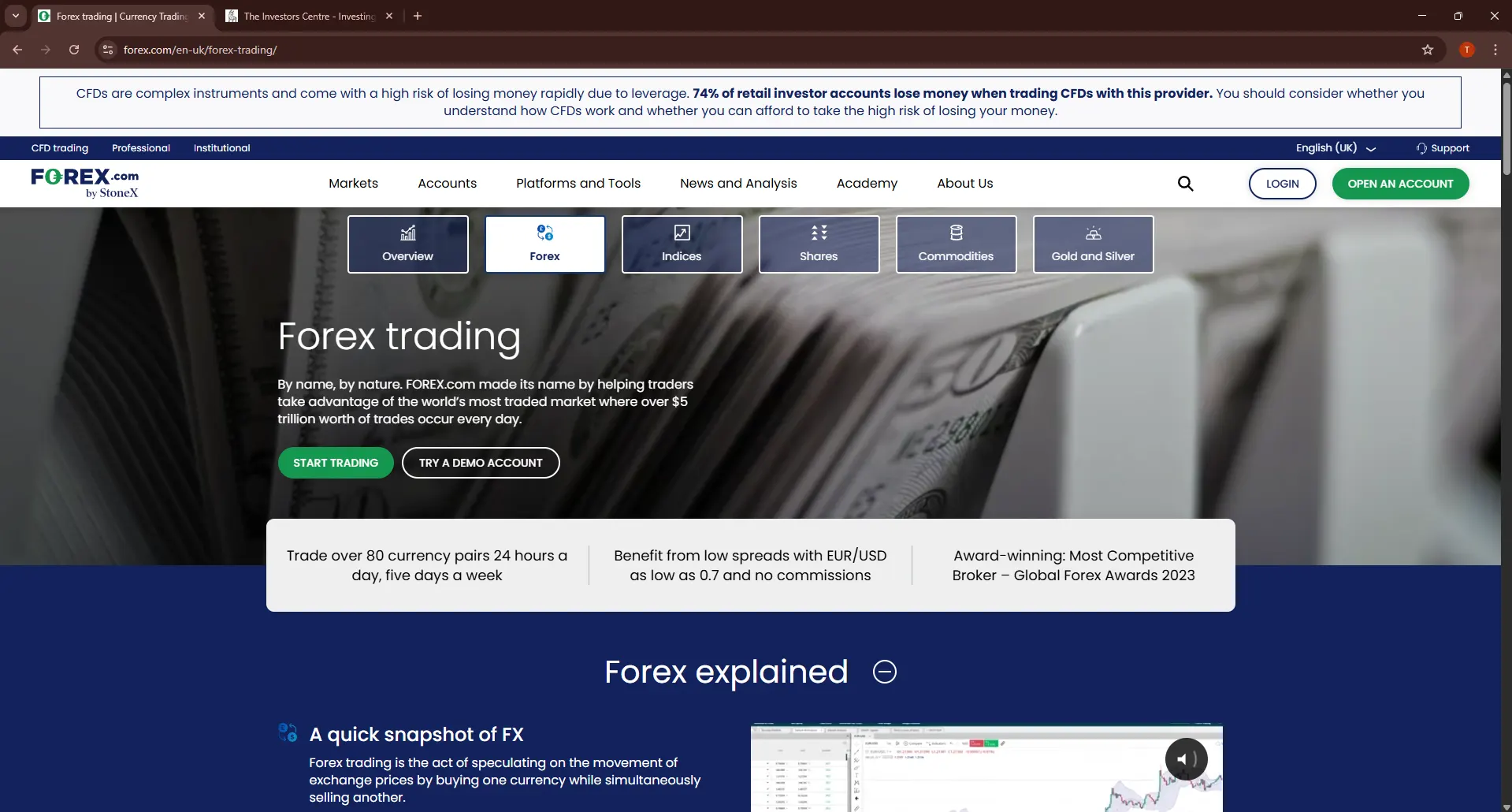
Pros
- Extensive market research and daily analysis
- Integrated Trading Central signals and insights
- Regular educational webinars and courses
- Access to MT4, MT5, and proprietary platform
Cons
- Spreads higher than discount brokers (1.0-1.3 pips)
- Minimum deposit of $100 CAD required
What Are the Spreads and Fees?
FOREX.com charges spreads from 1.0-1.3 pips on EUR/USD, positioned in the mid-range among Canadian brokers. The broker's value proposition lies in its comprehensive research and education rather than rock-bottom pricing. Standard accounts have no commissions, making costs transparent.
What Currency Pairs Can You Trade?
FOREX.com provides access to 80+ currency pairs including major, minor, and exotic pairs. The selection covers all commonly traded currencies with good liquidity. Minimum trade size is 1,000 units (0.01 lots), accessible for smaller accounts.
How Good Is the Trading Platform?
FOREX.com offers a proprietary web and mobile platform with integrated Trading Central research, plus full support for MetaTrader 4 and MetaTrader 5. The platforms include advanced charting, automated trading capabilities, and real-time market analysis. Daily market commentary and trading signals appear directly within the platform interface.
Is FOREX.com Safe and Regulated?
FOREX.com is operated by StoneX Financial Inc., which holds CIRO membership and is registered with provincial securities commissions. The company is a subsidiary of StoneX Group Inc. (NASDAQ: SNEX), providing financial transparency through public reporting. Client funds are segregated at Canadian chartered banks with CIPF coverage up to $1 million per account category.
Questrade — Best Canadian Multi-Asset Broker
🇨🇦 Best Canadian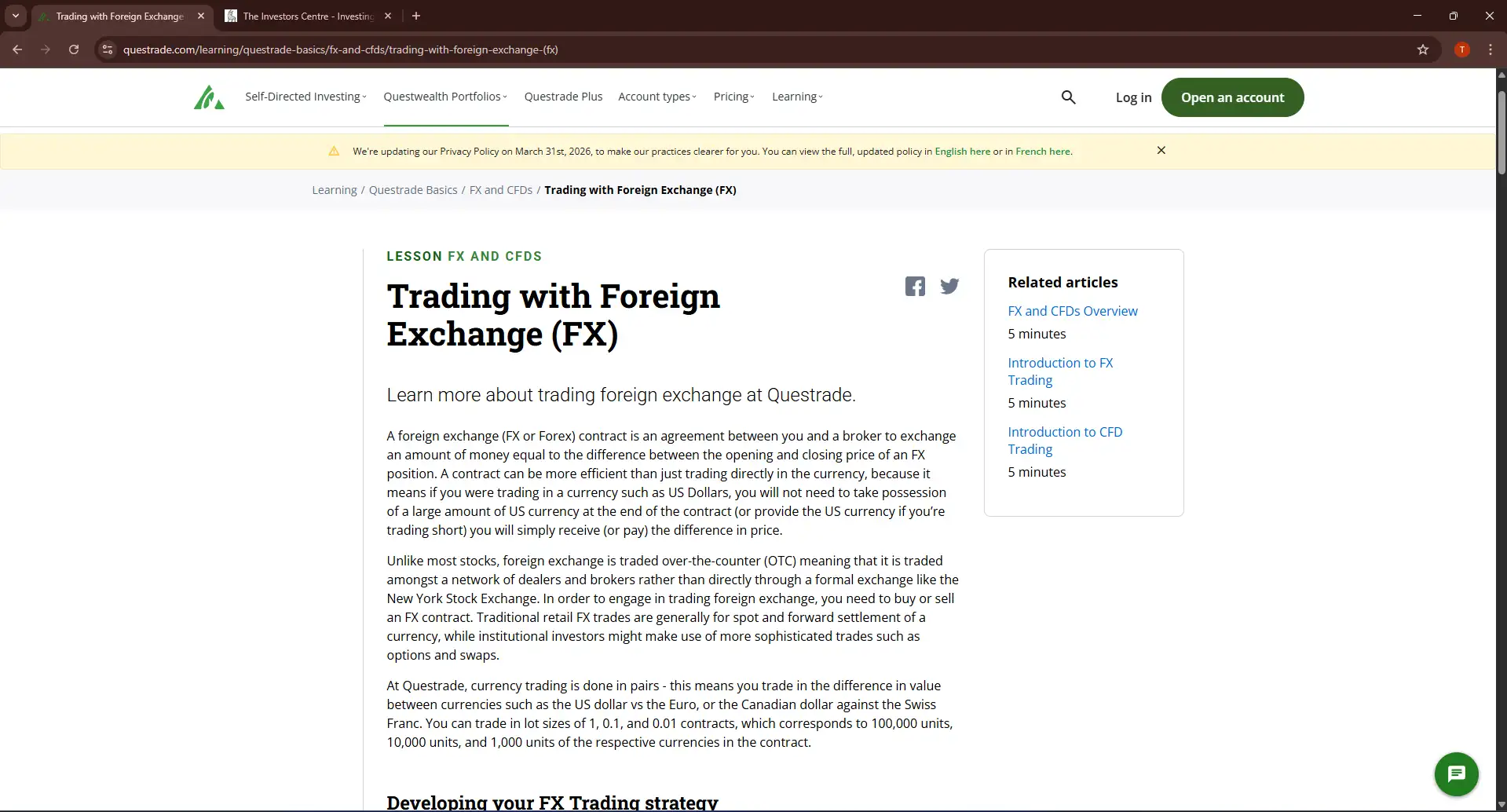
Pros
- Trade forex and stocks from one Canadian account
- Access to 100+ currency pairs
- Strong reputation among Canadian retail traders
- Registered accounts (TFSA, RRSP) available for stocks
Cons
- Spreads not as competitive as specialist forex brokers
- Platform less advanced than dedicated forex platforms
What Are the Spreads and Fees?
Questrade charges spreads averaging around 1.0 pip on EUR/USD and other major pairs. While not the tightest in the market, pricing is transparent with no hidden fees. The convenience of managing forex and stock investments from a single Canadian brokerage account offsets the slightly higher spreads for many traders.
What Currency Pairs Can You Trade?
Questrade provides access to 100+ currency pairs through its Questrade Global FX platform. All major and minor pairs are available, with decent liquidity on the most traded currencies. Minimum position size is $1,000 CAD per trade.
How Good Is the Trading Platform?
Questrade Global FX is a straightforward forex platform with essential charting and order management features. It won't impress advanced technical traders, but it gets the job done for casual forex trading. The real benefit is accessing forex alongside Questrade's excellent stock and ETF trading platforms (IQ Edge, mobile app) from a unified account.
Is Questrade Safe and Regulated?
Questrade Inc. holds CIRO membership and is registered with provincial securities commissions across Canada. The company has served Canadian investors since 1999 and is one of Canada's largest online brokers. Client funds are held in segregated accounts at major Canadian banks, with CIPF coverage providing up to $1 million per account category.
TD Direct Investing — Best for Bank Integration
🏦 Bank Backed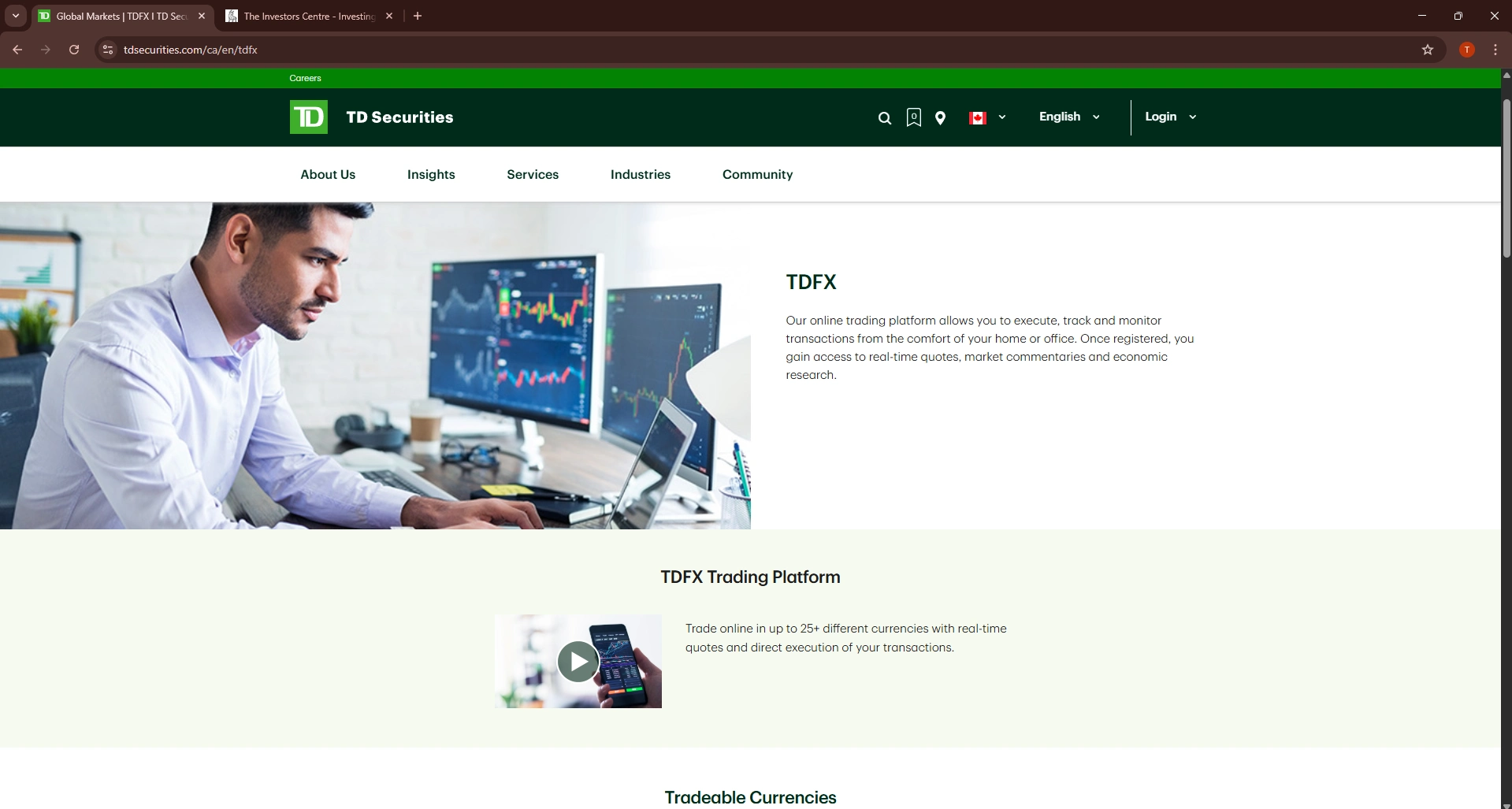
Pros
- Seamless integration with TD Bank accounts
- Instant fund transfers from TD chequing/savings
- In-branch support and phone assistance
- Strong security backed by major Canadian bank
Cons
- Wider spreads (~1.5 pips) than specialist brokers
- Smaller currency pair selection (50+)
What Are the Spreads and Fees?
TD Direct Investing charges spreads around 1.5 pips on major currency pairs, among the widest on our list. The premium pricing reflects the convenience of bank integration and comprehensive support rather than competitive trading costs. There are no explicit commissions, and funding via TD accounts is instant and free.
What Currency Pairs Can You Trade?
TD Direct Investing provides access to 50+ currency pairs including all major pairs and select minors. The selection is smaller than specialist forex brokers but covers the currencies most retail traders need. Minimum position size requirements apply based on currency volatility.
How Good Is the Trading Platform?
TD WebBroker is TD's primary trading platform, offering basic forex trading functionality alongside comprehensive stock and ETF trading tools. The platform won't impress professional forex traders but works well for casual traders. Mobile app access lets you monitor positions and execute basic trades from anywhere.
Is TD Direct Investing Safe and Regulated?
TD Direct Investing is operated by TD Waterhouse Canada Inc., a subsidiary of Toronto-Dominion Bank—one of Canada's largest banks. The broker holds CIRO membership and full CIPF coverage providing up to $1 million per account category. Client funds benefit from TD Bank's strong balance sheet and regulatory oversight by OSFI (Office of the Superintendent of Financial Institutions).
Saxo Bank — Best for Professional Traders
⚡ Professional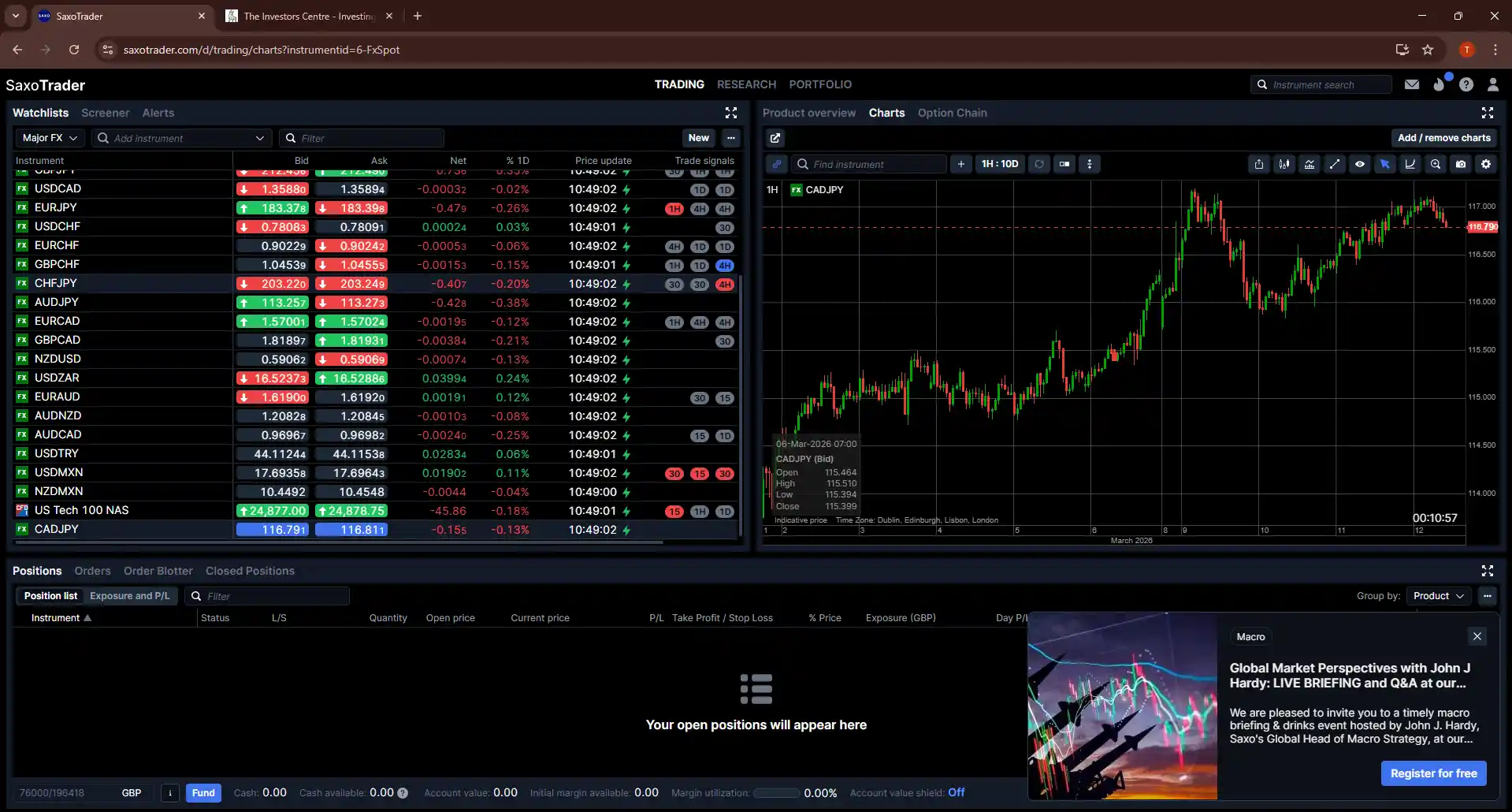
Pros
- Competitive spreads from 0.6 pips on EUR/USD
- Extensive pair selection (185+) including exotics
- Professional-grade SaxoTraderGO platform
- Strong institutional reputation since 1992
Cons
- Higher minimum deposit requirements
- Platform complexity may overwhelm beginners
What Are the Spreads and Fees?
Saxo Bank offers competitive spreads ranging from 0.6-0.9 pips on major pairs, positioning it among the tighter spreads available to Canadians. The broker operates a tiered pricing model where active traders receive volume-based discounts. Professional accounts access even tighter spreads with commissions.
What Currency Pairs Can You Trade?
Saxo Bank provides access to 185+ currency pairs—one of the most comprehensive selections available to Canadian traders. This includes all major and minor pairs plus extensive exotic currency coverage. Minimum trade sizes vary by account type, with professional accounts offering more flexibility.
How Good Is the Trading Platform?
SaxoTraderGO is Saxo's flagship platform, combining advanced charting, algorithmic trading capabilities, and comprehensive risk management tools in a modern interface. The platform supports over 40 technical indicators, customizable layouts, and real-time news integration. SaxoTraderPRO offers even more advanced features for professional traders.
Is Saxo Bank Safe and Regulated?
Saxo Bank Canada Inc. holds CIRO membership and maintains full compliance with Canadian securities regulations. The parent company, Saxo Bank A/S, is a licensed Danish bank regulated by the Danish Financial Supervisory Authority, providing additional oversight. Client funds are held in segregated accounts with CIPF coverage up to $1 million per account category.
What Should You Know About Canadian Forex Regulation?
Understanding Canadian forex regulation is essential for selecting a legitimate broker and protecting your capital. The regulatory landscape underwent significant changes in June 2023, which every Canadian trader should understand.
Why Does CIRO Regulation Matter?
The Canadian Investment Regulatory Organization (CIRO) is the national self-regulatory body overseeing all investment dealers offering forex trading in Canada. Formed in June 2023 through the merger of IIROC and MFDA, CIRO sets strict standards for capital adequacy, client fund segregation, and business conduct.
Trading with a CIRO-regulated broker ensures your funds are held separately from the broker's operating capital, reducing risk in case of broker insolvency. CIRO also monitors trading activity in real-time and publishes disciplinary actions against firms that violate regulations, providing transparency that offshore brokers cannot match.
What Leverage Limits Apply in Canada?
Canadian forex traders can access maximum leverage of 50:1 on major currency pairs like EUR/USD, GBP/USD, and USD/CAD. Minor and exotic pairs typically allow leverage up to 20:1, with some brokers applying lower limits on volatile currencies.
These limits are more conservative than offshore jurisdictions offering 500:1 or higher, but they protect retail traders from excessive losses. A 50:1 leverage ratio means a $1,000 deposit can control a $50,000 position—still substantial exposure to currency movements.
How Canadian Forex Regulation Works
How Does CIPF Protection Work?
The Canadian Investor Protection Fund (CIPF) protects client assets held with CIRO member firms up to $1 million per account category. If your broker becomes insolvent, CIPF works to return your cash and securities or provides compensation up to the coverage limit.
Coverage limits apply separately to general accounts ($1 million), registered retirement accounts like RRSPs ($1 million), and RESPs ($1 million). Importantly, CIPF does not cover trading losses—only missing assets due to broker insolvency. Quebec residents using mutual fund dealer accounts may have different coverage through the AMF.
How Is Forex Trading Taxed in Canada?
Understanding tax obligations is essential for Canadian forex traders, as the Canada Revenue Agency (CRA) treats currency trading profits as taxable income. The specific tax treatment depends on whether the CRA classifies your activity as investing or operating a business.
What Is the Difference Between Capital Gains and Business Income?
The CRA uses four main factors to determine your classification: trading frequency, holding period, time spent trading, and whether trading is your primary income source. Casual traders typically qualify for capital gains treatment, while active day traders may be classified as conducting business.
Capital gains treatment is more favourable—only 50% of net gains are included in taxable income (the "inclusion rate"). Business income, however, is fully taxable at your marginal rate. For 2026, a new 66.67% inclusion rate applies to capital gains exceeding $250,000 annually for individuals.
How Do You Report Forex Profits to the CRA?
Forex profits classified as capital gains are reported on Schedule 3 of your T1 tax return. You must calculate gains and losses for each trade, converting amounts to Canadian dollars using Bank of Canada exchange rates. Keep detailed records of entry prices, exit prices, and transaction dates.
If classified as business income, report profits on Form T2125 (Statement of Business Activities). This allows deduction of trading-related expenses like platform fees, data subscriptions, and equipment. All amounts must be reported in CAD regardless of which currency you traded.
What Are the Best Currency Pairs for Canadian Traders?
Canadian forex traders often focus on CAD pairs due to familiarity with domestic economic factors and reduced currency conversion friction when funding accounts. Understanding which pairs offer the best combination of liquidity, spreads, and trading opportunities helps optimise your strategy.
USD/CAD is the most traded CAD pair, with spreads typically ranging from 1.0 to 2.0 pips depending on your broker. The pair responds strongly to oil prices, Bank of Canada interest rate decisions, and US economic data releases. Canadian traders have a natural information advantage when trading their home currency.
EUR/CAD and GBP/CAD offer exposure to European economies while maintaining CAD as the quote currency. These pairs are less liquid than USD/CAD but can present opportunities during European trading sessions. For traders interested in crypto markets alongside forex, explore how to buy crypto in Canada through regulated platforms.
Final Thoughts
Selecting the best forex broker in Canada ultimately depends on your trading style, experience level, and priorities. CMC Markets leads our 2026 rankings with its combination of tight spreads, extensive currency pair selection, and powerful trading platforms—making it the strongest all-round choice for most Canadian traders.
For those prioritising the absolute lowest trading costs, Interactive Brokers delivers institutional-grade pricing that active traders will appreciate. Beginners should consider OANDA's accessible platform and no-minimum-deposit policy, while those wanting research-driven insights may prefer FOREX.com's analytical tools.
Regardless of which broker you choose, ensure they hold proper CIRO registration and CIPF membership to protect your capital. Canadian regulation provides meaningful safeguards that offshore brokers simply cannot match—your financial security is worth the peace of mind.
FAQs
Sources
- Canadian Investment Regulatory Organization (CIRO). "About CIRO." 2026.
- Canadian Investor Protection Fund (CIPF). "About CIPF Coverage." 2026.
- Ontario Securities Commission (OSC). "Canadian Investor Protection Fund." 2026.
- Canada Revenue Agency (CRA). "Reporting Income from Transactions." 2026.
- Bank of Canada. "Exchange Rates." 2026.
- GetSmarterAboutMoney.ca (OSC). "How Your Investments Are Protected." January 2025.
- Interactive Brokers Canada Inc. "Securities Account Protection." 2026.
- CMC Markets Canada Inc. "Forex Trading." 2026.
- OANDA Corporation. "Forex Trading Pricing." 2026.