
- Expertise:
- CFD Trading, Forex, Derivatives, Risk Management
- Credentials:
- Chartered ACII (2018) · Trading since 2012
- Tested:
- 40+ forex & CFD platforms with live accounts

- Expertise:
- Platform Testing, Cryptocurrency, Retail Investing
- Credentials:
- Active investor since 2013 · 11+ years experience
- Tested:
- 50+ platforms · 200+ guides authored
How We Test
Real accounts. Real money. Real trades. No demo accounts or press releases.
What we measure:
- Spreads vs advertised rates
- Execution speed and slippage
- Hidden fees (overnight, withdrawal, conversion)
- Actual withdrawal times
Scoring:
Fees (25%) · Platform (20%) · Assets (15%) · Mobile (15%) · Tools (10%) · Support (10%) · Regulation (5%)
Testing team:
Adam Woodhead (investing since 2013), Thomas Drury (Chartered ACII, 2018), Dom Farnell (investing since 2013) — 50+ platforms with funded accounts
Quarterly reviews · Corrections: [email protected]
Disclaimer
Not financial advice. Educational content only. We're not FCA authorised. Consult a qualified advisor before investing.
Capital at risk. Investments can fall. Past performance doesn't guarantee future results.
CFD warning. 67-84% of retail accounts lose money trading CFDs. High risk due to leverage.
Contact: [email protected]
What does trading gold cost on Pepperstone in Australia?
Spot gold (XAUUSD) prices from 0.1 points on Pepperstone, and you can pay for it two ways: the standard commodity pricing folds everything into the spread with no commission, while Razor Gold splits the cost into a raw spread from 0.1 plus a fixed commission from USD$3.50 per lot per side (converted to AUD at spot), the only commodity Pepperstone prices this way. ASIC caps retail gold CFD leverage at 20:1, a 5% margin, and the market runs nearly 24 hours on weekdays with a short daily pause and no weekend session. The details that actually decide your costs, the session timing from an Australian clock, the tom-next swaps and the account choice, are all below.
 Top Rated
Trading CFDs and FX carries significant risk and is not suitable for everyone. You have no interest in the underlying asset.
How is gold actually priced on Pepperstone?
Gold gets special treatment in Pepperstone's pricing, and understanding the two models is most of the cost decision.
Standard: everything in the spread
On the standard commodity pricing, XAUUSD quotes from 0.1 points with no commission; the whole cost of the trade is the gap between buy and sell, exactly as Pepperstone prices every other commodity CFD. One number, visible on the ticket, no arithmetic. For occasional gold traders this simplicity is worth having.
Razor Gold: raw spread plus commission
Gold is the one commodity Pepperstone also offers in Razor form: the raw spread passed through from 0.1 points, with a fixed, transparent commission from USD$3.50 per lot per side on top, converted to AUD at spot on an AUD account.
Why the split model exists
The logic mirrors the forex Razor account: the commission never widens, so active traders get a cost floor they can plan around while only the raw spread breathes with the market. On a metal whose spread can move sharply around US data, separating the fixed toll from the variable one is a real advantage for anyone trading gold in volume.
Who should skip it
A handful of trades a month will not notice the difference, and the standard pricing's single number is easier to track. As with forex, the commission model pays for itself through frequency; without frequency, take the simplicity.
Size, margin and leverage
A standard gold lot follows the usual 100-ounce convention (confirm the contract spec on your platform before sizing), and under ASIC's retail caps gold CFDs trade at up to 20:1 leverage, a 5% margin requirement, one notch tighter than the 30:1 on major forex pairs; other metals sit at 10:1. At current gold prices a single lot is serious notional exposure, so fractional sizing is the sensible default while you learn how this market moves.
When does gold move, from an Australian clock?
Gold trades nearly around the clock on weekdays, but it does not move evenly around the clock, and Australians sit in an interesting position on its map.
The trading hours, precisely
XAUUSD prices from 01:01 to 23:59 platform time Monday to Thursday and until 23:55 on Friday, with a roughly one-hour daily pause around the New York close and no weekend trading. That schedule keeps gold available through the entire Australian day and evening every weekday, with the daily break falling in the Australian morning.
Where the volatility lives
Gold's heaviest volume arrives with London and New York, whose overlap lands in the late Australian evening, and the US data releases that move gold hardest, inflation prints, payrolls, Fed decisions, hit around midnight to 1am on the east coast. But gold is also one of the few markets with a genuine Asian session: Shanghai and Singapore flows give it life during Australian business hours in a way most Western markets lack.
So day-to-day trading works fine on an Australian schedule.
The practical conclusion for stops and sizing
The biggest single-event moves happen while most Australians are asleep, which argues for one discipline above all: never carry a gold position into a major US data night with sizing that assumes you will be awake to manage it. Stops placed for the data, not for the chart, are what survive this market's schedule.
The overnight cost: tom-next swaps
Positions held past 5pm New York time incur metal swaps, calculated the same way as forex pairs: one point times your trade size times the tom-next rate, with multi-day adjustments around weekends. Swing traders should check the live swap for their direction before committing, because on a leveraged metal position held for weeks the financing grows into a bigger line than the spread ever was.
Which setup should an Australian gold trader choose?
Three practical decisions cover it, and none of them takes long.
Standard or Razor Gold?
Volume decides. Occasional traders take the standard spread and its simplicity. Anyone trading gold most days should price the Razor route: a raw 0.1-point market plus a fixed USD$3.50-per-side commission gives active traders the same predictable cost structure that makes the forex Razor account work, and the more you trade, the more the fixed commission model rewards you.
Which platform?
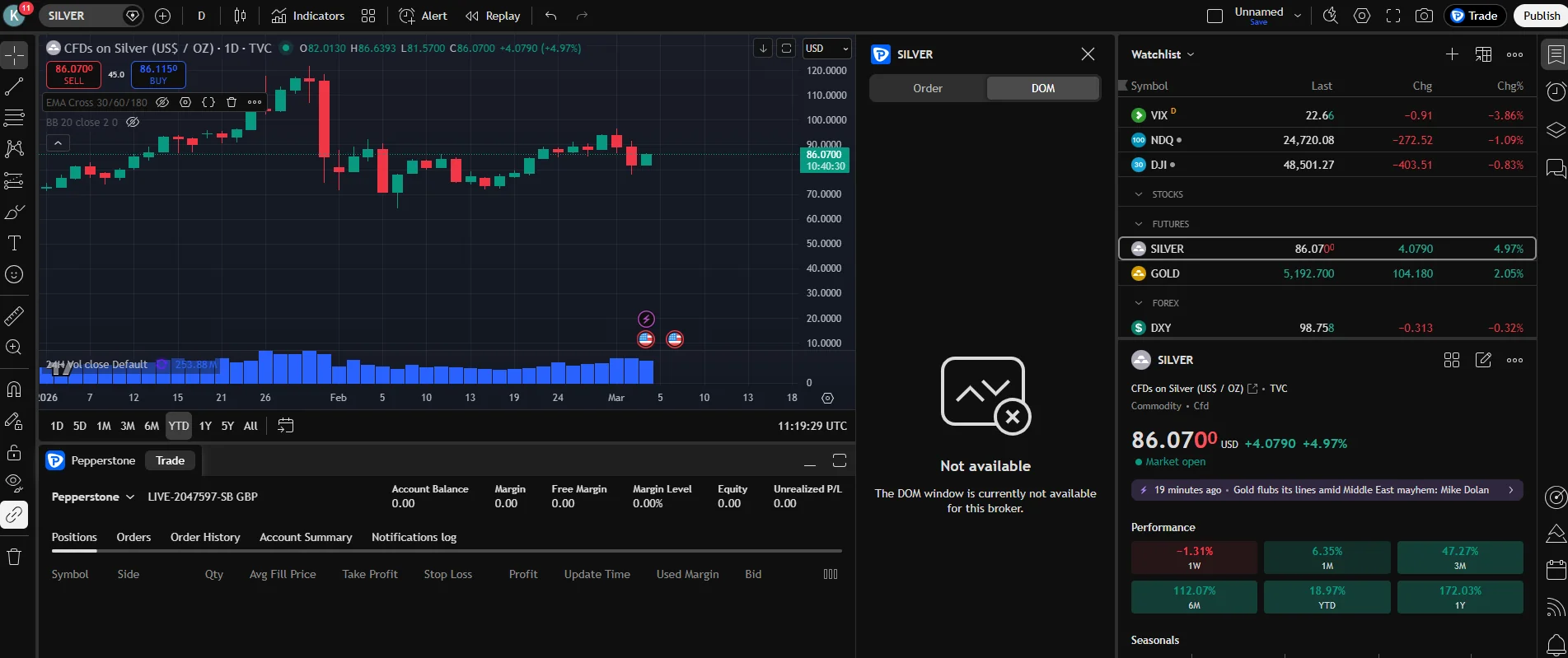
Gold trades on all of them: MT4, MT5, cTrader, TradingView and the Pepperstone platform. The choice follows your workflow rather than the instrument; on gold the cost decision is the pricing model, whichever platform you pick, and that keeps this simpler than the forex equivalent.
How big?
Smaller than instinct suggests. Twenty-to-one leverage on an instrument that can move one or two percent on a data print means a full lot swings hard against a small account, and the market's loudest moments arrive at Australian bedtime. Work backwards from what a losing trade should cost you, then size to that.

The verdict on Pepperstone for gold
For Australians trading XAUUSD, the offer is genuinely strong: a 0.1-point market, the only Razor-style raw-plus-commission pricing you will commonly find on a commodity, availability through the whole Australian day on every platform, and clean tom-next financing you can check before committing. The constraints are the market's, not the broker's: 20:1 is the ASIC ceiling, the biggest catalysts land late at night Australian time, and swaps tax patience on held positions. Gold sits alongside the rest of the pricing picture in my Pepperstone forex guide, and if the late-night data problem resonates, the same timezone logic drives my piece on 24-hour US share CFDs.
Frequently Asked Questions
References
- Pepperstone: commodity CFDs (gold spreads and hours)
- Pepperstone: Razor Gold explained
- Pepperstone: ASIC retail leverage limits
Trading CFDs and FX carries significant risk and is not suitable for everyone. You have no interest in the underlying asset.