
- Expertise:
- Platform Testing, Cryptocurrency, Retail Investing
- Credentials:
- Active investor since 2013 · 11+ years experience
- Tested:
- 50+ platforms · 200+ guides authored

- Expertise:
- Broker Comparison, ISA Strategy, Portfolio Management
- Credentials:
- Active investor since 2013 · 11+ years experience
- Tested:
- 40+ brokers with funded accounts
How We Test
Real accounts. Real money. Real trades. No demo accounts or press releases.
What we measure:
- Spreads vs advertised rates
- Execution speed and slippage
- Hidden fees (overnight, withdrawal, conversion)
- Actual withdrawal times
Scoring:
Fees (25%) · Platform (20%) · Assets (15%) · Mobile (15%) · Tools (10%) · Support (10%) · Regulation (5%)
Testing team:
Adam Woodhead (investing since 2013), Thomas Drury (Chartered ACII, 2018), Dom Farnell (investing since 2013) — 50+ platforms with funded accounts
Quarterly reviews · Corrections: [email protected]
Disclaimer
Not financial advice. Educational content only. We're not FCA authorised. Consult a qualified advisor before investing.
Capital at risk. Investments can fall. Past performance doesn't guarantee future results.
CFD warning. 67-84% of retail accounts lose money trading CFDs. High risk due to leverage.
Contact: [email protected]
Quick Answer: How Do You Short the US Dollar from Australia?
Buy AUD/USD through an ASIC-regulated forex broker like eToro (AFSL 491139) or IG Australia (AFSL 220440). When you buy AUD/USD, you're betting the USD will weaken against the AUD. The US Dollar Index fell 9.4% in 2025, with Morgan Stanley forecasting further declines to DXY 94 by mid-2026. ASIC limits forex leverage to 30:1 on major pairs for retail traders, and negative balance protection is mandatory.
 Top Rated
Trading CFDs and FX carries significant risk and is not suitable for everyone. You have no interest in the underlying asset.
What Is the Easiest Way to Short the US Dollar from Australia?
Buy AUD/USD through an ASIC-regulated forex broker like eToro or IG Australia. When you buy AUD/USD, you're betting the USD will weaken against the AUD. The US Dollar Index fell 9.4% in 2025, with Morgan Stanley forecasting further declines to DXY 94 by mid-2026.
How Do You Short the US Dollar Step by Step?
Here's a practical walkthrough for shorting USD via AUD/USD using an Australian forex broker:
Step 1 – Choose an ASIC-Regulated Broker
Select a broker holding an Australian Financial Services Licence. eToro (AFSL 491139), IG Australia (AFSL 220440), and CMC Markets (AFSL 238054) are popular choices offering competitive spreads on AUD/USD. Verify the AFSL number on ASIC's Professional Registers before depositing funds.
Step 2 – Open and Fund Your Account
Complete the application process, which includes identity verification under Australian anti-money laundering requirements. Fund your account via bank transfer, BPAY, or card. Most brokers have no minimum deposit, though $500-$2,000 provides adequate margin for sensible position sizing.
Step 3 – Analyse the Market
Review technical indicators (support/resistance levels, moving averages, RSI) and fundamental factors (Fed announcements, RBA decisions, economic data). Determine your entry point, profit target, and stop-loss level before placing any trade.
Step 4 – Place Your Trade
Navigate to AUD/USD on your trading platform. Select "Buy" to go long on AUD/USD (shorting USD). Choose your position size—one standard lot equals 100,000 AUD. Set your stop-loss and take-profit orders to manage risk automatically.
Step 5 – Monitor and Exit
Track your position against your trading plan. If AUD/USD rises as expected, you can close for a profit. If it falls, your stop-loss limits downside. Consider trailing stops to lock in profits while allowing the trade room to run.
What Does It Mean to Short the US Dollar?
Shorting the US dollar means speculating that its value will fall relative to another currency. Unlike stocks where you borrow shares to sell, forex trading works differently because currencies always trade in pairs. When you "short" the USD, you're simultaneously going "long" on another currency.
In every forex pair, there's a base currency (listed first) and a quote currency (listed second). For AUD/USD, the Australian dollar is the base and the US dollar is the quote. The exchange rate tells you how many US dollars one Australian dollar can buy. If AUD/USD rises from 0.65 to 0.70, the AUD has strengthened and the USD has weakened.
To short the USD, you can either buy a pair where USD is the quote currency (like AUD/USD or EUR/USD) or sell a pair where USD is the base currency (like USD/JPY or USD/CAD). Both approaches profit when the dollar declines.
Why Are Traders Shorting the US Dollar in 2026?
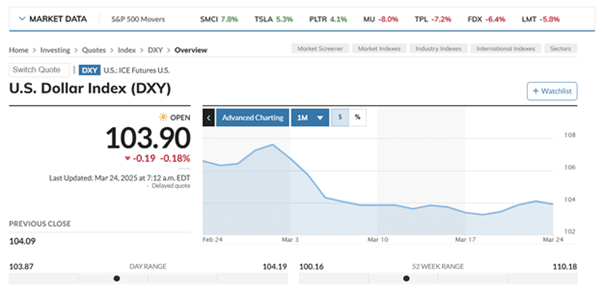
The US dollar enters 2026 facing significant headwinds that have traders positioning for further weakness. The DXY fell from around 108 to 98 during 2025, marking the largest annual decline since 2017. Several factors are driving bearish sentiment:
Federal Reserve Rate Cuts: The Fed cut rates three times in late 2025, bringing the Fed Funds rate to 3.50%-3.75%. Markets are pricing in two additional cuts for 2026. Lower interest rates typically weaken a currency by reducing its yield advantage over alternatives.
Fed Leadership Change: Jerome Powell's term ends in May 2026, with President Trump expected to appoint a successor perceived as more dovish. This uncertainty is weighing on USD sentiment, with Goldman Sachs noting increased risks of looser monetary policy.
Fiscal Deficit Concerns: The US fiscal deficit remains on an unsustainable trajectory according to the Congressional Budget Office. Concerns over heavy Treasury issuance and debt sustainability are prompting investors to demand higher risk premiums for holding US assets.
Rate Differential Narrowing: While the Fed eases, the Reserve Bank of Australia has held rates steady at 3.60% and may even consider hikes if inflation persists. ING estimates Australia will have the highest central bank rate in the G10 by mid-2026, supporting the AUD against the USD.
Bank Forecasts: Major institutions are projecting AUD/USD strength. Westpac forecasts 0.68 by June 2026, NAB expects 0.69, and IG analysts see potential for the pair to reach 0.69-0.70 over the year. Morgan Stanley projects the DXY could fall to 94 by Q2 2026 before recovering.
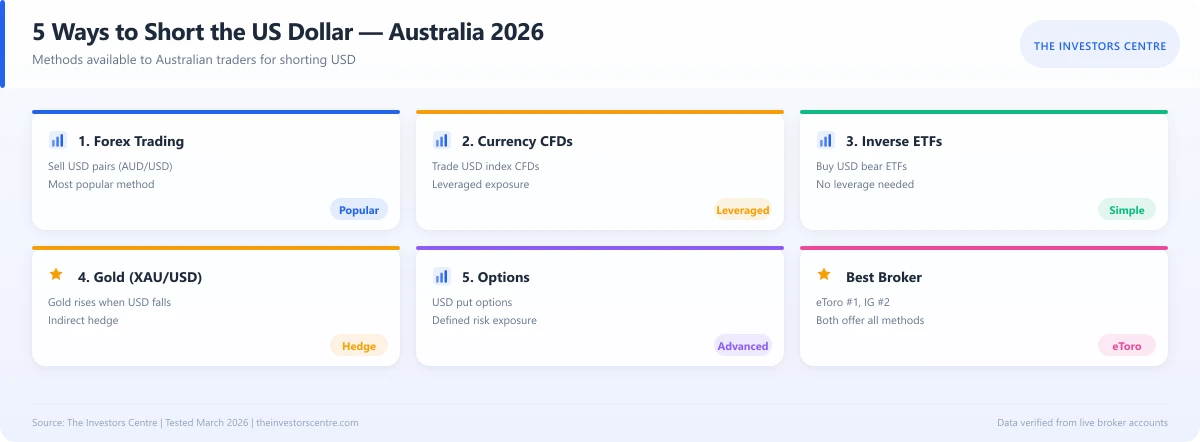
What Are the Best Ways to Short the US Dollar from Australia?
Australian traders have several methods to gain exposure to USD weakness, ranging from direct forex trading to passive ETF strategies. Each approach carries different risk profiles, capital requirements, and complexity levels.
Forex Trading – Short USD Directly via Currency Pairs
Forex trading is the most direct way to short the US dollar. By buying AUD/USD through an ASIC-regulated broker, you're effectively selling USD and buying AUD. If the exchange rate rises, you profit from the dollar's decline. Our guide to the best forex brokers in Australia covers the top ASIC-regulated platforms in detail.
The forex market operates 24 hours a day, five days a week, offering high liquidity and tight spreads on major pairs. Australian brokers like eToro (AFSL 491139), IG Australia (AFSL 220440), and CMC Markets (AFSL 238054) provide access to forex trading via CFDs, allowing you to trade on margin with leverage up to 30:1 on major pairs under ASIC rules. These platforms also feature in our best CFD brokers Australia guide.
For example, if AUD/USD is trading at 0.6700 and you buy one standard lot (100,000 AUD), you're effectively selling $67,000 USD. If the rate rises to 0.6800, your position is now worth $68,000 USD—a $1,000 profit (before spreads and fees). With 30:1 leverage, you'd only need around $2,233 AUD margin to control this position.
Popular platforms include MetaTrader 4, MetaTrader 5, cTrader, and TradingView, all offering advanced charting, technical indicators, and automated trading capabilities.
Inverse USD ETFs – Bet Against the Dollar with One Trade
Inverse ETFs provide a simpler way to short the dollar without directly trading forex. The most well-known option is the Invesco DB US Dollar Index Bearish Fund (UDN), which aims to track the inverse performance of the US Dollar Index against a basket of major currencies.
Unfortunately, no inverse USD ETF is listed directly on the ASX. Australian investors can access UDN through international trading platforms like Interactive Brokers (AFSL 453554), Stake, or Syfe, which provide access to US-listed ETFs. Be aware of currency conversion fees (typically 0.5-0.7%) and potential withholding tax implications on US-listed securities.
UDN suits investors who want "set and forget" exposure to USD weakness without monitoring forex positions or managing leverage. However, like all inverse ETFs, it's designed for short-term tactical use rather than long-term holding due to daily rebalancing effects.
AUD-Hedged ETFs – Benefit from USD Weakness Passively
If you hold international shares, currency hedging can protect your portfolio from USD weakness. When the AUD rises against the USD, unhedged US investments lose value when converted back to Australian dollars—even if the underlying shares perform well.
AUD-hedged ETFs eliminate this currency risk. When the USD weakens, your hedged international holdings maintain their value in AUD terms. Several ASX-listed options are available:
- VanEck Morningstar Wide Moat (AUD Hedged) ETF (MHOT) – US quality companies, currency hedged
- VanEck MSCI International Small Companies Quality (AUD Hedged) ETF (QHSM) – International small caps, hedged
- iShares Core S&P 500 (AUD Hedged) ETF (IHVV) – S&P 500 exposure, hedged to AUD
- Vanguard MSCI Index International Shares (Hedged) ETF (VGAD) – Developed markets, hedged
This approach suits long-term investors who want international diversification without USD exposure rather than active traders seeking to profit from dollar declines.
Gold Investment – The Classic USD Hedge
Gold has historically maintained a negative correlation with the US dollar. When the USD weakens, gold prices typically rise as the metal becomes cheaper for holders of other currencies, increasing demand. Gold also serves as a hedge against the inflation and fiscal concerns that are currently weighing on the dollar. Our guide on how to trade gold from Australia covers the various methods available.
Gold prices are forecast to remain strong at around US$4,000 per ounce in 2026, according to market analysts, with continued support from central bank buying and safe-haven demand. Australian investors can access gold through:
- Betashares Gold Bullion ETF (GOLD) – Tracks AUD gold price
- Perth Mint Gold (PMGOLD) – Backed by physical gold held by Perth Mint
- ETFS Physical Gold (GOLD.AXW) – Physical gold exposure
- Gold mining shares – Newmont, Northern Star, Evolution Mining
Gold is an indirect USD short—it won't move precisely inverse to the dollar, but it provides portfolio diversification and typically benefits during periods of dollar weakness.
Currency Conversion – Simple USD to AUD Strategy
For Australians earning income in USD or holding USD cash, the simplest way to benefit from expected dollar weakness is to convert to AUD. This involves no leverage, no complex instruments, and no ongoing management.
Timing matters. If you believe the USD will continue falling, converting sooner rather than later locks in a better exchange rate. Use low-fee currency transfer services like Wise, OFX, or Revolut rather than bank transfers, which typically charge 2-4% in hidden margins.
This approach suits expats, freelancers with US clients, or anyone receiving USD payments who expects the AUD to strengthen over the coming months.
Which Forex Pairs Can You Use to Short the US Dollar?
Several major currency pairs allow you to take a position against the US dollar. The mechanics differ depending on whether USD is the base or quote currency in the pair.

| Currency Pair | How to Short USD | You're Betting On | Typical Spread |
|---|---|---|---|
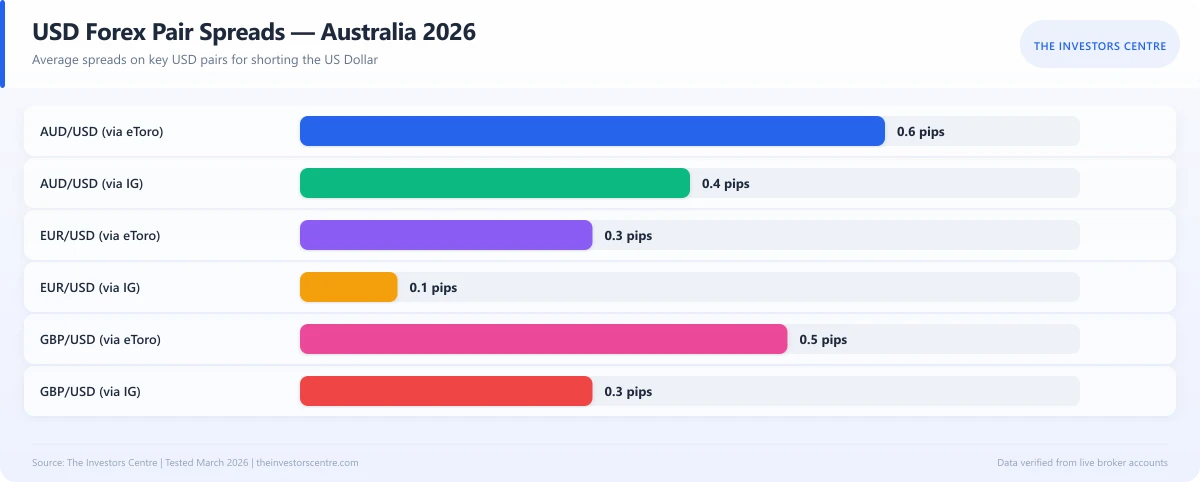
| AUD/USD | Buy (go long) | AUD strengthens vs USD | 0.4-0.6 pips |
| EUR/USD | Buy (go long) | EUR strengthens vs USD | 0.1-0.3 pips |
| GBP/USD | Buy (go long) | GBP strengthens vs USD | 0.4-0.8 pips |
| USD/JPY | Sell (go short) | JPY strengthens vs USD | 0.2-0.5 pips |
| USD/CAD | Sell (go short) | CAD strengthens vs USD | 0.5-1.0 pips |
| USD/CHF | Sell (go short) | CHF strengthens vs USD | 0.5-1.0 pips |
For Australian traders, AUD/USD is the natural choice—you're familiar with both currencies and can follow RBA announcements directly. EUR/USD offers the tightest spreads as the world's most traded pair, while USD/JPY provides exposure to the Bank of Japan's policy normalisation expected in 2026.
You can also short the US Dollar Index (DXY) directly through CFDs at brokers like IG and eToro, giving exposure to USD performance against a basket of six major currencies weighted heavily toward the euro (57.6%).
What Are ASIC's Rules for Forex Trading in Australia?
The Australian Securities and Investments Commission (ASIC) regulates forex and CFD trading under its Product Intervention Order, which imposes leverage limits and consumer protections for retail traders.
Leverage Limits:
- Major forex pairs (AUD/USD, EUR/USD, GBP/USD, USD/JPY): Maximum 30:1
- Minor forex pairs, gold, major indices: Maximum 20:1
- Other commodities, minor indices: Maximum 10:1
- Cryptocurrencies: Maximum 2:1
Negative Balance Protection: ASIC requires brokers to ensure retail clients cannot lose more than their account balance. If extreme market volatility causes losses exceeding your deposit, the broker must absorb the excess.
Margin Close-Out: Brokers must automatically close positions when your account equity falls to 50% of required margin, preventing catastrophic losses.
AFSL Requirement: Only trade with brokers holding an Australian Financial Services Licence. This ensures compliance with Australian consumer protections and access to dispute resolution through the Australian Financial Complaints Authority (AFCA).
What Are the Risks of Shorting the US Dollar?
While the current environment favours USD weakness, shorting any currency carries significant risks that traders must understand.
Leverage Amplifies Losses: With 30:1 leverage, a 3.3% move against your position wipes out your entire margin. Leverage magnifies both profits and losses equally—the same mechanism that creates opportunity also creates risk.
Unlimited Loss Potential: Unlike buying assets where losses are capped at your investment, shorting exposes you to theoretically unlimited losses if the USD strengthens unexpectedly. Always use stop-loss orders to define your maximum risk.
Short Squeeze Risk: If the USD suddenly reverses higher, traders rushing to exit short positions can drive the currency even higher, accelerating losses. This occurred in late 2024 when the DXY briefly spiked despite bearish consensus.
Interest Rate Surprises: If the Fed pauses rate cuts or the RBA unexpectedly eases, the interest rate differential could shift against your position. Central bank decisions can cause significant volatility.
Geopolitical Events: The USD often strengthens during global crises as investors seek safe havens. A major geopolitical shock could temporarily boost the dollar regardless of fundamentals.
Overnight Funding Costs: Holding leveraged forex positions overnight incurs swap charges based on interest rate differentials. With Australian rates currently above US rates, AUD/USD longs may receive small credits, but this can change.
Final Thoughts
The US dollar faces continued headwinds in 2026, with Fed rate cuts, fiscal concerns, and leadership uncertainty weighing on sentiment. For Australian traders, buying AUD/USD through an ASIC-regulated broker like eToro or IG remains the most direct way to profit from USD weakness.
Long-term investors may prefer AUD-hedged international ETFs or gold exposure rather than active forex trading. Those earning USD income should consider converting to AUD sooner rather than later if they expect the dollar to continue declining.
Regardless of your approach, manage risk carefully. Use stop-losses, size positions appropriately, and never risk more than you can afford to lose. Currency markets can move quickly, and even well-researched trades can go wrong.
FAQs
References
- Trading Economics. "United States Dollar Index Historical Data." 2026. tradingeconomics.com
- Morgan Stanley. "2026 Investment Strategy Outlook: U.S. Dollar Depreciation." 2025. morganstanley.com
- Reserve Bank of Australia. "Statement on Monetary Policy, December 2025." rba.gov.au
- ASIC. "Product Intervention Order—Contracts for Difference." Extended to May 2027. asic.gov.au
- Federal Reserve. "FOMC Statement, December 2025." federalreserve.gov
- Goldman Sachs. "Global FX Outlook 2026." 2025. goldmansachs.com
- ABN AMRO. "FX Outlook 2026: More Dollar Weakness Ahead." 2025. abnamro.com
- IMF. "Currency Composition of Official Foreign Exchange Reserves (COFER) Q3 2025." data.imf.org
Trading CFDs and FX carries significant risk and is not suitable for everyone. You have no interest in the underlying asset.