
- Expertise:
- Platform Testing, Cryptocurrency, Retail Investing
- Credentials:
- Active investor since 2013 · 11+ years experience
- Tested:
- 50+ platforms · 200+ guides authored

- Expertise:
- Broker Comparison, ISA Strategy, Portfolio Management
- Credentials:
- Active investor since 2013 · 11+ years experience
- Tested:
- 40+ brokers with funded accounts
How We Test
Real accounts. Real money. Real trades. No demo accounts or press releases.
What we measure:
- Spreads vs advertised rates
- Execution speed and slippage
- Hidden fees (overnight, withdrawal, conversion)
- Actual withdrawal times
Scoring:
Fees (25%) · Platform (20%) · Assets (15%) · Mobile (15%) · Tools (10%) · Support (10%) · Regulation (5%)
Testing team:
Adam Woodhead (investing since 2013), Thomas Drury (Chartered ACII, 2018), Dom Farnell (investing since 2013) — 50+ platforms with funded accounts
Quarterly reviews · Corrections: [email protected]
Disclaimer
Not financial advice. Educational content only. We're not FCA authorised. Consult a qualified advisor before investing.
Capital at risk. Investments can fall. Past performance doesn't guarantee future results.
CFD warning. 67-84% of retail accounts lose money trading CFDs. High risk due to leverage.
Contact: [email protected]
Quick Answer: How Do You Trade Gold in Australia?
Choose an ASIC-regulated broker like IG (AFSL 515106) or Pepperstone (AFSL 414530), open and verify your account, deposit funds, select your gold market (CFDs, ETFs, or futures), analyse price trends, set your position size with appropriate risk management, then execute your trade. Gold CFDs offer up to 1:20 leverage under ASIC rules, with negative balance protection mandatory for retail traders.
 Top Rated
Trading CFDs and FX carries significant risk and is not suitable for everyone. You have no interest in the underlying asset.
What Is the Easiest Way to Trade Gold?
The easiest way to trade gold from Australia is through CFD trading with an ASIC-regulated broker like IG or Pepperstone. CFDs (Contracts for Difference) let you speculate on gold price movements without owning physical bullion, with leverage amplifying your exposure.
Under ASIC's Product Intervention Order, gold CFD leverage is capped at 1:20 for retail traders. This means $1,000 in your account can control up to $20,000 worth of gold. While leverage magnifies potential profits, it equally amplifies losses, and overnight funding fees apply when positions are held past market close. CFD trading suits active traders who want to capitalise on short-term price movements without the complications of physical storage or delivery.
How Do You Trade Gold Step by Step?
Follow these six steps to start trading gold through an ASIC-regulated Australian broker. The entire process takes approximately 20 minutes from account opening to placing your first trade.
Step 1 — Choose an ASIC-Regulated Broker
Select a broker holding an Australian Financial Services Licence (AFSL) from ASIC. Check the broker's registration on the ASIC website using their licence number to verify legitimacy.
Compare gold spreads (the difference between buy and sell prices), available platforms, and additional features like educational resources. IG, Pepperstone, and CMC Markets are established ASIC-regulated options popular with Australian gold traders. Consider whether you want access to MetaTrader 4/5, proprietary platforms, or mobile trading apps.
Step 2 — Open and Verify Your Account
Complete the online application, which typically takes 10-15 minutes. You'll provide personal details, employment information, and answer questions about your trading experience and financial situation.
ASIC regulations require identity verification, so have your passport or driver's licence ready, plus a recent utility bill or bank statement as proof of address. Most brokers complete verification within 24-48 hours, though some offer instant verification through digital ID services.
Step 3 — Deposit Funds Into Your Trading Account
Fund your account via bank transfer, debit/credit card, or e-wallet options like PayPal. Many ASIC-regulated CFD brokers offer $0 minimum deposits, though having at least $500-$1,000 provides adequate margin for gold positions.
AUD accounts are standard, eliminating currency conversion fees. Bank transfers are typically free but take 1-2 business days, while card deposits are instant but may incur fees with some brokers.
Step 4 — Learn the Platform and Demo Trade First
Before risking real money, use your broker's demo account to familiarise yourself with the platform. Practice placing market orders, limit orders, and stop-loss orders using virtual funds.
Understand how margin works with gold CFDs. With 1:20 leverage, a $1,000 position requires $50 in margin. If gold moves against you, your broker will close positions automatically when equity falls to 50% of required margin under ASIC's margin close-out rules. Demo trading helps you experience this without financial consequences.
Step 5 — Analyse the Gold Market
Develop your analysis approach before trading. Technical analysis examines price charts, support and resistance levels, and indicators like moving averages and RSI to identify trading opportunities.
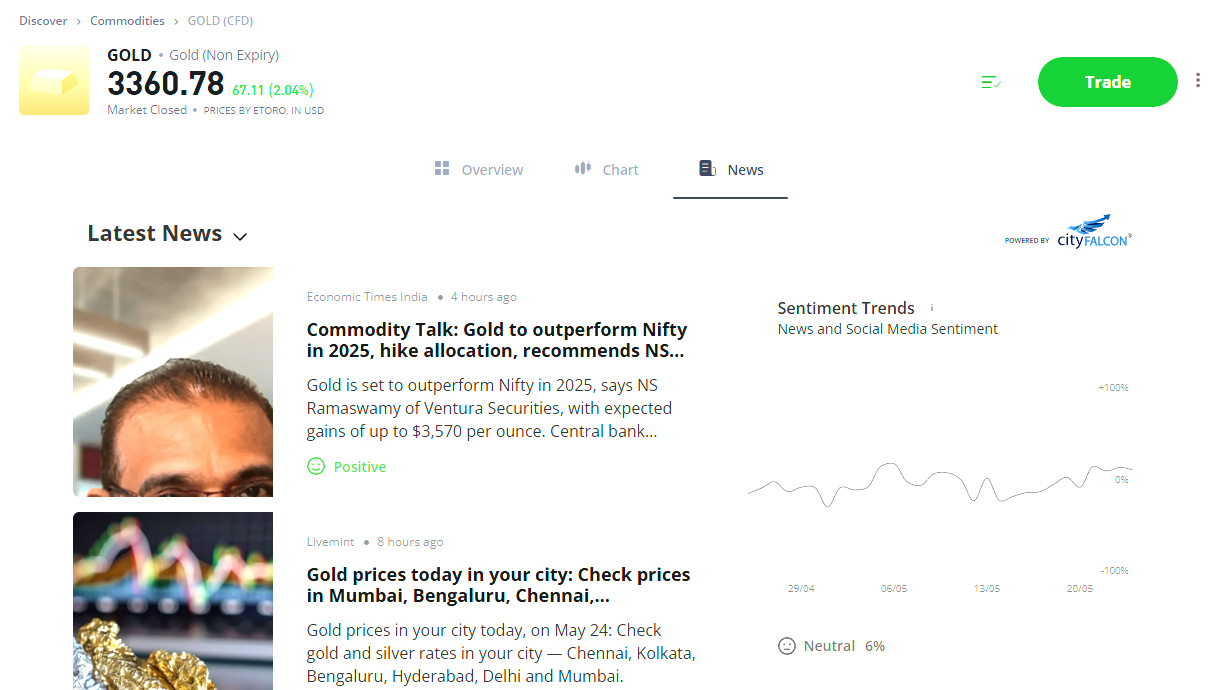
Fundamental analysis focuses on factors driving gold prices: interest rate decisions, US dollar strength, inflation data, and geopolitical events. The economic calendar on your trading platform highlights key announcements that may impact gold. Many traders who use the best day trading platforms combine both approaches for more informed decisions.
Step 6 — Place Your First Gold Trade
Start with a position size you're comfortable losing. A common rule is risking no more than 1-2% of your account on any single trade. For a $1,000 account, this means limiting potential losses to $10-$20 per trade.
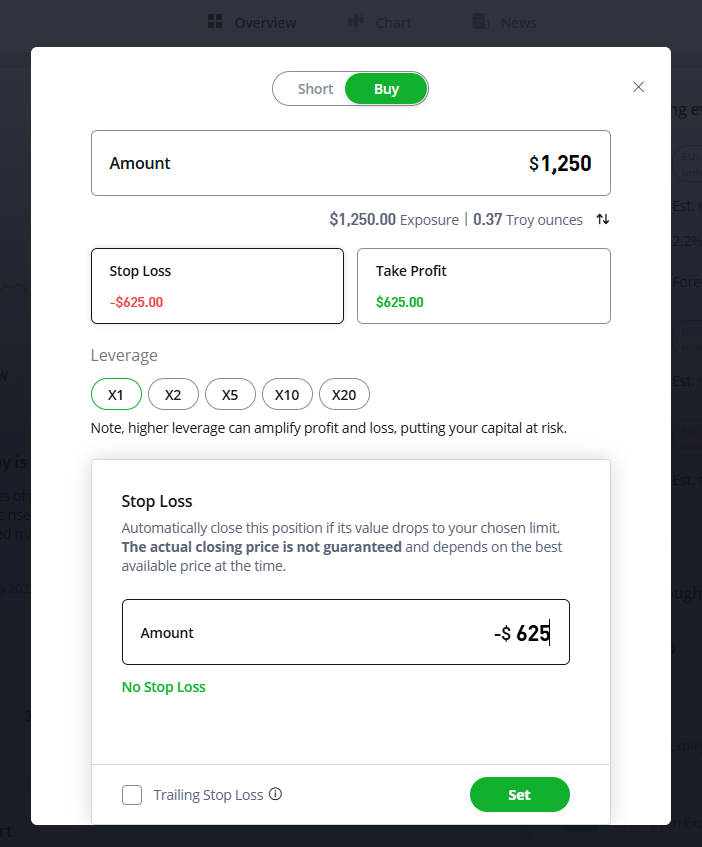
Set a stop-loss order to automatically close your position if gold moves against you beyond your risk threshold. Take-profit orders lock in gains at your target price. Monitor your trade, but avoid the temptation to constantly adjust stops based on short-term fluctuations.
What Is Gold Trading and Why Is It Popular?
Gold trading involves speculating on the price movements of gold without necessarily owning the physical metal. Australian traders can profit from both rising and falling gold prices through CFDs, ETFs, futures, and options.
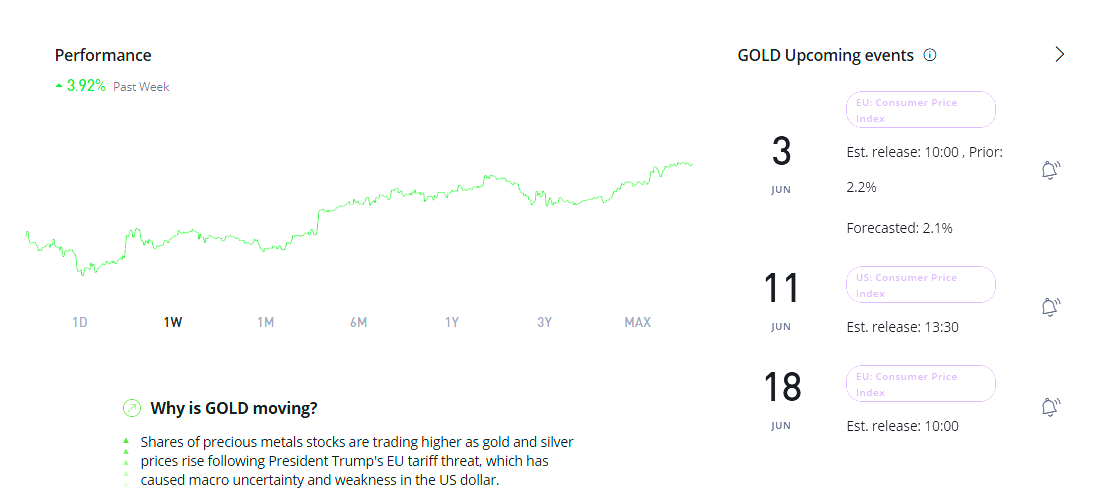
Gold delivered exceptional returns of 60% in 2025 according to the World Gold Council, setting over 50 all-time price highs throughout the year. This followed a strong 25.5% gain in 2024, making gold one of the best-performing asset classes over the two-year period.
Australian traders are drawn to gold for several reasons. The precious metal acts as a safe-haven asset during economic uncertainty, provides portfolio diversification away from shares and property, and often moves inversely to the Australian dollar. When the AUD weakens, gold priced in Australian dollars typically rises, providing a natural hedge for local investors.
What Are the Different Ways to Trade Gold?
What Is Gold CFD Trading?
CFDs (Contracts for Difference) let you speculate on gold price movements without owning physical bullion. You can profit from both rising prices (going long) and falling prices (going short), with leverage amplifying your exposure.
Under ASIC's Product Intervention Order, gold CFD leverage is capped at 1:20 for retail traders. This means $1,000 in your account can control up to $20,000 worth of gold. While leverage magnifies potential profits, it equally amplifies losses, and overnight funding fees apply when positions are held past market close.
CFD trading suits active traders who want to capitalise on short-term price movements without the complications of physical storage or delivery.
What Are Gold ETFs?
Gold ETFs (Exchange-Traded Funds) trade on the ASX like regular shares and provide exposure to gold prices without directly holding bullion. The main options for Australian investors include:
- Global X Physical Gold (ASX: GOLD) – The largest gold ETF on the ASX at $5.5 billion, backed by allocated physical gold bars
- Perth Mint Gold (ASX: PMGOLD) – Backed by the Western Australian Government guarantee, with the lowest management fee at 0.15%
- BetaShares Gold Bullion (ASX: QAU) – Currency-hedged to remove AUD/USD exchange rate risk
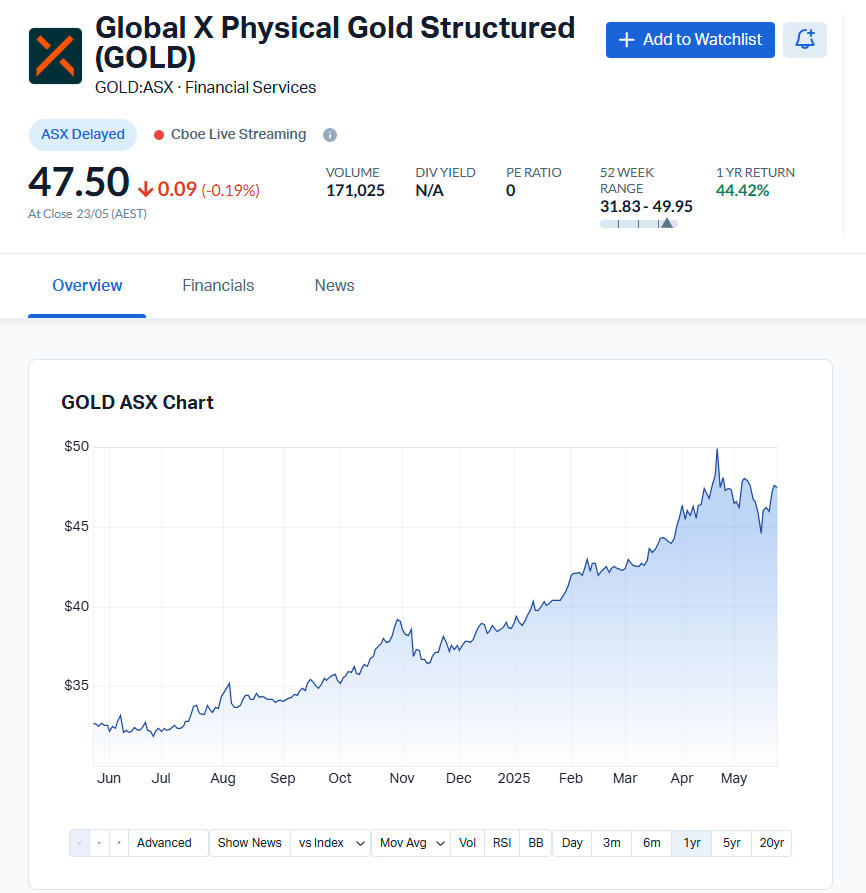
ETFs suit longer-term investors who want gold exposure within their share portfolio or superannuation. You buy and sell through your existing broker, and there's no need to arrange storage or insurance.
What About Gold Futures and Options?
Gold futures are standardised contracts to buy or sell gold at a predetermined price on a future date. They trade on exchanges like COMEX and require substantial capital due to contract sizes (typically 100 troy ounces).
Options give you the right, but not obligation, to buy (call) or sell (put) gold at a specific price before expiry. They offer defined risk since you can only lose the premium paid, making them useful for hedging strategies.
Both instruments suit experienced traders comfortable with derivatives. Most retail Australian traders prefer CFDs or ETFs for their accessibility and lower capital requirements.
Should You Buy Physical Gold?
Physical gold includes bullion bars, coins, and certificates. The Perth Mint is Australia's premier source, offering government-guaranteed storage and a range of investment-grade products.
Investment-grade gold (99.5% purity for bars, 99.9% for coins) is GST-free in Australia. However, you'll need to consider storage costs, insurance, and the buy/sell spread when purchasing physical bullion. The ATO treats physical gold as a capital asset, meaning CGT applies when you sell at a profit.
Physical gold suits investors seeking tangible wealth preservation rather than active trading profits.
What Factors Affect the Gold Price?
How Do Interest Rates Impact Gold?
Gold typically moves inversely to interest rates. When central banks raise rates, bonds and savings accounts become more attractive, reducing gold's appeal since it pays no yield. Conversely, rate cuts make gold relatively more attractive.
The US Federal Reserve's decisions carry the most weight globally. When the Fed signals rate cuts, gold often rallies in anticipation. Australian traders should monitor both the Fed and the Reserve Bank of Australia, as RBA decisions affect the AUD/gold relationship.
How Does the US Dollar Affect Gold?
Gold is priced in US dollars globally, creating an inverse relationship. When the USD strengthens, gold becomes more expensive for holders of other currencies, dampening demand and pushing prices lower. A weaker dollar has the opposite effect.
For Australian traders, this creates a double dynamic. If the USD weakens against both gold and the AUD, local gold prices may not rise as dramatically as USD-denominated prices. Currency-hedged products like ASX:QAU remove this complexity if you want pure gold exposure.
Why Is Gold Considered a Safe Haven?
Gold has served as a store of value for thousands of years, maintaining purchasing power across economic cycles. During market crashes, geopolitical crises, and periods of high inflation, investors typically flee to gold as a wealth preservation tool.
The 2024-2025 rally demonstrated this clearly. Geopolitical tensions, persistent inflation concerns, and economic uncertainty drove gold to record highs. Central banks purchased over 1,000 tonnes annually for three consecutive years according to the World Gold Council, reflecting institutional confidence in gold's safe-haven status.
What Role Do Central Banks Play?
Central banks are major gold market participants. Their buying and selling decisions can significantly influence prices, with purchases supporting prices and sales creating downward pressure.
Since 2022, central banks globally have been net buyers at historic levels, diversifying reserves away from USD-denominated assets. This structural demand has provided a price floor during market corrections and contributed to gold's strong performance in recent years.
What Do Australian Traders Need to Know About ASIC Regulation?
ASIC's Product Intervention Order, effective since March 2021 and extended through 2027, governs how CFDs are offered to retail traders in Australia. The regulations aim to reduce losses after ASIC found that most retail CFD traders lose money.
Key protections for Australian gold traders include:
- Leverage caps: Maximum 1:20 for gold CFDs (5% margin requirement)
- Negative balance protection: You cannot lose more than your account balance
- Margin close-out: Brokers must close positions when equity falls to 50% of required margin
- No inducements: Brokers cannot offer bonuses or rewards to encourage trading
Before these rules, some brokers offered leverage up to 500:1, leading to devastating losses during volatile periods. ASIC reported that aggregate retail client losses fell by 91% following the intervention. Always verify your broker holds a valid AFSL and check their registration on ASIC's professional register.
Do You Pay Tax on Gold Trading in Australia?
Yes, gold trading profits are taxable in Australia. The ATO treats gold as a capital asset, meaning Capital Gains Tax (CGT) applies when you sell at a profit.
Key tax considerations for Australian gold traders:
- CGT discount: Hold gold investments for 12+ months to qualify for a 50% CGT discount
- CFD profits: Taxed at your marginal income tax rate, typically as assessable income
- Capital losses: Can offset capital gains and be carried forward to future years
- GST: Investment-grade gold (99.5%+ purity) is GST-free; non-investment grade gold incurs 10% GST
Keep detailed records of all gold transactions including purchase dates, amounts, and costs. The ATO requires you to report capital gains in the financial year they occur, even if you reinvest the proceeds. Consider consulting a tax professional for personalised advice on your gold trading activities.
Which Are the Best Platforms to Trade Gold in Australia?
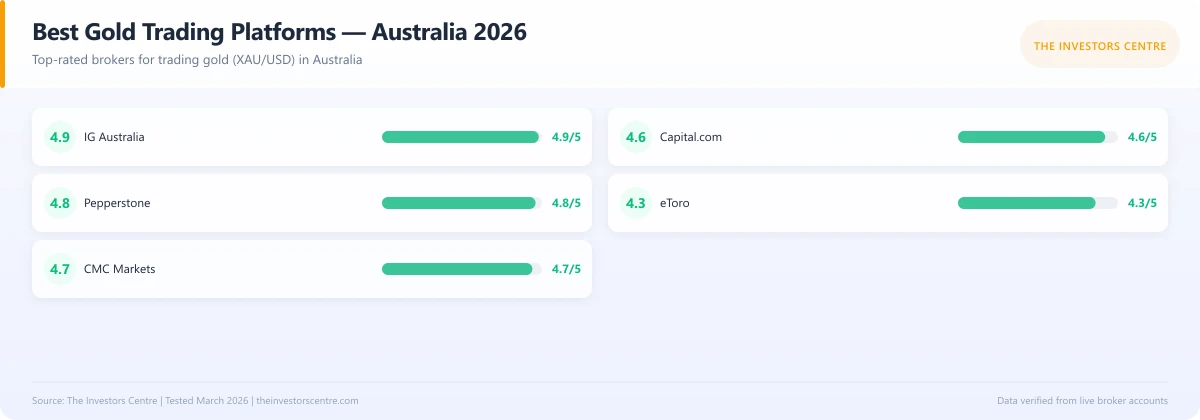
Australian gold traders have access to several ASIC-regulated platforms offering competitive spreads, multiple gold markets, and robust trading tools. The three leaders are IG Australia, Pepperstone, and CMC Markets.
| Rank | Platform | Gold Spread | Min. Deposit | Platforms | Rating |
|---|---|---|---|---|---|
| 1 | IG Australia | From $0.30 | $0 | Web, MT4, App | ⭐ 4.9 |
| 2 | Pepperstone | From $0.15 | $0 | MT4, MT5, cTrader | ⭐ 4.8 |
| 3 | CMC Markets | From $0.30 | $0 | Web, MT4, App | ⭐ 4.7 |
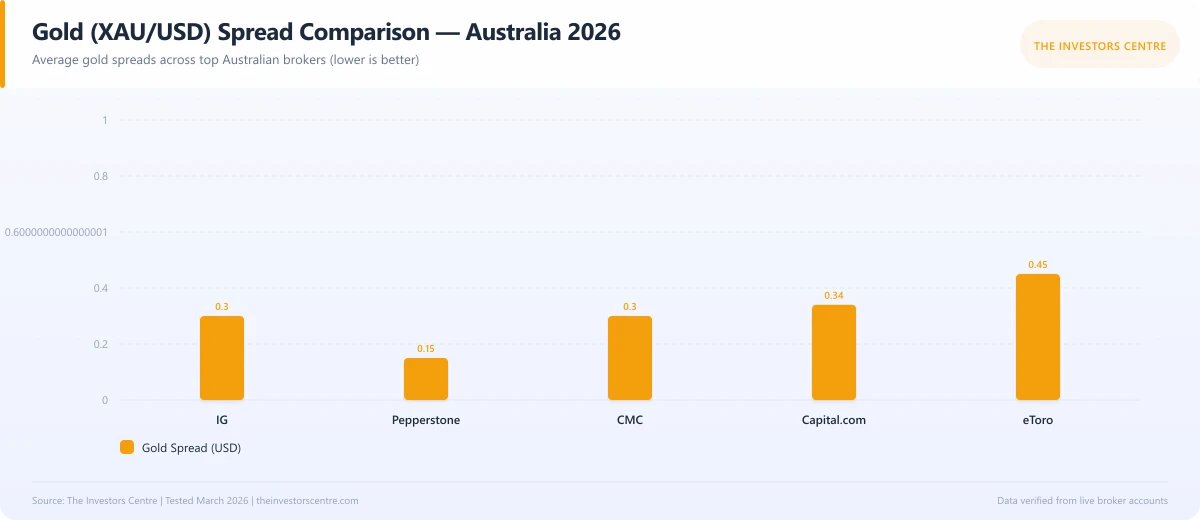
All three platforms hold valid AFSLs, comply with ASIC's leverage limits and negative balance protection requirements, and offer competitive pricing for gold CFD trading.
Here Are the Top 3 Best Gold Trading Platforms in Australia
1. IG Australia — Best Overall for Gold Trading
2. Pepperstone — Best for Low Spreads
3. CMC Markets — Best Trading Platform
1. IG Australia — Best Overall for Gold Trading
Pros
- 50+ years in business with 320,000+ clients globally
- Tight gold spreads from $0.30 with no commission on CFDs
- Multiple gold markets including spot, futures, and gold ETFs
- ASIC-regulated (AFSL 515106) with segregated client funds
Cons
- Overnight funding fees apply for positions held past market close
- Premium features like guaranteed stops incur additional charges
What Are IG's Gold Trading Fees?
IG charges gold CFD spreads from $0.30 with no commission for standard accounts. The spread represents the difference between buy and sell prices, so you pay this cost when entering and exiting trades.
Overnight funding applies to positions held past 10pm (AEST). For gold, this is calculated daily based on the underlying interbank rate plus IG's charge. Active traders should factor these costs into longer-term positions. IG's fee structure remains competitive among Australian trading platforms.
What Gold Markets Can You Trade on IG?
IG offers comprehensive gold exposure including spot gold CFDs (XAU/USD, XAU/AUD), gold futures CFDs, and CFDs on gold mining stocks and ETFs. You can trade gold against multiple currencies or speculate on individual gold producers.
The platform also provides access to gold options for more sophisticated strategies. With over 17,000 markets available, you can build diversified positions combining gold with other commodities, indices, and shares from a single account.
How Safe Is IG for Australian Traders?
IG Australia holds AFSL 515106 and operates under full ASIC regulation. Client funds are held in segregated accounts with top-tier Australian banks, separate from IG's operational capital.
The company has operated since 1974 and is listed on the London Stock Exchange (IGG), providing transparency through public financial reporting. IG complies with ASIC's Product Intervention Order, offering negative balance protection and capped leverage for retail clients.
Who Is IG Best For?
IG suits traders wanting a comprehensive, reliable platform from an established provider. The combination of tight spreads, extensive markets, and strong regulation makes it ideal for both beginners learning gold trading and experienced traders requiring advanced tools.
Those seeking the widest range of gold-related instruments, including options and ETF CFDs alongside spot trading, will find IG's offering particularly valuable.
2. Pepperstone — Best for Low Spreads
Pros
- Ultra-tight gold spreads from $0.15 on Razor accounts
- Choice of MT4, MT5, cTrader, and TradingView platforms
- Fast execution with no dealing desk intervention
- ASIC-regulated (AFSL 414530) Melbourne-headquartered broker
Cons
- Razor account charges $3.50 commission per side per lot
- No proprietary platform – relies on third-party software
What Are Pepperstone's Gold Trading Fees?
Pepperstone offers two account types for gold trading. The Standard account has spreads from $0.30 with no commission. The Razor account offers tighter spreads from $0.15 but charges $3.50 commission per side per standard lot.
For active gold traders, the Razor account typically works out cheaper despite the commission. Overnight swap rates apply to positions held past rollover. Pepperstone's pricing is among the most competitive for Australian traders focusing on gold.
What Gold Markets Can You Trade on Pepperstone?
Pepperstone provides gold CFDs against eight currencies: USD, AUD, EUR, GBP, CHF, JPY, SGD, and CNH. This flexibility lets you trade gold in your preferred currency pair or take positions on currency correlations.
Beyond spot gold, you can access CFDs on gold ETFs and major gold mining companies. The range suits traders wanting focused gold exposure rather than overwhelming market choice.
How Safe Is Pepperstone for Australian Traders?
Pepperstone holds AFSL 414530 and is headquartered in Melbourne, making it a genuinely Australian broker. Client funds are held in segregated trust accounts with National Australia Bank.
The broker has won multiple industry awards and serves over 400,000 clients globally. Full compliance with ASIC's leverage limits, negative balance protection, and margin close-out rules provides regulatory protection for retail gold traders.
Who Is Pepperstone Best For?
Pepperstone excels for cost-conscious traders prioritising tight spreads and fast execution. The Razor account particularly suits high-volume gold traders where the commission structure delivers lower overall costs.
Traders who prefer established third-party platforms like MetaTrader or cTrader over proprietary software will appreciate Pepperstone's platform flexibility and TradingView integration.
3. CMC Markets — Best Trading Platform
Pros
- Award-winning Next Generation platform with advanced charting
- Over 12,000 instruments including extensive gold products
- Free premium tools including pattern recognition and client sentiment
- ASIC-regulated (AFSL 238054) with 30+ years operating history
Cons
- Spreads slightly wider than Pepperstone's Razor account
- Platform complexity may overwhelm complete beginners
What Are CMC Markets' Gold Trading Fees?
CMC Markets charges gold spreads from $0.30 with no commission on CFD trades. The spread-only model simplifies cost calculations – what you see is what you pay.
Holding costs apply to overnight positions, calculated based on the relevant interbank rate. CMC's pricing module displays all costs transparently before trade execution, helping you understand the true expense of each position. For traders exploring multiple asset classes, CMC's forex trading capabilities are equally competitive.
What Gold Markets Can You Trade on CMC Markets?
CMC offers spot gold CFDs, gold futures CFDs, and CFDs on gold-related stocks and ETFs. The platform provides gold pricing against major currencies, allowing you to trade XAU/USD, XAU/AUD, XAU/EUR, and other pairs.
With 12,000+ instruments available, you can easily diversify from gold into other commodities, indices, shares, and forex from one integrated platform. The breadth suits traders building multi-asset portfolios.
How Safe Is CMC Markets for Australian Traders?
CMC Markets holds AFSL 238054 and has operated in Australia for over 30 years. The company is listed on the London Stock Exchange, providing transparency through regulated financial reporting.
Client money is held in segregated accounts with major Australian banks. CMC fully complies with ASIC's retail protection measures including leverage caps, negative balance protection, and standardised margin close-out procedures.
Who Is CMC Markets Best For?
CMC Markets suits traders who value powerful analytical tools and a sophisticated trading platform. The Next Generation platform offers superior charting, pattern recognition, and market analysis features included free.
Intermediate to advanced traders will extract the most value, though CMC's educational resources and demo account help beginners develop skills before trading live gold positions.
Final Thoughts
Gold trading offers Australian investors multiple pathways to access one of the world's most established asset classes. Whether you choose CFDs for active trading, ETFs for longer-term exposure, or physical bullion for wealth preservation, understanding the costs, regulations, and tax implications is essential.
ASIC's regulatory framework provides meaningful protection for retail traders, with leverage caps, negative balance protection, and margin close-out rules reducing the risk of catastrophic losses. Platforms like IG, Pepperstone, and CMC Markets offer ASIC-regulated access with competitive pricing and robust trading tools.
Start with a demo account to build familiarity before committing real capital. When you're ready to trade live, apply strict risk management – never risk more than you can afford to lose, and always use stop-loss orders to define your maximum downside on each trade.
FAQs
References
- World Gold Council. "Gold Outlook 2026: Push ahead or pull back." December 2025.
- ASIC. "22-082MR ASIC's CFD product intervention order extended for five years." April 2022.
- Australian Taxation Office. "Capital gains tax." 2026.
- World Gold Council. "Gold Demand Trends: Full Year 2024." February 2025.
- Perth Mint. "Perth Mint Gold (ASX: PMGOLD)." 2026.
- ASIC. "21-060MR ASIC's CFD product intervention order takes effect." March 2021.
Trading CFDs and FX carries significant risk and is not suitable for everyone. You have no interest in the underlying asset.