What does downsizing actually free up?
On average UK prices in July 2026, moving from a detached house to a semi releases £166,381 on paper — but £143,135 to £154,464 once you have paid the estate agent, the solicitor, the removal firm and the stamp duty. Detached to terraced leaves £191,534 to £202,863. Detached to a flat leaves the most, £231,560 to £242,889, but flat prices fell 2.4% over the year while detached prices rose. The biggest cost of the move is not the tax: it is the estate agent.
Why downsizing is the honest option
Of the four ways to get money out of a house, selling and buying something smaller is the only one that converts the wealth permanently, hands you the cash outright, and reduces your running costs at the same time. No interest rolls up. No lodger moves in. No debt sits against the property.
It is also the one people put off longest, because it means leaving a house they may have lived in for thirty years. That is a real cost and it does not appear in any table. What follows is only the financial half of the decision.
The question this page answers is narrow and useful: on today's actual prices, how much money does the move put in your hands?
The gap between property types, on real prices
These are HM Land Registry figures for July 2026 — sold prices, not asking prices.
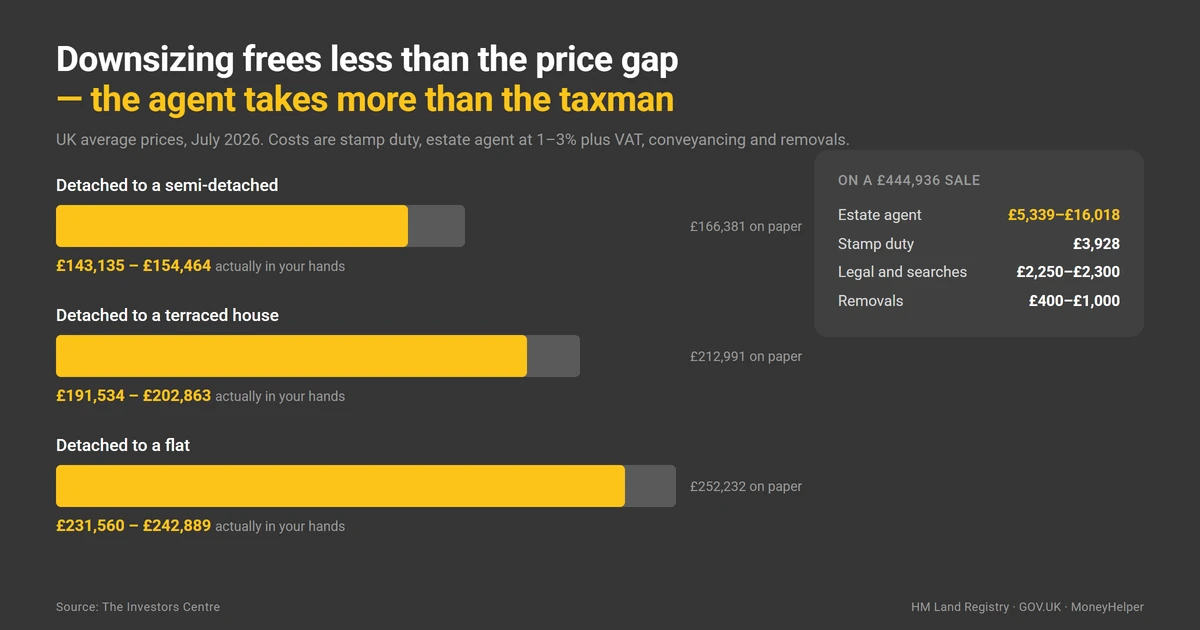
| Move | Sell for | Buy for | Gap on paper | Total cost of moving | Actually in your hands |
|---|---|---|---|---|---|
| Detached to semi-detached | £444,936 | £278,555 | £166,381 | £11,917 – £23,246 | £143,135 – £154,464 |
| Detached to terraced | £444,936 | £231,945 | £212,991 | £10,128 – £21,457 | £191,534 – £202,863 |
| Detached to flat or maisonette | £444,936 | £192,704 | £252,232 | £9,343 – £20,672 | £231,560 – £242,889 |
UK averages, July 2026. The cost range covers all four items broken down in the next section, and the spread is almost entirely the estate agent's commission, which runs from 1% to 3% of the sale price. Costs come to 7% to 14% of the gap on a move to a semi.
In England the numbers are larger, because the starting house is worth more: detached £474,626 to semi £292,024 is a gap of £182,602 on paper, before the same four costs.
Two things the gap column hides. The stamp duty falls as you downsize further, because you are buying into lower bands — £1,354 on an average flat against £3,928 on a semi. But the estate agent's fee is set by what you sell for, so it does not fall at all. That is why the cost of moving barely changes across the three rows while the gap grows.
What comes off the top
The gap is not what you bank. Four costs sit between the two prices and your account, and they are not in the order most people expect.
| Cost | How it is charged | On a detached-to-semi move |
|---|---|---|
| Estate agent, to sell | 1% to 3% of the sale price, plus 20% VAT | £5,339 – £16,018 |
| Stamp Duty Land Tax on the purchase | Banded, on what you buy (England and NI only) | £3,928 |
| Conveyancing, plus local searches | About £2,000 including VAT, searches £250–£300 | £2,250 – £2,300 |
| Removals | From £400 to over £1,000 | £400 – £1,000 |
| Total | £11,917 – £23,246 |
The estate agent is the biggest single cost, by a distance. On a £444,936 sale, the difference between negotiating 1% and accepting 3% is £10,679 — nearly three times the entire stamp duty bill. Stamp duty is only 17% to 33% of what the move costs you, which is the opposite of how most people think about it. Agent commission is negotiable and tax is not, so that is where the effort belongs.
Stamp duty is the one figure we can state exactly, because the bands are published. The gov.uk rates are below.
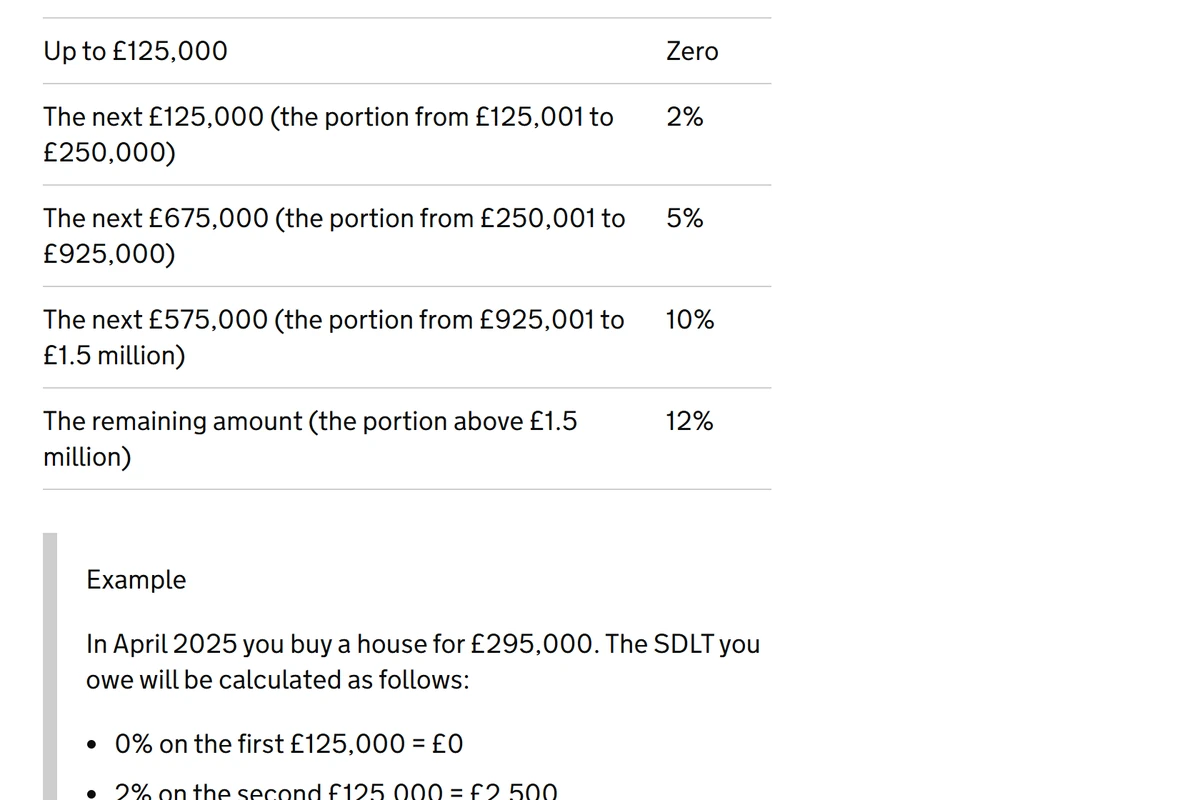
If you are in Wales or Scotland, the tax is a different tax. Wales charges Land Transaction Tax and Scotland charges Land and Buildings Transaction Tax, both on their own bands. The stamp duty figures on this page apply to England and Northern Ireland only, and you should not assume the Welsh or Scottish bill is similar.
There is no Capital Gains Tax to worry about on the sale. Private Residence Relief normally means the gain on your main home is not taxed, however large it has grown.
The flat-price trap
On the raw gap, moving to a flat looks like the obvious winner: £252,232 released against £166,381 for a semi. Before taking that at face value, look at which way each market is moving.
In the year to July 2026, UK house prices rose 1.4% overall. Detached prices rose. Flats and maisonettes fell 2.4% across the UK, and 3.5% in England. So the asset you would be selling appreciated and the asset you would be buying got cheaper — which helps you on the day you move, and works against you every year afterwards that you own the flat.
Flats also carry costs a house does not: service charges, ground rent on some leases, and the risk of a major works bill you have no control over. For someone downsizing specifically to create spendable money, a cheap asset with an uncapped bill attached deserves a hard look.
None of that makes a flat the wrong answer. It makes the headline gap the wrong way to choose.
What does the released money actually pay you?
This is the part worth being careful about, because a lump sum is not an income until you do something with it.
Take the £143,135 to £154,464 from a detached-to-semi move. At a 3% withdrawal rate that is about £358 to £386 a month; at 4%, about £477 to £515. Those are illustrations of arithmetic, not forecasts, not guaranteed, and not a recommended withdrawal rate — the point is the order of magnitude against the full new State Pension of £241.30 a week.
It is worth seeing what the costs did to that. On the paper gap of £166,381 the same 3% would have paid £416 a month. The fees cost you £30 to £58 a month, every month, for the rest of your retirement. That is the real price of not negotiating the agent's commission.
Two other things change on the same day, and they are easy to forget. Your running costs fall, because a smaller property costs less to heat, insure and maintain. And your remaining housing wealth is smaller, which matters if you were relying on it for later care costs or for what you leave behind.
If the wider question is whether the house was ever going to fund retirement on its own, we took that apart using every rolling return window since 1993 in is my house my pension?
How downsizing compares with the alternatives
Downsizing is one of four routes, and it is the only one that is finished when it is finished.
- Downsizing converts the value outright, cuts your bills, and costs you a move plus the fees above.
- Letting a room pays up to £7,500 a year tax free under the Rent a Room Scheme, needs no sale and no debt, and means sharing your home.
- A later-life or retirement interest-only mortgage keeps you in the house and requires you to service the interest from income you may not have.
- Equity release keeps you in the house with no monthly payments and lets the interest compound against you, which over a long retirement makes it the most expensive of the four.
We have set all four out, with what each one costs, in asset rich, cash poor.
Common questions
How much money does downsizing actually release?
On UK averages for July 2026, the gap is £166,381 moving from a detached house to a semi, £212,991 to a terraced house, and £252,232 to a flat. After every cost of moving you keep roughly £143,135 to £154,464, £191,534 to £202,863, and £231,560 to £242,889. The range is the estate agent's commission, which runs from 1% to 3% of the sale price plus VAT.
What is the biggest cost of downsizing?
The estate agent, not the tax. On an average detached sale of £444,936 the commission is £5,339 at 1% plus VAT and £16,018 at 3% plus VAT, against a stamp duty bill of £3,928 on an average semi. Stamp duty is only 17% to 33% of the total cost of the move. Commission is negotiable; the tax is not.
Do I pay stamp duty when I downsize?
Yes, on the property you buy, at standard residential rates — there is no relief for downsizers. Because you are buying something cheaper, the bill is usually modest: £3,928 on an average semi, £1,354 on an average flat. In Wales and Scotland the tax is Land Transaction Tax and Land and Buildings Transaction Tax respectively, on different bands.
Do I pay Capital Gains Tax on the house I sell?
Normally no. Private Residence Relief means there is usually no CGT on the gain on your main home, regardless of how much it has risen.
Is it better to downsize or release equity?
Downsizing is cheaper over a long retirement, because equity release lets interest compound against the property. Equity release is less disruptive, because you stay put. The trade is money against staying in your home, and it is a regulated decision that needs specialist advice.
Should I downsize to a flat?
It frees the most money and carries the most risk. UK flat prices fell 2.4% in the year to July 2026 while the wider market rose, and flats bring service charges, possible ground rent and major works bills. Compare the whole cost of ownership, not the purchase price.
Sources
- HM Land Registry — UK House Price Index, reference month July 2026, average prices by property type for the UK, England, Wales and Scotland. Retrieved 28 September 2026.
- GOV.UK: Stamp Duty Land Tax residential property rates, checked 28 September 2026.
- MoneyHelper — Mortgage fees and costs when buying or selling a home. Estate agent commission 1% to 3% plus VAT, legal fees about £2,000 including VAT, local searches £250 to £300, removals from £400 to over £1,000. Checked 29 September 2026.
- GOV.UK: Tax when you sell your home — Private Residence Relief.
- GOV.UK: Renting a room in your home, Rent a Room threshold £7,500.
- GOV.UK: The new State Pension, £241.30 a week, checked 28 September 2026.
Capital at risk. This article is information, not financial, tax or mortgage advice. The Investors Centre is not authorised to give pension, mortgage or equity release advice; speak to an FCA-regulated adviser about your own circumstances.