
- Expertise:
- CFD Trading, Forex, Derivatives, Risk Management
- Credentials:
- Chartered ACII (2018) · Trading since 2012
- Tested:
- 40+ forex & CFD platforms with live accounts

- Expertise:
- Platform Testing, Cryptocurrency, Retail Investing
- Credentials:
- Active investor since 2013 · 11+ years experience
- Tested:
- 50+ platforms · 200+ guides authored
How We Test
Real accounts. Real money. Real trades. No demo accounts or press releases.
What we measure:
- Spreads vs advertised rates
- Execution speed and slippage
- Hidden fees (overnight, withdrawal, conversion)
- Actual withdrawal times
Scoring:
Fees (25%) · Platform (20%) · Assets (15%) · Mobile (15%) · Tools (10%) · Support (10%) · Regulation (5%)
Testing team:
Adam Woodhead (investing since 2013), Thomas Drury (Chartered ACII, 2018), Dom Farnell (investing since 2013) — 50+ platforms with funded accounts
Quarterly reviews · Corrections: [email protected]
Disclaimer
Not financial advice. Educational content only. We're not FCA authorised. Consult a qualified advisor before investing.
Capital at risk. Investments can fall. Past performance doesn't guarantee future results.
CFD warning. 67-84% of retail accounts lose money trading CFDs. High risk due to leverage.
Contact: [email protected]
Which should an Australian trader pick, Pepperstone or eToro?
Decide what you want to be holding in six months and the choice makes itself. Pepperstone (Pepperstone Group Limited, AFSL 414530) is a trading toolkit: CFDs on 1,350+ instruments under ASIC's retail leverage caps, raw-spread pricing, and six platforms to run it on. eToro (eToro AUS Capital Limited, AFSL 491139) is a multi-asset app: real shares from 17 major global exchanges, real crypto, CFDs where you want leverage, and the CopyTrader system that lets you mirror other investors from US$200. Active CFD traders will find Pepperstone cheaper and better equipped. Investors who want to own assets, or copy someone who does, cannot do either at Pepperstone at all. Both quote most fees in US dollars, which Australians should read twice before comparing anything.
 Top Rated
Trading CFDs and FX carries significant risk and is not suitable for everyone. You have no interest in the underlying asset.
What is each platform actually for?
Both firms hold Australian financial services licences, and that is close to where the resemblance stops. I checked each company's Australian pages on 1 September 2026, and they are not selling the same product to the same person.
Pepperstone: a specialist CFD broker
Everything at Pepperstone is a CFD, a leveraged derivative capped for Australian retail clients at 30:1 on major forex pairs, 20:1 on gold, 5:1 on shares and 2:1 on crypto. You never own the underlying. What you get in exchange is the trading machinery: raw spreads plus a fixed commission on the Razor account, spread-only pricing on Standard, and a platform list that runs to TradingView, MT4, MT5, cTrader and Pepperstone's own web and mobile platform. The A$-equivalent minimum deposit is about $10 by card, none on bank transfer, and there is no inactivity fee. My comparison against its closest structural rival covers the execution side in more depth: Pepperstone vs IC Markets.
eToro: ownership first, CFDs attached
eToro's Australian offer leads with real assets. Shares across 17 major global exchanges, ETFs with zero commission, and real crypto with a staking rewards program, all held in your name on the platform rather than as derivative exposure. CFDs exist inside the app too, under the same ASIC caps that apply to Pepperstone, but they are the seasoning rather than the meal. The 2026 addition that changed the comparison is AUD currency accounts: deposit, hold and withdraw in Australian dollars, with no FX conversion fee when trading Australian stocks and free withdrawals from AUD accounts. Older reviews still list a US$5 withdrawal fee and a monthly inactivity charge. As at 1 September 2026 the fee page shows neither for AUD-account users, though the US$5 fee still applies to withdrawals from USD accounts.
So the fork is ownership versus execution. eToro will actually sell you the share; what Pepperstone sells is a faster, cheaper way of trading its price.
What do they cost where you can compare them?
Not everywhere, is the first thing to say.
Pepperstone publishes no stock-ownership pricing because it has no stock ownership, and eToro publishes no per-lot forex commission because its CFDs are spread-only. The comparable ground looks like this.
| Cost line | Pepperstone | eToro |
|---|---|---|
| Forex CFD, per standard lot | Razor: raw spread + AUD 7 per lot round turn on MT4/MT5 with an AUD account (at open on MT4, AUD 3.50 per side on MT5); Standard adds roughly 1 pip instead | Spread-only; no per-lot commission published |
| Share exposure | Share CFDs, commission-based, price exposure only | Real shares: a US$1 or US$2 commission may apply each way depending on exchange; the AU headline is a US$2 flat fee |
| ETFs | Not offered as ownership | Zero commission on all ETF trades |
| Crypto | Crypto CFDs (2:1 retail cap); spot buying sits with the separate Pepperstone Crypto product | Real coins at a flat 1% per side; crypto CFDs carry a 1% spread |
| Withdrawals | Free | Free from AUD accounts; US$5 from USD accounts, minimum US$30 |
| Inactivity | None | None per the current fee page |
For a pure forex or index CFD trader, Pepperstone's raw-plus-commission model is built to be the cheaper route at any real frequency, and eToro does not seriously contest that ground. The other thing the table shows is how little of it is quoted in AUD: Pepperstone's commissions are USD figures converted at spot to your account currency, and eToro quotes stock commissions and CopyTrader minimums in USD outright. eToro's AUD accounts soften this for Australian shares specifically. On everything else, both firms make you do the conversion.
Who wins the copy trading question?
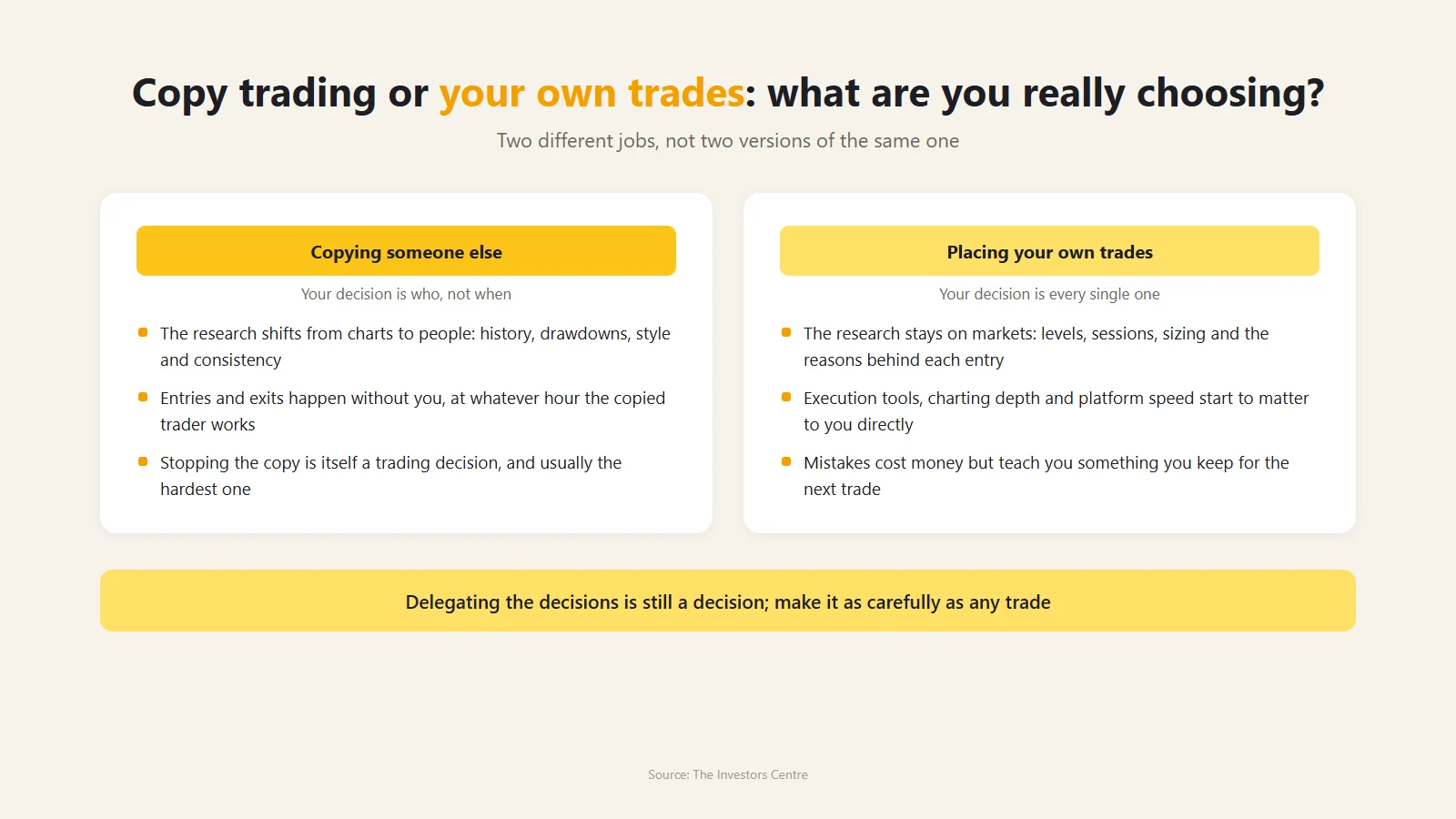
eToro, and it is not close. CopyTrader is the product the whole platform is named for: pick an investor, allocate a minimum of US$200, and your account mirrors their moves proportionally, up to 100 traders at once, with a copy stop loss to cap the arrangement and no charge for the copying itself beyond normal spreads and fees. The pool of people to copy is enormous because eToro's social layer is the point of the place.
Pepperstone's answer is thinner in Australia. cTrader has a copy facility built into the platform itself, with strategy providers setting their own fees, but Pepperstone's Australian pages do not currently present a copy trading product, so treat availability as something to confirm with the broker rather than assume. If copying other investors is the reason you are opening an account, that ambiguity settles the whole comparison by itself.
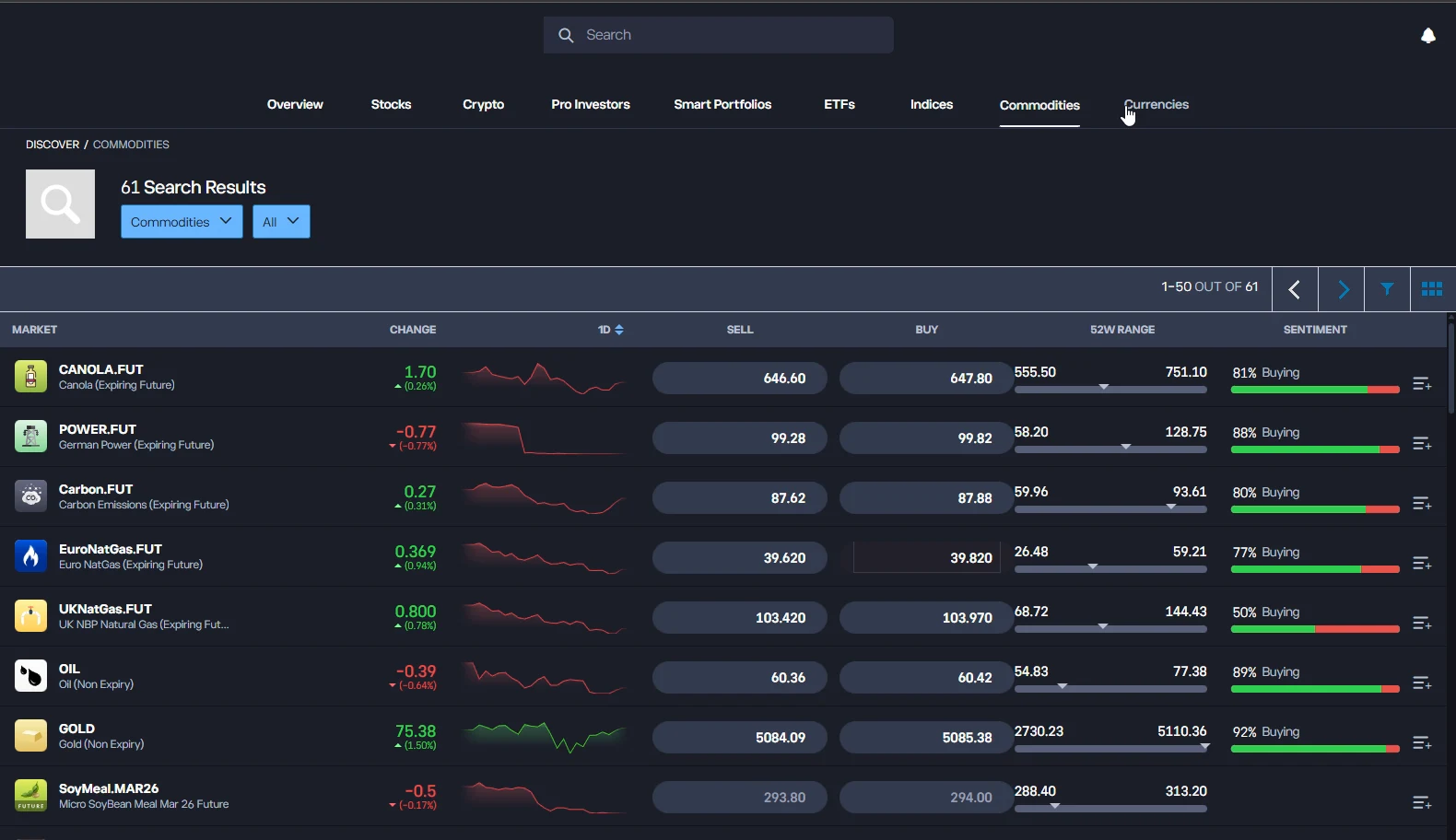
How different are the platforms?
The count alone says most of it: six against one. Pepperstone hands you TradingView, MT4, MT5, cTrader, its own web platform and its mobile app, and lets you pick per job: MT5 for automation, cTrader for execution depth, TradingView for charting, the house app for simplicity. One catch: Razor commission varies with the platform you choose, so picking your charts also picks your per-lot rate.
eToro runs one proprietary platform, web and app, with no MT4, no MT5 and no TradingView connection. Before writing that up as a loss, be fair about who it serves: a single well-designed app in which stocks, ETFs, crypto, CFDs and copied portfolios sit side by side is exactly what a part-time investor wants, and the learning curve is a fraction of MetaTrader's. Traders who need EAs, depth-of-market data or raw charting control will feel the walls quickly. Investors mostly will not.
One practical note on trying either before funding: Pepperstone's demo lengths vary by platform, 30 days on its own platform, 60 on MT4 and MT5, and cTrader demos persist as long as you log in every 90 days, so the trial itself tells you something about which platform habit you are forming. eToro offers a virtual portfolio inside the same app, which suits its audience for the same reason the single app does.
Who should choose which?
Three profiles cover most readers. The frequent CFD trader, anyone running forex or index strategies with real position counts, belongs at Pepperstone for the raw pricing and the platform choice; start with the account-opening guide, which includes the appropriateness assessment ASIC requires. The buy-and-hold investor who wants actual shares, ETFs and coins in their own name belongs at eToro, because Pepperstone simply does not sell ownership. And anyone still on the fence should read my assessment of who Pepperstone actually suits first. The six-month question still does the sorting after that: picture what you want to be holding by then, and open the account that sells it.
Frequently Asked Questions
References
- eToro: Australian offer, entity and AFSL disclosure (checked 1 September 2026)
- eToro: AU fee schedule (checked 1 September 2026)
- eToro: CopyTrader terms and minimums (checked 1 September 2026)
- eToro: AUD currency accounts (checked 1 September 2026)
- Pepperstone: Razor and Standard pricing (checked 1 September 2026)
- Pepperstone: platform line-up (checked 1 September 2026)
Trading CFDs and FX carries significant risk and is not suitable for everyone. You have no interest in the underlying asset.