
- Expertise:
- CFD Trading, Forex, Derivatives, Risk Management
- Credentials:
- Chartered ACII (2018) · Trading since 2012
- Tested:
- 40+ forex & CFD platforms with live accounts

- Expertise:
- Broker Comparison, ISA Strategy, Portfolio Management
- Credentials:
- Active investor since 2013 · 11+ years experience
- Tested:
- 40+ brokers with funded accounts
How We Test
Real accounts. Real money. Real trades. No demo accounts or press releases.
What we measure:
- Spreads vs advertised rates
- Execution speed and slippage
- Hidden fees (overnight, withdrawal, conversion)
- Actual withdrawal times
Scoring:
Fees (25%) · Platform (20%) · Assets (15%) · Mobile (15%) · Tools (10%) · Support (10%) · Regulation (5%)
Testing team:
Adam Woodhead (investing since 2013), Thomas Drury (Chartered ACII, 2018), Dom Farnell (investing since 2013) — 50+ platforms with funded accounts
Quarterly reviews · Corrections: [email protected]
Disclaimer
Not financial advice. Educational content only. We're not FCA authorised. Consult a qualified advisor before investing.
Capital at risk. Investments can fall. Past performance doesn't guarantee future results.
CFD warning. 67-84% of retail accounts lose money trading CFDs. High risk due to leverage.
Contact: [email protected]
Quick Answer: Is Pepperstone Worth It for Australian Beginners?
Pepperstone is a low-cost, ASIC-regulated CFD broker (AFSL 414530) with spreads from 0.1 pips on the Razor account and a choice of five trading platforms including TradingView and MetaTrader. But it is important to be clear up front: CFDs are complex, leveraged products that carry a high risk of losing money quickly, and they are not suitable for everyone. If you are new to trading, that risk matters more, not less. This page looks at what Pepperstone offers and what to weigh carefully before you start, rather than treating CFD trading as a sensible default when you are starting out.
 Top Rated
Trading CFDs and FX carries significant risk and is not suitable for everyone. You have no interest in the underlying asset.
Why Am I Assessing Pepperstone for Australian Beginners?
Pepperstone has been my primary CFD broker since 2021 and I have tested every element of the platform that a new trader would encounter: account registration, demo trading, platform navigation, educational content, and customer support response times. I am not an Australian resident, but I spend significant time in Australia and have tested the AU entity directly. This assessment is built on hands-on experience rather than marketing material, and it is written to help you weigh the risks as much as the features.
Pepperstone Group Limited is regulated by the Australian Securities and Investments Commission under AFSL 414530. Unlike the UK entity, there is no government-backed compensation scheme for Australian clients. That point is covered in more detail on Pepperstone's safety credentials. For the full broker assessment across all experience levels, the complete Pepperstone review covers the broader picture.
Who Regulates Pepperstone in Australia, and What Does That Mean?
Pepperstone Group Limited holds Australian Financial Services Licence 414530, issued by ASIC. The company was founded in Melbourne in 2010, which makes it one of the few globally recognised CFD brokers that originated in Australia rather than arriving here through a subsidiary structure. ASIC regulation requires segregated client funds held with tier-1 Australian banks, transparent pricing disclosures, and adherence to retail leverage caps introduced in 2021.
The critical point: Australia has no equivalent to the UK's FSCS or the EU's ICF investor compensation schemes. If an ASIC-regulated broker were to fail, client money in segregated accounts would be returned through the insolvency process, but there is no government-backed guarantee covering a specific dollar amount. This applies to every ASIC-regulated broker, including Pepperstone, IG and Capital.com, and anyone trading should understand this structural reality before depositing significant capital.
What Draws Australian Beginners to Pepperstone Over Other Brokers?
Pepperstone's appeal for first-time Australian traders comes down to three things: genuinely low trading costs, a choice of familiar platforms, and an onboarding process that does not overwhelm. The Standard account charges no commission, with all costs built into spreads starting around 1.0 pips on EUR/USD, which removes the confusion that commission-plus-spread pricing creates for people placing their first trades. There is no minimum deposit, no platform fee, and no inactivity charge. None of that changes the underlying risk of CFD trading, but it does lower the cost of learning.
My first live trade on the AU entity was a 0.01-lot AUD/USD position on the Standard account, funded with AUD $200 via PayID. The deposit cleared instantly. The trade itself was unremarkable, a small gain closed within the hour, but what stood out was how little friction existed between deciding to trade and actually executing. That simplicity cuts both ways: it is easy to start, which means it is also easy to take on risk before you are ready. For help choosing an account, the Razor vs Standard breakdown walks through the cost differences in detail.
How Does Pepperstone Compare With Other Australian CFD Brokers?
| Feature | Pepperstone | IG Australia | Capital.com AU |
|---|---|---|---|
| ASIC Licence | AFSL 414530 | AFSL 515106 | AFSL 513393 |
| Compensation Scheme | None | None | None |
| Minimum Deposit | AUD $0 | AUD $0 (bank), $300 (card) | AUD $20 |
| EUR/USD Typical Spread | From 0.1 pips (Razor) | From 0.6 pips | From 0.6 pips |
| Demo Account | 30 days | Unlimited | Unlimited |
| Platforms | MT4, MT5, cTrader, TradingView, Pepperstone | IG platform, MT4, ProRealTime | Own platform, MT4 |
| Education Quality | Good: webinars, guides, analysis | Excellent: IG Academy (18 courses) | Good: AI-assisted, app-focused |
| Inactivity Fee | None | AUD $18/month (after 24 months) | None |
| Real Shares | No, CFDs only | Yes, ASX and international | No, CFDs only |
Table based on publicly available information as of March 2026. Spreads are variable and may differ from those shown.
How Straightforward Is It to Open a Pepperstone Account in Australia?
The entire application process is online and runs through a single form. When I last tested it in February 2026, the form took under 7 minutes to complete. Pepperstone asks for personal details, tax information, a self-assessment of trading knowledge, and identification, via an Australian driver's licence or passport handled through automated verification. My account was approved within 3 hours on a weekday afternoon.
You choose between two account types at signup: Standard or Razor. Standard is the simpler starting point, with no commission, spread-only pricing, and the same market access as Razor. There is no minimum deposit requirement, so you can fund with a small amount while you learn. BPay, PayID, Visa, Mastercard, PayPal, Apple Pay, and Google Pay are all available for Australian deposits. As part of the application, you will also complete a short appropriateness assessment, which is covered in the account-opening walkthrough. For a deeper comparison of which account type suits different trading styles, the account selection guide covers the decision.
What Learning Resources Does Pepperstone Offer Australian Beginners?
Pepperstone provides a structured education hub covering forex basics, platform tutorials, risk management principles, and market analysis. The content is organised by skill level, and regular webinars hosted by market analysts give newer traders access to live commentary and Q&A sessions. The quality sits between IG Australia's IG Academy (which is more structured with progress tracking) and the looser article-based libraries offered by most mid-tier brokers.
Daily market analysis and trade ideas are published through the Pepperstone website and integrated into the platform. These are functional for understanding what is moving and why, though they should be treated as context rather than trade signals. The educational offering is solid, not industry-leading, but comprehensive enough that a new trader could build foundational knowledge without needing third-party courses. Education does not remove the risk of CFD trading, so it is worth pairing with plenty of demo practice before going live.
The Demo Account: Useful, but the 30-Day Limit Matters
Pepperstone's demo account runs for 30 days on the Australian entity. It loads with virtual funds and mirrors live market pricing across forex, indices, commodities, and crypto CFDs. For learning platform mechanics and testing order types, it does the job well. The limitation is the time constraint: 30 days is tight for a complete beginner who needs to learn both the platform and basic trading concepts at the same time.
IG Australia and Capital.com AU both offer unlimited demos, which is a genuine advantage for anyone who wants to practise without a deadline. If the 30-day window expires on Pepperstone, you can request a reset through support, but it adds an unnecessary friction point. For traders disciplined enough to commit 2 to 3 weeks of focused practice, the 30 days is workable. For those who want to take their time, it is a real drawback.
Mistakes New Traders Commonly Make on Pepperstone
The most frequent errors I see new traders make are over-leveraging early positions, ignoring overnight swap costs on positions held past market close, and switching between too many instruments before developing competence in one. Pepperstone's leverage defaults to ASIC maximums (30:1 on major forex), and new traders often underestimate how quickly a 30:1 position moves against them. Starting with 5:1 or 10:1 effective leverage and scaling up gradually is a safer approach.
Which Pepperstone Platform Is Easiest for Someone Starting Out?
Pepperstone offers five platforms in Australia: MetaTrader 4, MetaTrader 5, cTrader, TradingView, and the proprietary Pepperstone platform. For most new traders, MetaTrader 4 remains the simplest entry point. It is lightweight, widely documented through free online tutorials, and handles the basics, including market orders, stop-losses and basic charting, without presenting an overwhelming interface on first login.
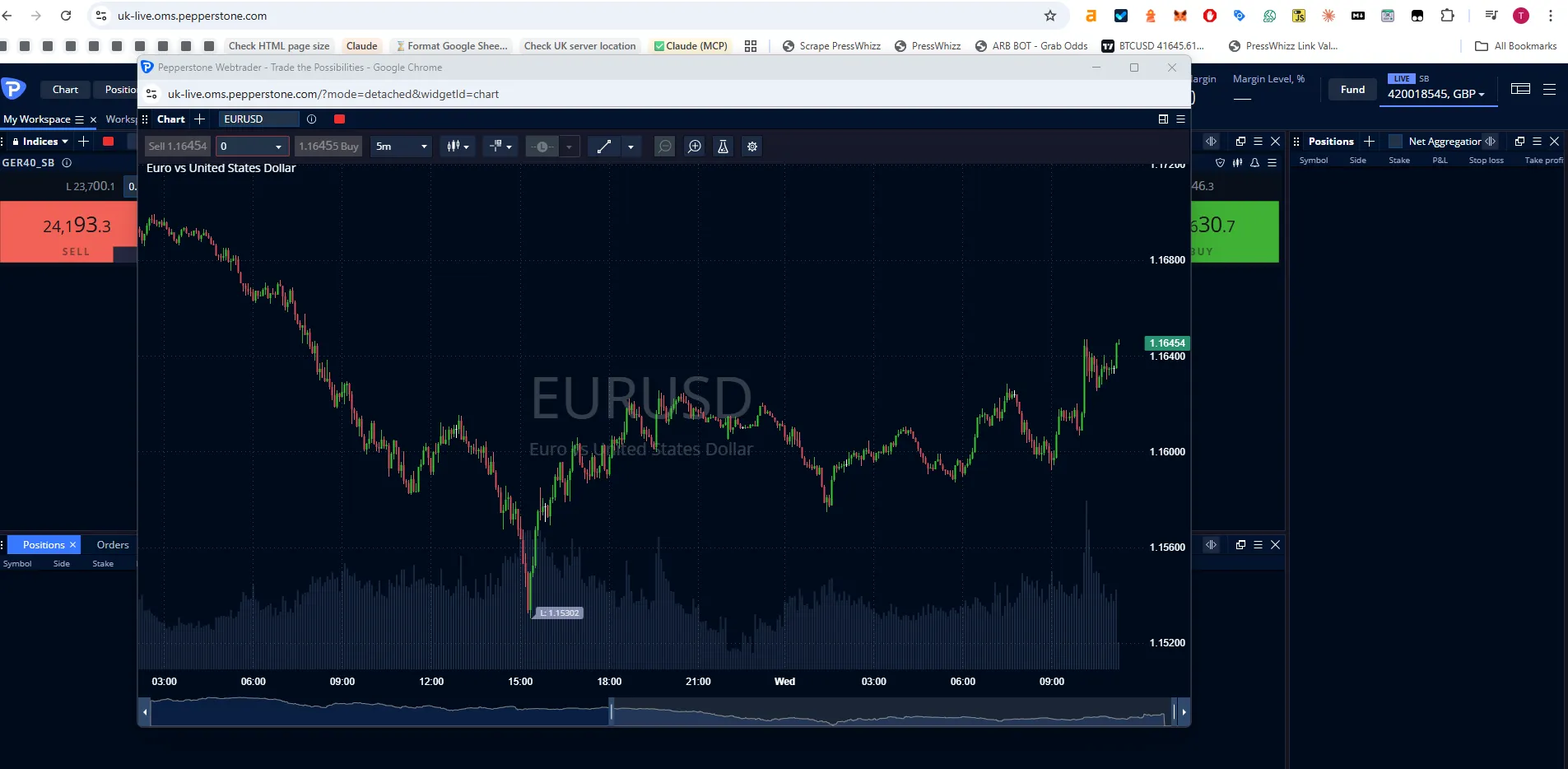
TradingView integration is the more interesting option for anyone who has already used TradingView's free charting tools. Connecting a Pepperstone account lets you trade directly from charts you may already be familiar with, which reduces the platform learning curve. cTrader is powerful but better suited to traders who have progressed past the fundamentals. The Pepperstone proprietary platform sits somewhere between the two, cleaner than MT4 but less feature-rich than cTrader, and is worth testing via the demo before committing. For a broader look at platform suitability, the platform assessment compares each option.
Is the Pepperstone Mobile App Suitable for New Traders?
The mobile apps (both the proprietary app and the MT4/MT5 mobile versions) handle trade placement, market monitoring, and account management cleanly. The proprietary app is the more modern and intuitive of the options, with simplified trade tickets, customisable watchlists, and secure biometric login. Charting on mobile is inevitably more limited than desktop, but for managing existing positions and placing straightforward trades on the move, it performs well.
Are Pepperstone's Costs and Spreads Competitive?
Pepperstone's fee structure is one of its strongest features for cost-conscious Australian traders. The Standard account charges zero commission, with all costs in the spread, which averages around 1.0 to 1.1 pips on EUR/USD. The Razor account offers raw spreads from 0.1 pips but adds AUD $3.50 commission per lot per side (AUD $7.00 round turn). For someone placing small positions, the Standard account is simpler and often cheaper once you account for the commission on Razor.
| Instrument | Standard Spread | Razor Spread + Commission |
|---|---|---|
| EUR/USD | 1.0 to 1.1 pips | 0.1 pips + AUD $3.50/side |
| GBP/USD | 1.2 pips | 0.3 pips + AUD $3.50/side |
| Gold (XAU/USD) | ~1.2 pips | 0.2 pips + AUD $3.50/side |
| US 500 Index | ~0.8 points | 0.4 points + AUD $3.50/side |
Are There Hidden Charges to Know About?
No inactivity fee. No platform fee. No deposit fees on any Australian payment method. Domestic withdrawals are free; international bank transfers carry a AUD $20 charge. The cost that most often catches new traders off guard is overnight swap, the financing charge applied to leveraged CFD positions held past the daily rollover. This is standard across all CFD brokers, but Pepperstone discloses swap rates clearly within each platform. Closing positions within the same trading session avoids it entirely.
How Does Pepperstone Help Australian Traders Manage Risk?
Negative balance protection is mandatory for ASIC-regulated retail CFD accounts, and Pepperstone complies fully, so a retail account cannot fall below zero. Note that this is a retail-client protection only; if you are classified as a professional client, you do not receive it. Beyond that regulatory baseline, every platform offers stop-loss and take-profit orders, and Pepperstone supports micro-lot trading (0.01 lots), which lets you limit exposure to a few dollars per pip movement on major forex pairs.
ASIC leverage caps are the other structural safeguard. Retail clients are restricted to 30:1 on major forex, 20:1 on indices, 10:1 on most commodities (20:1 on gold), 5:1 on shares, and 2:1 on crypto. These limits exist specifically to protect less experienced traders from outsized losses. Treat them as ceilings, not targets. Starting at 5:1 or 10:1 effective leverage is far more sensible while you learn how position sizing interacts with market volatility.
What Is Pepperstone's Customer Support Like for New Traders?
Support is available 24 hours a day, 5 days a week via live chat, email, and phone. When I tested live chat in February 2026 with a question about platform differences between MT4 and cTrader, the response came through in under 90 seconds and was specific enough to be useful, not a scripted redirect to the FAQ page. Email responses took 3 to 4 hours during business hours. Weekend support is unavailable, which is typical for ASIC-regulated CFD brokers but worth flagging if you might need help during a weekend of research.
Final Verdict: What Beginners Should Weigh Before Choosing Pepperstone
CFDs are complex, leveraged products that carry a high risk of losing money quickly, and they will not suit everyone. That caution matters most when you are starting out, so the honest framing is not "is this a good broker for beginners" but "if you have understood the risks and decided to trade CFDs, is this a sensible place to do it." On that question, Pepperstone is competitive. The combination of zero minimum deposit, zero inactivity fees, spreads from 0.1 pips (Razor) or around 1.0 pips (Standard), and ASIC regulation under AFSL 414530 makes it a low-cost, well-regulated entry point, and five platform options mean you can start on MT4 and move to TradingView or cTrader as your skills develop.
The honest caveats: the 30-day demo limit is restrictive compared with IG Australia's unlimited demo, and a complete beginner should not feel rushed by it. There are no real shares, only CFDs, so anyone wanting to start with ASX stock investing will need a separate provider. And there is no government-backed compensation scheme under ASIC, a structural gap that applies to every Australian broker. None of Pepperstone's strengths reduce the risk of CFD trading itself. If you are weighing share trading alongside CFDs, IG Australia's suitability is worth comparing.
Risk warning: Trading CFDs and FX carries significant risk and is not suitable for everyone. You have no interest in the underlying asset. Consider whether you understand how CFDs work and whether you can afford to take the high risk of losing your money.
What Has Changed With Pepperstone Australia in 2026?
- TradingView integration now available across both Standard and Razor accounts, giving access to advanced charting from day one
- Average EUR/USD spread on the Razor account measured at 0.0 to 0.2 pips during Sydney/London overlap sessions in my February 2026 testing
- Improved proprietary mobile app with faster order execution and a simplified trade ticket designed for newer users
- New webinar series launched in Q1 2026 covering risk management fundamentals and platform navigation
- No changes to the AUD $0 minimum deposit, zero inactivity fee, or zero platform fee structure
FAQs: Pepperstone for Beginners in Australia
How I Tested Pepperstone as a New Trader
To assess Pepperstone from a new Australian trader's perspective, I timed the account setup, tested the demo across multiple platforms, measured customer support responsiveness, and evaluated educational resources. Below is a summary of the key findings.
| Test | Date | Result | Notes |
|---|---|---|---|
| Account registration time | 10 Feb 2026 | 6 minutes 55 seconds | Online form, Australian passport uploaded via mobile |
| Account verification | 10 Feb 2026 | 2 hours 45 minutes | Weekday submission, approved same afternoon |
| Demo account setup | 10 Feb 2026 | Under 2 minutes | Available immediately after registration, no deposit needed |
| First live trade (Standard) | 11 Feb 2026 | AUD/USD at 1.1 pip spread | Funded with AUD $200 via PayID, instant deposit |
| Live chat response time | 12 Feb 2026 | 1 minute 22 seconds | Asked about MT4 vs cTrader differences, received clear platform-specific answer |
| Withdrawal test | 18 Feb 2026 | Received next business day | AUD $100 withdrawal to Australian bank account, no fee charged |
All tests conducted on a live Pepperstone Australia account (AFSL 414530). Times may vary depending on submission day and verification workload. Last updated: 5 March 2026.
Corrections & Update Log
- 23 Jun 2026: Compliance pass. Softened beginner-suitability positioning and removed superlatives. Replaced the hardcoded 74-89% loss-rate stat with the ASIC risk warning (ASIC does not mandate a loss-rate percentage). Clarified negative balance protection as a retail-only protection with the professional-client carve-out. Removed em and en dashes and the inline-styled risk box.
- 5 Mar 2026: Initial publication. Built from scratch using Pepperstone AU data, ASIC register verification, and hands-on testing of the Australian entity. Not a localisation of the UK page.
References
Trading CFDs and FX carries significant risk and is not suitable for everyone. You have no interest in the underlying asset.