Is my house my pension? The short answer
No — but not for the reason most people assume. On returns it is genuinely close: over 15-year holding periods since 1993, shares beat UK house prices in only about half of them. Where the house loses badly is everything else. It pays no income, you cannot sell part of it, and it puts your entire retirement on one street. A pension is not a better bet than a house. It is a different kind of asset, and it is the kind that pays you.
Why this question will not go away
Because for a lot of British households the house genuinely is the biggest thing they own, and it got that way without any effort. Households in England and Wales headed by someone aged 65 or over owned homes worth an estimated £1.83 trillion at the 2021 Census, or about £2.01 trillion restating the same homes at 2025 prices. That is 36.2% of all owner-occupied housing value, and 91.8% of those households owned outright.
Set against that, the full new State Pension is £241.30 a week — £12,547.60 a year, or about £1,046 a month. It is not hard to see why someone with a third of a million pounds of mortgage-free house looks at that number and concludes the house is the real pension.
So let us test it properly, on the returns first, and then on the four things that returns do not capture.
Round 1: which has actually returned more?
This is where most articles cheat, so here is the method up front. Comparing one start date to today decides the answer before you begin. Measured from the market bottom in March 2009, shares win every single window. Measured in sterling from 2003, shares win every single window. Both are true and both are useless.
So instead of one window, we used every window. UK house prices come from the Nationwide index, which runs quarterly back to 1952. Shares are the S&P 500 with dividends reinvested, monthly from February 1993. We lined the two up at each quarter end and measured every overlapping holding period.
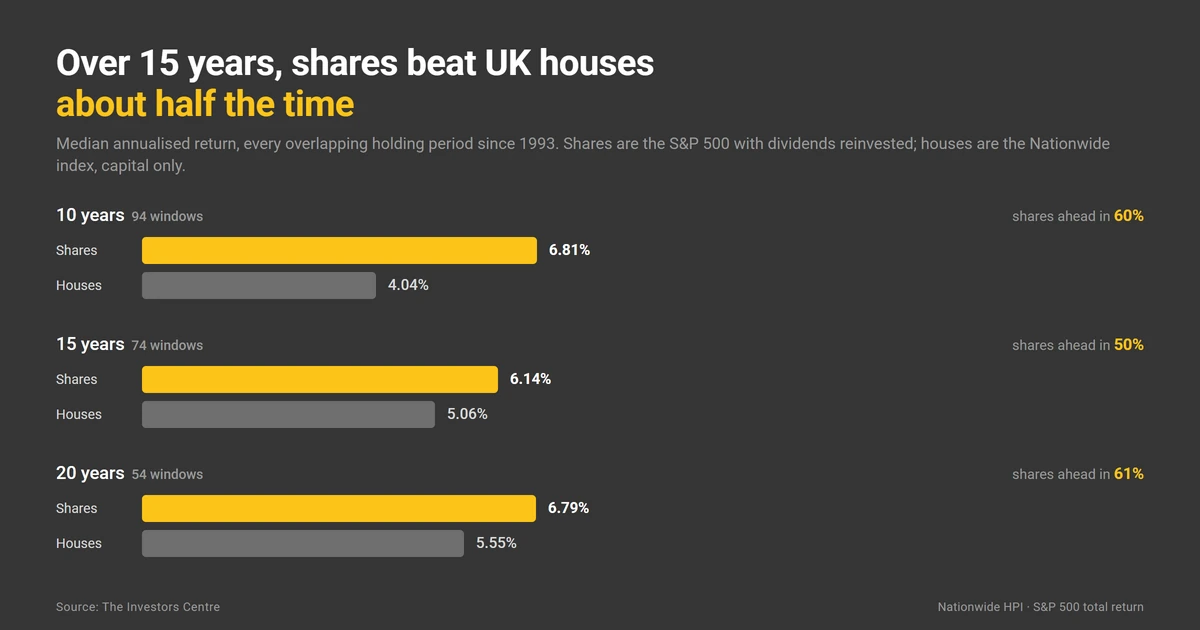
| Holding period | Windows measured | Shares, median | UK houses, median | Shares ahead in |
|---|---|---|---|---|
| 10 years | 94 | 6.81% a year | 4.04% a year | 60% of windows |
| 15 years | 74 | 6.14% a year | 5.06% a year | 50% of windows |
| 20 years | 54 | 6.79% a year | 5.55% a year | 61% of windows |
Read that middle row again. Over 15-year holding periods since 1993, shares with every dividend reinvested beat UK house prices in half the windows. Not most. Half.
The ranges are the more interesting part. The worst 10-year run for shares lost 4.68% a year — that is the window starting in March 1999, which walked straight into the dot-com collapse. The worst 10-year run for houses still made +1.40% a year. Houses have been the steadier of the two, by a wide margin.
Two caveats, both of which cut against the house rather than for it. The share figures are in US dollars; over the period where we can measure sterling, a UK investor's unhedged return was higher, because the pound weakened. And the house figures are capital only, with no maintenance, no insurance and no transaction costs deducted — which is the right way to measure a home you live in rather than rent out, but it flatters the house.
Round 1 is a draw. Anyone who tells you shares obviously beat housing, or that you cannot go wrong with bricks, is arguing from one start date.
Round 2: which one pays you?
This is where the argument stops being close.
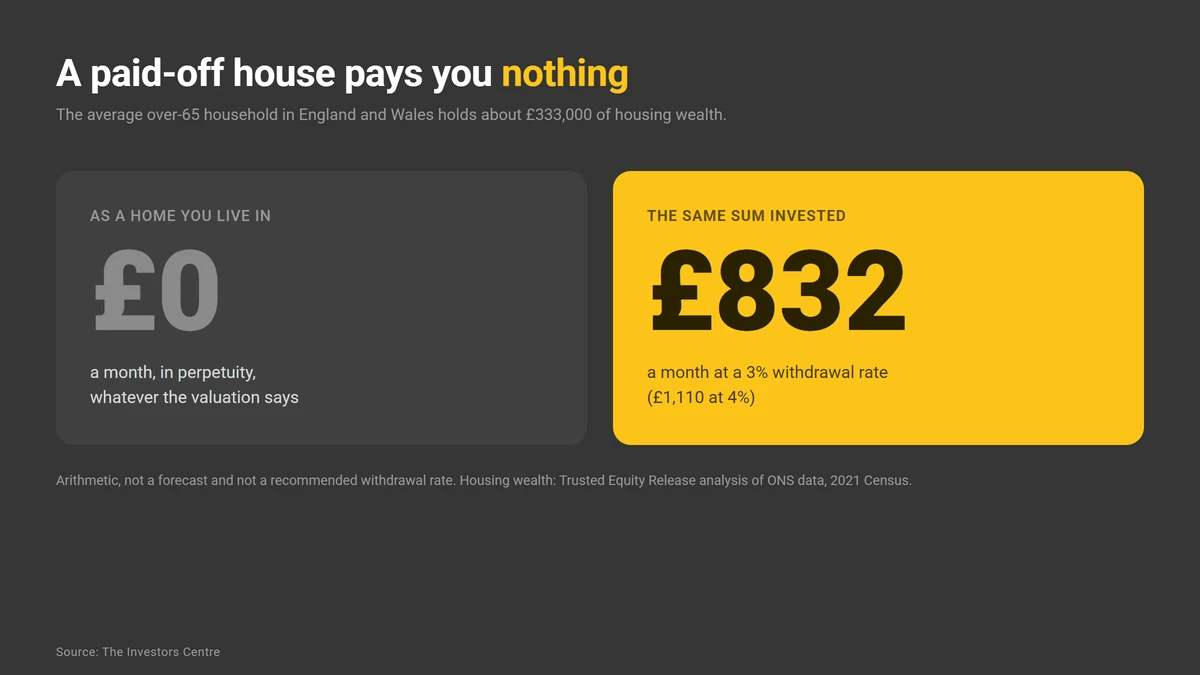
The average over-65 owner household in England and Wales holds roughly £333,000 of housing wealth. As a house you live in, that produces an income of £0 a month, in perpetuity, no matter what the valuation does.
For scale only: at a 3% withdrawal rate the same £333,000 invested would produce about £832 a month, and at 4% about £1,110 a month. Those are illustrations of arithmetic, not forecasts and not a recommended withdrawal rate. But the comparison is the point — the house and the portfolio can hold the identical sum and one of them buys groceries.
A pension is designed to convert a pot into a monthly payment. A house is designed to keep the rain off. Both can do their own job well. Only one of them is a pension.
Round 3: can you spend part of it?
You can sell £800 of a fund. You cannot sell £800 of a house.
Indivisibility sounds like a technicality and it is actually the central problem. Every route to getting money out of a home is all-or-nothing or expensive: sell up and move, borrow against it and pay interest, release equity and let interest compound against you, or let a room and accept a lodger. Each is a real option, and each has a cost that a drawdown instruction to a pension provider does not.
It also means the house cannot flex with you. A pension pot can pay more in a bad year and less in a good one. A house pays the same nothing either way.
Pension wins.
Round 4: which is treated better by the tax system?
Genuinely split, and this is the round where the house lands a real punch.
The home wins on the way out. Private Residence Relief means there is normally no Capital Gains Tax on any gain on your main home, however large. Seven decades of price growth, untaxed. Nothing in the pension world matches that for simplicity.
The pension wins on the way in and on access. Contributions get tax relief at your marginal rate, the annual allowance is £60,000 for most people, and you can normally take 25% of the pot free of income tax from age 55, rising to 57. An ISA does the same job from the other direction: £20,000 a year in, no tax on growth, no tax on withdrawal.
So: the house has the better exit and the pension has the better entrance and the better tap. Call it honours even, and note that this is the one round where "put it all in the house" has a serious argument.

Round 5: how concentrated is the bet?
If your retirement is the house, your retirement is one building, on one street, in one town, in one country, exposed to one planning decision and one local employer closing down.
A global equity pension holds thousands of companies across dozens of economies. That diversification is not a marketing line, it is the entire reason the rolling windows above have the shape they do: shares had a decade that lost 4.68% a year and still came out ahead over 20 years, because the thing recovers and rebalances. A street does not rebalance.
Concentration is also invisible until it matters. Nobody thinks of a paid-off house as a risky position, because it does not print a price every day. It is still a single, undiversified, illiquid holding worth several times the owner's annual income.
Pension wins.
Round 6: what does each one cost to hold?
A pension or ISA costs you a platform fee and a fund charge — typically a fraction of a per cent a year, and entirely visible.
A house costs a roof every few decades, a boiler more often than that, buildings insurance every year, and the slow drip of maintenance that does not show up as a fee anywhere. None of that is deducted from the 4% to 5.5% a year the house price data shows, which means the real return on the bricks is lower than the table in Round 1 suggests.
Transaction costs finish the job. Getting money out of a house means an estate agent, a conveyancer, a removals firm and, on the way back in, stamp duty. Getting money out of a pension means a form.
Pension wins, and the gap here is bigger than most people's mental model.
The six rounds, scored
| Round | What it tests | The house | A pension or ISA | Winner |
|---|---|---|---|---|
| 1 | Long-run return | 4.0% to 5.6% a year median, and much steadier | 6.1% to 6.8% a year median, ahead in 50% to 61% of windows | Draw |
| 2 | Income it pays | £0 a month | About £832 a month per £333,000 at 3% | Pension |
| 3 | Can you spend part of it | No — all or nothing | Yes, to the pound | Pension |
| 4 | Tax treatment | No CGT on the main home | Relief in, 25% tax free, ISA growth untaxed | Honours even |
| 5 | Diversification | One building, one street | Thousands of companies | Pension |
| 6 | Cost to hold and to exit | Upkeep, insurance, agent, stamp duty | Platform and fund fees | Pension |
Four to nil with two draws. The house is not beaten on returns — it is beaten on everything returns do not measure.
So what is a house, if it is not a pension?
It is a place to live that has historically gone up in value, and that is genuinely valuable. Owning outright by the time you retire removes the largest single cost most households have. That is worth more than people credit — it is just not the same thing as an income.
The practical position is that the house handles your housing cost and something else has to handle your spending. If the house is currently doing both jobs on paper and neither in your bank account, that is the asset rich, cash poor problem, and we have set out the four routes out of it in asset rich, cash poor.
If the plan is to convert some of the bricks into money by moving somewhere smaller, that has a price of its own, and we have costed it line by line in downsizing to fund retirement.
Common questions
Has property beaten shares in the UK?
It depends entirely on the window, which is why we measured all of them. Over 15-year holding periods since 1993, shares with dividends reinvested beat UK house prices in about 50% of windows; over 10 years, 60%; over 20 years, 61%. Houses were far less volatile: their worst 10-year run still gained 1.4% a year, while shares' worst lost 4.7% a year.
Can I retire on my house?
Only by converting part of it into money, because as a home it pays no income. The routes are selling and buying smaller, letting a room, borrowing against it, or releasing equity. Each has a cost, and which one fits depends on whether you are willing to move.
Is it better to overpay the mortgage or pay into a pension?
They do different things: overpaying removes a future cost, a pension builds a future income, and pension contributions attract tax relief that mortgage overpayments do not. Which is right depends on your interest rate, your tax rate and your timeline, and it is a question for a regulated adviser rather than an article.
Why do you use the S&P 500 rather than a UK index?
Because we needed a long total-return series with dividends reinvested, and that is the longest reliable one available. UK index price series exclude dividends, which are most of the UK equity return and would have understated shares badly. We have flagged the currency effect on the page.
Does the house data include rent or running costs?
No. It is capital growth only. That is the correct measure for a home you live in rather than let out — you receive shelter, not rent — but it means maintenance, insurance and transaction costs are not deducted. The real return on the bricks is therefore lower than the headline.
Sources
- Nationwide House Price Index — UK house prices since 1952, full quarterly series, downloaded 28 September 2026.
- S&P 500 total return, dividends reinvested, monthly February 1993 to September 2026.
- Trusted Equity Release — Over-65s housing wealth statistics, analysis of ONS data, 2021 Census.
- GOV.UK: the new State Pension, £241.30 a week, checked 28 September 2026.
- GOV.UK: pension annual allowance and ISA allowance, checked 28 September 2026.
- GOV.UK: Private Residence Relief, tax when you sell your home.
Rolling-window method: house and share series aligned at each quarter end, every overlapping 10, 15 and 20-year holding period measured, medians and ranges reported. Figures re-checked 28 September 2026.
Capital at risk. This article is information, not financial advice. Past returns are not a guide to future returns. The Investors Centre is not authorised to give pension, mortgage or equity release advice; speak to an FCA-regulated adviser about your own circumstances.