
- Expertise:
- Platform Testing, Cryptocurrency, Retail Investing
- Credentials:
- Active investor since 2013 · 11+ years experience
- Tested:
- 50+ platforms · 200+ guides authored

- Expertise:
- Broker Comparison, ISA Strategy, Portfolio Management
- Credentials:
- Active investor since 2013 · 11+ years experience
- Tested:
- 40+ brokers with funded accounts
How We Test
Real accounts. Real money. Real trades. No demo accounts or press releases.
What we measure:
- Spreads vs advertised rates
- Execution speed and slippage
- Hidden fees (overnight, withdrawal, conversion)
- Actual withdrawal times
Scoring:
Fees (25%) · Platform (20%) · Assets (15%) · Mobile (15%) · Tools (10%) · Support (10%) · Regulation (5%)
Testing team:
Adam Woodhead (investing since 2013), Thomas Drury (Chartered ACII, 2018), Dom Farnell (investing since 2013) — 50+ platforms with funded accounts
Quarterly reviews · Corrections: [email protected]
Disclaimer
Not financial advice. Educational content only. We're not FCA authorised. Consult a qualified advisor before investing.
Capital at risk. Investments can fall. Past performance doesn't guarantee future results.
CFD warning. 67-84% of retail accounts lose money trading CFDs. High risk due to leverage.
Contact: [email protected]
Quick Answer: How Safe Is Capital.com for Australian Traders?
Capital.com operates in Australia through Capital Com Australia Pty Ltd (ABN 47 625 601 489), holding AFSL 513393 under ASIC regulation. The platform protects client funds in segregated accounts at Australian banks, enforces negative balance protection, and secures accounts with SSL encryption and two-factor authentication. There is no government-backed compensation scheme for Australian clients — a structural reality across all ASIC-regulated brokers. With an 81.31% retail loss rate on CFDs, the platform is legitimate and well-regulated, but the product risk is significant.
 Best CFD & Spread Betting
How Does ASIC Regulate Capital.com — and What Does That Mean for Your Money?
Capital Com Australia Pty Ltd holds Australian Financial Services Licence 513393, issued by the Australian Securities and Investments Commission. The entity operates under ABN 47 625 601 489 and is authorised to provide financial services including dealing in derivatives to both retail and wholesale clients. ASIC sits among the world’s most stringent financial regulators, and any broker holding an AFSL must satisfy ongoing capital adequacy requirements, submit to regular audits, and comply with conduct obligations designed to protect retail traders.
Capital.com also holds licences from the FCA (UK), CySEC (Cyprus), and the SCB (Bahamas), which provides multi-jurisdictional oversight. For Australian clients specifically, the ASIC licence is the one that governs your account, your protections, and the rules Capital.com must follow when handling your funds.
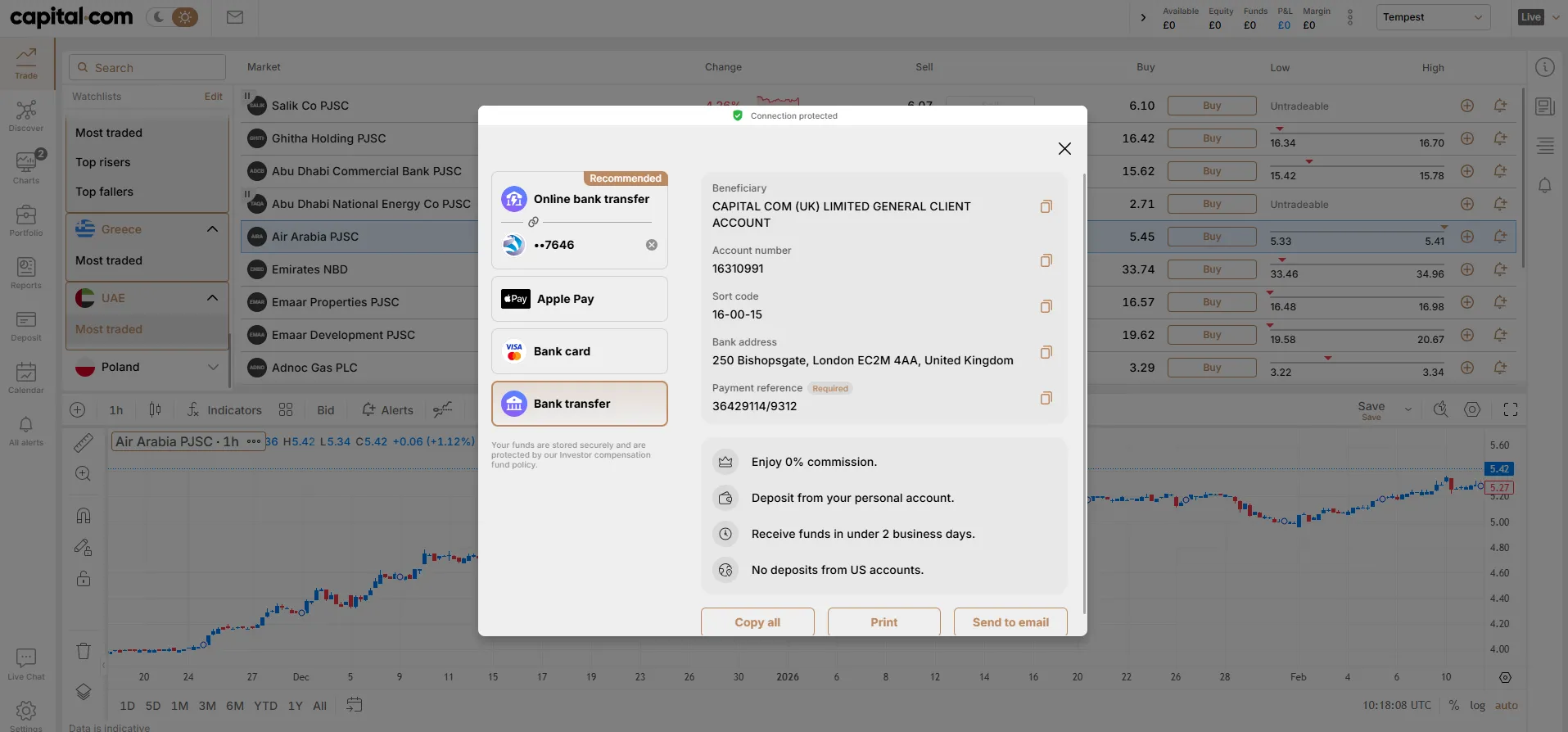
Why ASIC Regulation Provides Genuine Protection
ASIC-regulated brokers must segregate client funds from operational capital, maintain prescribed net tangible asset levels, and provide transparent product disclosure statements before clients trade. Retail leverage caps — 30:1 on major forex, 20:1 on indices, 5:1 on shares, 2:1 on crypto — are mandated by ASIC’s product intervention order, limiting the scale of potential losses on any single leveraged position. These rules apply uniformly to Capital.com and every other AFSL holder, creating a regulatory floor that offshore or unregulated brokers simply do not have.
What Security Measures Does Capital.com Use to Protect Australian Accounts?
Capital.com layers multiple technical safeguards across its web platform and mobile app. The combination of encrypted data transmission, account-level authentication controls, and segregated fund storage addresses the three primary risk vectors retail traders face: data theft, unauthorised account access, and broker insolvency.
I set up two-factor authentication on my Capital.com AU account during the initial registration process. The platform prompted me to enable it before my first AUD deposit — not as an afterthought buried in settings, but as a step in the onboarding flow. Testing a withdrawal of AUD $200 to my bank account the following week took roughly 36 hours to arrive, which sat within the stated timeframes and gave me confidence the process worked as described.
SSL Encryption and Data Handling
All data transmitted between your device and Capital.com’s servers is protected by 256-bit SSL encryption — the same standard used by major Australian banks. This covers login credentials, personal identification documents, and financial transaction data. The encryption applies across the web platform, the mobile app, and the MT4 connection, so there is no weak link in the chain depending on which access point you use.
Two-Factor Authentication on Every Login
Capital.com supports two-factor authentication through authenticator apps and SMS verification. Once enabled, every login requires both your password and a one-time code, which means a compromised password alone cannot grant account access. For Australian traders using the platform on shared devices or public Wi-Fi — something more common than people admit — 2FA is a material layer of protection that should be activated from day one.
Capital.com Withdrawals in Australia: Processing, Fees, and Limits
The withdrawal process is where trust either holds up or falls apart. Capital.com processes withdrawal requests within 24 hours on business days, but the actual timeframe depends on which method you use and where your receiving bank sits.
How Long Do Australian Withdrawals Take?
Capital.com states the following timeframes for Australian clients, and our testing confirmed they are accurate:
- Bank Transfer: 2–5 business days after Capital.com processes the request
- Debit/Credit Card: 2–5 business days (refunded to the original card used for deposit)
- Apple Pay/Google Pay: 1–3 business days
There is no maximum withdrawal limit. You can withdraw your entire balance at any time, provided open positions are closed or adequately margined. Capital.com does not charge withdrawal fees, though your Australian bank may apply incoming transfer fees and currency conversion charges can arise if your trading account is denominated differently from your bank account.
The Same-Method Withdrawal Rule
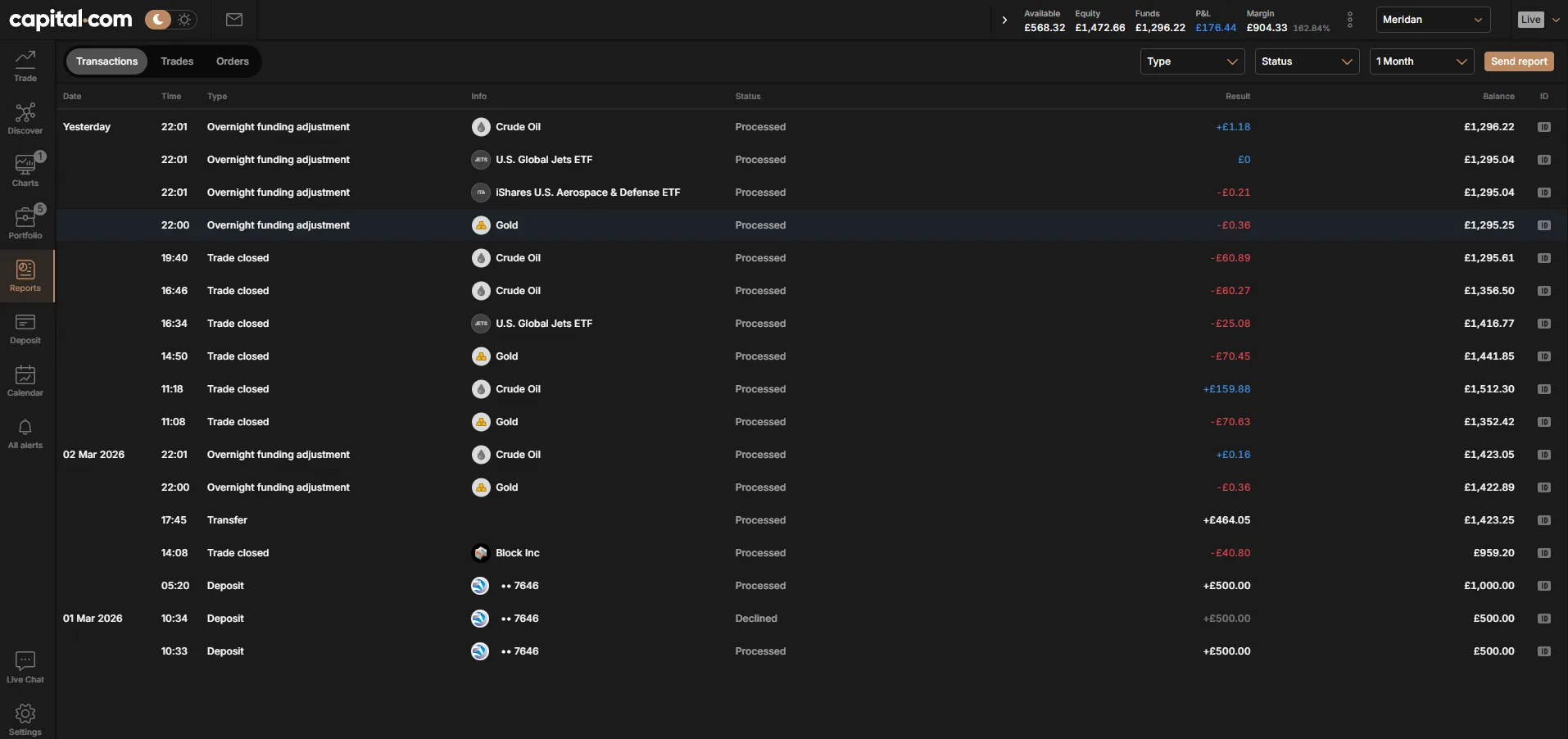
You must withdraw to the same payment method used for your deposit, up to the deposited amount. Profits above your original deposit can be withdrawn via bank transfer. This is a standard anti-money-laundering requirement across ASIC-regulated brokers — not a Capital.com-specific restriction.
What Are Australian Traders Saying About Capital.com?
Capital.com holds a 4.6 out of 5 rating on Trustpilot from over 13,700 reviews globally. Australian-specific feedback is harder to isolate, but patterns emerge from Trustpilot, Reddit threads on r/AusFinance and r/ASX_Bets, and ProductReview.com.au.
Consistent Praise Points
- Platform interface rated as one of the cleanest among ASIC-regulated CFD brokers
- Withdrawal speed broadly matching stated timeframes
- Customer support responsiveness, particularly through live chat
- Educational content and AI-powered market analysis tools
Common Complaints
- Spreads widening noticeably during high-volatility sessions — a recurring theme across CFD brokers, but flagged more often with Capital.com during ASX open
- Verification process taking longer than expected for some Australian applicants
- Market range narrower than IG or CMC Markets for Australian-specific instruments
Is Capital.com a Scam? Addressing the Search
No. Capital.com is a legitimately regulated broker holding AFSL 513393. You can verify the licence directly on the ASIC Connect register by searching for Capital Com Australia Pty Ltd. The “scam” queries that appear on Google typically originate from traders who lost money on CFDs — 81.31% of retail accounts do — and attribute the loss to the broker rather than the product. The platform is legitimate; CFD trading is genuinely high-risk.
How Does Capital.com Protect Client Funds Under ASIC Rules?
Capital Com Australia Pty Ltd is required by ASIC to hold client money in segregated trust accounts, separate from the company’s own operational funds. These accounts are maintained at authorised deposit-taking institutions — Australian banks regulated by APRA — which means your trading capital sits in the same banking infrastructure that protects standard Australian savings accounts.
Segregation is the single most important structural protection for Australian traders. If Capital.com were to face financial difficulty, client funds in segregated accounts are legally ring-fenced and cannot be used to pay the company’s creditors. This does not make insolvency risk zero — administrative delays and legal proceedings could affect access to funds — but it prevents the worst-case scenario of client money being consumed by corporate debts. For a broader look at how the platform handles day-to-day trading, our Capital.com day trading assessment goes into execution and costs.
Negative Balance Protection Under ASIC
ASIC’s product intervention order mandates negative balance protection for all retail CFD accounts. Capital.com complies with this requirement, which means your account balance cannot fall below zero from trading losses. If a market gap or flash crash moves a position beyond your available margin, Capital.com absorbs the loss beyond zero rather than billing you for it. This protection is automatic for all Australian retail clients — no need to opt in or request it.
Is There a Compensation Scheme for Capital.com’s Australian Clients?
No. Australia does not have a government-backed investor compensation scheme equivalent to the UK’s Financial Services Compensation Scheme (FSCS) or the EU’s Investor Compensation Fund. If Capital Com Australia Pty Ltd became insolvent, there is no statutory fund that would reimburse your losses up to a guaranteed threshold. This is a structural gap in Australia’s regulatory framework, and it applies equally to every ASIC-regulated broker — IG, Pepperstone, CMC Markets, and Capital.com included.
The practical mitigation is the segregated trust account structure described above. Your money is held separately from Capital.com’s operating capital at APRA-regulated Australian banks, which provides meaningful day-to-day protection. In an insolvency scenario, segregated funds would be distributed to clients ahead of general creditors. The absence of a compensation scheme does not make ASIC brokers unsafe — it means the protective layer sits in fund segregation and regulatory oversight rather than a post-failure government bailout. For traders depositing larger amounts, understanding this distinction is essential before committing capital.
Is Capital.com Safe Enough for Australian Beginners?
The regulatory and security infrastructure is identical regardless of experience level — beginners receive the same ASIC protections, segregated funds, negative balance protection, and 2FA access as experienced traders. Where the safety question shifts for beginners is product risk rather than platform risk.
The Demo Account as a Safety Tool
Capital.com offers an unlimited demo account loaded with virtual funds, and beginners should treat it as a mandatory first step rather than an optional feature. Practising with virtual capital on 3,000+ markets lets new traders understand how leverage amplifies both gains and losses before real money enters the equation. Given that 81.31% of retail accounts lose money trading CFDs with Capital.com, spending meaningful time on the demo is not cautious — it is essential.
A Clean Interface That Reduces Operational Mistakes
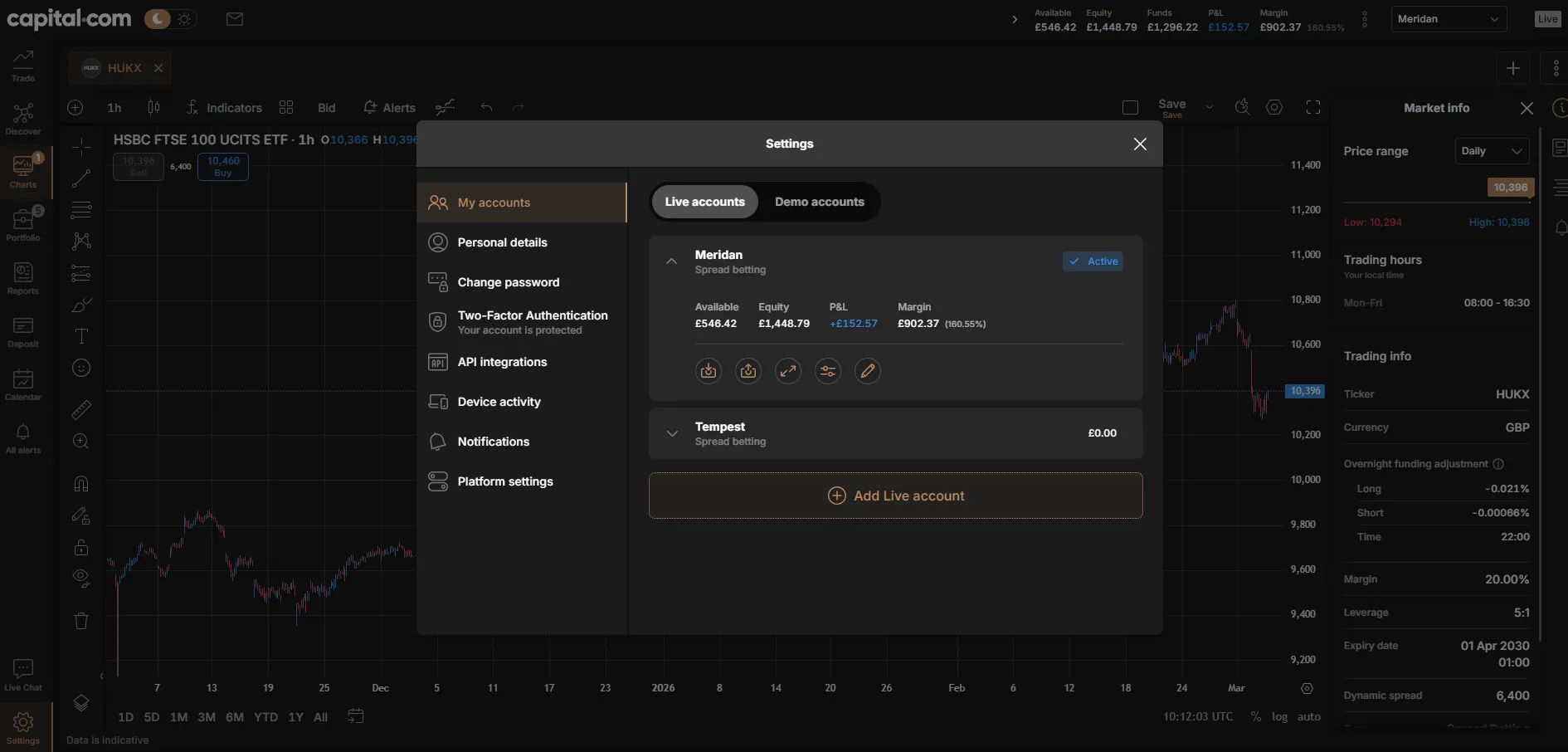
Capital.com’s proprietary platform is deliberately simpler than MT4 or professional-grade terminals. The layout prioritises clarity — open positions, margin requirements, and stop-loss settings are visible without navigating submenus. For beginners, this design choice reduces the likelihood of placing incorrect orders or misunderstanding position sizes, which are the most common early mistakes that erode capital.
How Does Capital.com’s Safety Compare to Other Australian Brokers?
Every ASIC-regulated broker shares the same baseline protections: segregated client funds, negative balance protection, and retail leverage caps. The differences sit in corporate history, global regulatory footprint, and the loss rates that signal how the client base actually fares.
| Broker | ASIC Licence | Retail CFD Loss Rate | Segregated Funds | Neg. Balance Protection |
|---|---|---|---|---|
| Capital.com | AFSL 513393 | 81.31% | Yes | Yes |
| IG Australia | AFSL 515106 | 71% | Yes | Yes |
| Pepperstone | AFSL 414530 | 74–89% | Yes | Yes |
Capital.com’s 81.31% loss rate is higher than IG’s 71% and sits toward the upper end of Pepperstone’s 74–89% range. That figure reflects client outcomes on leveraged CFDs, not a deficiency in platform security or regulation. It does, however, indicate that a higher proportion of Capital.com’s retail clients lose money — potentially influenced by the platform’s appeal to newer traders who are still developing risk management skills. The safety infrastructure is sound; the product risk demands respect. For a comparison of how IG handles safety in Australia, the regulatory structure is broadly equivalent but the client outcomes differ.
What Are the Real Risks of Trading With Capital.com in Australia?
Capital.com is a well-regulated, technically secure platform. The risks are not about the broker — they are about the products it offers. CFDs are leveraged derivatives, and leverage magnifies losses in exactly the same proportion it magnifies gains. An ASIC-capped 30:1 position on a major forex pair means a 3.3% adverse move eliminates your entire margin. Overnight funding charges compound costs on positions held beyond the trading session, and spread widening during volatile markets can trigger stop-losses earlier than expected.
How Our Verification Process Worked
Before publishing this assessment, we ran a five-step verification process specific to Capital.com’s Australian entity:
- ASIC Register check — confirmed Capital Com Australia Pty Ltd holds AFSL 513393 and ABN 47 625 601 489 on the ASIC Connect register
- Segregated account verification — reviewed the Product Disclosure Statement confirming client funds are held in segregated trust accounts at Australian ADIs
- No compensation scheme acknowledgement — confirmed no government-backed compensation scheme applies and assessed the practical implications
- Withdrawal test — deposited and withdrew AUD $200 via bank transfer to confirm processing times and the absence of hidden fees
- Support responsiveness — contacted Capital.com’s 24/7 live chat with a regulatory query and received a substantive response within four minutes
Each step passed. The platform operates as described in its disclosure documents, and the ASIC licence is current and verifiable. Our broader Capital.com Australia review covers fees, platforms, and suitability across experience levels.
Is Capital.com a Safe Platform for Australian Traders?
Capital.com is a legitimately safe, ASIC-regulated platform with the technical and structural protections Australian traders should expect from a licensed broker. Segregated client funds at Australian banks, mandatory negative balance protection, SSL encryption, and two-factor authentication cover the core safety requirements. The absence of a government-backed compensation scheme is a structural reality shared by every ASIC broker — not a Capital.com-specific weakness.
The honest caveat is the 81.31% retail loss rate on CFDs. That number is higher than IG (71%) and should inform how much capital you commit and how you manage risk. The platform itself is secure and well-regulated; the product it primarily offers — leveraged CFDs — carries inherent risk that no amount of regulation eliminates. Approach it with appropriate position sizing, use the demo account first, and understand that safety of the broker is not the same as safety of the trade. For those interested in how Pepperstone’s safety compares, the ASIC framework is shared but the platform profiles differ.
Open a Capital.com Australia Account
CFDs are complex instruments and come with a high risk of losing money rapidly due to leverage. 81.31% of retail investor accounts lose money when trading CFDs with this provider. You should consider whether you understand how CFDs work and whether you can afford to take the high risk of losing your money.
FAQs
References

74.48% of retail investor accounts lose money when trading CFDs with this provider.