
- Expertise:
- CFD Trading, Forex, Derivatives, Risk Management
- Credentials:
- Chartered ACII (2018) · Trading since 2012
- Tested:
- 40+ forex & CFD platforms with live accounts

- Expertise:
- Platform Testing, Cryptocurrency, Retail Investing
- Credentials:
- Active investor since 2013 · 11+ years experience
- Tested:
- 50+ platforms · 200+ guides authored
How We Test
Real accounts. Real money. Real trades. No demo accounts or press releases.
What we measure:
- Spreads vs advertised rates
- Execution speed and slippage
- Hidden fees (overnight, withdrawal, conversion)
- Actual withdrawal times
Scoring:
Fees (25%) · Platform (20%) · Assets (15%) · Mobile (15%) · Tools (10%) · Support (10%) · Regulation (5%)
Testing team:
Adam Woodhead (investing since 2013), Thomas Drury (Chartered ACII, 2018), Dom Farnell (investing since 2013) — 50+ platforms with funded accounts
Quarterly reviews · Corrections: [email protected]
Disclaimer
Not financial advice. Educational content only. We're not FCA authorised. Consult a qualified advisor before investing.
Capital at risk. Investments can fall. Past performance doesn't guarantee future results.
CFD warning. 67-84% of retail accounts lose money trading CFDs. High risk due to leverage.
Contact: [email protected]
How do you trade the ASX 200 on Pepperstone?
Pepperstone trades the ASX 200 as the AUS200 cash CFD, from a 1-point spread with no commission, or the AUS200-F futures CFD from 3 points. Both track the S&P/ASX 200, and hold time is what separates them: the cash contract settles a funding adjustment every night it stays open, while the futures contract folds that carry into its wider spread and a three-month cycle. Trading runs close to 21 hours a day around a 40-minute afternoon break, and retail leverage on the index CFD reaches 20:1 under ASIC's caps. The sections below put the session times on a Sydney clock and price the overnight carry in Australian dollars. The contract choice comes first.
 Top Rated
Trading CFDs and FX carries significant risk and is not suitable for everyone. You have no interest in the underlying asset.
Cash or futures: which AUS200 contract fits your trade?
Pepperstone's cash AUS200 starts at a 1-point spread with nightly funding; the AUS200-F starts at 3 points with the funding built into the spread. One structural difference, and it settles most of the choice.
| Term | AUS200 cash CFD | AUS200-F futures CFD |
|---|---|---|
| Minimum spread | 1 point | 3 points |
| Commission | None | None |
| Expiry | None | Three-month cycle, rolled automatically at expiry |
| Overnight funding | Charged or credited nightly | None; the cost sits in the spread |
The cash contract can be held for an hour or a year, and every night it survives the daily cut-off a funding adjustment lands on the account, longs paying the reference rate and shorts receiving it, with Pepperstone's charge layered on top either way. The AUS200-F works the other way round. It runs a three-month contract cycle and rolls automatically at expiry, trading from a minimum size of 1; overnight funding never applies, because that cost already sits in the wider spread.
Hold time decides it. An intraday trade pays no funding on either contract, which makes the cash market's tighter 1-point floor the cheaper home for anything opened and closed inside a session. A position measured in weeks keeps feeding the nightly meter, and at some point the futures contract's two extra points become the cheaper way to carry the same view. If the average hold runs past a fortnight, price the AUS200-F first.
When does the AUS200 trade in Sydney?
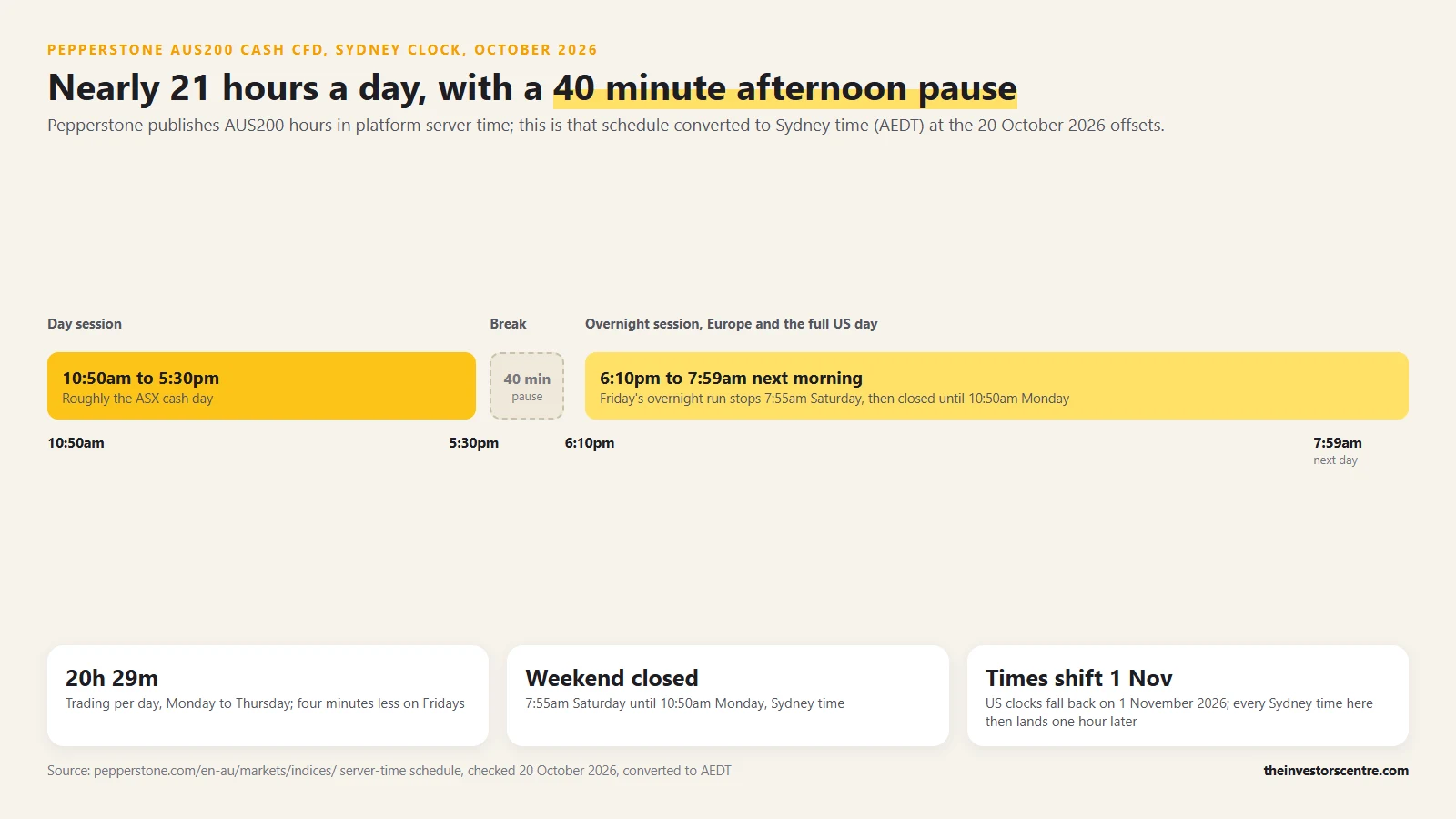
Pepperstone's AUS200 trades 20 hours and 29 minutes a day, Monday to Thursday, split into two Sydney sessions by a 40-minute afternoon break. The break is the piece to memorise: 5:30pm to 6:10pm Sydney time under October's clocks, mid-evening for most of the country, and orders working through it can be cancelled or rejected rather than simply held over. Friday finishes four minutes earlier, and the weekend is fully closed, whatever the overnight session's reach suggests.
The session map in Sydney time
Under the 20 October 2026 offsets, the AUS200 runs 10:50am to 5:30pm, then 6:10pm to 7:59am the next morning, Sydney time.
| Session | Sydney time (October 2026) |
|---|---|
| Day session | 10:50am to 5:30pm, roughly the ASX cash day |
| Afternoon break | 5:30pm to 6:10pm, every trading day |
| Overnight session | 6:10pm to 7:59am the next morning, through Europe and the full US day |
| Friday close | Overnight session ends 7:55am Saturday |
| Weekend | Closed until 10:50am Monday |
Why every one of those times moves
Pepperstone publishes AUS200 hours in platform server time, GMT+3 while US daylight saving runs and GMT+2 otherwise. The schedule reads Monday to Thursday 02:50 to 09:30 and 10:10 to 23:59, Fridays to 23:55. The Sydney figures above are our conversion of that schedule at October's offsets, AEDT sitting eight hours ahead of the server, and because the US falls back on 1 November 2026 while Australia does not, every Sydney time on this page, the break included, lands one hour later from that morning until the clocks next cross. Pepperstone also states plainly that trading hours are subject to change with seasonal and market factors. Treat the server-time schedule as the fixed reference and the Sydney clock as a translation with a re-check due every November and April.
What does an AUS200 position cost to run?
Pepperstone charges no commission on index CFDs; a cash AUS200 trade pays its spread, from 1 point, plus any overnight funding. The spread is the visible charge, and from 1 point is a floor rather than a promise; the live number moves with the underlying, so size the trade from the ticket in front of you.
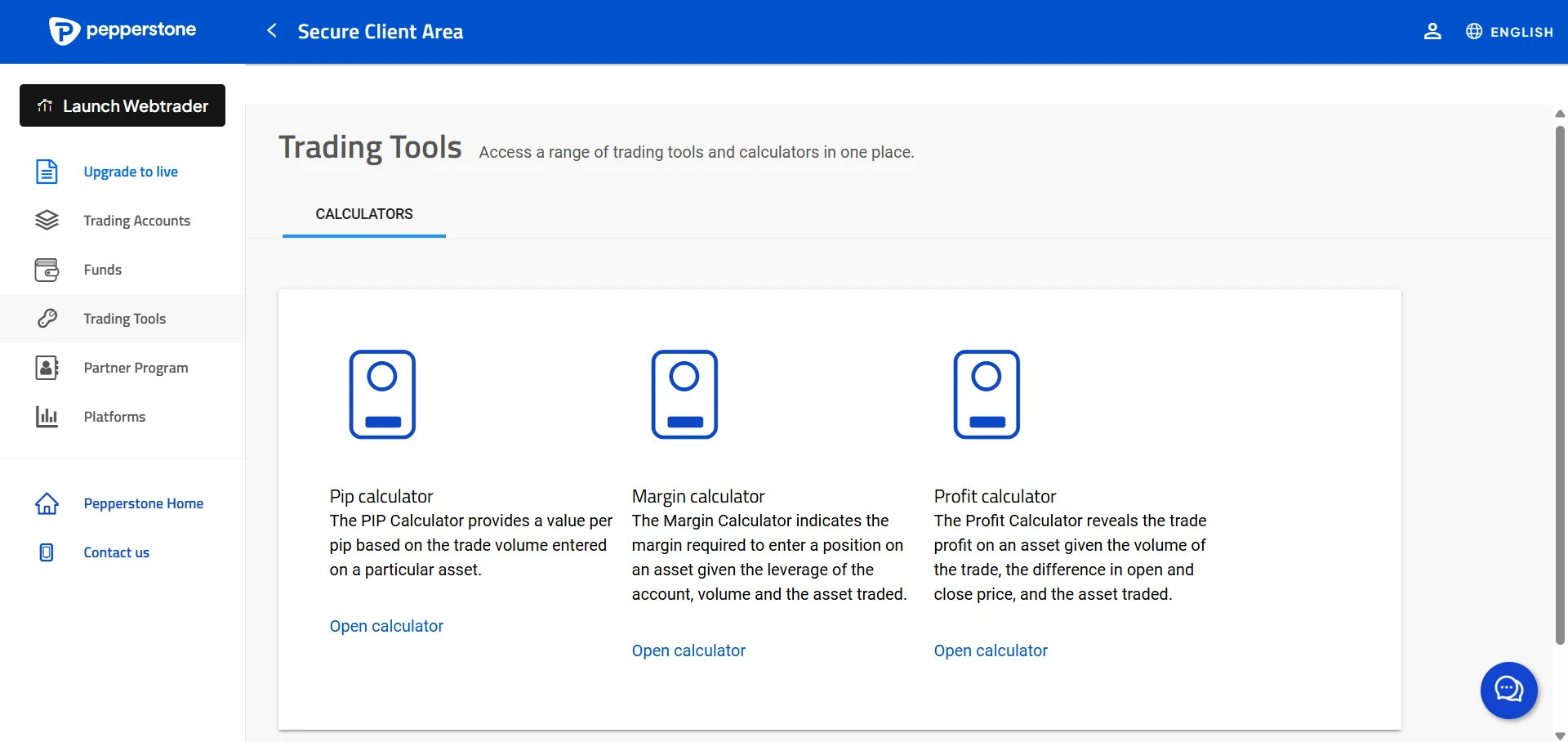
Now the funding line. Pepperstone publishes it as an exact formula: daily swap charge or credit = (market closing price x trade size x (2.5% plus or minus the reference rate)) / 360. A long position pays the reference rate on top of the 2.5% charge; a short receives it against the charge instead.
The carry in Australian dollars
The 2.5% component alone comes to about 69 cents a night on A$10,000 of exposure. Thirty nights stack up to A$20.83, which is not quite thirty times 69 cents; the nightly figure rounds down and the monthly one does not. The reference rate then shifts the bill either way. One evening of this is small, and a position kept for the quarter it was never meant to run has paid the meter ninety-odd times, which is exactly the trade Pepperstone built the AUS200-F for: it charges nothing nightly and prices the carry once, in its 3-point spread.
Which platforms carry the AUS200?
All six Pepperstone platforms list the AUS200: MT4, MT5, cTrader, TradingView, and Pepperstone's own web platform and mobile app. The index sits inside a 26-strong index CFD range that is identical across the line-up, so nothing about the AUS200 itself changes with the platform, and the decision is workflow rather than access.
Automated trading is the one line to check. It runs on MT4, MT5, cTrader and TradingView; the proprietary platform does not support it, so a plan that leaves an EA minding the overnight session belongs on one of those four. The rest of the differences are mapped in the platform comparison. Pepperstone Group Limited, the Australian entity behind all six, holds AFSL 414530 from its Melbourne base.
How does the ASX 200 pair with 24-hour US coverage?
The AUS200's overnight session ends at 7:59am Sydney time, and Pepperstone's 24-hour US share CFDs cover most of the hours it sits out. The AUS200 is the home-index anchor, the market that lets a Sydney trader hold or adjust local exposure right through the European and US hours instead of waiting for the next ASX bell, which is where most of the index's overnight gaps are born.
The US side fills what the AUS200 leaves open: the 40-minute afternoon break and the 2 hours 51 minutes between the overnight close and the next day session. Why run a northern-hemisphere trading day from an Australian evening at all? That case, the hours and the liquidity behind them, is made in the timezone advantage piece. The weekend stays shut on both sides, from the AUS200's 7:55am Saturday close to its 10:50am Monday open; every other stretch of the week, one of the two markets is live, so an Australian account here is rarely locked out for long.
Frequently Asked Questions
References
- Pepperstone: index CFD markets and AUS200 trading hours (en-au), checked 20 October 2026
- Pepperstone: index fees, funding formula and AUS200-F terms (en-au), checked 20 October 2026
- Pepperstone: costs and fees, commission policy (en-au), checked 20 October 2026
- Pepperstone: trading platforms (en-au), checked 20 October 2026
Trading CFDs and FX carries significant risk and is not suitable for everyone. You have no interest in the underlying asset.