
- Expertise:
- CFD Trading, Forex, Derivatives, Risk Management
- Credentials:
- Chartered ACII (2018) · Trading since 2012
- Tested:
- 40+ forex & CFD platforms with live accounts

- Expertise:
- Platform Testing, Cryptocurrency, Retail Investing
- Credentials:
- Active investor since 2013 · 11+ years experience
- Tested:
- 50+ platforms · 200+ guides authored
How We Test
Real accounts. Real money. Real trades. No demo accounts or press releases.
What we measure:
- Spreads vs advertised rates
- Execution speed and slippage
- Hidden fees (overnight, withdrawal, conversion)
- Actual withdrawal times
Scoring:
Fees (25%) · Platform (20%) · Assets (15%) · Mobile (15%) · Tools (10%) · Support (10%) · Regulation (5%)
Testing team:
Adam Woodhead (investing since 2013), Thomas Drury (Chartered ACII, 2018), Dom Farnell (investing since 2013) — 50+ platforms with funded accounts
Quarterly reviews · Corrections: [email protected]
Disclaimer
Not financial advice. Educational content only. We're not FCA authorised. Consult a qualified advisor before investing.
Capital at risk. Investments can fall. Past performance doesn't guarantee future results.
CFD warning. 67-84% of retail accounts lose money trading CFDs. High risk due to leverage.
Contact: [email protected]
What shapes a gold strategy from Australia?
Two structural facts, and neither is negotiable. First, the clock: gold's heaviest trading arrives with London and New York, which puts its loudest hours in the late Australian evening and its biggest scheduled catalysts near midnight on the east coast. Second, the currency: XAUUSD is priced in US dollars while your account and your life are priced in Australian ones, and the AUD is itself a commodity currency that tends to move when gold moves. Every workable Australian gold strategy is really an answer to those two facts. Below are the sessions mapped to AEST, what the AUD entanglement does to your results, two strategies built around the timezone, and how to cost them on Pepperstone's Razor pricing, with gold CFDs capped at 20:1 leverage for retail clients under ASIC's rules.
 Top Rated
Trading CFDs and FX carries significant risk and is not suitable for everyone. You have no interest in the underlying asset.
When does gold actually move on an Australian clock?
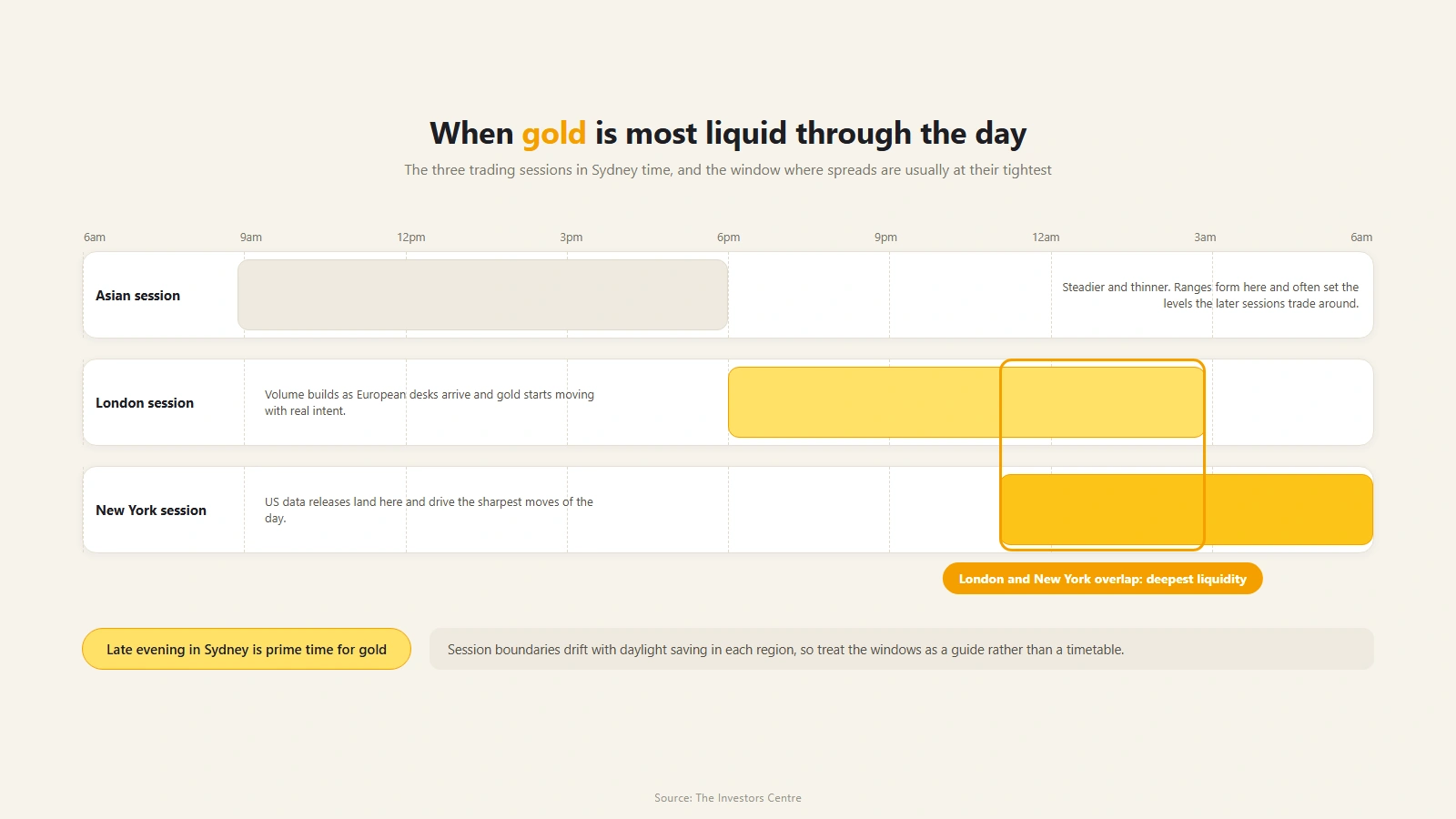
Gold is one of the few markets that genuinely lives through the Australian day, and the day divides into three acts.
Your business hours: the Asian session
Shanghai and Singapore give gold real two-way flow while Australia is at work, which most Western markets simply do not have. Moves are usually smaller and rangier than what comes later, and that is precisely what makes the session useful: it builds the reference range that the evening will either respect or destroy. On plenty of days, feeding that range to the evening strategy is all the session is for.
Your evening: London, then the overlap
London comes in around 5pm AEST in the southern winter and closer to 7pm Sydney time in summer, and volume steps up immediately. The London and New York overlap, gold's busiest stretch, then runs through the late Australian evening. If you can trade between roughly 7pm and midnight, you are trading gold's main event at a perfectly civilised local hour. This is the timezone's quiet gift to Australians, and the same logic I explored for equities in the timezone advantage piece.
Your night: the US data minefield
The 8.30am New York data slot, inflation prints and payrolls above all, lands around 10.30pm AEST, or half past midnight in Sydney's daylight-saving months. Fed decisions arrive worse, around 4am to 6am east-coast time. Carrying a leveraged gold position into those windows while asleep should be a choice made deliberately, before the evening ends, rather than something you find out about at breakfast. Exact market hours and the daily pause sit on my gold CFD costs page.
What does the AUD do to your gold trade?
It sits inside the trade, invited or not, and the problem and the gift are the same mechanism seen from two sides.
The entanglement, concretely
Trade XAUUSD from an AUD account and your profit or loss accrues in US dollars, then converts. Now add the awkward part: AUD/USD is a commodity currency pair that often strengthens in the same risk-on conditions that can weigh on gold, and weakens in the risk-off episodes that lift it. A long gold position that pays off during a market scare frequently pays off twice for an Australian, once on the metal and once on the conversion, while the reverse configuration shaves a slice off the winnings. Neither effect is huge on a day trade. On a position held for weeks, the currency leg can be a meaningful fraction of the result.
XAUAUD, conditionally
The clean fix would be trading gold quoted directly in Australian dollars. Pepperstone quotes gold against several currencies in some of its markets material, but I could not verify XAUAUD on the Australian product list in the documents checked for this guide, so treat it as unconfirmed: if it appears in your platform's symbol search, it removes the conversion leg entirely, and you should still compare its spread against XAUUSD before assuming it is the cheaper route, because crosses normally quote wider than the main market. If it is not listed, the practical alternative is simply sizing with the currency effect in mind.
Strategy one: what does the Asian range tell the London open?
This one uses your working day as the setup and your early evening as the trade. Through Australian business hours, mark the high and low gold has built in the Asian session. When London arrives in your early evening, watch how the new volume treats that range: a clean break with follow-through is a momentum entry in the direction of the break, while a sharp poke through one side that snaps straight back is a fade back towards the middle.
The discipline is all in the second act. Stops go beyond the opposite side of whatever structure you traded; round numbers are not structure. Position size comes from the stop distance, never from the 20:1 CFD margin allowance, which will happily let you hold far more gold than the volatility justifies. And the trade should be resolved, win or lose, by the time the US data window opens, because this is an evening strategy and it should end in the evening. On the days no clean break or failed poke appears, nothing gets traded, and standing aside on those days costs nothing at all.
Strategy two: how do you trade US data without trading the spike?
Late evening, AEST. A US inflation print lands at 10.30pm and gold jumps. The temptation is to be in the market for the release itself; the method is to refuse. Spreads widen sharply in the seconds around a major print, the first move frequently reverses within minutes, and a fill inside that chaos is a coin toss dressed as a trade.
Instead, write the plan before the number: the levels above and below that would matter if reached, and what you would do at each. Then let the release happen flat, give the market its first thrash, and trade the aftermath, either continuation once the move proves it can hold a level, or the fade once the spike visibly fails. You are trading the market's second decision, which is slower and cheaper to join than its first. On Fed nights, which land in the small hours of the Australian morning, the real choice is between staying up for it and standing aside; a sleeping trader has no business holding leveraged gold through a press conference. None of this promises a profitable pattern, and nothing on this page does. What the timezone gives Australians is the ability to run the method awake, which is more than most of the world gets.
What does a gold strategy cost to run on Razor?
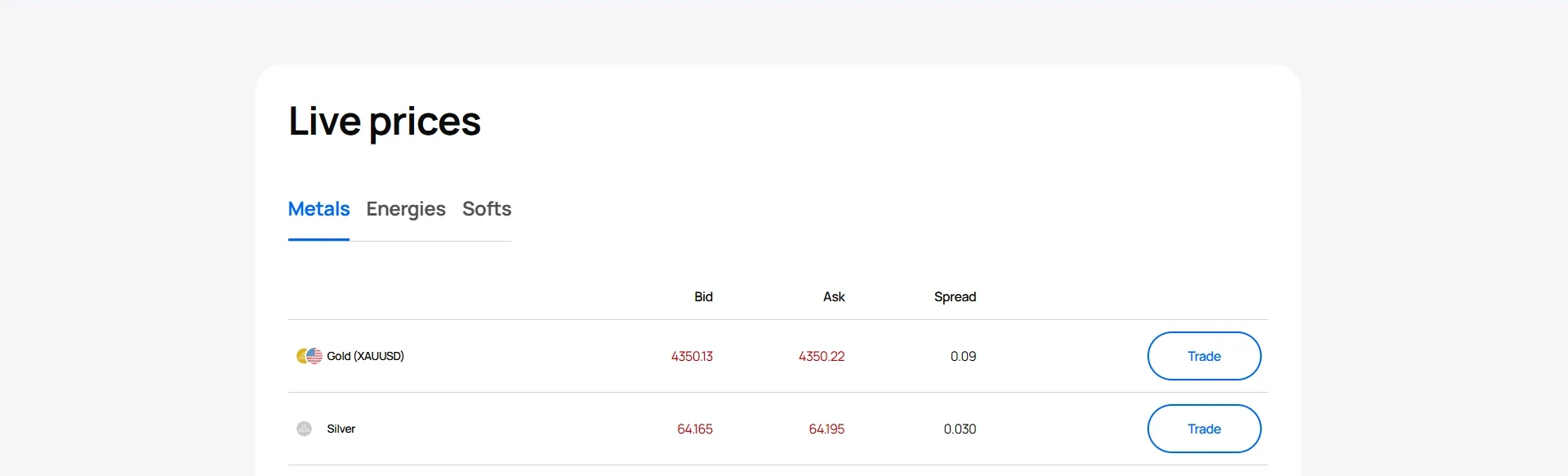
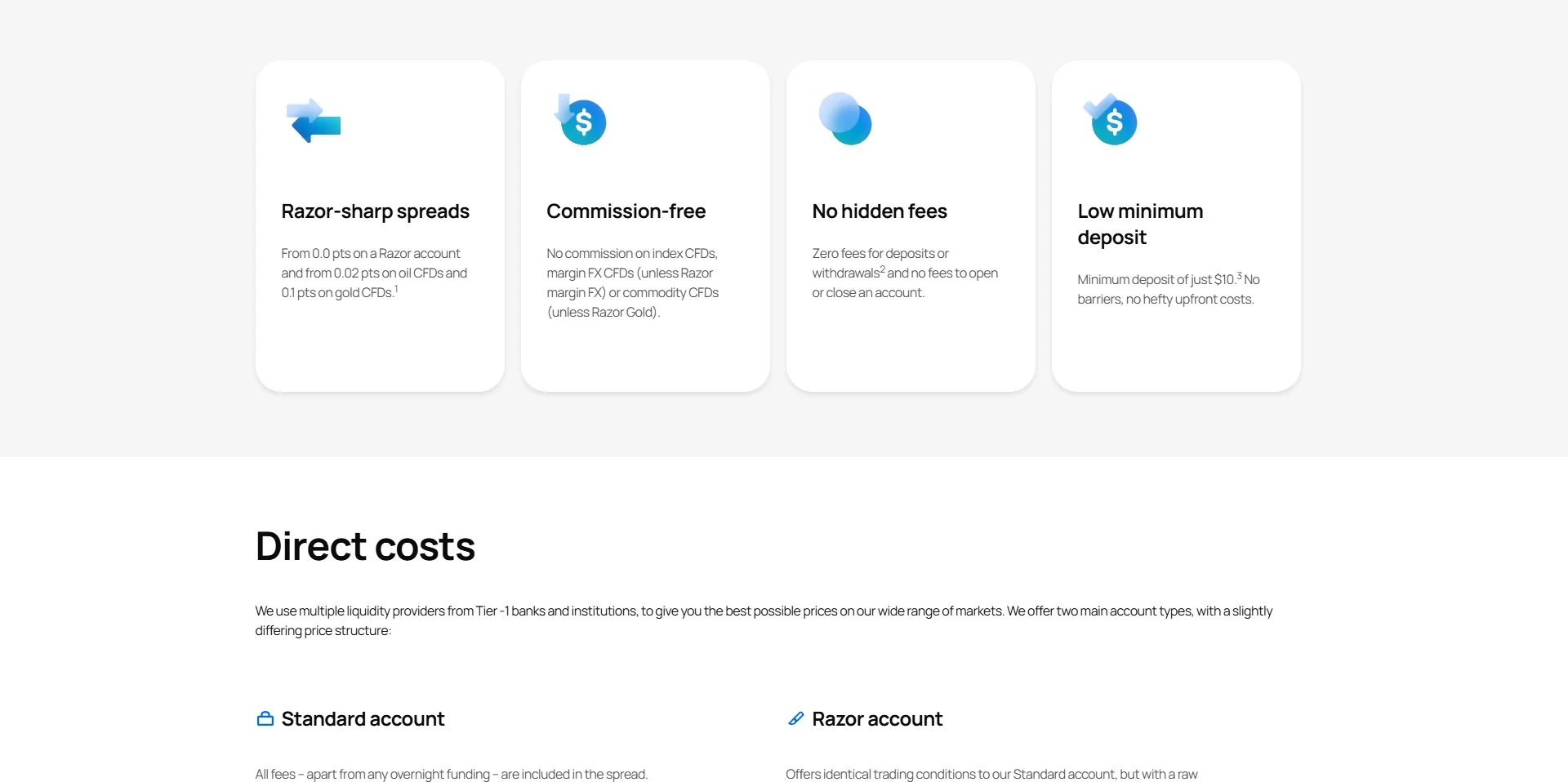
Costs decide more strategy arguments than signals do, and gold on Pepperstone has a pricing wrinkle worth planning around: it is the one commodity offered both on standard spread-only pricing and in a Razor form that splits a raw spread from a fixed commission. I keep the actual figures, spread floors, per-lot commission and the overnight swap mechanics, on the gold CFD costs page, checked against Pepperstone's published schedule, so this page can concentrate on which model fits which strategy without the two pages drifting out of sync.
The mapping is straightforward. Strategy one trades most evenings, so frequency favours the fixed-commission Razor route, where the toll is predictable and only the raw spread breathes. Strategy two trades less often but deliberately near data, exactly when spreads are at their widest, so its real cost control is timing the entry after the release rather than any account choice. Both strategies are intraday by design, which sidesteps overnight financing almost entirely; the moment you let either become a held position, read the swap section on the costs page first, because financing compounds while you sleep. Either account works on any of the six platforms, TradingView, cTrader, MT4, MT5 or Pepperstone's own web and mobile platform, and my platform comparison covers how that choice moves your commission.
Frequently Asked Questions
References
- Pepperstone: commodity CFD markets (en-au)
- Pepperstone: trading hours (en-au)
- Pepperstone: trading platforms (en-au)
Trading CFDs and FX carries significant risk and is not suitable for everyone. You have no interest in the underlying asset.