
- Expertise:
- CFD Trading, Forex, Derivatives, Risk Management
- Credentials:
- Chartered ACII (2018) · Trading since 2012
- Tested:
- 40+ forex & CFD platforms with live accounts

- Expertise:
- Platform Testing, Cryptocurrency, Retail Investing
- Credentials:
- Active investor since 2013 · 11+ years experience
- Tested:
- 50+ platforms · 200+ guides authored
How We Test
Real accounts. Real money. Real trades. No demo accounts or press releases.
What we measure:
- Spreads vs advertised rates
- Execution speed and slippage
- Hidden fees (overnight, withdrawal, conversion)
- Actual withdrawal times
Scoring:
Fees (25%) · Platform (20%) · Assets (15%) · Mobile (15%) · Tools (10%) · Support (10%) · Regulation (5%)
Testing team:
Adam Woodhead (investing since 2013), Thomas Drury (Chartered ACII, 2018), Dom Farnell (investing since 2013) — 50+ platforms with funded accounts
Quarterly reviews · Corrections: [email protected]
Disclaimer
Not financial advice. Educational content only. We're not FCA authorised. Consult a qualified advisor before investing.
Capital at risk. Investments can fall. Past performance doesn't guarantee future results.
CFD warning. 67-84% of retail accounts lose money trading CFDs. High risk due to leverage.
Contact: [email protected]
What Is the Best Options Broker in Australia?
IG Australia is our #1 pick for 2026, offering spread-based CFD options trading on Australian and global markets with no minimum deposit. For those seeking ASX-only access with simple flat pricing, CMC Markets is the best alternative due to its $33 flat fee per trade with direct exchange access and CHESS sponsorship.

67% of retail CFD accounts lose money.

70% of retail CFD accounts lose money.
64% of retail CFD accounts lose money.

Trading and investing involve risk. Capital at Risk

Trading and investing involve risk. Capital at Risk

Trading and investing involve risk. Capital at Risk

62.5% of retail CFD accounts lose money
How Do the Best Options Brokers in Australia Compare?
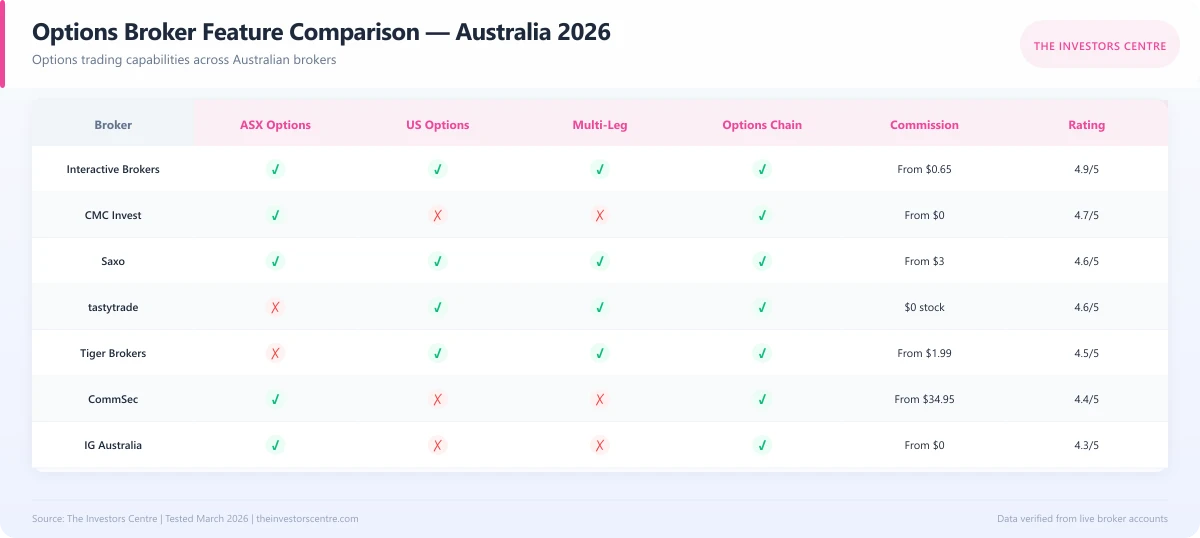
Options trading in Australia offers two distinct paths: ASX exchange-traded options (ETOs) for local stocks and indices, or international options through US and global exchanges. The best broker depends on which markets you want to access, how frequently you trade, and whether you need advanced strategy tools. ASX options typically cost more per trade but offer direct exposure to Australian companies, while US options provide greater liquidity and lower per-contract fees.
| # | Provider | ASX Options | US Options | Key Features | Min. Deposit | Rating |
|---|---|---|---|---|---|---|
| 1 | IG Australia | CFD only | CFD only | Spread-based CFD options, not exchange-traded | $0 | ⭐ 4.9 |
| 2 | CMC Markets | $33 flat | N/A | CHESS sponsorship, direct ASX access, quiz approval | $0 | ⭐ 4.7 |
| 3 | Saxo | N/A | USD 2-3 | Premium research, advanced charts, global markets | AUD 1,000 | ⭐ 4.6 |
| 4 | tastytrade | N/A | USD 1 | Options-focused platform, tastylive education, US-only | $0 | ⭐ 4.6 |
| 5 | Tiger Brokers | N/A | USD 0.95 | Asian markets focus, mobile-first, fractional shares | $0 | ⭐ 4.5 |
| 6 | CommSec | $34.95 flat | N/A | CBA integration, ASX-only, established brand | $0 | ⭐ 4.4 |
| 7 | Interactive Brokers | AUD 0.50-2.20 | USD 0.15-0.65 | 150+ markets, TWS platform, advanced analytics | $0 | ⭐ 4.3 |
What Markets and Approval Systems Do Options Brokers Offer?
Market access varies significantly between brokers. Interactive Brokers provides the broadest coverage across ASX, US, European, and Asian exchanges. CMC Markets and CommSec focus exclusively on ASX options. tastytrade specialises in US options with exceptional educational resources. Approval requirements protect traders by ensuring appropriate strategy access based on experience.
| Provider | ASX ETOs | US Options | Other Markets | Approval System |
|---|---|---|---|---|
| IG Australia | CFD only | CFD only | CFD only | Risk assessment |
| CMC Markets | Yes | No | No | Quiz-based tiers |
| Saxo | No | Yes | Europe, Asia | Experience-based |
| tastytrade | No | Yes | No | Standard options approval |
| Tiger Brokers | No | Yes | Hong Kong | Experience questionnaire |
| CommSec | Yes | No | No | Standard approval form |
| Interactive Brokers | Yes | Yes | Europe, Asia | Questionnaire-based |
Here Are The Top 7 Best Options Brokers in Australia:
1. IG Australia — Best for CFD Options
2. CMC Markets — Best for ASX Options
3. Saxo — Best for Research & Analysis
4. tastytrade — Best for US Options
5. Tiger Brokers — Best for Asian Markets
6. CommSec — Best for Bank Integration
7. Interactive Brokers — Best Overall Options Broker
IG Australia – Best for CFD Options
CFD Options Only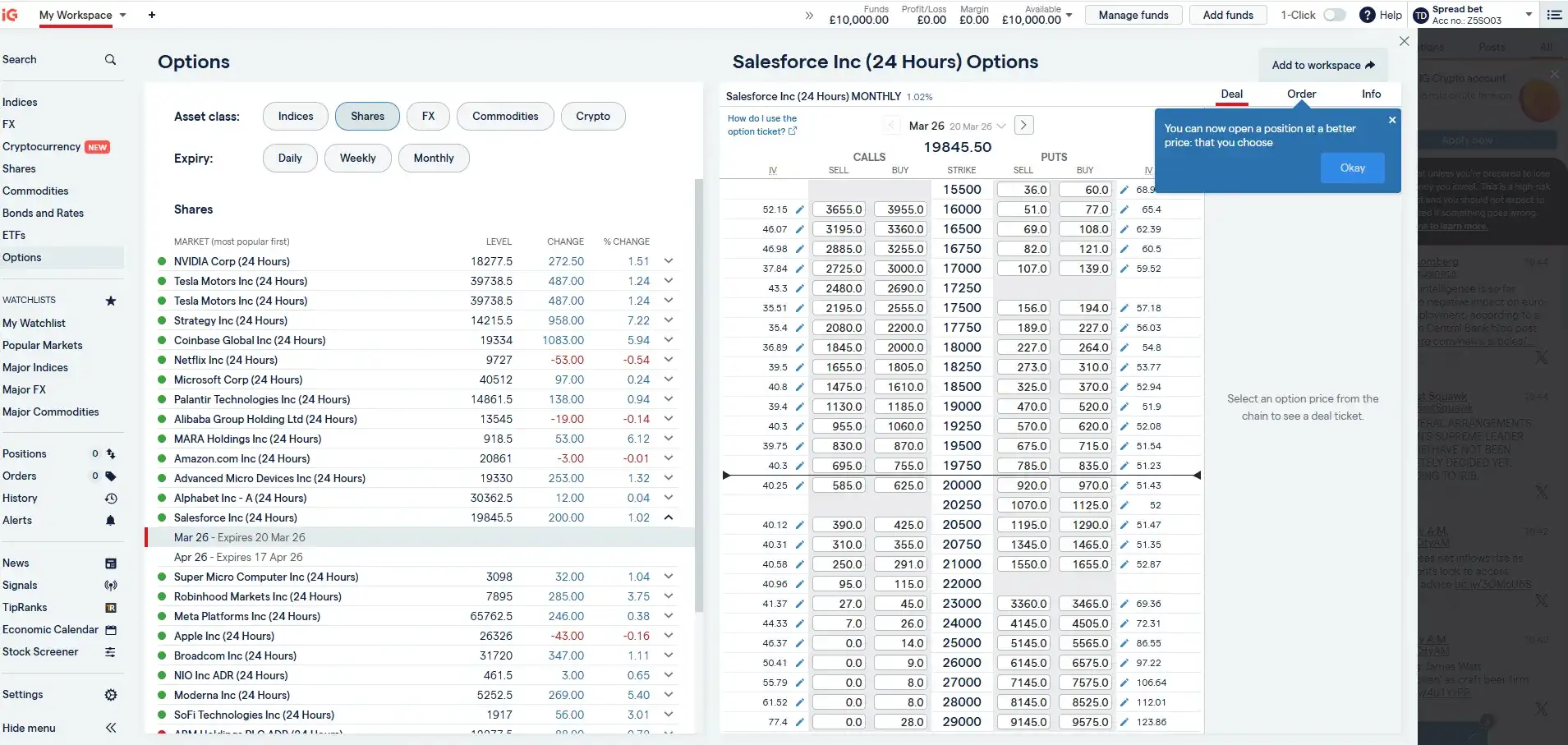
Pros
- Flexible contract sizes and expiries
- No commissions (spread-based pricing)
- Wide range of underlying markets
- Established broker with strong regulation
- No minimum deposit
Cons
- Not exchange-traded options (CFDs only)
- Counterparty risk (IG is the counterparty)
- Not suitable for traditional options strategies
How Are IG's CFD Options Priced?
IG's CFD options use spread-based pricing rather than commissions. You pay the difference between bid and ask prices, which varies by underlying asset, volatility, and liquidity. Spreads on major indices and liquid stocks are typically tighter than less liquid markets. Overnight financing charges apply to positions held overnight. There are no fixed per-contract commissions or exercise fees because you're not trading standardised exchange contracts. Cost comparison with exchange-traded options is difficult because the spread-based model works differently. IG's spreads might be better than commission-based pricing for very short-term trades but potentially more expensive for longer-term positions. There's no minimum deposit and no account keeping fees.
What Underlies IG's CFD Options?
IG offers CFD options on indices, forex, commodities, stocks, and cryptocurrencies – a broader range than most exchange-traded options brokers. However, these are CFDs, not exchange-traded options. The key difference: you're entering an over-the-counter contract with IG rather than buying a standardised option listed on an exchange. This means no ASX ETO access, no US options exchange access. Instead, you get IG-created derivatives that track the price movements of underlying assets. CFD options offer flexibility in strike prices and expiries that exchange-traded options don't provide. But you face counterparty risk – if IG fails, your positions are at risk. Exchange-traded options have clearing house guarantees. Most traditional options strategies don't work with CFD options.
What Platform Does IG Provide?
IG's platform excels for CFD trading with real-time pricing, advanced charting, and risk management tools. The interface displays option Greeks, profit/loss scenarios, and pricing calculators. ProRealTime charts are available for technical analysis. Mobile apps provide full trading functionality. The platform is sophisticated for CFD derivatives. However, the workflow differs from exchange-traded options platforms because you're not accessing exchange order books or seeing market depth. You're seeing IG's pricing for creating CFD positions. Risk management is crucial – the platform includes stop-losses and guaranteed stop-losses (for a premium) to limit downside. Education resources focus on CFD strategies rather than traditional options strategies like covered calls, which don't apply to CFD options.
Who Should Consider IG Australia?
IG suits traders specifically wanting CFD options rather than exchange-traded options. If you understand the difference and want the flexibility, wider market coverage, and leverage that CFD options provide, IG is a strong choice within the CFD category. Experienced derivatives traders comfortable with counterparty risk may appreciate CFD options' flexibility. However, most traders searching for "options brokers" want exchange-traded options for strategies like covered calls, protective puts, or vertical spreads. For these traders, IG is not suitable. The name "options" is misleading because CFD options and exchange-traded options serve different purposes. IG ranks last on this list not because it's a poor broker, but because it offers a different product than most options traders seek. For actual CFD options trading, IG is reputable and well-regulated.
CMC Markets – Best for ASX Options
Best for ASX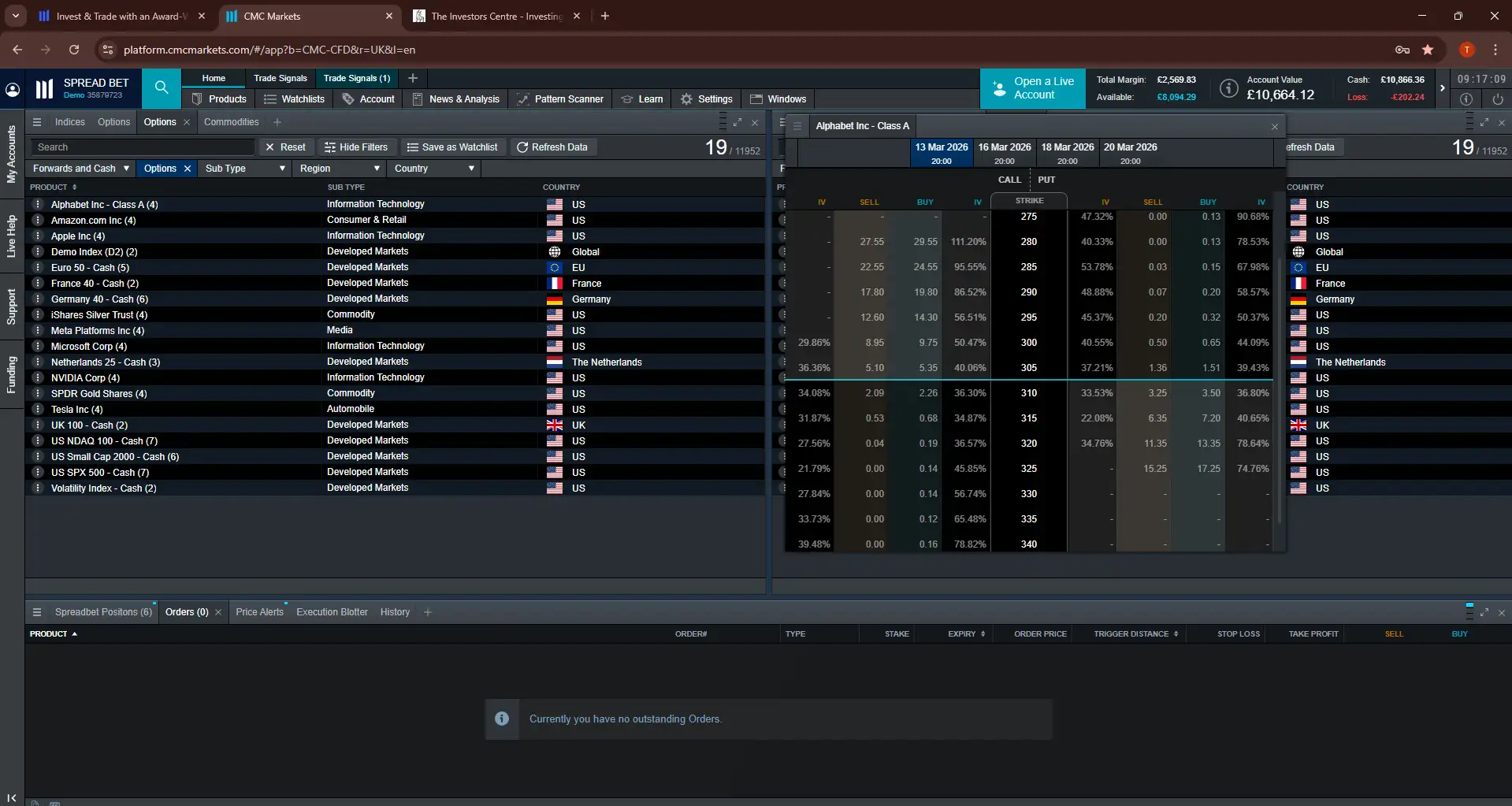
Pros
- CHESS sponsorship for direct ownership
- Flat $33 fee good for multiple contracts
- Quiz-based approval ensures understanding
- Simple platform for ASX focus
- No minimum deposit
Cons
- ASX options only (no US or international)
- Higher per-contract cost for single contracts
- Limited advanced analytics compared to IBKR
What Does CMC Markets Charge for Options?
CMC Markets charges a flat $33 brokerage per options trade regardless of contract size or number of contracts in the order. This makes CMC competitive when trading multiple contracts – for example, buying 10 contracts costs $33 total ($3.30 per contract), compared to IBKR's tiered rate of $5-20 for the same trade. However, single contract trades cost $33 versus IBKR's $0.50-2.20. Exercise and assignment fees are $33 per occurrence. There's no account keeping fees or minimum balance requirements. The flat fee structure provides cost certainty and benefits traders who typically trade multiple contracts per order.
What Options Markets Does CMC Markets Offer?
CMC Markets provides access exclusively to ASX exchange-traded options. You can trade equity options on major ASX-listed stocks including BHP, CBA, CSL, and others with listed options. Index options are available on the S&P/ASX 200 (XJO). All options trades execute directly on the ASX with clearing through ASX Clear, providing the same clearing guarantees as other exchange participants. Holdings appear under CHESS sponsorship with your own Holder Identification Number (HIN), meaning you directly own the options contracts. CMC does not offer international options – traders wanting US or global options need to use IBKR, Saxo, or another international broker.
How Does CMC Markets's Platform Work?
The CMC Markets platform emphasises simplicity for ASX-focused traders. The options trading interface displays available strikes and expiries with real-time bid-ask spreads and volume. You can place market, limit, and stop orders on options. The platform includes basic options analytics showing Greeks (delta, gamma, theta, vega) and break-even calculations. Multi-leg strategies are supported once you've completed the appropriate approval level. CMC's distinctive quiz-based approval system requires passing short quizzes to unlock each strategy tier – starting with covered calls and protected puts, progressing through spreads and strangles. This educational approach ensures traders understand strategies before accessing them. Real-time ASX data is included at no extra cost.
Who Should Choose CMC Markets?
CMC Markets suits traders focused exclusively on ASX options who value CHESS sponsorship and direct ownership. The flat $33 fee works well for those trading multiple contracts per order – buying or selling 5-10 contracts becomes cost-competitive with IBKR's tiered pricing. Traders wanting to build ASX options expertise appreciate the quiz-based progression system that enforces learning before strategy access. The simplified platform appeals to those who find IBKR's Trader Workstation overwhelming. CMC is not suitable for anyone wanting US options access or advanced institutional-grade analytics. For pure ASX options trading with straightforward pricing and direct ownership, CMC represents the best Australian-focused alternative to IBKR.
Saxo – Best for Research & Analysis
Best Research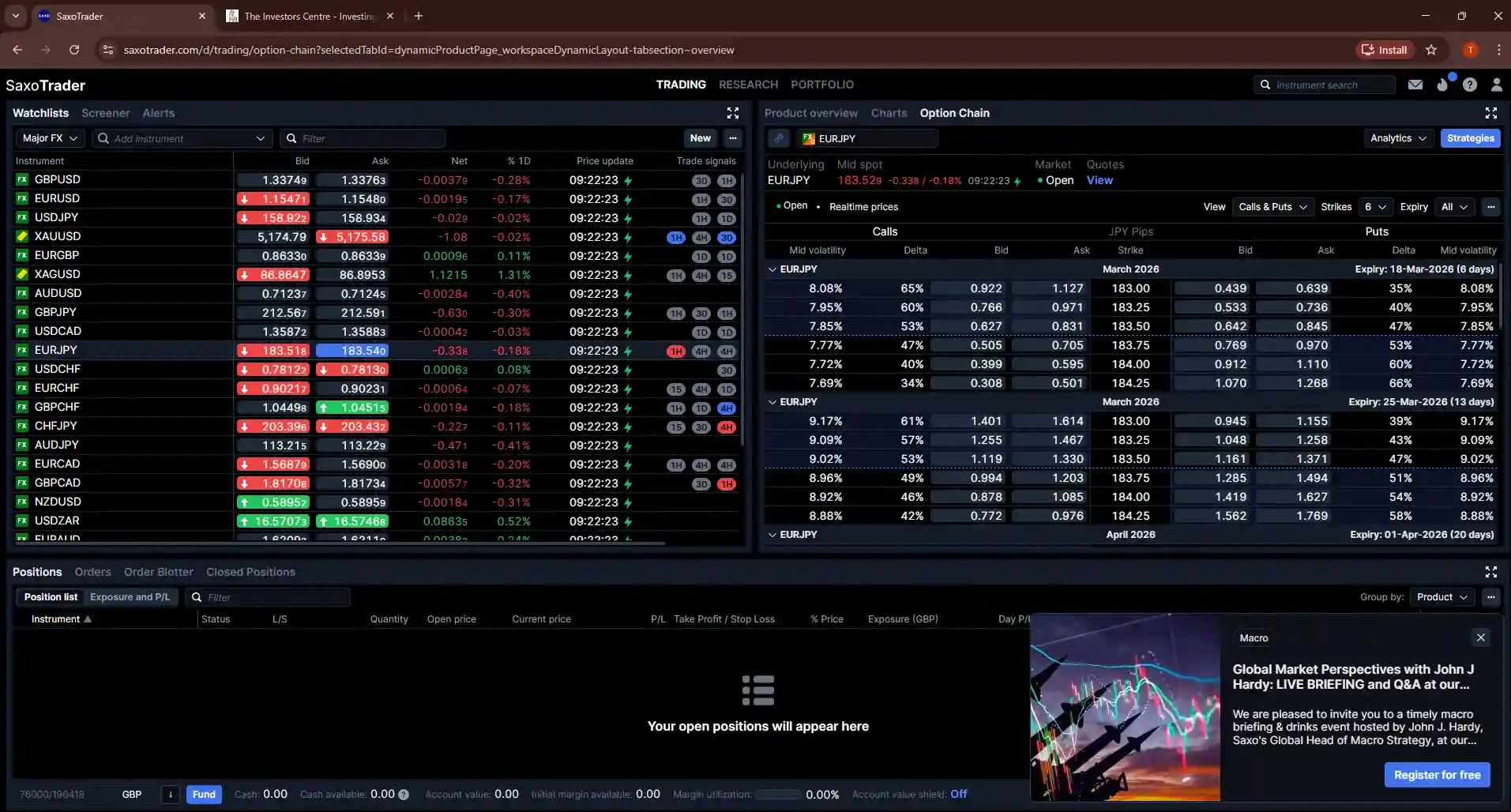
Pros
- Premium research and market insights
- Sophisticated SaxoTraderGO platform
- US and European options access
- Advanced charting and technical analysis
- Strong regulatory oversight (Danish FSA, ASIC)
Cons
- Higher fees than IBKR (USD 2-3 per contract)
- AUD 1,000 minimum deposit requirement
- No ASX options access
What Are Saxo's Options Trading Costs?
Saxo Bank charges USD 2-3 per contract for US options depending on account tier, with lower rates available for high-volume traders. Exercise and assignment fees apply. European options pricing varies by exchange. While more expensive than IBKR's USD 0.15-0.65, Saxo's fees are competitive within the premium broker segment. The platform requires a minimum AUD 1,000 deposit to open an account. There are no monthly account fees, though inactivity charges may apply to dormant accounts. Currency conversion spreads are competitive for a traditional bank structure. The higher fee structure is offset by the exceptional research, platform quality, and customer service that Saxo provides.
What Options Markets Can You Access?
Saxo provides access to US options exchanges including CBOE, NYSE, and NASDAQ, covering stocks, ETFs, and indices. European options are available through Eurex and other European exchanges. Asian market access includes Hong Kong and Singapore options. Notably, Saxo does not offer ASX exchange-traded options – Australian traders wanting domestic options need to use IBKR, CMC, or CommSec instead. Saxo's strength lies in US and European options for traders wanting exposure to international markets with comprehensive research support. The broker's global banking license facilitates multi-currency trading and competitive foreign exchange rates for international positions.
How Does Saxo's Platform Compare?
SaxoTraderGO represents a sweet spot between accessibility and sophistication. The web-based platform provides advanced charting with over 50 technical indicators, drawing tools, and multiple chart types. Options trading includes full Greeks display, strategy builders, and risk analysis tools. The platform's research integration stands out – you can access analyst reports, earnings estimates, and fundamental data without leaving the trading interface. Pattern recognition, market scanners, and economic calendar integration support informed decision-making. Mobile apps offer nearly full desktop functionality. The platform strikes an excellent balance for traders who want professional tools without IBKR's complexity. Market data is included for most exchanges, with some premium feeds available at additional cost.
Who Benefits Most from Saxo?
Saxo suits options traders who prioritise research quality and platform sophistication over rock-bottom fees. Those trading US options based on fundamental analysis appreciate the integrated research reports and analyst estimates. Traders wanting European options access find Saxo one of the few Australian-accessible brokers offering this. The platform appeals to those who found IBKR too complex but want more analytical capability than CMC or CommSec provide. With the AUD 1,000 minimum deposit, Saxo targets committed traders rather than beginners. The broker works well for medium-to-long-term options strategies where research matters more than per-trade cost minimisation. Not suitable for ASX options or traders wanting the absolute lowest fees.
tastytrade – Best for US Options
Best for US Options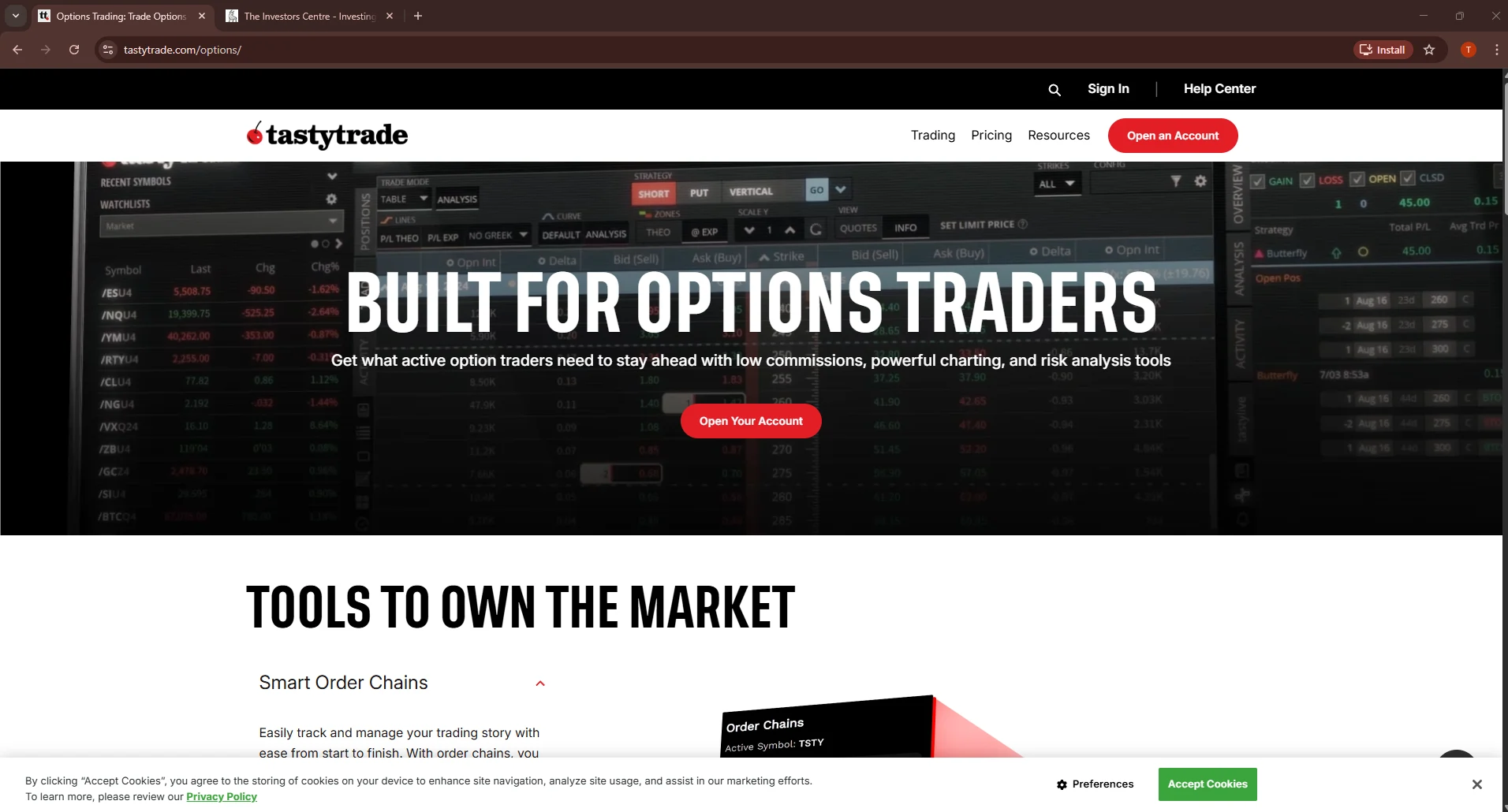
Pros
- USD 1 per contract capped at $10 per leg
- Integration with tastylive education network
- Platform designed specifically for options
- Free closing trades (under $0.05)
- No minimum deposit requirement
Cons
- US options only (no ASX or international)
- Higher per-contract cost than IBKR
- Limited stock and ETF trading features
What Does tastytrade Charge for Options?
tastytrade uses a simple USD 1 per contract fee structure with a $10 maximum per leg. This cap benefits complex strategies – for example, an iron condor (4 legs) costs $40 maximum regardless of contract quantity, versus potentially hundreds at per-contract brokers. Closing trades under $0.05 are free, encouraging profit-taking and position management. Exercise and assignment are free. Stock trades cost $0 for the first 50 shares, then $0.20 per share thereafter (designed to discourage stock trading as tastytrade focuses on options). There's no account minimum, monthly fees, or inactivity charges. Currency conversion occurs at competitive spreads. The fee structure heavily favours multi-leg option strategies.
What Options Can You Trade at tastytrade?
tastytrade provides access exclusively to US options markets – CBOE, NYSE, NASDAQ, and others. You can trade options on US stocks, ETFs, and indices including SPX, SPY, QQQ, and thousands of individual stocks. The focus is entirely US-centric. No ASX options, no European options, no Asian options. This narrow focus allows tastytrade to optimise the platform specifically for US options strategies. The broker's philosophy emphasises liquid, high-volume US options where bid-ask spreads are tightest. For Australian traders, this means all positions are in USD and subject to AUD/USD currency fluctuations. However, US options offer deeper liquidity and tighter spreads than ASX options in most cases.
How Does the tastytrade Platform Work?
The tastytrade platform prioritises speed and efficiency for options entry. The interface displays probability of profit, expected value, and Greeks prominently. Multi-leg strategy templates make complex trades quick to execute – select iron condor, choose strikes, place order. The curve view visualises P&L across price ranges and time. Integration with tastylive (the free educational network) is seamless – watch live trading shows, then execute similar strategies immediately. The platform assumes users understand options and removes hand-holding in favour of speed. Mobile apps offer near-full functionality. Paper trading is available for practice. The platform shines for active traders making frequent options trades rather than buy-and-hold investors.
Who Should Choose tastytrade?
tastytrade suits Australian traders committed to actively trading US options who want to immerse themselves in options education. The integration with tastylive's daily shows provides continuous learning and strategy ideas. Traders using complex multi-leg strategies benefit from the $10 per leg cap. Those wanting to join a community of options-focused traders appreciate tastytrade's culture. However, the platform is unsuitable for anyone wanting ASX options or diversified international market access. It's also not ideal for stock-focused investors who occasionally trade options. tastytrade works best for those who make options their primary trading vehicle and are willing to focus exclusively on US markets. The free tastylive education makes it excellent for committed learners.
Tiger Brokers – Best for Asian Markets
Best for Asian Markets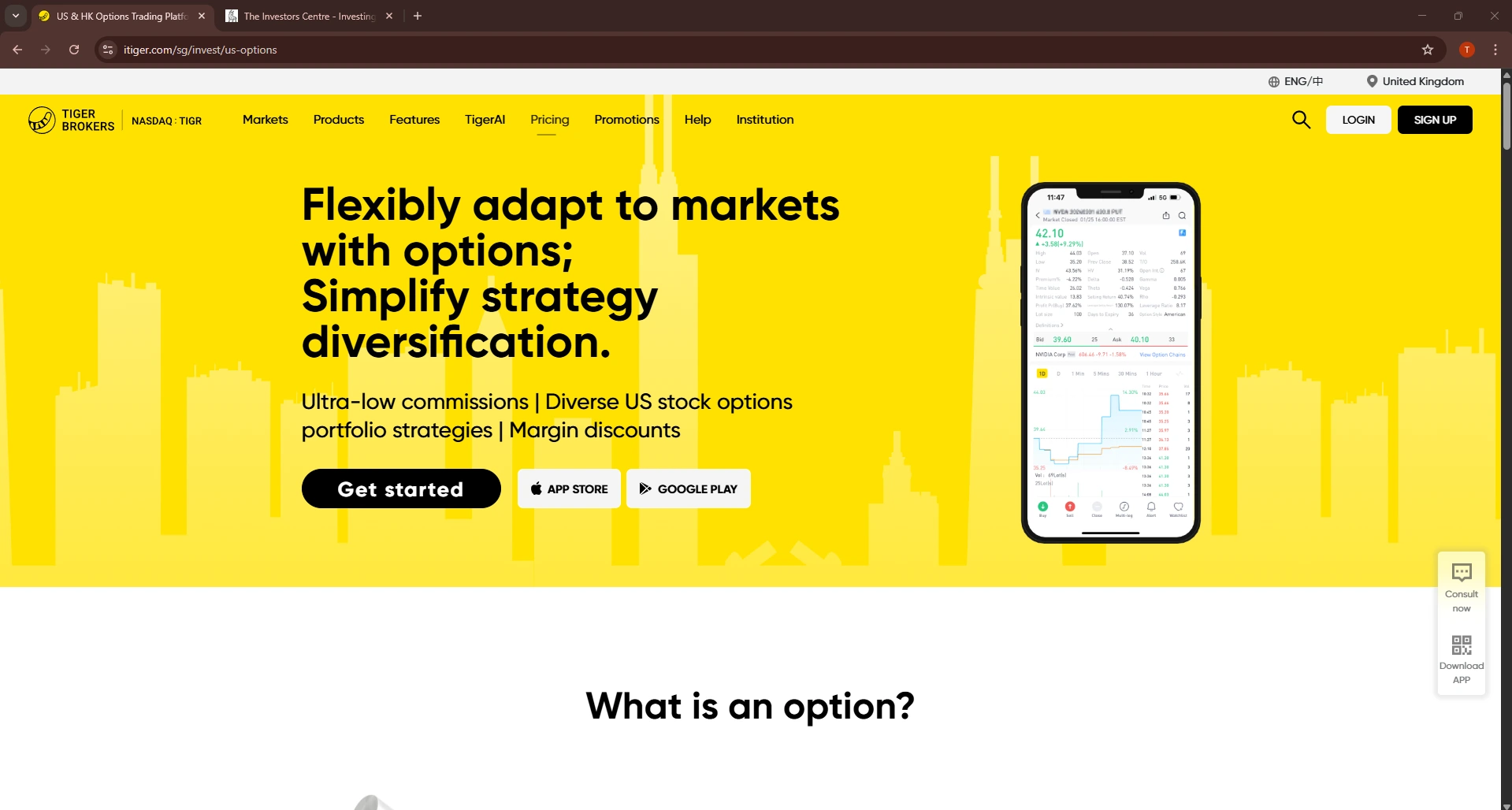
Pros
- Competitive USD 0.95 per contract for US options
- Access to Hong Kong options
- Mobile-first platform design
- Social and community features
- No minimum deposit
Cons
- Limited educational resources compared to tastytrade
- No ASX options access
- Newer broker with shorter track record
What Are Tiger Brokers' Options Fees?
Tiger Brokers charges USD 0.95 per contract for US options with a USD 0.99 minimum per order. Exercise and assignment fees apply. Hong Kong options have separate pricing. The fee structure is competitive within the mid-tier broker range – lower than Saxo but higher than IBKR's tiered pricing. Stock trading is free with no commissions. There's no account minimum, monthly fees, or inactivity charges. Currency conversion spreads are competitive. The simple per-contract pricing makes costs predictable. Tiger's value proposition comes from combining reasonable fees with Asian market access that other brokers don't offer Australian traders.
What Options Markets Does Tiger Brokers Offer?
Tiger Brokers provides US options access across major exchanges with coverage of stocks, ETFs, and indices. Hong Kong options are available, giving exposure to Asian companies like Alibaba, Tencent, and Xiaomi that may not be easily accessible through other brokers. This US-plus-Asia combination differentiates Tiger from purely US-focused brokers like tastytrade. No ASX options or European options are available. The broker's Singapore base and Asian focus make it natural for traders interested in both US technology stocks and Asian growth companies. For Australian traders of Asian background or those with specific interest in Hong Kong markets, Tiger offers capabilities that IBKR, CMC, and tastytrade don't emphasise.
How Does Tiger's Platform Compare?
Tiger Trade emphasises mobile-first design with social features unusual among Western brokers. The app includes news feeds, community discussions, and the ability to follow other traders' portfolios. Options trading includes standard features like Greeks, multi-leg strategies, and profit calculators. The interface aims for simplicity over depth – less overwhelming than TWS, less educational than tastytrade. Charting is adequate rather than advanced. Where Tiger differentiates is the social aspect – seeing what stocks and options the community is discussing. This appeals to traders who like the community feel of platforms like Reddit but want it integrated into their broker. Desktop access is available but clearly secondary to mobile experience.
Who Should Use Tiger Brokers?
Tiger Brokers suits mobile-first traders who want exposure to both US and Hong Kong options from a single account. Those interested in Asian technology companies appreciate direct Hong Kong access. Younger traders comfortable with social trading features may prefer Tiger's community-oriented approach over traditional broker isolation. The absence of minimum deposits removes barriers for beginners. However, Tiger lacks the educational depth of tastytrade, the analytical power of IBKR, and ASX options access. It's best for traders specifically wanting Asian market exposure alongside US options, or those preferring modern mobile-first experiences over desktop complexity. The shorter track record means Tiger appeals to those comfortable with newer fintech brokers rather than established institutions.
Interactive Brokers – Best Overall Options Broker
Best Overall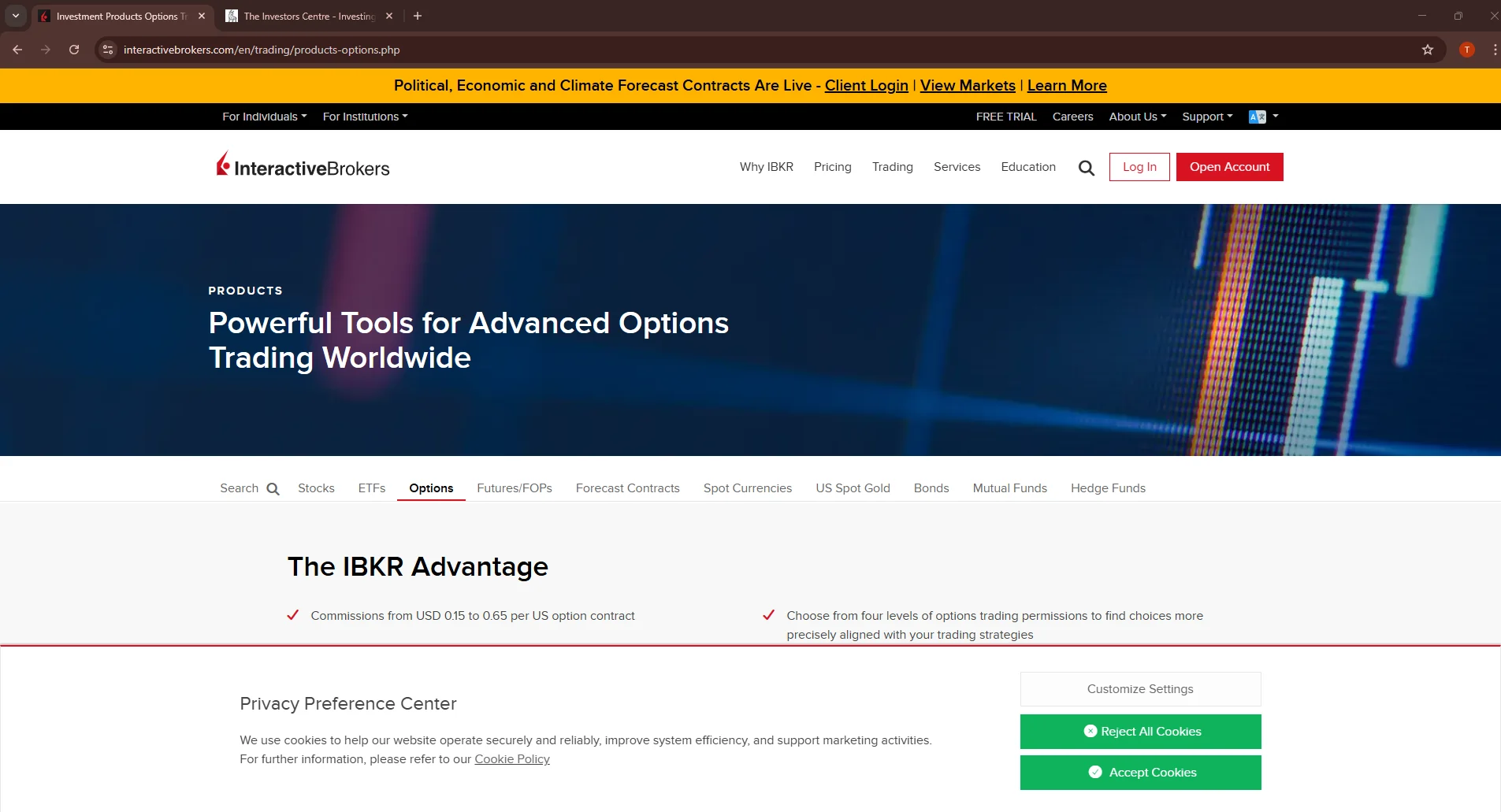
Pros
- Lowest options fees in Australia (AUD 0.50/contract ASX)
- Access to ASX, US, European, and Asian options markets
- Professional-grade Trader Workstation platform
- Advanced options analytics and strategy builders
- No minimum deposit requirement
Cons
- Steep learning curve for Trader Workstation
- Complex interface may overwhelm beginners
- Inactivity fees apply (waived for under 25s)
What Are Interactive Brokers' Options Trading Fees?
Interactive Brokers offers two pricing structures for options. The tiered plan charges AUD 0.50-2.20 per contract for ASX options depending on monthly volume, with costs decreasing as you trade more. US options start at USD 0.15-0.65 per contract. The fixed plan charges AUD 2.00 for ASX options and USD 1.00 for US options regardless of volume. Exercise and assignment fees are AUD 6 for ASX and USD 0 for US options. Most active traders benefit from tiered pricing, while the fixed plan suits those making occasional large trades. There's no minimum deposit, though accounts with less than USD 2,000 face a USD 20 monthly activity fee (waived for traders under 25).
What Markets Can You Trade Options On?
Interactive Brokers provides unmatched market access across 150+ exchanges globally. You can trade ASX exchange-traded options on Australian stocks and indices like the XJO. US options are available on stocks, ETFs, indices, and futures across multiple exchanges including CBOE, NYSE, and NASDAQ. European options markets include Eurex and Euronext. Asian markets cover Hong Kong, Japan, Singapore, and India. This makes IBKR the only Australian broker offering genuine global options trading from a single account. Currency conversion occurs automatically at competitive spreads typically around 0.002% (2 basis points), far lower than retail bank rates.
What Platform Does Interactive Brokers Provide?
Trader Workstation (TWS) is IBKR's flagship platform, offering professional-grade tools including multi-leg order entry, options strategy builders, probability calculators, and real-time Greeks display. The platform's OptionTrader interface shows comprehensive chains with bid-ask spreads, implied volatility, and volume data. Advanced users can create custom scanners, automated strategies, and algorithmic trading rules. For mobile and casual traders, the GlobalTrader app provides simplified options trading with paper trading mode to practice strategies. TWS has a steep learning curve but rewards those willing to master it. Market data subscriptions are available from USD 1-30/month depending on exchanges required, with some basic data included free.
Who Should Choose Interactive Brokers?
Interactive Brokers suits serious options traders wanting the lowest fees and broadest market access. Active traders benefit most from the tiered pricing structure where costs decrease with volume. Those trading both ASX and international options appreciate managing all positions from one account. The platform's sophistication makes it ideal for experienced traders using complex strategies like iron condors, butterflies, or calendar spreads. However, beginners may find the interface overwhelming initially – the paper trading feature helps bridge this gap. IBKR also suits cost-conscious traders willing to tolerate some complexity in exchange for potentially saving thousands annually in fees compared to traditional Australian brokers.
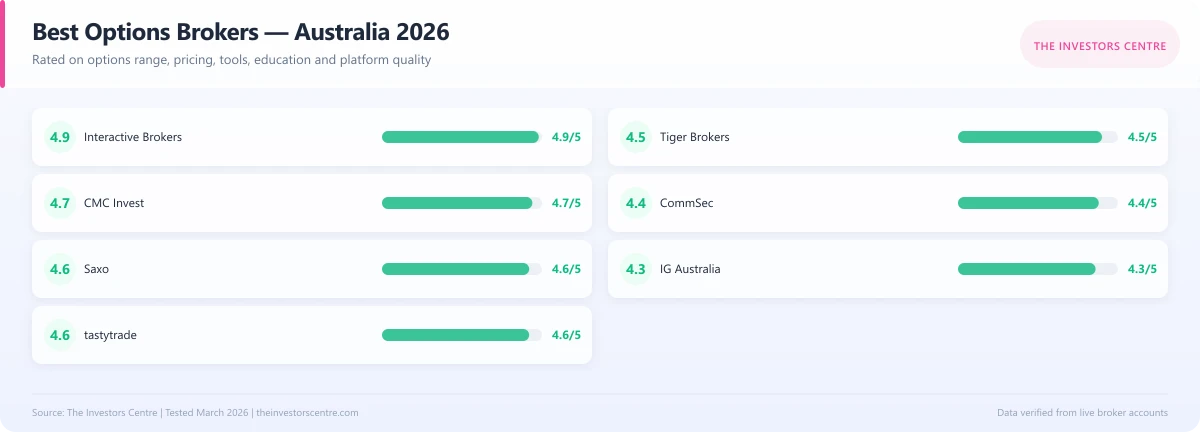
How Do You Choose an Options Broker in Australia?
Selecting an options broker requires matching your trading style to platform capabilities. ASX-focused traders need brokers with direct ETO access like CMC Markets, CommSec, or IBKR. Those wanting US options should consider IBKR, tastytrade, or Tiger. Fee sensitivity varies – active traders benefit from per-contract pricing while occasional traders may prefer flat fees.
What Fees Should You Compare When Choosing an Options Broker?
Options trading involves multiple fee types beyond headline brokerage. Per-contract fees (IBKR, tastytrade) versus flat fees (CMC, CommSec) suit different trading patterns. Exercise and assignment fees apply when options are exercised rather than closed. Margin interest affects strategies requiring borrowed funds. Platform fees, data subscriptions, and currency conversion costs for international trading add to total expenses.
Calculate total costs based on your expected trading pattern. A trader making 10 ASX options trades monthly might pay $330 with CMC versus $50-220 with IBKR depending on contract sizes. For gold trading or other commodities, options fees compound with underlying costs.
What Is Options Approval and Why Do You Need It?
All brokers require options approval before granting trading access. This involves completing questionnaires about your trading experience, financial situation, investment objectives, and understanding of options risks. Brokers assess responses to determine appropriate approval levels – typically ranging from basic (covered calls only) through to advanced (naked positions, complex spreads).
Approval requirements protect both trader and broker. Options can result in losses exceeding initial investment for certain strategies. By assessing experience and understanding, brokers ensure traders access only strategies appropriate to their knowledge level. CMC's quiz-based progression system exemplifies structured approval, unlocking strategies as traders demonstrate competency.
What Are the Tax Implications of Options Trading in Australia?
Options profits in Australia are generally taxable, though treatment varies by circumstance. Premiums received from writing options are typically assessable income in the year received. Premiums paid for options may form part of cost base if exercised, or may be deductible if options expire worthless – depending on whether trading is characterised as investment or business.
Active traders may have all profits and losses treated on revenue account, meaning full deductibility of losses against other income. Occasional investors likely face capital gains treatment with the 50% CGT discount potentially available for positions held over 12 months. The ATO's guidance on taxation of financial arrangements provides detailed rules – consulting a tax professional is advisable given the complexity.
Final Thoughts
Australia's options market offers genuine choice across ASX exchange-traded options and international markets. Interactive Brokers emerges as the clear overall winner, combining the lowest fees with unmatched market access across ASX, US, European, and Asian exchanges. The platform's sophistication rewards traders willing to master Trader Workstation's learning curve.
For ASX-focused traders wanting simpler experiences, CMC Markets delivers direct exchange access with CHESS sponsorship at reasonable flat fees. Those committed to US options education should strongly consider tastytrade's purpose-built platform and exceptional learning resources. CommSec suits CBA customers valuing bank integration over cost optimisation.
Understanding the distinction between exchange-traded options and CFD options is critical – they're fundamentally different instruments despite similar names. For those wanting to short stocks like Tesla through options strategies, US options via IBKR or tastytrade provide the necessary market access. Choose based on your target markets, trading frequency, and platform preference rather than simply lowest fees.
FAQs
Sources
- ASIC. "Binary Options Product Intervention Order 2021/240." 2021
- ASX. "Equity Derivatives Statistics and Market Data." 2026
- Australian Taxation Office. "Taxation of Financial Arrangements." 2026
- Interactive Brokers Australia. "Commission Schedules for Options." 2026
- CMC Markets. "Options Trading Fees and Features." 2026
- CommSec. "Rates and Fees Schedule." 2026
- Saxo Markets Australia. "Pricing Structure." 2026